Exam Complete
|
TMUA 2022 Paper 2
0.0%
0/20
Topic Breakdown
Basis of Logic
Weak
0/5 · 0%
Logic of Arguments
Weak
0/2 · 0%
Plane Geometry
Weak
0/2 · 0%
Inequalities
Weak
0/2 · 0%
Differentiation
Weak
0/1 · 0%
Polynomials
Weak
0/1 · 0%
Coordinate Geometry
Weak
0/1 · 0%
Counting and Probabilities
Weak
0/1 · 0%
Integration
Weak
0/1 · 0%
Algebraic Manipulations
Weak
0/1 · 0%
Exponentials and Logarithms
Weak
0/1 · 0%
Functions and Their Graphs
Weak
0/1 · 0%
Trigonometric Functions
Weak
0/1 · 0%
Target your weak topics with focused practice.
Practice weak topics →Results by Question
1
Differentiation
Wrong
Determine the number of stationary points on the curve with equation
\(y = 3x^4 + 4x^3 + 6x^2 - 5\)
A
\(0\)
\(1\)
Correct Answer
C
\(2\)
D
\(3\)
E
\(4\)
Explanation
We differentiate to obtain
$
frac(d y, d
x) = 12x^3 + 12x^2 + 12x. $ We solve the equation \(\dfrac{d y}{d x} = 0\) to find the number of stationary points: $ 12x^3 + 12x^2 + 12x = 0 $ if and only if $ 12x(x^2 + x +
1) = 0. $ So either \(x = 0\) or \(x^2 + x + 1 = 0\). But this quadratic has discriminant \(1^2 - 4 \times 1 = -3 < 0\), so it has no real solutions. Thus there is only one stationary point, at \(x = 0\), and the answer is option B.
x) = 12x^3 + 12x^2 + 12x. $ We solve the equation \(\dfrac{d y}{d x} = 0\) to find the number of stationary points: $ 12x^3 + 12x^2 + 12x = 0 $ if and only if $ 12x(x^2 + x +
1) = 0. $ So either \(x = 0\) or \(x^2 + x + 1 = 0\). But this quadratic has discriminant \(1^2 - 4 \times 1 = -3 < 0\), so it has no real solutions. Thus there is only one stationary point, at \(x = 0\), and the answer is option B.
2
Polynomials
Wrong
Find the coefficient of the \(x^5\) term in the expansion of
\((1+x)^5 \times \displaystyle\sum_{i=0}^5 x^i\)
A
\(1\)
B
\(5\)
C
\(16\)
D
\(25\)
\(32\)
Correct Answer
Explanation
We expand the brackets in the first term using the binomial theorem and write out the sum in full to get
$
(1 + 5x + 10x^2 + 10x^3 + 5x^4 + x^5) times (1 + x + x^2 + x^3 + x^4 + x^5).
$
The \(x^5\) term in the product is obtained by taking all possible pairs of a term in the first bracket and a term in the second whose product is \(c x^5\) for some number \(c\), and then adding these together. Therefore the \(x^5\) term in the product is
$
1 dot.op x^5 + 5x dot.op x^4 + 10x^2 dot.op x^3 + 10x^3 dot.op x^2 + 5x^4 dot.op x + x^5 dot.op 1 = (1 + 5 + 10 + 10 + 5 + 1)x^5 = 32x^5.
$
Therefore the correct answer is option E.
3
Basis of Logic
Wrong
Consider the following statement about the positive integer \(n\)
if \(n\) is prime, then \(n^2 + 2\) is *not* prime
Which of the following is a *counterexample* to this statement?
I. \(n = 2\)
II. \(n = 3\)
III. \(n = 4\)
I. \(n = 2\)
II. \(n = 3\)
III. \(n = 4\)
A
none of them
B
I only
II only
Correct Answer
D
III only
E
I and II only
F
I and III only
G
II and III only
H
I, II and III
Explanation
I \(n = 2\) is prime and \(n^2 + 2 = 6\) is not prime, so this case satisfies the statement and is not a counterexample.
II \(n = 3\) is prime but \(n^2 + 2 = 11\) is prime, so this is a counterexample as it does not satisfy the statement.
III \(n = 4\) is not prime, so it satisfies the statement and is not a counterexample.
Therefore only II provides a counterexample, which is option C.
4
Coordinate Geometry
Wrong
The point \(P\) has coordinates \((p, q)\), and the equation of a circle is
\(x^2 + 2f x + y^2 + 2g y + h = 0\)
where \(f\), \(g\), \(h\), \(p\) and \(q\) are all real constants.
Let \(L\) be the distance between the centre of the circle and the point \(P\).
Which one of the following is *sufficient* on its own to be able to calculate \(L\)?
A
the values of \(f\), \(g\) and \(h\)
the values of \(f\), \(g\), \(p\) and \(q\)
Correct Answer
C
the values of \(f\), \(h\), \(p\) and \(q\)
D
the values of \(g\), \(h\), \(p\) and \(q\)
E
none of the options A-D is sufficient on its own
Explanation
We can rewrite the equation of circle by completing the square to find its centre. We get:
$
(x+f)^2 - f^2 + (y+g)^2 - g^2 + h = 0
$
which we can rearrange as
$
(x+f)^2 + (y+g)^2 = f^2 + g^2 - h.
$
Therefore the centre is at \((-f, -g)\) (and the radius is \(\sqrt{f^2 + g^2 - h}\), but that is not relevant to us here).
Then the distance between the centre of the circle and the point P is given by
$
L^2 = (p+f)^2 + (q+g)^2
$
so we need the values of \(f\), \(g\), \(p\) and \(q\). Hence the correct answer is option B.
5
Basis of Logic
Wrong
A straight line \(L\) passes through \((1, 2)\).
Let P be the statement
*if* the \(y\)-intercept of \(L\) is negative, *then* the \(x\)-intercept of \(L\) is positive.
Which of the following statements *must* be true?
I. P
II. the converse of P
III. the contrapositive of P
I. P
II. the converse of P
III. the contrapositive of P
A
none of them
B
I only
C
II only
D
III only
E
I and II only
I and III only
Correct Answer
G
II and III only
H
I, II and III
Explanation
I Let us sketch a line through \((1, 2)\) with a negative y-intercept:
It is clear from this sketch that if the line has a negative y-intercept, it must have a positive x-intercept. (A more formal proof goes as follows: since \(y < 0\) when \(x = 0\) and \(y > 0\) when \(x = 1\), there must be some value of \(x\) with \(0 < x < 1\) where \(y = 0\). Therefore the x-intercept must lie between 0 and 1.)
II The converse of P reads: If the x-intercept of L is positive, then the y-intercept of L is negative. This is the case if the x-intercept is between 0 and 1, as in the previous sketch, but if the x-intercept is greater than 1, this is no longer true:
So the converse of P is false.
III The contrapositive of P has the same truth value as P itself, so the contrapositive of P is true.
Therefore only I and III are true, and the correct answer is option F.
6
Basis of Logic
Wrong
A list consists of \(n\) integers.
Consider the following statements:
P: \(n\) is odd.
Q: The median of the list is one of the numbers in the list.
Which one of the following is true?
A
P is *necessary and sufficient* for Q.
B
P is *necessary* but *not sufficient* for Q.
P is *sufficient* but *not necessary* for Q.
Correct Answer
D
P is *not necessary* and *not sufficient* for Q.
Explanation
Suppose P is true. Since there are an odd number of integers in the list, there is a unique middle one (when they are written in increasing order), so this is the median. Therefore Q is true, and P is sufficient for Q.
Now suppose that Q is true. It does not follow that \(n\) is odd; here is a counterexample: if the list is \(2, 2\), then \(n = 2\) and the median is 2, so Q is true, but P is false. (In general, any list with \(n\) even and the middle pair of numbers equal is a counterexample.) Therefore P is not necessary for Q.
The correct answer is option C.
7
Logic of Arguments
Wrong
Consider the following claim:
The difference between two consecutive positive cube numbers is always prime.
Here is an attempted proof of this claim:
I. \((x+1)^3 = x^3 + 3x^2 + 3x + 1\)
II. Taking \(x\) to be a positive integer, the difference between two consecutive cube numbers can be expressed as \((x+1)^3 - x^3 = 3x^2 + 3x + 1\)
III. It is impossible to factorise \(3x^2 + 3x + 1\) into two linear factors with integer coefficients because its discriminant is negative.
IV. Therefore for every positive integer value of \(x\) the integer \(3x^2 + 3x + 1\) cannot be factorised.
V. Hence, the difference between two consecutive cube numbers will always be prime. Which of the following best describes this proof?
I. \((x+1)^3 = x^3 + 3x^2 + 3x + 1\)
II. Taking \(x\) to be a positive integer, the difference between two consecutive cube numbers can be expressed as \((x+1)^3 - x^3 = 3x^2 + 3x + 1\)
III. It is impossible to factorise \(3x^2 + 3x + 1\) into two linear factors with integer coefficients because its discriminant is negative.
IV. Therefore for every positive integer value of \(x\) the integer \(3x^2 + 3x + 1\) cannot be factorised.
V. Hence, the difference between two consecutive cube numbers will always be prime. Which of the following best describes this proof?
A
The proof is completely correct, and the claim is true.
B
The proof is completely correct, but there are counterexamples to the claim.
C
The proof is wrong, and the first error occurs on line I.
D
The proof is wrong, and the first error occurs on line II.
E
The proof is wrong, and the first error occurs on line III.
The proof is wrong, and the first error occurs on line IV.
Correct Answer
G
The proof is wrong, and the first error occurs on line V.
Explanation
Searching for small counterexamples to the claim does not find any; the first few differences are all prime. So we do have to check the proof in detail, as it might be correct.
The algebraic expansion on line I is correct.
The expression in line II is also correct, using the expansion from line
I. For line III, if we could write \(3x^2 + 3x + 1 = (ax + b)(cx + d)\) with real coefficients \(a\), \(b\), \(c\) and \(d\), then we would have real roots of the equation \(3x^3 + 3x + 1 = 0\), namely \(x = -\dfrac{b}{a}\) and \(x = -\dfrac{d}{c}\). But the discriminant is \(3^2 - 4 \times 3 \times 1 = -3 < 0\), so this is impossible. So this statement is true. Line IV is more tricky: just because the algebraic expression is not factorisable into algebraic factors does *not* mean that the integer it represents for any particular value of \(x\) is not factorisable in integers. As a simpler example, the algebraic expression \(x^2 + 1\) is not factorisable into real algebraic factors, yet substituting integers for \(x\) shows that the integer value can sometimes be factorised: taking \(x = 3\) gives \(3^2 + 1 = 10 = 2 \times 5\), for example. So this line of the argument is not valid. Line V does follow from lines II and
IV. Therefore the proof is wrong, and the first (and only) error occurs on line IV (option F). It is worth noting that the 'opposite' argument does work: if an algebraic expression does factorise as \((ax + b)(cx + d)\) with \(a\), \(b\), \(c\) and \(d\) integers, then the value of original expression always factorises (as an integer) when \(x\) is an integer, just by substituting the value of \(x\) into the factorised form. (It is possible, though, that one of the factors is 1, so the integer may be prime for some value(s) of \(x\).) It also turns out that in this case, if we search far enough, we do find a counterexample to the claim: \(6^3 - 5^3 = 216 - 125 = 91 = 7 \times 13\). (It might have been the case that the claim was true even though the attempted proof had an error.)
I. For line III, if we could write \(3x^2 + 3x + 1 = (ax + b)(cx + d)\) with real coefficients \(a\), \(b\), \(c\) and \(d\), then we would have real roots of the equation \(3x^3 + 3x + 1 = 0\), namely \(x = -\dfrac{b}{a}\) and \(x = -\dfrac{d}{c}\). But the discriminant is \(3^2 - 4 \times 3 \times 1 = -3 < 0\), so this is impossible. So this statement is true. Line IV is more tricky: just because the algebraic expression is not factorisable into algebraic factors does *not* mean that the integer it represents for any particular value of \(x\) is not factorisable in integers. As a simpler example, the algebraic expression \(x^2 + 1\) is not factorisable into real algebraic factors, yet substituting integers for \(x\) shows that the integer value can sometimes be factorised: taking \(x = 3\) gives \(3^2 + 1 = 10 = 2 \times 5\), for example. So this line of the argument is not valid. Line V does follow from lines II and
IV. Therefore the proof is wrong, and the first (and only) error occurs on line IV (option F). It is worth noting that the 'opposite' argument does work: if an algebraic expression does factorise as \((ax + b)(cx + d)\) with \(a\), \(b\), \(c\) and \(d\) integers, then the value of original expression always factorises (as an integer) when \(x\) is an integer, just by substituting the value of \(x\) into the factorised form. (It is possible, though, that one of the factors is 1, so the integer may be prime for some value(s) of \(x\).) It also turns out that in this case, if we search far enough, we do find a counterexample to the claim: \(6^3 - 5^3 = 216 - 125 = 91 = 7 \times 13\). (It might have been the case that the claim was true even though the attempted proof had an error.)
8
Counting and Probabilities
Wrong
A selection, \(S\), of \(n\) terms is taken from the arithmetic sequence \(1, 4, 7, 10, ..., 70\).
Consider the following statement:
\((*)\) There are two distinct terms in \(S\) whose sum is \(74\).
What is the smallest value of \(n\) for which \((*)\) is *necessarily* true?
A
\(12\)
B
\(13\)
\(14\)
Correct Answer
D
\(21\)
E
\(22\)
F
\(23\)
Explanation
We first determine the number of terms in the whole sequence: there are \(\dfrac{70-1}{3} + 1 = 23 + 1 = 24\) terms.
We next determine the number of pairs that sum to 74. The pairs are:
\(4 + 70\), \(7 + 67\)
⋮
\(34 + 40\), \([37 + 37]\)
The final pair is excluded because the two terms have to be distinct to fit the rule in (*). The number of valid pairs is therefore \(\dfrac{34-4}{3} + 1 = 10 + 1 = 11\).
If a selection S does not satisfy the rule in (*), then it can have at most one term from each of these pairs, so it has to leave out at least 11 terms. So it can have at most \(24 - 11 = 13\) terms. Therefore if S has at least 14 terms, it must satisfy (*).
We also need to show that if S only has 13 terms, it might not satisfy (*). We can include 1, 37 and one term from each listed pair, giving \(2 + 11 = 13\) terms. These 13 terms do not contain a distinct pair summing to 37.
Hence the smallest value of \(n\) which forces (*) to be true is 14, and the correct answer is option C.
9
Basis of Logic
Wrong
Consider the following statement:
\((*)\) For all real numbers \(x\), if \(x < k\) then \(x^2 < k\)
What is the complete set of values of \(k\) for which \((*)\) is true?
no real numbers
Correct Answer
B
\(k > 0\)
C
\(k < 1\)
D
\(k \leq 1\)
E
\(0 < k < 1\)
F
\(0 < k \leq 1\)
G
all real numbers
Explanation
The statement (*) does not restrict us to positive real numbers \(x\), so whatever the value of \(k\), we can always find a large negative number \(x\) with \(x < k\) and \(x^2 \geq k\).
We can even be explicit about this (though that is not required to answer this question): if \(k \leq 0\), we can take \(x = k - 1\) in which case \(x^2 > 0 \geq k\), and if \(k > 0\), we can take \(x = -\sqrt{k}\) so \(x < 0 < k\) and \(x^2 = k \geq k\).
Therefore (*) is true for no real values of \(k\), and the correct option is A.
10
Basis of Logic
Wrong
Which of the following statements is/are true?
I. *For all* real numbers \(x\) and *for all* positive integers \(n\), \(x < n\)
II. *For all* real numbers \(x\), *there exists* a positive integer \(n\) such that \(x < n\)
III. *There exists* a real number \(x\) such that *for all* positive integers \(n\), \(x < n\)
I. *For all* real numbers \(x\) and *for all* positive integers \(n\), \(x < n\)
II. *For all* real numbers \(x\), *there exists* a positive integer \(n\) such that \(x < n\)
III. *There exists* a real number \(x\) such that *for all* positive integers \(n\), \(x < n\)
A
none of them
B
I only
C
II only
D
III only
E
I and II only
F
I and III only
II and III only
Correct Answer
H
I, II and III
Explanation
I We can find a counterexample to this statement: taking \(x = 2\) and \(n = 1\) shows that this statement is false.
II This is true; if \(x \leq 0\), we can take \(n = 1\), and if \(x > 0\), we can take \(n\) to be the smallest integer greater than \(x\).
III This is true; we can take \(x = 0\). (If, though, we replaced 'positive integers' with 'integers', the resulting statement would be false.)
Therefore II and III are true, and the correct option is G.
11
Plane Geometry
Wrong
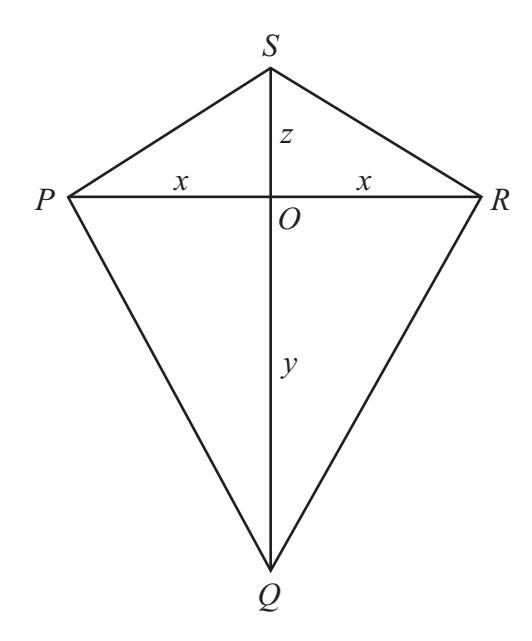
The diagram shows a kite \(P Q R S\) whose diagonals meet at \(O\).
\(O P = x\)
\(O Q = y\)
\(O R = x\)
\(O S = z\)
Which of the following is *necessary and sufficient* for angle \(S P Q\) to be a right angle?
A
\(x = y = z\)
B
\(2x = y + z\)
\(x^2 = y z\)
Correct Answer
D
\(y = z\)
E
\(y^2 = x^2 + z^2\)
Explanation
The angle \(SPQ\) is a right angle if and only if triangle \(SPQ\) satisfies Pythagoras's theorem, that is, if and only if
$
SP^2 + PQ^2 = SQ^2.
$
Since \(PQRS\) is a kite, its diagonals intersect at right angles, so both \(SOP\) and \(POQ\) are right-angled triangles. Therefore, again by Pythagoras,
$
SP^2 = x^2 + z^2
$
$
PQ^2 = x^2 + y^2.
$
Substituting this, along with \(SQ = y + z\), into the above equation gives the following necessary and sufficient condition for angle \(SPQ\) to be a right angle:
$
x^2 + z^2 + x^2 + y^2 = (y+z)^2.
$
Expanding and simplifying, this is equivalent to
$
2x^2 = 2yz
$
or
$
x^2 = yz.
$
Therefore option C gives a necessary and sufficient condition.
(One should also check that none of the others are necessary and sufficient; we could take \(x = 2\), \(y = 4\), \(z = 1\): this satisfies option C but none of the others.)
12
Integration
Wrong
Place the following integrals in order of size, starting with the smallest.
\(P = \displaystyle\int_{0}^{1} 2^{\sqrt{x}} d x\)
\(Q = \displaystyle\int_{0}^{1} 2^x d x\)
\(R = \displaystyle\int_{0}^{1} (\sqrt{2})^x d x\)
A
\(P < Q < R\)
B
\(P < R < Q\)
C
\(Q < P < R\)
D
\(Q < R < P\)
E
\(R < P < Q\)
\(R < Q < P\)
Correct Answer
Explanation
We do not know how to integrate any of these, so we will instead compare the integrands as the integrals are all from 0 to 1.
We have \(\sqrt{2}^x = 2^{\dfrac{x}{2}}\), which makes \(R\) look a little simpler. Since \(\dfrac{x}{2} < x\) for \(0 < x < 1\), \(2^{\dfrac{x}{2}} < 2^x\) in this interval, and so \(R < Q\).
Now in this interval, we also have \(x < \sqrt{x}\) (as \(x^2 < x\)), so \(2^x < 2^\sqrt{x}\), hence \(Q < P\).
Combining these, we find that \(R < Q < P\), so the correct option is F.
13
Algebraic Manipulations
Wrong
Consider the statement \((*)\) about a real number \(x\):
\((*)\) *There exists* a real number \(y\) such that \(x - x y + y\) is negative.
For how many real values of \(x\) is \((*)\) true?
A
no values of \(x\)
B
exactly one value of \(x\)
C
exactly two values of \(x\)
D
all except exactly two values of \(x\)
all except exactly one value of \(x\)
Correct Answer
F
all values of \(x\)
Explanation
For each fixed value of \(x\), we can think about this expression as being a function of \(y\). We can write the expression as \((1 - x)y + x\), which is just \(m y + c\) where \(m = 1 - x\) and \(c = x\). This is the equation of a straight line graph, so it takes every real value, both positive and negative, as long as \(m \neq 0\).
The case \(m = 0\) occurs exactly when \(x = 1\), and in this case, the expression becomes \((1-1)y+1 = 1\), so it is always \(1\), for every value of \(y\).
Therefore \((*)\) is true for all except exactly one value of \(x\), namely \(x = 1\), and the correct answer is option E.
14
Inequalities
Wrong
Consider the two inequalities:
\(|x+5| < |x+11|\)
\(|x+11| < |x+1|\)
Which one of the following is correct?
A
There is no real number for which both inequalities are true.
B
There is exactly one real number for which both inequalities are true.
C
The real numbers for which both inequalities are true form an interval of length 1.
The real numbers for which both inequalities are true form an interval of length 2.
Correct Answer
E
The real numbers for which both inequalities are true form an interval of length 3.
F
The real numbers for which both inequalities are true form an interval of length 4.
G
The real numbers for which both inequalities are true form an interval of length 5.
Explanation
To solve this question, we use the fact that \(|x-a|\) can be understood as the distance of \(x\) from \(a\). The first inequality is true if and only if \(x\) is closer to \(-5\) than to \(-11\), i.e., if and only if \(x > -8\). The second inequality is true if and only if \(x\) is closer to \(-11\) than to \(-1\), i.e., if and only if \(x < -6\).
Therefore both inequalities are true if and only if \(-8 < x < -6\), which is an interval of length \(2\), which is option D.
One could also do this question by sketching the graphs of \(y = |x + 5|\) and \(y = |x + 11|\) and working out where they intersect, and so on. But that requires a lot more work than the approach presented here.
15
Exponentials and Logarithms
Wrong
The real numbers \(x\), \(y\) and \(z\) are all greater than 1, and satisfy the equations
\(\log_x y = z\) and \(\log_y z = x\)
Which one of the following equations for \(\log_z x\) must be true?
A
\(\log_z x = y\)
B
\(\log_z x = \dfrac{1}{y}\)
C
\(\log_z x = x y\)
D
\(\log_z x = \dfrac{1}{x y}\)
E
\(\log_z x = x z\)
\(\log_z x = \dfrac{1}{x z}\)
Correct Answer
G
\(\log_z x = y z\)
H
\(\log_z x = \dfrac{1}{y z}\)
Explanation
Since \(\log_x y = z\), we have \(y = x^z\). Likewise \(z = y^x\). Combining these gives
$
z = y^x = (x^z)^x = x^(x z).
$
Therefore raising the equation to the power of \(1/(x z)\) gives \(z^{1/(x z)} = x\), hence \(\log_z x = 1/(x z)\), which is option F.
16
Inequalities
Wrong
In this question, \(a_1, ..., a_100\) and \(b_1, ..., b_100\) and \(c_1, ..., c_100\) are three sequences of integers such that
\(a_n \leq b_n + c_n\)
for each \(n\).
Which of the following statements *must* be true?
I. \((\text{minimum of } a_1, ..., a_100) \leq (\text{minimum of } b_1, ..., b_100) + (\text{minimum of } c_1, ..., c_100)\)
II. \((\text{minimum of } a_1, ..., a_100) \geq (\text{minimum of } b_1, ..., b_100) + (\text{minimum of } c_1, ..., c_100)\)
III. \((\text{maximum of } a_1, ..., a_100) \leq (\text{maximum of } b_1, ..., b_100) + (\text{maximum of } c_1, ..., c_100)\)
I. \((\text{minimum of } a_1, ..., a_100) \leq (\text{minimum of } b_1, ..., b_100) + (\text{minimum of } c_1, ..., c_100)\)
II. \((\text{minimum of } a_1, ..., a_100) \geq (\text{minimum of } b_1, ..., b_100) + (\text{minimum of } c_1, ..., c_100)\)
III. \((\text{maximum of } a_1, ..., a_100) \leq (\text{maximum of } b_1, ..., b_100) + (\text{maximum of } c_1, ..., c_100)\)
A
none of them
B
I only
C
II only
III only
Correct Answer
E
I and II only
F
I and III only
G
II and III only
H
I, II and III
Explanation
For each of these, we can try to construct a counterexample, and if that doesn't work, we may understand why the statement must be true.
For simplicity in the explanations below, let's write
$
A_(min) = "minimum of " a_1, dots, a_100
$
$
B_(min) = "minimum of " b_1, dots, b_100
$
$
C_(min) = "minimum of " c_1, dots, c_100
$
and similarly for \(A_{\max}\) etc.
I Let's suppose that \(B_{\min} = 0\) and \(C_{\min} = 0\). Can we then make the minimum of the \(a_n\)'s greater than zero?
Yes, we can: if we take \(b_1 = 0\) and the rest of the \(b_n\)'s to be \(100\), and we take \(c_100 = 0\) and the rest of the \(c_n\)'s to be \(100\), then we can have \(a_n = 100\) for every \(n\), so the minimum of the \(a_n\)'s is \(100\).
Therefore this statement is not necessarily true.
II If we try the same example as in I, we find that \(A_{\min} = 100\), which is greater than \(B_{\min} + C_{\min}\), so the inequality holds in this case.
But to get a counterexample, we want to make \(A_{\min}\) small. Helpfully, the condition \(a_n \leq b_n + c_n\) allows us to make each \(a_n\) as small as we like. So if we take \(a_n = 0\), \(b_n = 1\) and \(c_n = 1\) for all \(n\), then the condition will be satisfied for each \(n\), but we will have \(A_{\min} = 0\) and \(B_{\min} = C_{\min} = 1\), so \(A_{\min} < B_{\min} + C_{\min}\) in this case.
Therefore this statement is not necessarily true either.
III Both of the counterexamples we used for I and II satisfy this statement. It is not obvious how to construct a counterexample: every simple example satisfies this statement. So let us instead try to prove it.
Each \(a_n\) satisfies the condition \(a_n \leq b_n + c_n\). Now \(b_n \leq B_{\max}\) and \(c_n \leq C_{\max}\) for each \(n\), so \(a_n \leq B_{\max} + C_{\max}\) for each \(n\). But this means that the maximum of all of the \(a_n\)'s also satisfies this condition, that is \(A_{\max} \leq B_{\max} + C_{\max}\), so the given statement must be true.
Therefore only statement III must be true, and the correct answer is option D.
17
Logic of Arguments
Wrong
A student answered the following question:
\(a\) and \(b\) are non-zero real numbers.
Prove that the equation \(x^3 + a x^2 + b = 0\) has three distinct real roots if \(27 b \left(b + \dfrac{4 a^3}{27}\right) < 0\)
Here is the student's solution:
I. We differentiate \(y = x^3 + a x^2 + b\) to get \(\dfrac{d y}{d x} = 3x^2 + 2a x = x(3x + 2a)\). Solving \(\dfrac{d y}{d x} = 0\) shows that the stationary points are at \((0, b)\) and \(\left(-\dfrac{2a}{3}, b + \dfrac{4 a^3}{27}\right)\)
II. If \(27 b \left(b + \dfrac{4 a^3}{27}\right) < 0\), then \(b\) and \(b + \dfrac{4 a^3}{27}\) must have opposite signs, and so one of the stationary points is above the \(x\)-axis and one is below.
III. If the cubic has three distinct real roots, then one of the stationary points is above the \(x\)-axis and one is below.
IV. Hence if \(27 b \left(b + \dfrac{4 a^3}{27}\right) < 0\), then the equation has three distinct real roots. Which one of the following options best describes the student's solution?
I. We differentiate \(y = x^3 + a x^2 + b\) to get \(\dfrac{d y}{d x} = 3x^2 + 2a x = x(3x + 2a)\). Solving \(\dfrac{d y}{d x} = 0\) shows that the stationary points are at \((0, b)\) and \(\left(-\dfrac{2a}{3}, b + \dfrac{4 a^3}{27}\right)\)
II. If \(27 b \left(b + \dfrac{4 a^3}{27}\right) < 0\), then \(b\) and \(b + \dfrac{4 a^3}{27}\) must have opposite signs, and so one of the stationary points is above the \(x\)-axis and one is below.
III. If the cubic has three distinct real roots, then one of the stationary points is above the \(x\)-axis and one is below.
IV. Hence if \(27 b \left(b + \dfrac{4 a^3}{27}\right) < 0\), then the equation has three distinct real roots. Which one of the following options best describes the student's solution?
A
It is a completely correct solution.
B
The student has instead proved the converse of the statement in the question.
C
The solution is wrong, because the student should have stated step II after step III.
D
The solution is wrong, because the student should have shown the converse of the result in step II.
The solution is wrong, because the student should have shown the converse of the result in step III.
Correct Answer
Explanation
Considering the offered options, the focus is on the order of the steps and whether the steps prove what they should be proving; there is no requirement for us to check the algebraic calculations themselves.
The task is to prove that if \(27b\left(b + \dfrac{4a^3}{27}\right) < 0\), then \(x^3 + a x^2 + b = 0\) has three distinct real roots.
In step I, the student finds the stationary points of \(y = x^3 + a x^2 + b\).
In step II, the student assumes that \(27b\left(b + \dfrac{4a^3}{27}\right) < 0\), which is the correct thing to do to prove an 'if ... then' statement.
In step III, the student says 'if the cubic has three distinct real roots then ...', which is correct but is not useful: we know that one of the stationary points is above the \(x\)-axis and the other is below and we wish to deduce that the cubic has three distinct real roots.
In step IV, the student uses the result of II and the result 'if one of the stationary points is above the \(x\)-axis and one is below, then the equation has three distinct real roots', which is the converse of the statement in step
III. Therefore the correct option is E: the student should have shown the converse of the result in step III.
III. Therefore the correct option is E: the student should have shown the converse of the result in step III.
18
Functions and Their Graphs
Wrong
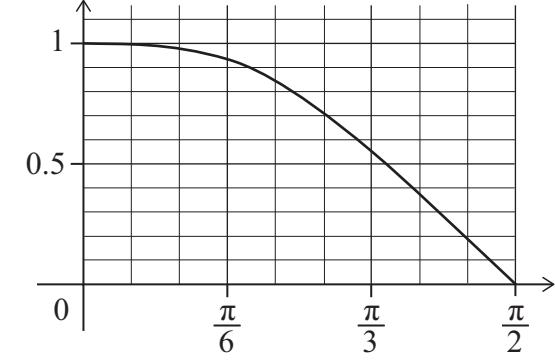
P, Q, R and S show the graphs of
\(y = (\cos x)^{\cos x}\), \(y = (\sin x)^{\sin x}\), \(y = (\cos x)^{\sin x}\) and \(y = (\sin x)^{\cos x}\)
for \(0 < x < \dfrac{\pi}{2}\) in some order.
Which row in the following table correctly identifies the graphs?
A
\(y=(\cos x)^{\cos x}\): P, \(y=(\sin x)^{\sin x}\): Q, \(y=(\cos x)^{\sin x}\): R, \(y=(\sin x)^{\cos x}\): S
B
\(y=(\cos x)^{\cos x}\): P, \(y=(\sin x)^{\sin x}\): Q, \(y=(\cos x)^{\sin x}\): S, \(y=(\sin x)^{\cos x}\): R
C
\(y=(\cos x)^{\cos x}\): Q, \(y=(\sin x)^{\sin x}\): P, \(y=(\cos x)^{\sin x}\): R, \(y=(\sin x)^{\cos x}\): S
D
\(y=(\cos x)^{\cos x}\): Q, \(y=(\sin x)^{\sin x}\): P, \(y=(\cos x)^{\sin x}\): S, \(y=(\sin x)^{\cos x}\): R
\(y=(\cos x)^{\cos x}\): R, \(y=(\sin x)^{\sin x}\): S, \(y=(\cos x)^{\sin x}\): P, \(y=(\sin x)^{\cos x}\): Q
Correct Answer
F
\(y=(\cos x)^{\cos x}\): R, \(y=(\sin x)^{\sin x}\): S, \(y=(\cos x)^{\sin x}\): Q, \(y=(\sin x)^{\cos x}\): P
G
\(y=(\cos x)^{\cos x}\): S, \(y=(\sin x)^{\sin x}\): R, \(y=(\cos x)^{\sin x}\): P, \(y=(\sin x)^{\cos x}\): Q
H
\(y=(\cos x)^{\cos x}\): S, \(y=(\sin x)^{\sin x}\): R, \(y=(\cos x)^{\sin x}\): Q, \(y=(\sin x)^{\cos x}\): P
Explanation
Let us substitute values into the four equations to begin with.
When \(x = 0\), we have
$
(cos x)^(cos
x) = 1^1 = 1 $ $ (sin x)^(sin
x) = 0^0 = ? $ $ (cos x)^(sin
x) = 1^0 = 1 $ $ (sin x)^(cos
x) = 0^1 = 0 $ This shows that graph Q is \(y = (\sin x)^{\cos x}\). (We do not know what \((\sin x)^{\sin x}\) is when \(x = 0\), but from the graphs given, since three of the functions have value \(1\) at \(x = 0\) and only one is \(0\), it must be \(1\).) Next, let us consider the value at \(x = \dfrac{\pi}{2}\): $ (cos x)^(cos
x) = 0^0 = ? $ $ (sin x)^(sin
x) = 1^1 = 1 $ $ (cos x)^(sin
x) = 0^1 = 0 $ $ (sin x)^(cos
x) = 1^0 = 1 $ Again, as only one graph has value \(0\) at \(x = \dfrac{\pi}{2}\), graph P depicts \((\cos x)^{\sin x}\). (We did not actually need to calculate the final line of this list, as we have already identified this function as being graph Q.) So we are left with \((\cos x)^{\cos x}\) and \((\sin x)^{\sin x}\) as graphs R and S in some order. Let us put in the value \(x = \dfrac{\pi}{6}\), as that is clearly different between the two functions. We have $ (cos x)^(cos
x) = (frac(sqrt(3), 2))^(frac(sqrt(3), 2)) $ $ (sin x)^(sin
x) = (frac(1, 2))^(frac(1, 2)) $ The first of these looks horrible, but we can approximate the value of the second of these; it is just \(\sqrt{\dfrac{1}{2}} \approx 0.7\), so this must be graph S. Similarly, \((\cos x)^{\cos x} \approx 0.7\) at \(x = \dfrac{\pi}{3}\), which is graph R. Therefore the graphs are: \((\cos x)^{\cos x}\): graph R \((\sin x)^{\sin x}\): graph S \((\cos x)^{\sin x}\): graph P \((\sin x)^{\cos x}\): graph Q which is option E.
x) = 1^1 = 1 $ $ (sin x)^(sin
x) = 0^0 = ? $ $ (cos x)^(sin
x) = 1^0 = 1 $ $ (sin x)^(cos
x) = 0^1 = 0 $ This shows that graph Q is \(y = (\sin x)^{\cos x}\). (We do not know what \((\sin x)^{\sin x}\) is when \(x = 0\), but from the graphs given, since three of the functions have value \(1\) at \(x = 0\) and only one is \(0\), it must be \(1\).) Next, let us consider the value at \(x = \dfrac{\pi}{2}\): $ (cos x)^(cos
x) = 0^0 = ? $ $ (sin x)^(sin
x) = 1^1 = 1 $ $ (cos x)^(sin
x) = 0^1 = 0 $ $ (sin x)^(cos
x) = 1^0 = 1 $ Again, as only one graph has value \(0\) at \(x = \dfrac{\pi}{2}\), graph P depicts \((\cos x)^{\sin x}\). (We did not actually need to calculate the final line of this list, as we have already identified this function as being graph Q.) So we are left with \((\cos x)^{\cos x}\) and \((\sin x)^{\sin x}\) as graphs R and S in some order. Let us put in the value \(x = \dfrac{\pi}{6}\), as that is clearly different between the two functions. We have $ (cos x)^(cos
x) = (frac(sqrt(3), 2))^(frac(sqrt(3), 2)) $ $ (sin x)^(sin
x) = (frac(1, 2))^(frac(1, 2)) $ The first of these looks horrible, but we can approximate the value of the second of these; it is just \(\sqrt{\dfrac{1}{2}} \approx 0.7\), so this must be graph S. Similarly, \((\cos x)^{\cos x} \approx 0.7\) at \(x = \dfrac{\pi}{3}\), which is graph R. Therefore the graphs are: \((\cos x)^{\cos x}\): graph R \((\sin x)^{\sin x}\): graph S \((\cos x)^{\sin x}\): graph P \((\sin x)^{\cos x}\): graph Q which is option E.
19
Plane Geometry
Wrong
A polygon has \(n\) vertices, where \(n \geq 3\). It has the following properties:
- Every vertex of the polygon lies on the circumference of a circle \(C\).
- The centre of the circle \(C\) is inside the polygon.
- The radii from the centre of the circle \(C\) to the vertices of the polygon cut the polygon into \(n\) triangles of equal area.
For which values of \(n\) are these properties *sufficient* to deduce that the polygon is regular?
A
no values of \(n\)
\(n = 3\) only
Correct Answer
C
\(n = 3\) and \(n = 4\) only
D
\(n = 3\) and \(n \geq 5\) only
E
all values of \(n\)
Explanation
We sketch a part of the polygon with the triangles described in the question:
Suppose the angle of one of the triangles is \(\theta\), as shown. Then the area of the triangle is given by \(frac(1,2) r^2 \sin \theta\) where \(r\) is the radius of the circle (using the formula \(A = frac(1,2) a b \sin C\)).
Since \(r\) is the same for each of the triangles, all the triangles will have equal area if and only if \(\sin \theta\) is the same for each triangle. This will certainly be the case if the polygon is regular, but we have to determine if this can be true in any other situation.
If two of the triangles have angles at the centre of the circle of \(\theta\) and \(\phi\), then \(\sin \phi = \sin \theta\) if and only if \(\phi = \theta\) or \(\phi = \pi - \theta\). Can we have the latter possibility? If so, it would mean we have some angles being \(\theta\) and some being \(\pi - \theta\).
Suppose then that \(\theta\) is acute and \(\pi - \theta\) is obtuse. (We cannot have a reflex angle as the centre of the circle lies inside the polygon, and if \(\theta\) is a right angle, then \(\pi - \theta = \theta\).) Suppose further that \(k\) of the angles of the polygon triangles equal \(\pi - \theta\) and the remaining \(n - k\) equal \(\theta\). Then the sum of these triangle angles is given by
$
(n-k)theta + k(pi-theta) = 2pi
$
since they form a whole circle. We can rearrange this to \((n-2k)\theta = (2-k)\pi\) and hence
$
theta = frac((2-k)pi, n-2k).
$
There can be at most three obtuse angled triangles (as four would be more than a whole circle), so let's try \(k = 1\), \(k = 2\) and \(k = 3\) in turn.
If \(k=1\), we have \(\theta = \dfrac{\pi}{n-2}\). It looks as though this will work for every \(n\), but we have to be a little careful as we need \(\theta\) to be acute. When \(n=3\), we get \(\theta=\pi\), which is not allowed. When \(n=4\), we get \(\theta=\dfrac{\pi}{2}\), which is again not allowed. When \(n>4\), \(\theta<\dfrac{\pi}{2}\), so this does work. Therefore when \(n \geq 5\), it is possible for the conditions to be satisfied but for the polygon not to be regular.
Now consider \(k=2\), giving \(\theta=\dfrac{0}{n-4}\). We only need to consider \(n=3\) and \(n=4\), as we have dealt with \(n \geq 5\) above. This is zero when \(n=3\), so it does not work for a triangle. When \(n=4\), this formula is not meaningful (it gives \(\dfrac{0}{0}\)). We can instead go back to the original equation \((n-2k)\theta=(2-k)\pi\), which becomes \(0=0\) in this case, meaning that it works for any value of \(\theta\). And indeed, this gives two angles of \(\theta\) and two of \(\pi-\theta\), so we get a non-regular polygon with equal area triangles. The simplest example is a non-square rectangle.
We are left with the case \(k=3\) to consider. When \(n=3\), there would be no acute angles and three obtuse ones, and the formula gives \(\theta = \dfrac{-\pi}{-3} = \dfrac{\pi}{3}\). And indeed, a triangle with three obtuse angles of \(\dfrac{\pi}{3}\) is an equilateral triangle satisfying the conditions. Therefore the only triangle \((n=3)\) satisfying the conditions is regular.
We have thus been able to construct non-regular polygons satisfying the conditions for every \(n \geq 4\), but not for \(n = 3\). Hence the correct answer is option B.
20
Trigonometric Functions
Wrong
The functions \(f_1\) to \(f_5\) are defined on the real numbers by
\(f_1(x) = \cos x\)
\(f_2(x) = \sin(\cos x)\)
\(f_3(x) = \cos(\sin(\cos x))\)
\(f_4(x) = \sin(\cos(\sin(\cos x)))\)
\(f_5(x) = \cos(\sin(\cos(\sin(\cos x))))\)
where all numbers are taken to be in radians.
These functions have maximum values \(m_1\), \(m_2\), \(m_3\), \(m_4\) and \(m_5\), respectively.
Which one of the following statements is true?
A
\(m_1, m_2, m_3, m_4\) and \(m_5\) are all equal to 1
B
\(0 < m_5 < m_4 < m_3 < m_2 < m_1 = 1\)
C
\(m_1 = m_3 = m_5 = 1\) and \(0 < m_2 = m_4 < 1\)
D
\(m_1 = m_3 = m_5 = 1\) and \(0 < m_4 < m_2 < 1\)
\(m_1 = m_3 = 1\) and \(0 < m_2 = m_4 < 1\) and \(0 < m_5 < 1\)
Correct Answer
F
\(m_1 = m_3 = 1\) and \(0 < m_4 < m_2 < 1\) and \(0 < m_5 < 1\)
Explanation
We note that we can rewrite each of the functions \(f_2\) to \(f_5\) in terms of the previous function:
$
f_1(x) = cos x
$
$
f_2(x) = sin f_1(x)
$
$
f_3(x) = cos f_2(x)
$
$
f_4(x) = sin f_3(x)
$
$
f_5(x) = cos f_4(x)
$
Since \(f_1(x) = \cos x\) is periodic with period \(2\pi\), each of the other functions also repeats every \(2\pi\) (though it may have a shortest period less than this), and so we only need to consider \(0 \leq x \leq 2\pi\). (We could actually restrict ourselves to \(0 \leq x \leq \pi\), as the values of \(\cos x\) in the range \(\pi < x \leq 2\pi\) are a repeat of the values in the range \(0 \leq x \leq \pi\), but we will draw a complete period anyway.)
Sketching the graph of each of these functions is the most straightforward way to proceed. We note first a result that we will need later: \(\pi \approx 3.14\) so \(\dfrac{\pi}{2} \approx 1.6\) and hence \(\sin 1 < \sin\left(\dfrac{\pi}{2}\right) = 1\).
A sketch of \(f_1(x) = \cos x\) is straightforward:
We see that \(m_1 = 1\), and the minimum value taken is \(-1\). Now \(f_2(x) = \sin f_1(x)\), so this goes between \(-\sin 1\) and \(\sin 1\), with roots where \(f_1(x) = 0\); recall that \(\sin 1 < 1\):
We see that \(m_2 = \sin 1 < 1\), and the minimum value taken is \(-\sin 1\).
Now \(f_3(x) = \cos f_2(x)\). When \(f_2(x) = 0\), \(f_3(x) = 1\), so \(f_3(x)\) has a maximum of \(1\) at \(x = \dfrac{\pi}{2}\) and at \(x = \dfrac{3\pi}{2}\). But \(f_3(x)\) never reaches \(0\) as \(f_2(x)\) never reaches \(\dfrac{\pi}{2} \approx 1.6\) or \(-\dfrac{\pi}{2} \approx -1.6\). Therefore the graph looks something like this:
Therefore \(m_3 = 1\), and the minimum value taken is \(\cos(\sin 1)\).
Next, \(f_4(x) = \sin f_3(x)\), so this will be an oscillating curve going between \(\sin(\cos(\sin 1))\) and \(\sin 1\):
Thus \(m_4 = \sin 1\).
Finally, \(f_5(x) = \cos f_4(x)\), so this will be an oscillating curve going between \(\cos(\sin 1)\) and \(\cos(\sin(\cos(\sin 1)))\):
To summarise, we have \(m_1 = m_3 = 1\), \(m_2 = m_4 = \sin 1\) and \(m_5 = \cos(\sin(\cos(\sin 1)))\), and the correct option is E.
It is also interesting to note from these accurate graphs that the subsequent functions are getting flatter and flatter and seem to be tending to a straight line (though the limiting value is different in the functions \(f_n\) where \(n\) is even and those where \(n\) is odd).