TMUA 2022 Paper 2

20 questions

0 / 20
TMUA 2022 Paper 2 0/20
1 Differentiation · Level 3
Determine the number of stationary points on the curve with equation \(y = 3x^4 + 4x^3 + 6x^2 - 5\)
A
\(0\)
B
\(1\)
C
\(2\)
D
\(3\)
E
\(4\)
2 Polynomials · Level 3
Find the coefficient of the \(x^5\) term in the expansion of \((1+x)^5 \times \displaystyle\sum_{i=0}^5 x^i\)
A
\(1\)
B
\(5\)
C
\(16\)
D
\(25\)
E
\(32\)
3 Basis of Logic · Level 3
Consider the following statement about the positive integer \(n\) if \(n\) is prime, then \(n^2 + 2\) is *not* prime Which of the following is a *counterexample* to this statement?
I. \(n = 2\)
II. \(n = 3\)
III. \(n = 4\)
A
none of them
B
I only
C
II only
D
III only
E
I and II only
F
I and III only
G
II and III only
H
I, II and III
4 Coordinate Geometry · Level 3
The point \(P\) has coordinates \((p, q)\), and the equation of a circle is \(x^2 + 2f x + y^2 + 2g y + h = 0\) where \(f\), \(g\), \(h\), \(p\) and \(q\) are all real constants. Let \(L\) be the distance between the centre of the circle and the point \(P\). Which one of the following is *sufficient* on its own to be able to calculate \(L\)?
A
the values of \(f\), \(g\) and \(h\)
B
the values of \(f\), \(g\), \(p\) and \(q\)
C
the values of \(f\), \(h\), \(p\) and \(q\)
D
the values of \(g\), \(h\), \(p\) and \(q\)
E
none of the options A-D is sufficient on its own
5 Basis of Logic · Level 3
A straight line \(L\) passes through \((1, 2)\). Let P be the statement *if* the \(y\)-intercept of \(L\) is negative, *then* the \(x\)-intercept of \(L\) is positive. Which of the following statements *must* be true?
I. P
II. the converse of P
III. the contrapositive of P
A
none of them
B
I only
C
II only
D
III only
E
I and II only
F
I and III only
G
II and III only
H
I, II and III
6 Basis of Logic · Level 3
A list consists of \(n\) integers. Consider the following statements: P: \(n\) is odd. Q: The median of the list is one of the numbers in the list. Which one of the following is true?
A
P is *necessary and sufficient* for Q.
B
P is *necessary* but *not sufficient* for Q.
C
P is *sufficient* but *not necessary* for Q.
D
P is *not necessary* and *not sufficient* for Q.
7 Logic of Arguments · Level 3
Consider the following claim: The difference between two consecutive positive cube numbers is always prime. Here is an attempted proof of this claim:
I. \((x+1)^3 = x^3 + 3x^2 + 3x + 1\)
II. Taking \(x\) to be a positive integer, the difference between two consecutive cube numbers can be expressed as \((x+1)^3 - x^3 = 3x^2 + 3x + 1\)
III. It is impossible to factorise \(3x^2 + 3x + 1\) into two linear factors with integer coefficients because its discriminant is negative.
IV. Therefore for every positive integer value of \(x\) the integer \(3x^2 + 3x + 1\) cannot be factorised.
V. Hence, the difference between two consecutive cube numbers will always be prime. Which of the following best describes this proof?
A
The proof is completely correct, and the claim is true.
B
The proof is completely correct, but there are counterexamples to the claim.
C
The proof is wrong, and the first error occurs on line I.
D
The proof is wrong, and the first error occurs on line II.
E
The proof is wrong, and the first error occurs on line III.
F
The proof is wrong, and the first error occurs on line IV.
G
The proof is wrong, and the first error occurs on line V.
8 Counting and Probabilities · Level 3
A selection, \(S\), of \(n\) terms is taken from the arithmetic sequence \(1, 4, 7, 10, ..., 70\). Consider the following statement: \((*)\) There are two distinct terms in \(S\) whose sum is \(74\). What is the smallest value of \(n\) for which \((*)\) is *necessarily* true?
A
\(12\)
B
\(13\)
C
\(14\)
D
\(21\)
E
\(22\)
F
\(23\)
9 Basis of Logic · Level 3
Consider the following statement: \((*)\) For all real numbers \(x\), if \(x < k\) then \(x^2 < k\) What is the complete set of values of \(k\) for which \((*)\) is true?
A
no real numbers
B
\(k > 0\)
C
\(k < 1\)
D
\(k \leq 1\)
E
\(0 < k < 1\)
F
\(0 < k \leq 1\)
G
all real numbers
10 Basis of Logic · Level 3
Which of the following statements is/are true?
I. *For all* real numbers \(x\) and *for all* positive integers \(n\), \(x < n\)
II. *For all* real numbers \(x\), *there exists* a positive integer \(n\) such that \(x < n\)
III. *There exists* a real number \(x\) such that *for all* positive integers \(n\), \(x < n\)
A
none of them
B
I only
C
II only
D
III only
E
I and II only
F
I and III only
G
II and III only
H
I, II and III
11 Plane Geometry · Level 3
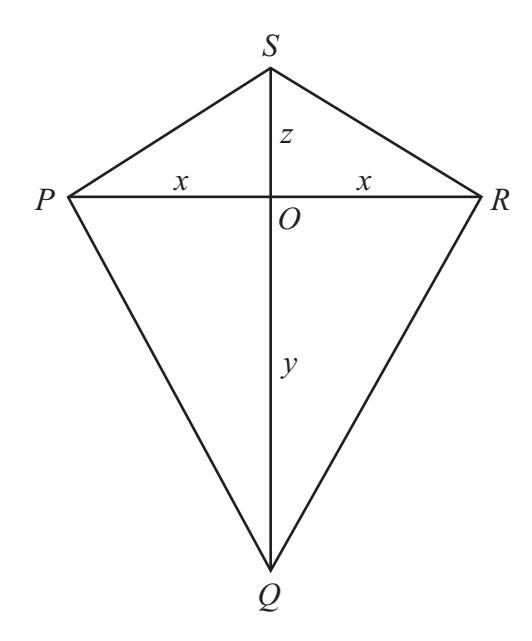
The diagram shows a kite \(P Q R S\) whose diagonals meet at \(O\). \(O P = x\) \(O Q = y\) \(O R = x\) \(O S = z\) Which of the following is *necessary and sufficient* for angle \(S P Q\) to be a right angle?
question image
A
\(x = y = z\)
B
\(2x = y + z\)
C
\(x^2 = y z\)
D
\(y = z\)
E
\(y^2 = x^2 + z^2\)
12 Integration · Level 3
Place the following integrals in order of size, starting with the smallest. \(P = \displaystyle\int_{0}^{1} 2^{\sqrt{x}} d x\) \(Q = \displaystyle\int_{0}^{1} 2^x d x\) \(R = \displaystyle\int_{0}^{1} (\sqrt{2})^x d x\)
A
\(P < Q < R\)
B
\(P < R < Q\)
C
\(Q < P < R\)
D
\(Q < R < P\)
E
\(R < P < Q\)
F
\(R < Q < P\)
13 Algebraic Manipulations · Level 3
Consider the statement \((*)\) about a real number \(x\): \((*)\) *There exists* a real number \(y\) such that \(x - x y + y\) is negative. For how many real values of \(x\) is \((*)\) true?
A
no values of \(x\)
B
exactly one value of \(x\)
C
exactly two values of \(x\)
D
all except exactly two values of \(x\)
E
all except exactly one value of \(x\)
F
all values of \(x\)
14 Inequalities · Level 3
Consider the two inequalities: \(|x+5| < |x+11|\) \(|x+11| < |x+1|\) Which one of the following is correct?
A
There is no real number for which both inequalities are true.
B
There is exactly one real number for which both inequalities are true.
C
The real numbers for which both inequalities are true form an interval of length 1.
D
The real numbers for which both inequalities are true form an interval of length 2.
E
The real numbers for which both inequalities are true form an interval of length 3.
F
The real numbers for which both inequalities are true form an interval of length 4.
G
The real numbers for which both inequalities are true form an interval of length 5.
15 Exponentials and Logarithms · Level 3
The real numbers \(x\), \(y\) and \(z\) are all greater than 1, and satisfy the equations \(\log_x y = z\) and \(\log_y z = x\) Which one of the following equations for \(\log_z x\) must be true?
A
\(\log_z x = y\)
B
\(\log_z x = \dfrac{1}{y}\)
C
\(\log_z x = x y\)
D
\(\log_z x = \dfrac{1}{x y}\)
E
\(\log_z x = x z\)
F
\(\log_z x = \dfrac{1}{x z}\)
G
\(\log_z x = y z\)
H
\(\log_z x = \dfrac{1}{y z}\)
16 Inequalities · Level 3
In this question, \(a_1, ..., a_100\) and \(b_1, ..., b_100\) and \(c_1, ..., c_100\) are three sequences of integers such that \(a_n \leq b_n + c_n\) for each \(n\). Which of the following statements *must* be true?
I. \((\text{minimum of } a_1, ..., a_100) \leq (\text{minimum of } b_1, ..., b_100) + (\text{minimum of } c_1, ..., c_100)\)
II. \((\text{minimum of } a_1, ..., a_100) \geq (\text{minimum of } b_1, ..., b_100) + (\text{minimum of } c_1, ..., c_100)\)
III. \((\text{maximum of } a_1, ..., a_100) \leq (\text{maximum of } b_1, ..., b_100) + (\text{maximum of } c_1, ..., c_100)\)
A
none of them
B
I only
C
II only
D
III only
E
I and II only
F
I and III only
G
II and III only
H
I, II and III
17 Logic of Arguments · Level 3
A student answered the following question: \(a\) and \(b\) are non-zero real numbers. Prove that the equation \(x^3 + a x^2 + b = 0\) has three distinct real roots if \(27 b \left(b + \dfrac{4 a^3}{27}\right) < 0\) Here is the student's solution:
I. We differentiate \(y = x^3 + a x^2 + b\) to get \(\dfrac{d y}{d x} = 3x^2 + 2a x = x(3x + 2a)\). Solving \(\dfrac{d y}{d x} = 0\) shows that the stationary points are at \((0, b)\) and \(\left(-\dfrac{2a}{3}, b + \dfrac{4 a^3}{27}\right)\)
II. If \(27 b \left(b + \dfrac{4 a^3}{27}\right) < 0\), then \(b\) and \(b + \dfrac{4 a^3}{27}\) must have opposite signs, and so one of the stationary points is above the \(x\)-axis and one is below.
III. If the cubic has three distinct real roots, then one of the stationary points is above the \(x\)-axis and one is below.
IV. Hence if \(27 b \left(b + \dfrac{4 a^3}{27}\right) < 0\), then the equation has three distinct real roots. Which one of the following options best describes the student's solution?
A
It is a completely correct solution.
B
The student has instead proved the converse of the statement in the question.
C
The solution is wrong, because the student should have stated step II after step III.
D
The solution is wrong, because the student should have shown the converse of the result in step II.
E
The solution is wrong, because the student should have shown the converse of the result in step III.
18 Functions and Their Graphs · Level 3
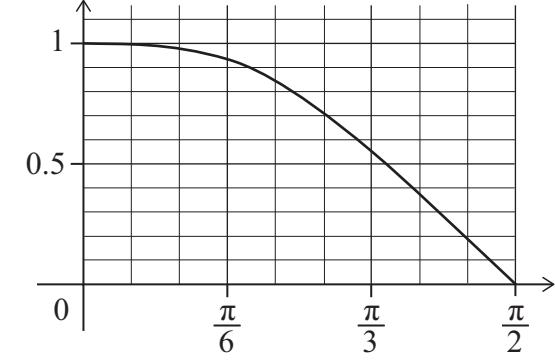
P, Q, R and S show the graphs of \(y = (\cos x)^{\cos x}\), \(y = (\sin x)^{\sin x}\), \(y = (\cos x)^{\sin x}\) and \(y = (\sin x)^{\cos x}\) for \(0 < x < \dfrac{\pi}{2}\) in some order. Which row in the following table correctly identifies the graphs?
question image
A
\(y=(\cos x)^{\cos x}\): P, \(y=(\sin x)^{\sin x}\): Q, \(y=(\cos x)^{\sin x}\): R, \(y=(\sin x)^{\cos x}\): S
B
\(y=(\cos x)^{\cos x}\): P, \(y=(\sin x)^{\sin x}\): Q, \(y=(\cos x)^{\sin x}\): S, \(y=(\sin x)^{\cos x}\): R
C
\(y=(\cos x)^{\cos x}\): Q, \(y=(\sin x)^{\sin x}\): P, \(y=(\cos x)^{\sin x}\): R, \(y=(\sin x)^{\cos x}\): S
D
\(y=(\cos x)^{\cos x}\): Q, \(y=(\sin x)^{\sin x}\): P, \(y=(\cos x)^{\sin x}\): S, \(y=(\sin x)^{\cos x}\): R
E
\(y=(\cos x)^{\cos x}\): R, \(y=(\sin x)^{\sin x}\): S, \(y=(\cos x)^{\sin x}\): P, \(y=(\sin x)^{\cos x}\): Q
F
\(y=(\cos x)^{\cos x}\): R, \(y=(\sin x)^{\sin x}\): S, \(y=(\cos x)^{\sin x}\): Q, \(y=(\sin x)^{\cos x}\): P
G
\(y=(\cos x)^{\cos x}\): S, \(y=(\sin x)^{\sin x}\): R, \(y=(\cos x)^{\sin x}\): P, \(y=(\sin x)^{\cos x}\): Q
H
\(y=(\cos x)^{\cos x}\): S, \(y=(\sin x)^{\sin x}\): R, \(y=(\cos x)^{\sin x}\): Q, \(y=(\sin x)^{\cos x}\): P
19 Plane Geometry · Level 3
A polygon has \(n\) vertices, where \(n \geq 3\). It has the following properties: - Every vertex of the polygon lies on the circumference of a circle \(C\). - The centre of the circle \(C\) is inside the polygon. - The radii from the centre of the circle \(C\) to the vertices of the polygon cut the polygon into \(n\) triangles of equal area. For which values of \(n\) are these properties *sufficient* to deduce that the polygon is regular?
A
no values of \(n\)
B
\(n = 3\) only
C
\(n = 3\) and \(n = 4\) only
D
\(n = 3\) and \(n \geq 5\) only
E
all values of \(n\)
20 Trigonometric Functions · Level 3
The functions \(f_1\) to \(f_5\) are defined on the real numbers by \(f_1(x) = \cos x\) \(f_2(x) = \sin(\cos x)\) \(f_3(x) = \cos(\sin(\cos x))\) \(f_4(x) = \sin(\cos(\sin(\cos x)))\) \(f_5(x) = \cos(\sin(\cos(\sin(\cos x))))\) where all numbers are taken to be in radians. These functions have maximum values \(m_1\), \(m_2\), \(m_3\), \(m_4\) and \(m_5\), respectively. Which one of the following statements is true?
A
\(m_1, m_2, m_3, m_4\) and \(m_5\) are all equal to 1
B
\(0 < m_5 < m_4 < m_3 < m_2 < m_1 = 1\)
C
\(m_1 = m_3 = m_5 = 1\) and \(0 < m_2 = m_4 < 1\)
D
\(m_1 = m_3 = m_5 = 1\) and \(0 < m_4 < m_2 < 1\)
E
\(m_1 = m_3 = 1\) and \(0 < m_2 = m_4 < 1\) and \(0 < m_5 < 1\)
F
\(m_1 = m_3 = 1\) and \(0 < m_4 < m_2 < 1\) and \(0 < m_5 < 1\)

Answered: 0 / 20

0 / 20