Exam Complete
|
Stewart 9th Section 2.6: Implicit Differentiation
0.0%
0/65
Results by Question
1
Implicit Diff - Basic
Error Rate 100%
Wrong
(a) Find \(y'\) by implicit differentiation.
(b) Solve the equation explicitly for \(y\) and differentiate to get \(y'\) in terms of \(x\).
(c) Check that your solutions to parts (a) and (b) are consistent by substituting the expression for \(y\) into your solution for part (a).
\(5x^2 - y^3 = 7\)
(No answer submitted)
Answer
(a) \(y' = \dfrac{10x}{3y^2}\)
(b) \(y = (5x^2 - 7)^{\dfrac{1}{3}}\), \(y' = \dfrac{10x}{3}(5x^2 - 7)^{-\dfrac{2}{3}}\)
(c) Substituting \(y = (5x^2 - 7)^{\dfrac{1}{3}}\) into \(\dfrac{10x}{3y^2}\) gives the same result.
Compare with the answer above and grade yourself:
No explanation
2
Implicit Diff - Basic
Error Rate 100%
Wrong
(a) Find \(y'\) by implicit differentiation.
(b) Solve the equation explicitly for \(y\) and differentiate to get \(y'\) in terms of \(x\).
(c) Check that your solutions to parts (a) and (b) are consistent by substituting the expression for \(y\) into your solution for part (a).
\(6x^4 + y^5 = 2x\)
(No answer submitted)
Answer
(a) \(y' = \dfrac{2 - 24x^3}{5y^4}\)
(b) \(y = (2x - 6x^4)^{\dfrac{1}{5}}\), \(y' = \dfrac{2 - 24x^3}{5}(2x - 6x^4)^{-\dfrac{4}{5}}\)
Compare with the answer above and grade yourself:
No explanation
3
Implicit Diff - Basic
Error Rate 100%
Wrong
(a) Find \(y'\) by implicit differentiation.
(b) Solve the equation explicitly for \(y\) and differentiate to get \(y'\) in terms of \(x\).
(c) Check that your solutions to parts (a) and (b) are consistent by substituting the expression for \(y\) into your solution for part (a).
\(\sqrt{x} + \sqrt{y} = 1\)
(No answer submitted)
Answer
(a) \(y' = -\dfrac{\sqrt{y}}{\sqrt{x}} = -\sqrt{\dfrac{y}{x}}\)
(b) \(y = (1 - \sqrt{x})^2\), \(y' = -\dfrac{1 - \sqrt{x}}{\sqrt{x}}\)
Compare with the answer above and grade yourself:
No explanation
4
Implicit Diff - Basic
Error Rate 100%
Wrong
(a) Find \(y'\) by implicit differentiation.
(b) Solve the equation explicitly for \(y\) and differentiate to get \(y'\) in terms of \(x\).
(c) Check that your solutions to parts (a) and (b) are consistent by substituting the expression for \(y\) into your solution for part (a).
\(\dfrac{2}{x} - \dfrac{1}{y} = 4\)
(No answer submitted)
Answer
(a) \(y' = -\dfrac{y^2}{x^2} \cdot \dfrac{2}{1} = -\dfrac{2y^2}{x^2}\)
(b) \(y = \dfrac{x}{4x - 2}\), differentiate using quotient rule.
Compare with the answer above and grade yourself:
No explanation
5
Implicit Diff - Intermediate
Error Rate 100%
Wrong
\( x^2 - 4x y + y^2 = 4 \)
(No answer submitted)
Answer
\(\dfrac{d y}{d x} = \dfrac{4y - 2x}{2y - 4x} = \dfrac{2y - x}{y - 2x}\)
Compare with the answer above and grade yourself:
No explanation
6
Implicit Diff - Intermediate
Error Rate 100%
Wrong
\( 2x^2 + x y - y^2 = 2 \)
(No answer submitted)
Answer
\(\dfrac{d y}{d x} = \dfrac{-(4x + y)}{x - 2y} = \dfrac{4x + y}{2y - x}\)
Compare with the answer above and grade yourself:
No explanation
7
Implicit Diff - Intermediate
Error Rate 100%
Wrong
\( x^4 + x^2 y^2 + y^3 = 5 \)
(No answer submitted)
Answer
\(\dfrac{d y}{d x} = -\dfrac{4x^3 + 2x y^2}{2x^2 y + 3y^2}\)
Compare with the answer above and grade yourself:
No explanation
8
Implicit Diff - Intermediate
Error Rate 100%
Wrong
\( x^3 - x y^2 + y^3 = 1 \)
(No answer submitted)
Answer
\(\dfrac{d y}{d x} = \dfrac{y^2 - 3x^2}{3y^2 - 2x y}\)
Compare with the answer above and grade yourself:
No explanation
9
Implicit Diff - Intermediate
Error Rate 100%
Wrong
\( \dfrac{x^2}{x + y} = y^2 + 1 \)
(No answer submitted)
Answer
\(\dfrac{d y}{d x} = \dfrac{2x(x + y) - x^2}{(x + y)^2 \cdot (-1) + 2y(x+y)^2} \). Use quotient rule on the left side, then solve for \(y'\).
Compare with the answer above and grade yourself:
No explanation
10
Implicit Diff - Intermediate
Error Rate 100%
Wrong
\( y^5 + x^2 y^3 = 1 + x^4 y \)
(No answer submitted)
Answer
\(\dfrac{d y}{d x} = \dfrac{4x^3 y - 2x y^3}{5y^4 + 3x^2 y^2 - x^4}\)
Compare with the answer above and grade yourself:
No explanation
11
Implicit Diff - Intermediate
Error Rate 100%
Wrong
\( \sin x + \cos y = 2x - 3y \)
(No answer submitted)
Answer
\(\dfrac{d y}{d x} = \dfrac{2 - \cos x}{3 - \sin y}\)
Compare with the answer above and grade yourself:
No explanation
12
Implicit Diff - Intermediate
Error Rate 100%
Wrong
\( y \sin(x^2) = x \sin(y^2) \)
(No answer submitted)
Answer
\(\dfrac{d y}{d x} = \dfrac{\sin(y^2) - 2x y \cos(x^2)}{\sin(x^2) - 2x y \cos(y^2)}\)
Compare with the answer above and grade yourself:
No explanation
13
Implicit Diff - Intermediate
Error Rate 100%
Wrong
\( \sin(x + y) = \cos x + \cos y \)
(No answer submitted)
Answer
\(\dfrac{d y}{d x} = \dfrac{\sin x + \cos(x + y)}{\sin y - \cos(x + y)} = -\dfrac{\cos(x + y) + \sin x}{\cos(x + y) - \sin y}\)
Compare with the answer above and grade yourself:
No explanation
14
Implicit Diff - Intermediate
Error Rate 100%
Wrong
\( \tan(x - y) = 2x y^3 + 1 \)
(No answer submitted)
Answer
\(\dfrac{d y}{d x} = \dfrac{\sec^2(x - y) - 2y^3}{\sec^2(x - y) + 6x y^2}\). Differentiate noting \(\dfrac{d}{d x}[\tan(x-y)] = \sec^2(x-y)(1 - y')\).
Compare with the answer above and grade yourself:
No explanation
15
Implicit Diff - Intermediate
Error Rate 100%
Wrong
\( \tan\left(\dfrac{x}{y}\right) = x + y \)
(No answer submitted)
Answer
Use \(\dfrac{d}{d x}[\tan\left(\dfrac{x}{y}\right)] = \sec^2\left(\dfrac{x}{y}\right) \cdot \dfrac{y - x y'}{y^2}\) and set equal to \(1 + y'\). Solve for \(y'\).
Compare with the answer above and grade yourself:
No explanation
16
Implicit Diff - Intermediate
Error Rate 100%
Wrong
\( \sin(x y) = \cos(x + y) \)
(No answer submitted)
Answer
\(\dfrac{d y}{d x} = -\dfrac{y \cos(x y) + \sin(x + y)}{x \cos(x y) + \sin(x + y)}\)
Compare with the answer above and grade yourself:
No explanation
17
Implicit Diff - Intermediate
Error Rate 100%
Wrong
\( \sqrt{x + y} = x^4 + y^4 \)
(No answer submitted)
Answer
\(\dfrac{d y}{d x} = \dfrac{4x^3 - \dfrac{1}{2\sqrt{x + y}}}{\dfrac{1}{2\sqrt{x + y}} - 4y^3}\)
Compare with the answer above and grade yourself:
No explanation
18
Implicit Diff - Intermediate
Error Rate 100%
Wrong
\( \sin x \cos y = x^2 - 5y \)
(No answer submitted)
Answer
\(\dfrac{d y}{d x} = \dfrac{2x - \cos x \cos y}{5 - \sin x \sin y}\)
Compare with the answer above and grade yourself:
No explanation
19
Implicit Diff - Intermediate
Error Rate 100%
Wrong
\( \sqrt{x y} = 1 + x^2 y \)
(No answer submitted)
Answer
Differentiate: \(\dfrac{y + x y'}{2\sqrt{x y}} = 2x y + x^2 y'\). Solve for \(y'\).
Compare with the answer above and grade yourself:
No explanation
20
Implicit Diff - Intermediate
Error Rate 100%
Wrong
\( x y = \sqrt{x^2 + y^2} \)
(No answer submitted)
Answer
Differentiate: \(y + x y' = \dfrac{2x + 2y y'}{2\sqrt{x^2 + y^2}} = \dfrac{x + y y'}{\sqrt{x^2 + y^2}}\). Solve for \(y'\).
Compare with the answer above and grade yourself:
No explanation
21
Implicit Diff - Given Values
Error Rate 100%
Wrong
If \(f(x) + x^2 [f(x)]^3 = 10\) and \(f(1) = 2\), find \(f'(1)\).
(No answer submitted)
Answer
Differentiate: \(f'(x) + 2x[f(x)]^3 + 3x^2[f(x)]^2 f'(x) = 0\). At \(x = 1\): \(f'(1) + 2(8) + 3(4)f'(1) = 0\), so \(13 f'(1) = -16\), \(f'(1) = -\dfrac{16}{13}\).
Compare with the answer above and grade yourself:
No explanation
22
Implicit Diff - Given Values
Error Rate 100%
Wrong
If \(g(x) + x \sin g(x) = x^2\), find \(g'(0)\).
(No answer submitted)
Answer
At \(x = 0\): \(g(0) = 0\). Differentiate: \(g'(x) + \sin g(x) + x \cos g(x) \cdot g'(x) = 2x\). At \(x = 0\): \(g'(0) + 0 + 0 = 0\), so \(g'(0) = 0\).
Compare with the answer above and grade yourself:
No explanation
23
Implicit Diff - dx/dy
Error Rate 100%
Wrong
Regard \(y\) as the independent variable and \(x\) as the dependent variable and use implicit differentiation to find \(\dfrac{d x}{d y}\).
\(x^4 y^2 - x^3 y + 2x y^3 = 0\)
(No answer submitted)
Answer
Differentiate with respect to \(y\): \(4x^3 x' y^2 + 2x^4 y - 3x^2 x' y - x^3 + 2x' y^3 + 6x y^2 = 0\). Solve for \(x' = \dfrac{d x}{d y}\).
Compare with the answer above and grade yourself:
No explanation
24
Implicit Diff - dx/dy
Error Rate 100%
Wrong
Regard \(y\) as the independent variable and \(x\) as the dependent variable and use implicit differentiation to find \(\dfrac{d x}{d y}\).
\(y \sec x = x \tan y\)
(No answer submitted)
Answer
Differentiate with respect to \(y\): \(\sec x + y \sec x \tan x \cdot x' = x' \tan y + x \sec^2 y\). Solve for \(x' = \dfrac{d x}{d y}\).
Compare with the answer above and grade yourself:
No explanation
25
Implicit Diff - Tangent Lines
Error Rate 100%
Wrong
\(y \sin 2x = x \cos 2y\), \(\quad \left(\dfrac{\pi}{2}, \dfrac{\pi}{4}\right)\)
(No answer submitted)
Answer
Differentiate: \(y' \sin 2x + 2y \cos 2x = \cos 2y - 2x \sin 2y \cdot y'\). At \(\left(\dfrac{\pi}{2}, \dfrac{\pi}{4}\right)\): evaluate and solve for \(y'\), then write tangent line equation.
Compare with the answer above and grade yourself:
No explanation
26
Implicit Diff - Tangent Lines
Error Rate 100%
Wrong
\(\tan(x + y) + \sec(x - y) = 2\), \(\quad \left(\dfrac{\pi}{8}, \dfrac{\pi}{8}\right)\)
(No answer submitted)
Answer
At \(\left(\dfrac{\pi}{8}, \dfrac{\pi}{8}\right)\): \(\tan\left(\dfrac{\pi}{4}\right) + \sec(0) = 1 + 1 = 2\) checks. Differentiate and evaluate to find the tangent line.
Compare with the answer above and grade yourself:
No explanation
27
Implicit Diff - Tangent Lines
Error Rate 100%
Wrong
\(x^{\dfrac{2}{3}} + y^{\dfrac{2}{3}} = 4\), \(\quad (-3\sqrt{3}, 1)\) (astroid)
(No answer submitted)
Answer
\(\dfrac{d y}{d x} = -\left(\dfrac{y}{x}\right)^{\dfrac{1}{3}}\). At \((-3\sqrt{3}, 1)\): \(y' = -\left(\dfrac{1}{-3\sqrt{3}}\right)^{\dfrac{1}{3}}\). Write tangent line.
Compare with the answer above and grade yourself:
No explanation
28
Implicit Diff - Tangent Lines
Error Rate 100%
Wrong
\(y^2(6 - x) = x^3\), \(\quad (2, \sqrt{2})\) (cissoid of Diocles)
(No answer submitted)
Answer
Differentiate: \(2y y'(6 - x) + y^2(-1) = 3x^2\). At \((2, \sqrt{2})\): solve for \(y'\) and write tangent line equation.
Compare with the answer above and grade yourself:
No explanation
29
Implicit Diff - Tangent Lines
Error Rate 100%
Wrong
\(x^2 - x y - y^2 = 1\), \(\quad (2, 1)\) (hyperbola)
(No answer submitted)
Answer
\(\dfrac{d y}{d x} = \dfrac{2x - y}{x + 2y}\). At \((2, 1)\): \(y' = \dfrac{4 - 1}{2 + 2} = \dfrac{3}{4}\). Tangent: \(y - 1 = \dfrac{3}{4}(x - 2)\).
Compare with the answer above and grade yourself:
No explanation
30
Implicit Diff - Tangent Lines
Error Rate 100%
Wrong
\(x^2 + 2x y + 4y^2 = 12\), \(\quad (2, 1)\) (ellipse)
(No answer submitted)
Answer
\(\dfrac{d y}{d x} = -\dfrac{2x + 2y}{2x + 8y} = -\dfrac{x + y}{x + 4y}\). At \((2, 1)\): \(y' = -\dfrac{3}{6} = -\dfrac{1}{2}\). Tangent: \(y - 1 = -\dfrac{1}{2}(x - 2)\).
Compare with the answer above and grade yourself:
No explanation
31
Implicit Diff - Tangent Lines
Error Rate 100%
Wrong
\(x^2 + y^2 = (2x^2 + 2y^2 - x)^2\), \(\quad \left(0, \dfrac{1}{2}\right)\) (cardioid)
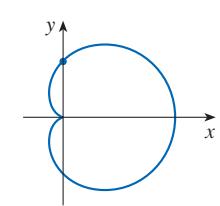
(No answer submitted)
Answer
Differentiate both sides using chain rule. At \(\left(0, \dfrac{1}{2}\right)\): the curve satisfies \(\dfrac{1}{4} = \left(\dfrac{1}{2}\right)^2 = \dfrac{1}{4}\). Find \(y'\) and write tangent line.
Compare with the answer above and grade yourself:
No explanation
32
Implicit Diff - Tangent Lines
Error Rate 100%
Wrong
\(x^2 y^2 = (y + 1)^2(4 - y^2)\), \(\quad (2\sqrt{3}, 1)\) (conchoid of Nicomedes)
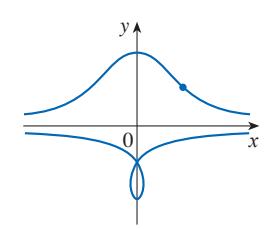
(No answer submitted)
Answer
Differentiate both sides implicitly. At \((2\sqrt{3}, 1)\): evaluate and solve for \(y'\), then write tangent line equation.
Compare with the answer above and grade yourself:
No explanation
33
Implicit Diff - Tangent Lines
Error Rate 100%
Wrong
\(2(x^2 + y^2)^2 = 25(x^2 - y^2)\), \(\quad (3, 1)\) (lemniscate)
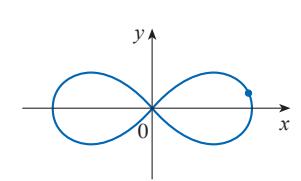
(No answer submitted)
Answer
Differentiate: \(4(x^2 + y^2)(2x + 2y y') = 25(2x - 2y y')\). At \((3, 1)\): \(4(10)(6 + 2y') = 25(6 - 2y')\). Solve for \(y'\) and write tangent line.
Compare with the answer above and grade yourself:
No explanation
34
Implicit Diff - Tangent Lines
Error Rate 100%
Wrong
\(y^2(y^2 - 4) = x^2(x^2 - 5)\), \(\quad (0, -2)\) (devil's curve)
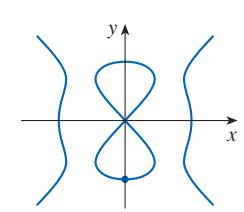
(No answer submitted)
Answer
Differentiate: \(2y y'(y^2 - 4) + y^2(2y y') = 2x(x^2 - 5) + x^2(2x)\), i.e., \(2y y'(2y^2 - 4) = 2x(2x^2 - 5)\). At \((0, -2)\): \(y' = 0\). Tangent: \(y = -2\).
Compare with the answer above and grade yourself:
No explanation
35
Implicit Diff - Tangent Lines
Error Rate 100%
Wrong
(a) The curve with equation \(y^2 = 5x^4 - x^2\) is called a kampyle of Eudoxus. Find an equation of the tangent line to this curve at the point \((1, 2)\).
(b) Illustrate part (a) by graphing the curve and the tangent line on a common screen.
(No answer submitted)
Answer
(a) Differentiate: \(2y y' = 20x^3 - 2x\). At \((1, 2)\): \(4y' = 18\), so \(y' = \dfrac{9}{2}\). Tangent: \(y - 2 = \dfrac{9}{2}(x - 1)\).
Compare with the answer above and grade yourself:
No explanation
36
Implicit Diff - Tangent Lines
Error Rate 100%
Wrong
(a) The curve with equation \(y^2 = x^3 + 3x^2\) is called a Tschirnhausen cubic. Find an equation of the tangent line to this curve at the point \((1, -2)\).
(b) At what points does this curve have horizontal tangents?
(c) Illustrate parts (a) and (b) by graphing the curve and the tangent lines on a common screen.
(No answer submitted)
Answer
(a) \(2y y' = 3x^2 + 6x\). At \((1, -2)\): \(-4y' = 9\), \(y' = -\dfrac{9}{4}\). Tangent: \(y + 2 = -\dfrac{9}{4}(x - 1)\).
(b) Horizontal tangents where \(3x^2 + 6x = 0\), i.e., \(x = 0\) or \(x = -2\). At \(x = -2\): \(y^2 = -8 + 12 = 4\), \(y = \pm 2\). At \(x = 0\): \(y = 0\).
Compare with the answer above and grade yourself:
No explanation
37
Implicit Diff - Second Derivative
Error Rate 100%
Wrong
Find \(y''\) by implicit differentiation. Simplify where possible.
\(x^2 + 4y^2 = 4\)
(No answer submitted)
Answer
\(y' = -\dfrac{x}{4y}\). \(y'' = -\dfrac{4y - x \cdot 4y'}{16y^2} = -\dfrac{4y + \dfrac{x^2}{y}}{16y^2} = -\dfrac{4y^2 + x^2}{16y^3} = -\dfrac{4}{16y^3} = -\dfrac{1}{4y^3}\).
Compare with the answer above and grade yourself:
No explanation
38
Implicit Diff - Second Derivative
Error Rate 100%
Wrong
Find \(y''\) by implicit differentiation. Simplify where possible.
\(x^2 + x y + y^2 = 3\)
(No answer submitted)
Answer
\(y' = -\dfrac{2x + y}{x + 2y}\). Differentiate again using quotient rule and substitute \(y'\) to find \(y''\). Use \(x^2 + x y + y^2 = 3\) to simplify: \(y'' = -\dfrac{18}{(x + 2y)^3}\).
Compare with the answer above and grade yourself:
No explanation
39
Implicit Diff - Second Derivative
Error Rate 100%
Wrong
Find \(y''\) by implicit differentiation. Simplify where possible.
\(\sin y + \cos x = 1\)
(No answer submitted)
Answer
\(y' = \dfrac{\sin x}{\cos y}\). \(y'' = \dfrac{\cos x \cos y - \sin x (-\sin y) y'}{\cos^2 y} = \dfrac{\cos x \cos y + \sin^2 x \sin y}{\cos^3 y}\). Can use \(\sin y = 1 - \cos x\) to simplify further.
Compare with the answer above and grade yourself:
No explanation
40
Implicit Diff - Second Derivative
Error Rate 100%
Wrong
Find \(y''\) by implicit differentiation. Simplify where possible.
\(x^3 - y^3 = 7\)
(No answer submitted)
Answer
\(y' = \dfrac{x^2}{y^2}\). \(y'' = \dfrac{2x y^2 - x^2 \cdot 2y y'}{y^4} = \dfrac{2x y - 2x^2 y'}{y^3} = \dfrac{2x y - \dfrac{2x^4}{y^2}}{y^3} = -\dfrac{2x(x^3 - y^3)}{y^5} = -\dfrac{14x}{y^5}\).
Compare with the answer above and grade yourself:
No explanation
41
Implicit Diff - Second Derivative
Error Rate 100%
Wrong
If \(x y + y^3 = 1\), find the value of \(y''\) at the point where \(x = 0\).
(No answer submitted)
Answer
At \(x = 0\): \(y^3 = 1\), so \(y = 1\). \(y' = -\dfrac{y}{x + 3y^2}\). At \((0, 1)\): \(y' = -\dfrac{1}{3}\). Differentiate again to find \(y''\) at \((0, 1)\).
Compare with the answer above and grade yourself:
No explanation
42
Implicit Diff - Second Derivative
Error Rate 100%
Wrong
If \(x^2 + x y + y^3 = 1\), find the value of \(y'''\) at the point where \(x = 1\).
(No answer submitted)
Answer
At \(x = 1\): \(1 + y + y^3 = 1\), so \(y + y^3 = 0\), giving \(y = 0\). Find \(y'\), \(y''\), and \(y'''\) successively at \((1, 0)\).
Compare with the answer above and grade yourself:
No explanation
43
Implicit Diff - Curves
Error Rate 100%
Wrong
Fanciful shapes can be created by using the implicit plotting capabilities of computer algebra systems.
(a) Graph the curve with equation \(y(y^2 - 1)(y - 2) = x(x - 1)(x - 2)\). At how many points does this curve have horizontal tangents? Estimate the \(x\)-coordinates of these points.
(b) Find equations of the tangent lines at the points \((0, 1)\) and \((0, 2)\).
(c) Find the exact \(x\)-coordinates of the points in part (a).
(d) Create even more fanciful curves by modifying the equation in part (a).
(No answer submitted)
Answer
(b) At \((0, 1)\): implicit differentiation gives \(y'(y^2 - 1)(y - 2) + ...\) evaluated. At \((0, 2)\): similarly.
(c) Horizontal tangents where \(\dfrac{d}{d x}[x(x-1)(x-2)] \neq 0\) but the \(y\)-factor equation gives \(y' = 0\).
Compare with the answer above and grade yourself:
No explanation
44
Implicit Diff - Curves
Error Rate 100%
Wrong
(a) The curve with equation \(2y^3 + y^2 - y^5 = x^4 - 2x^3 + x^2\) has been likened to a bouncing wagon. Use a computer algebra system to graph this curve and discover why.
(b) At how many points does this curve have horizontal tangent lines? Find the \(x\)-coordinates of these points.
(No answer submitted)
Answer
(b) Horizontal tangents where \(\dfrac{d y}{d x} = 0\), i.e., \(4x^3 - 6x^2 + 2x = 0\), giving \(2x(2x^2 - 3x + 1) = 0\), so \(x = 0\), \(x = \dfrac{1}{2}\), \(x = 1\).
Compare with the answer above and grade yourself:
No explanation
45
Implicit Diff - Curves
Error Rate 100%
Wrong
Find the points on the lemniscate in Exercise 33 where the tangent is horizontal.
(No answer submitted)
Answer
From \(2(x^2 + y^2)^2 = 25(x^2 - y^2)\), set \(y' = 0\): this requires \(4(x^2 + y^2)(2x) = 25(2x)\), so \(x^2 + y^2 = \dfrac{25}{4}\) (when \(x \neq 0\)). Combine with original equation to find the points.
Compare with the answer above and grade yourself:
No explanation
46
Implicit Diff - Ellipse/Hyperbola
Error Rate 100%
Wrong
Show that the tangent line to the ellipse
\( \dfrac{x^2}{a^2} + \dfrac{y^2}{b^2} = 1 \)
at the point \((x_0, y_0)\) has the equation
\( \dfrac{x_0 x}{a^2} + \dfrac{y_0 y}{b^2} = 1 \)
(No answer submitted)
Answer
Implicit differentiation gives \(y' = -\dfrac{b^2 x_0}{a^2 y_0}\). Tangent at \((x_0, y_0)\): \(y - y_0 = -\dfrac{b^2 x_0}{a^2 y_0}(x - x_0)\). Multiply through by \(\dfrac{y_0}{b^2}\) and use \(\dfrac{x_0^2}{a^2} + \dfrac{y_0^2}{b^2} = 1\) to simplify.
Compare with the answer above and grade yourself:
No explanation
47
Implicit Diff - Ellipse/Hyperbola
Error Rate 100%
Wrong
Find an equation of the tangent line to the hyperbola
\( \dfrac{x^2}{a^2} - \dfrac{y^2}{b^2} = 1 \)
at the point \((x_0, y_0)\).
(No answer submitted)
Answer
By the same method as Exercise 46: \(\dfrac{x_0 x}{a^2} - \dfrac{y_0 y}{b^2} = 1\).
Compare with the answer above and grade yourself:
No explanation
48
Implicit Diff - Ellipse/Hyperbola
Error Rate 100%
Wrong
Show that the sum of the \(x\)- and \(y\)-intercepts of any tangent line to the curve \(\sqrt{x} + \sqrt{y} = \sqrt{c}\) is equal to \(c\).
(No answer submitted)
Answer
At \((x_0, y_0)\): \(y' = -\sqrt{\dfrac{y_0}{x_0}}\). Tangent: \(y - y_0 = -\sqrt{\dfrac{y_0}{x_0}}(x - x_0)\). Find \(x\)-intercept (set \(y = 0\)) and \(y\)-intercept (set \(x = 0\)). Their sum equals \((\sqrt{x_0} + \sqrt{y_0})^2 = c\).
Compare with the answer above and grade yourself:
No explanation
49
Implicit Diff - Geometry
Error Rate 100%
Wrong
Show that the tangent line to the circle \(x^2 + y^2 = r^2\) at the point \(P(x_0, y_0)\) is perpendicular to the radius \(O P\).
(No answer submitted)
Answer
Slope of \(O P\) is \(\dfrac{y_0}{x_0}\). Implicit differentiation: \(y' = -\dfrac{x_0}{y_0}\). Product of slopes: \(\dfrac{y_0}{x_0} \cdot \left(-\dfrac{x_0}{y_0}\right) = -1\). Therefore perpendicular.
Compare with the answer above and grade yourself:
No explanation
50
Implicit Diff - Geometry
Error Rate 100%
Wrong
The Power Rule can be proved using implicit differentiation for the case where \(n\) is a rational number, \(n = \dfrac{p}{q}\), and \(y = f(x) = x^n\) is assumed beforehand to be a differentiable function. If \(y = x^{\dfrac{p}{q}}\), then \(y^q = x^p\). Use implicit differentiation to show that
\( y' = \dfrac{p}{q} x^{\dfrac{p}{q} - 1} \)
(No answer submitted)
Answer
Differentiate \(y^q = x^p\): \(q y^{q-1} y' = p x^{p-1}\). So \(y' = \dfrac{p x^{p-1}}{q y^{q-1}} = \dfrac{p x^{p-1}}{q \left(x^{\dfrac{p}{q}}\right)^{q-1}} = \dfrac{p x^{p-1}}{q x^{p - \dfrac{p}{q}}} = \dfrac{p}{q} x^{\dfrac{p}{q} - 1}\).
Compare with the answer above and grade yourself:
No explanation
51
Implicit Diff - Orthogonal Trajectories
Error Rate 100%
Wrong
Two curves are orthogonal if their tangent lines are perpendicular at each point of intersection. Show that the given families of curves are orthogonal trajectories of each other; that is, every curve in one family is orthogonal to every curve in the other family. Sketch both families of curves on the same axes.
\(x^2 + y^2 = r^2\), \(\quad a x + b y = 0\)
(No answer submitted)
Answer
First family (circles): \(y' = -\dfrac{x}{y}\). Second family (lines through origin): slope \(= -\dfrac{a}{b}\), but \(a x + b y = 0\) means \(\dfrac{y}{x} = -\dfrac{a}{b}\), so slope of line through origin to \((x, y)\) is \(\dfrac{y}{x}\). Product of slopes: \(\left(-\dfrac{x}{y}\right)\left(\dfrac{y}{x}\right) = -1\).
Compare with the answer above and grade yourself:
No explanation
52
Implicit Diff - Orthogonal Trajectories
Error Rate 100%
Wrong
Show that the given families of curves are orthogonal trajectories of each other.
\(x^2 + y^2 = a x\), \(\quad x^2 + y^2 = b y\)
(No answer submitted)
Answer
First family: \(2x + 2y y' = a\), but \(a = \dfrac{x^2 + y^2}{x}\), so \(y'_1 = \dfrac{a - 2x}{2y} = \dfrac{y^2 - x^2}{2x y}\). Similarly \(y'_2 = \dfrac{2x y}{x^2 - y^2}\). Product = \(-1\).
Compare with the answer above and grade yourself:
No explanation
53
Implicit Diff - Orthogonal Trajectories
Error Rate 100%
Wrong
Show that the given families of curves are orthogonal trajectories of each other.
\(y = c x^2\), \(\quad x^2 + 2y^2 = k\)
(No answer submitted)
Answer
First family: \(y' = 2c x\). Since \(c = \dfrac{y}{x^2}\), \(y'_1 = \dfrac{2y}{x}\). Second family: \(2x + 4y y' = 0\), \(y'_2 = -\dfrac{x}{2y}\). Product: \(\dfrac{2y}{x} \cdot \left(-\dfrac{x}{2y}\right) = -1\).
Compare with the answer above and grade yourself:
No explanation
54
Implicit Diff - Orthogonal Trajectories
Error Rate 100%
Wrong
Show that the given families of curves are orthogonal trajectories of each other.
\(y = a x^3\), \(\quad x^2 + 3y^2 = b\)
(No answer submitted)
Answer
First family: \(y' = 3a x^2 = \dfrac{3y}{x}\). Second family: \(2x + 6y y' = 0\), \(y' = -\dfrac{x}{3y}\). Product: \(\dfrac{3y}{x} \cdot \left(-\dfrac{x}{3y}\right) = -1\).
Compare with the answer above and grade yourself:
No explanation
55
Implicit Diff - Orthogonal Trajectories
Error Rate 100%
Wrong
Show that the families of ellipses and hyperbolas
\( \dfrac{x^2}{a^2} + \dfrac{y^2}{b^2} = 1, \quad \dfrac{x^2}{A^2} - \dfrac{y^2}{B^2} = 1 \)
are orthogonal trajectories of each other if \(a^2 < A^2\) and \(a^2 - b^2 = A^2 + B^2\) (so that the conics have the same foci).
(No answer submitted)
Answer
Ellipse: \(y' = -\dfrac{b^2 x}{a^2 y}\). Hyperbola: \(y' = \dfrac{B^2 x}{A^2 y}\). Product: \(-\dfrac{b^2 B^2}{a^2 A^2}\). Using \(a^2 - b^2 = A^2 + B^2\) and the equations at intersection to show the product equals \(-1\).
Compare with the answer above and grade yourself:
No explanation
56
Implicit Diff - Orthogonal Trajectories
Error Rate 100%
Wrong
Find the value of the number \(a\) such that the families of curves \(y = (x + c)^{-1}\) and \(y = a(x + k)^{\dfrac{1}{3}}\) are orthogonal trajectories of each other.
(No answer submitted)
Answer
First family: \(y' = -(x + c)^{-2} = -y^2\). Second family: \(y' = \dfrac{a}{3}(x + k)^{-\dfrac{2}{3}} = \dfrac{y}{3(x + k)} = \dfrac{a^3}{3y^2}\) (using \(y^3 = a^3(x + k)\)). For orthogonality: \((-y^2) \cdot \dfrac{a^3}{3y^2} = -1\), so \(a^3 = 3\), \(a = \sqrt[3]{3}\).
Compare with the answer above and grade yourself:
No explanation
57
Implicit Diff - Applied/Proof
Error Rate 100%
Wrong
The Van der Waals equation for \(n\) moles of a gas is
\( \left(P + \dfrac{n^2 a}{V^2}\right)(V - n b) = n R T \)
where \(P\) is the pressure, \(V\) is the volume, and \(T\) is the temperature of the gas. The constant \(R\) is the universal gas constant and \(a\) and \(b\) are positive constants that are characteristic of a particular gas.
(a) Use implicit differentiation to find \(\dfrac{d V}{d P}\).
(b) Find \(\dfrac{d V}{d P}\) for carbon dioxide at a specific volume and pressure.
(No answer submitted)
Answer
(a) Differentiate with respect to \(P\): \((V - n b) + \left(P + \dfrac{n^2 a}{V^2}\right)\left(\dfrac{d V}{d P}\right) + \dfrac{-2n^2 a}{V^3} \cdot \dfrac{d V}{d P} \cdot (V - n b) = 0\) (at constant \(T\)). Solve for \(\dfrac{d V}{d P}\).
Compare with the answer above and grade yourself:
No explanation
58
Implicit Diff - Applied/Proof
Error Rate 100%
Wrong
(a) The equation \(x^2 + x y + y^2 + 1 = 0\) is an implicit curve. Use implicit differentiation to find \(y'\).
(b) Plot the curve in part (a). What do you see? Prove it.
(c) Comment on the result of part (a) in light of part (b).
(No answer submitted)
Answer
(a) \(y' = -\dfrac{2x + y}{x + 2y}\).
(b) The curve has no real points. \(x^2 + x y + y^2 + 1 = \left(x + \dfrac{y}{2}\right)^2 + \dfrac{3y^2}{4} + 1 \geq 1 > 0\) for all real \((x, y)\).
(c) The derivative formula is meaningless since there are no points on the curve.
Compare with the answer above and grade yourself:
No explanation
59
Implicit Diff - Applied/Proof
Error Rate 100%
Wrong
The equation \(x^2 - x y + y^2 = 3\) represents a rotated ellipse, that is, an ellipse whose axes are not parallel to the coordinate axes. Find the points at which this ellipse crosses the \(x\)-axis and show that the tangent lines at these points are parallel.
(No answer submitted)
Answer
On \(x\)-axis: \(y = 0\), so \(x^2 = 3\), \(x = \pm \sqrt{3}\). \(y' = \dfrac{y - 2x}{2y - x}\). At \((\sqrt{3}, 0)\): \(y' = \dfrac{-2\sqrt{3}}{-\sqrt{3}} = 2\). At \((-\sqrt{3}, 0)\): \(y' = \dfrac{2\sqrt{3}}{\sqrt{3}} = 2\). Both slopes equal 2, so tangent lines are parallel.
Compare with the answer above and grade yourself:
No explanation
60
Implicit Diff - Applied/Proof
Error Rate 100%
Wrong
(a) Where does the normal line to the ellipse \(x^2 - x y + y^2 = 3\) at the point \((-1, 1)\) intersect the ellipse a second time?
(b) Illustrate part (a) by graphing the ellipse and the normal line.
(No answer submitted)
Answer
(a) At \((-1, 1)\): \(y' = \dfrac{1 - 2(-1)}{2(1) - (-1)} = \dfrac{3}{3} = 1\). Normal slope \(= -1\). Normal line: \(y - 1 = -(x + 1)\), i.e., \(y = -x\). Substitute into \(x^2 - x y + y^2 = 3\): \(x^2 + x^2 + x^2 = 3\), \(x^2 = 1\), \(x = \pm 1\). Second intersection at \((1, -1)\).
Compare with the answer above and grade yourself:
No explanation
61
Implicit Diff - Applied/Proof
Error Rate 100%
Wrong
Find all points on the curve \(x^2 y^2 + x y = 2\) where the slope of the tangent line is \(-1\).
(No answer submitted)
Answer
Differentiate: \(2x y^2 + 2x^2 y y' + y + x y' = 0\). Set \(y' = -1\): \(2x y^2 - 2x^2 y + y - x = 0\). Factor and solve simultaneously with \(x^2 y^2 + x y = 2\).
Compare with the answer above and grade yourself:
No explanation
62
Implicit Diff - Applied/Proof
Error Rate 100%
Wrong
Find equations of both tangent lines to the ellipse \(x^2 + 4y^2 = 36\) that pass through the point \((12, 3)\).
(No answer submitted)
Answer
Tangent at \((x_0, y_0)\) on ellipse: \(x_0 x + 4 y_0 y = 36\). This passes through \((12, 3)\): \(12 x_0 + 12 y_0 = 36\), i.e., \(x_0 + y_0 = 3\). Combine with \(x_0^2 + 4 y_0^2 = 36\) to find the tangent points.
Compare with the answer above and grade yourself:
No explanation
63
Implicit Diff - Applied/Proof
Error Rate 100%
Wrong
Use implicit differentiation to find \(\dfrac{d y}{d x}\) for the equation \(\dfrac{x}{y} = y^2 + 1\) (where \(y \neq 0\)). Then show that you get the same answer when you perform implicit differentiation on the equivalent equation \(x = y^3 + y\) (where \(y \neq 0\)).
(No answer submitted)
Answer
From \(\dfrac{x}{y} = y^2 + 1\): \(\dfrac{y - x y'}{y^2} = 2y y'\). Solve for \(y' = \dfrac{y}{x + 2y^3} = \dfrac{1}{3y^2 + 1}\) (using \(x = y^3 + y\)).
From \(x = y^3 + y\): \(1 = 3y^2 y' + y'\), so \(y' = \dfrac{1}{3y^2 + 1}\). Same result.
Compare with the answer above and grade yourself:
No explanation
64
Implicit Diff - Applied/Proof
Error Rate 100%
Wrong
The Bessel function of order 0, \(y = J(x)\), satisfies the differential equation \(x y'' + y' + x y = 0\) for all values of \(x\) and its value at 0 is \(J(0) = 1\).
(a) Find \(J'(0)\).
(b) Use implicit differentiation of the differential equation to find \(J''(0)\).
(No answer submitted)
Answer
(a) At \(x = 0\): \(0 \cdot y''(0) + y'(0) + 0 = 0\), so \(J'(0) = 0\).
(b) Differentiate: \(y'' + x y''' + y'' + y + x y' = 0\). At \(x = 0\): \(2 J''(0) + J(0) = 0\), so \(J''(0) = -\dfrac{1}{2}\).
Compare with the answer above and grade yourself:
No explanation
65
Implicit Diff - Applied/Proof
Error Rate 100%
Wrong
A lamp is located three units to the right of the \(y\)-axis and a shadow is created by the elliptical region \(x^2 + 4y^2 \leq 5\). If the point \((-5, 0)\) is on the edge of the shadow, how far above the \(x\)-axis is the lamp?
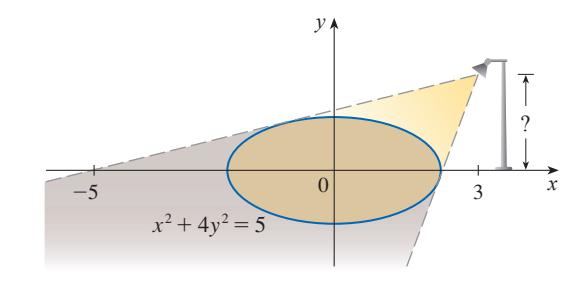
(No answer submitted)
Answer
The lamp is at \((3, h)\). The shadow edge passes through \((-5, 0)\) tangent to the ellipse \(x^2 + 4y^2 = 5\). Find the tangent line from \((-5, 0)\) to the ellipse, then determine \(h\) so the line from \((3, h)\) through the tangent point reaches \((-5, 0)\).
Compare with the answer above and grade yourself:
No explanation