Stewart 9th Section 2.6: Implicit Differentiation

65 questions

0 / 65
Stewart 9th Section 2.6: Implicit Differentiation 0/65
1 Implicit Diff - Basic · Level 2
(a) Find \(y'\) by implicit differentiation.
(b) Solve the equation explicitly for \(y\) and differentiate to get \(y'\) in terms of \(x\).
(c) Check that your solutions to parts (a) and (b) are consistent by substituting the expression for \(y\) into your solution for part (a). \(5x^2 - y^3 = 7\)

Enter your answer directly below each part above.

2 Implicit Diff - Basic · Level 2
(a) Find \(y'\) by implicit differentiation.
(b) Solve the equation explicitly for \(y\) and differentiate to get \(y'\) in terms of \(x\).
(c) Check that your solutions to parts (a) and (b) are consistent by substituting the expression for \(y\) into your solution for part (a). \(6x^4 + y^5 = 2x\)

Enter your answer directly below each part above.

3 Implicit Diff - Basic · Level 2
(a) Find \(y'\) by implicit differentiation.
(b) Solve the equation explicitly for \(y\) and differentiate to get \(y'\) in terms of \(x\).
(c) Check that your solutions to parts (a) and (b) are consistent by substituting the expression for \(y\) into your solution for part (a). \(\sqrt{x} + \sqrt{y} = 1\)

Enter your answer directly below each part above.

4 Implicit Diff - Basic · Level 2
(a) Find \(y'\) by implicit differentiation.
(b) Solve the equation explicitly for \(y\) and differentiate to get \(y'\) in terms of \(x\).
(c) Check that your solutions to parts (a) and (b) are consistent by substituting the expression for \(y\) into your solution for part (a). \(\dfrac{2}{x} - \dfrac{1}{y} = 4\)

Enter your answer directly below each part above.

5 Implicit Diff - Intermediate · Level 3
\( x^2 - 4x y + y^2 = 4 \)
6 Implicit Diff - Intermediate · Level 3
\( 2x^2 + x y - y^2 = 2 \)
7 Implicit Diff - Intermediate · Level 3
\( x^4 + x^2 y^2 + y^3 = 5 \)
8 Implicit Diff - Intermediate · Level 3
\( x^3 - x y^2 + y^3 = 1 \)
9 Implicit Diff - Intermediate · Level 3
\( \dfrac{x^2}{x + y} = y^2 + 1 \)
10 Implicit Diff - Intermediate · Level 3
\( y^5 + x^2 y^3 = 1 + x^4 y \)
11 Implicit Diff - Intermediate · Level 3
\( \sin x + \cos y = 2x - 3y \)
12 Implicit Diff - Intermediate · Level 3
\( y \sin(x^2) = x \sin(y^2) \)
13 Implicit Diff - Intermediate · Level 3
\( \sin(x + y) = \cos x + \cos y \)
14 Implicit Diff - Intermediate · Level 3
\( \tan(x - y) = 2x y^3 + 1 \)
15 Implicit Diff - Intermediate · Level 3
\( \tan\left(\dfrac{x}{y}\right) = x + y \)
16 Implicit Diff - Intermediate · Level 3
\( \sin(x y) = \cos(x + y) \)
17 Implicit Diff - Intermediate · Level 3
\( \sqrt{x + y} = x^4 + y^4 \)
18 Implicit Diff - Intermediate · Level 3
\( \sin x \cos y = x^2 - 5y \)
19 Implicit Diff - Intermediate · Level 3
\( \sqrt{x y} = 1 + x^2 y \)
20 Implicit Diff - Intermediate · Level 3
\( x y = \sqrt{x^2 + y^2} \)
21 Implicit Diff - Given Values · Level 3
If \(f(x) + x^2 [f(x)]^3 = 10\) and \(f(1) = 2\), find \(f'(1)\).
22 Implicit Diff - Given Values · Level 3
If \(g(x) + x \sin g(x) = x^2\), find \(g'(0)\).
23 Implicit Diff - dx/dy · Level 3
Regard \(y\) as the independent variable and \(x\) as the dependent variable and use implicit differentiation to find \(\dfrac{d x}{d y}\). \(x^4 y^2 - x^3 y + 2x y^3 = 0\)
24 Implicit Diff - dx/dy · Level 3
Regard \(y\) as the independent variable and \(x\) as the dependent variable and use implicit differentiation to find \(\dfrac{d x}{d y}\). \(y \sec x = x \tan y\)
25 Implicit Diff - Tangent Lines · Level 3
\(y \sin 2x = x \cos 2y\), \(\quad \left(\dfrac{\pi}{2}, \dfrac{\pi}{4}\right)\)
26 Implicit Diff - Tangent Lines · Level 3
\(\tan(x + y) + \sec(x - y) = 2\), \(\quad \left(\dfrac{\pi}{8}, \dfrac{\pi}{8}\right)\)
27 Implicit Diff - Tangent Lines · Level 3
\(x^{\dfrac{2}{3}} + y^{\dfrac{2}{3}} = 4\), \(\quad (-3\sqrt{3}, 1)\) (astroid)
28 Implicit Diff - Tangent Lines · Level 3
\(y^2(6 - x) = x^3\), \(\quad (2, \sqrt{2})\) (cissoid of Diocles)
29 Implicit Diff - Tangent Lines · Level 3
\(x^2 - x y - y^2 = 1\), \(\quad (2, 1)\) (hyperbola)
30 Implicit Diff - Tangent Lines · Level 3
\(x^2 + 2x y + 4y^2 = 12\), \(\quad (2, 1)\) (ellipse)
31 Implicit Diff - Tangent Lines · Level 4
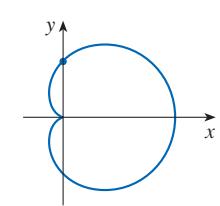
\(x^2 + y^2 = (2x^2 + 2y^2 - x)^2\), \(\quad \left(0, \dfrac{1}{2}\right)\) (cardioid)
question image
32 Implicit Diff - Tangent Lines · Level 4
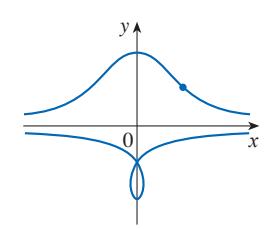
\(x^2 y^2 = (y + 1)^2(4 - y^2)\), \(\quad (2\sqrt{3}, 1)\) (conchoid of Nicomedes)
question image
33 Implicit Diff - Tangent Lines · Level 4
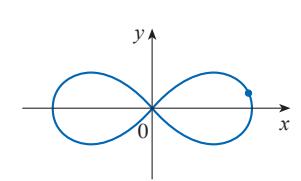
\(2(x^2 + y^2)^2 = 25(x^2 - y^2)\), \(\quad (3, 1)\) (lemniscate)
question image
34 Implicit Diff - Tangent Lines · Level 4
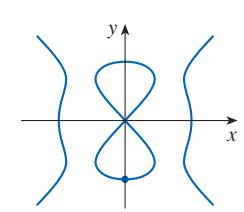
\(y^2(y^2 - 4) = x^2(x^2 - 5)\), \(\quad (0, -2)\) (devil's curve)
question image
35 Implicit Diff - Tangent Lines · Level 3
(a) The curve with equation \(y^2 = 5x^4 - x^2\) is called a kampyle of Eudoxus. Find an equation of the tangent line to this curve at the point \((1, 2)\).
(b) Illustrate part (a) by graphing the curve and the tangent line on a common screen.

Enter your answer directly below each part above.

36 Implicit Diff - Tangent Lines · Level 3
(a) The curve with equation \(y^2 = x^3 + 3x^2\) is called a Tschirnhausen cubic. Find an equation of the tangent line to this curve at the point \((1, -2)\).
(b) At what points does this curve have horizontal tangents?
(c) Illustrate parts (a) and (b) by graphing the curve and the tangent lines on a common screen.

Enter your answer directly below each part above.

37 Implicit Diff - Second Derivative · Level 4
Find \(y''\) by implicit differentiation. Simplify where possible. \(x^2 + 4y^2 = 4\)
38 Implicit Diff - Second Derivative · Level 4
Find \(y''\) by implicit differentiation. Simplify where possible. \(x^2 + x y + y^2 = 3\)
39 Implicit Diff - Second Derivative · Level 4
Find \(y''\) by implicit differentiation. Simplify where possible. \(\sin y + \cos x = 1\)
40 Implicit Diff - Second Derivative · Level 4
Find \(y''\) by implicit differentiation. Simplify where possible. \(x^3 - y^3 = 7\)
41 Implicit Diff - Second Derivative · Level 4
If \(x y + y^3 = 1\), find the value of \(y''\) at the point where \(x = 0\).
42 Implicit Diff - Second Derivative · Level 4
If \(x^2 + x y + y^3 = 1\), find the value of \(y'''\) at the point where \(x = 1\).
43 Implicit Diff - Curves · Level 4
Fanciful shapes can be created by using the implicit plotting capabilities of computer algebra systems.
(a) Graph the curve with equation \(y(y^2 - 1)(y - 2) = x(x - 1)(x - 2)\). At how many points does this curve have horizontal tangents? Estimate the \(x\)-coordinates of these points.
(b) Find equations of the tangent lines at the points \((0, 1)\) and \((0, 2)\).
(c) Find the exact \(x\)-coordinates of the points in part (a).
(d) Create even more fanciful curves by modifying the equation in part (a).

Enter your answer directly below each part above.

44 Implicit Diff - Curves · Level 4
(a) The curve with equation \(2y^3 + y^2 - y^5 = x^4 - 2x^3 + x^2\) has been likened to a bouncing wagon. Use a computer algebra system to graph this curve and discover why.
(b) At how many points does this curve have horizontal tangent lines? Find the \(x\)-coordinates of these points.

Enter your answer directly below each part above.

45 Implicit Diff - Curves · Level 4
Find the points on the lemniscate in Exercise 33 where the tangent is horizontal.
46 Implicit Diff - Ellipse/Hyperbola · Level 4
Show that the tangent line to the ellipse \( \dfrac{x^2}{a^2} + \dfrac{y^2}{b^2} = 1 \) at the point \((x_0, y_0)\) has the equation \( \dfrac{x_0 x}{a^2} + \dfrac{y_0 y}{b^2} = 1 \)
47 Implicit Diff - Ellipse/Hyperbola · Level 4
Find an equation of the tangent line to the hyperbola \( \dfrac{x^2}{a^2} - \dfrac{y^2}{b^2} = 1 \) at the point \((x_0, y_0)\).
48 Implicit Diff - Ellipse/Hyperbola · Level 4
Show that the sum of the \(x\)- and \(y\)-intercepts of any tangent line to the curve \(\sqrt{x} + \sqrt{y} = \sqrt{c}\) is equal to \(c\).
49 Implicit Diff - Geometry · Level 3
Show that the tangent line to the circle \(x^2 + y^2 = r^2\) at the point \(P(x_0, y_0)\) is perpendicular to the radius \(O P\).
50 Implicit Diff - Geometry · Level 4
The Power Rule can be proved using implicit differentiation for the case where \(n\) is a rational number, \(n = \dfrac{p}{q}\), and \(y = f(x) = x^n\) is assumed beforehand to be a differentiable function. If \(y = x^{\dfrac{p}{q}}\), then \(y^q = x^p\). Use implicit differentiation to show that \( y' = \dfrac{p}{q} x^{\dfrac{p}{q} - 1} \)
51 Implicit Diff - Orthogonal Trajectories · Level 4
Two curves are orthogonal if their tangent lines are perpendicular at each point of intersection. Show that the given families of curves are orthogonal trajectories of each other; that is, every curve in one family is orthogonal to every curve in the other family. Sketch both families of curves on the same axes. \(x^2 + y^2 = r^2\), \(\quad a x + b y = 0\)
52 Implicit Diff - Orthogonal Trajectories · Level 4
Show that the given families of curves are orthogonal trajectories of each other. \(x^2 + y^2 = a x\), \(\quad x^2 + y^2 = b y\)
53 Implicit Diff - Orthogonal Trajectories · Level 4
Show that the given families of curves are orthogonal trajectories of each other. \(y = c x^2\), \(\quad x^2 + 2y^2 = k\)
54 Implicit Diff - Orthogonal Trajectories · Level 4
Show that the given families of curves are orthogonal trajectories of each other. \(y = a x^3\), \(\quad x^2 + 3y^2 = b\)
55 Implicit Diff - Orthogonal Trajectories · Level 5
Show that the families of ellipses and hyperbolas \( \dfrac{x^2}{a^2} + \dfrac{y^2}{b^2} = 1, \quad \dfrac{x^2}{A^2} - \dfrac{y^2}{B^2} = 1 \) are orthogonal trajectories of each other if \(a^2 < A^2\) and \(a^2 - b^2 = A^2 + B^2\) (so that the conics have the same foci).
56 Implicit Diff - Orthogonal Trajectories · Level 4
Find the value of the number \(a\) such that the families of curves \(y = (x + c)^{-1}\) and \(y = a(x + k)^{\dfrac{1}{3}}\) are orthogonal trajectories of each other.
57 Implicit Diff - Applied/Proof · Level 4
The Van der Waals equation for \(n\) moles of a gas is \( \left(P + \dfrac{n^2 a}{V^2}\right)(V - n b) = n R T \) where \(P\) is the pressure, \(V\) is the volume, and \(T\) is the temperature of the gas. The constant \(R\) is the universal gas constant and \(a\) and \(b\) are positive constants that are characteristic of a particular gas.
(a) Use implicit differentiation to find \(\dfrac{d V}{d P}\).
(b) Find \(\dfrac{d V}{d P}\) for carbon dioxide at a specific volume and pressure.

Enter your answer directly below each part above.

58 Implicit Diff - Applied/Proof · Level 4
(a) The equation \(x^2 + x y + y^2 + 1 = 0\) is an implicit curve. Use implicit differentiation to find \(y'\).
(b) Plot the curve in part (a). What do you see? Prove it.
(c) Comment on the result of part (a) in light of part (b).

Enter your answer directly below each part above.

59 Implicit Diff - Applied/Proof · Level 4
The equation \(x^2 - x y + y^2 = 3\) represents a rotated ellipse, that is, an ellipse whose axes are not parallel to the coordinate axes. Find the points at which this ellipse crosses the \(x\)-axis and show that the tangent lines at these points are parallel.
60 Implicit Diff - Applied/Proof · Level 4
(a) Where does the normal line to the ellipse \(x^2 - x y + y^2 = 3\) at the point \((-1, 1)\) intersect the ellipse a second time?
(b) Illustrate part (a) by graphing the ellipse and the normal line.

Enter your answer directly below each part above.

61 Implicit Diff - Applied/Proof · Level 4
Find all points on the curve \(x^2 y^2 + x y = 2\) where the slope of the tangent line is \(-1\).
62 Implicit Diff - Applied/Proof · Level 4
Find equations of both tangent lines to the ellipse \(x^2 + 4y^2 = 36\) that pass through the point \((12, 3)\).
63 Implicit Diff - Applied/Proof · Level 4
Use implicit differentiation to find \(\dfrac{d y}{d x}\) for the equation \(\dfrac{x}{y} = y^2 + 1\) (where \(y \neq 0\)). Then show that you get the same answer when you perform implicit differentiation on the equivalent equation \(x = y^3 + y\) (where \(y \neq 0\)).
64 Implicit Diff - Applied/Proof · Level 4
The Bessel function of order 0, \(y = J(x)\), satisfies the differential equation \(x y'' + y' + x y = 0\) for all values of \(x\) and its value at 0 is \(J(0) = 1\).
(a) Find \(J'(0)\).
(b) Use implicit differentiation of the differential equation to find \(J''(0)\).

Enter your answer directly below each part above.

65 Implicit Diff - Applied/Proof · Level 4
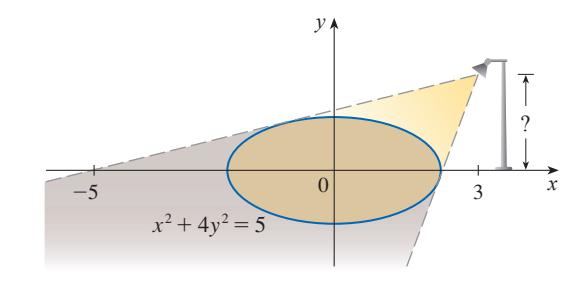
A lamp is located three units to the right of the \(y\)-axis and a shadow is created by the elliptical region \(x^2 + 4y^2 \leq 5\). If the point \((-5, 0)\) is on the edge of the shadow, how far above the \(x\)-axis is the lamp?
question image

Answered: 0 / 65