Exam Complete
|
TMUA 2022 Paper 1
0.0%
0/20
Topic Breakdown
Integration
Weak
0/3 · 0%
Plane Geometry
Weak
0/3 · 0%
Sequences and Series
Weak
0/2 · 0%
Algebraic Manipulations
Weak
0/2 · 0%
Functions and Their Graphs
Weak
0/2 · 0%
Curve Sketching
Weak
0/2 · 0%
Trigonometric Equations
Weak
0/1 · 0%
Coordinate Geometry
Weak
0/1 · 0%
Exponentials and Logarithms
Weak
0/1 · 0%
Differentiation
Weak
0/1 · 0%
Equations
Weak
0/1 · 0%
Counting and Probabilities
Weak
0/1 · 0%
Target your weak topics with focused practice.
Practice weak topics →Results by Question
1
Trigonometric Equations
Wrong
How many real solutions are there to the equation
\(2 \cos^4 \theta - 5 \cos^2 \theta + 3 = 0\)
in the interval \(0 \leq \theta \leq 2 \pi\) ?
A
1
B
2
3
Correct Answer
D
4
E
5
F
6
G
7
H
8
Explanation
This equation is a quadratic in \(\cos^2 \theta\), and it factorises as
$
(2cos^2 theta - 3)(cos^2 theta -
1) = 0. $ Therefore \(2\cos^4 \theta - 5\cos^2 \theta + 3 = 0\) if and only if \(\cos^2 \theta = \dfrac{3}{2}\) or \(\cos^2 \theta = 1\). The first equation has no real solutions, so the original equation holds if and only if \(\cos^2 \theta = 1\), or \(\cos \theta = \pm 1\). \(\cos \theta = 1\) has the solutions \(\theta = 0\) and \(\theta = 2\pi\) in the interval \(0 \leq \theta \leq 2\pi\), and \(\cos \theta = -1\) has the solution \(\theta = \pi\) in this interval. Therefore the original equation has three real solutions in the interval, and the correct option is C.
1) = 0. $ Therefore \(2\cos^4 \theta - 5\cos^2 \theta + 3 = 0\) if and only if \(\cos^2 \theta = \dfrac{3}{2}\) or \(\cos^2 \theta = 1\). The first equation has no real solutions, so the original equation holds if and only if \(\cos^2 \theta = 1\), or \(\cos \theta = \pm 1\). \(\cos \theta = 1\) has the solutions \(\theta = 0\) and \(\theta = 2\pi\) in the interval \(0 \leq \theta \leq 2\pi\), and \(\cos \theta = -1\) has the solution \(\theta = \pi\) in this interval. Therefore the original equation has three real solutions in the interval, and the correct option is C.
2
Coordinate Geometry
Wrong
Find the complete set of values of \(p\) for which the equation
\(x^2 - 2 p x + y^2 - 6 y - p^2 + 8 p + 9 = 0\)
describes a circle in the \(x y\)-plane.
A
\(p < -\dfrac{9}{4}\)
B
\(0 < p < 4\)
C
\(-1 < p < 9\)
\(p < 0\) or \(p > 4\)
Correct Answer
E
\(p < -1\) or \(p > 9\)
F
all real values of \(p\)
Explanation
We rewrite the equation in completed square form: starting from
$
x^2 - 2p x + y^2 - 6y - p^2 + 8p + 9 = 0,
$
completing the square for \(x\) and \(y\) gives
$
(x-p)^2 - p^2 + (y-3)^2 - 9 - p^2 + 8p + 9 = 0,
$
which simplifies to
$
(x-p)^2 + (y-3)^2 - 2p^2 + 8p = 0
$
or
$
(x-p)^2 + (y-3)^2 = 2p^2 - 8p.
$
This is a circle with squared radius \(2p^2 - 8p\), as long as this is positive. So the complete set of values of \(p\) for which the original equation describes a circle in the \(x y\)-plane are those for which \(2p^2 - 8p > 0\), or \(p^2 - 4p > 0\).
This factorises as \(p(p - 4) > 0\), which has roots \(p = 0\), \(p = 4\), so the complete set of values in which the inequality holds is \(p < 0\) or \(p > 4\), which is option D.
3
Integration
Wrong
Given the following statements about a function f
- \(f''(x) = a\) for all \(x\)
- \(f(0) = 1\), \(f(1) = 2\)
find the value of \(a\).
A
\(-6\)
B
\(-3\)
C
\(-2\)
D
\(2\)
E
\(3\)
\(6\)
Correct Answer
Explanation
Using the first statement, \(f''(x) = a\) for all \(x\), we can integrate to get \(f'(x) = a x + b\) for some constant \(b\), and a further integration gives \(f(x) = \dfrac{1}{2} a x^2 + b x + c\) for some constant \(c\).
The second statement then yields \(f(0) = c = 1\) and \(f(1) = \dfrac{1}{2} a + b + 1 = 2\), so \(a + 2b = 2\).
Finally, we can now use the third statement:
$
integral_0^1 f(x) dx = [1/6 a x^3 + 1/2 b x^2 + x]_0^1
$
$
= 1/6 a + 1/2 b + 1
$
$
= 1
$
so that \(a + 3b = 0\).
Combining the simultaneous equations
$
a + 2b = 2
$
$
a + 3b = 0
$
gives \(b = -2\) and \(a = 6\), so the correct answer is option F.
4
Plane Geometry
Wrong
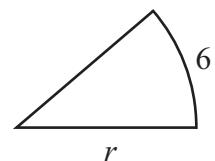
These sectors of circles are similar.
The arc length of the smaller sector is 6.
The difference between the areas of the sectors is 21.
Find the positive difference between the perimeters of the sectors.
A
4.5
B
7
8
Correct Answer
D
9
E
10.5
F
14
G
15
Explanation
Suppose that the angle of the sector is \(\theta\) (in radians). Then the arc length of the smaller sector is \(r \theta\) and the area is \(\dfrac{1}{2} r^2 \theta\).
For the smaller sector, this gives \(r \theta = 6\), so \(\theta = \dfrac{6}{r}\). Therefore the area is \(\dfrac{1}{2} r^2 \left(\dfrac{6}{r}\right) = 3r\).
Likewise, since the larger sector has the same angle as the smaller one, its arc length is \((r+3)\left(\dfrac{6}{r}\right)\) and its area is \(\dfrac{1}{2} (r + 3)^2 \left(\dfrac{6}{r}\right) = 3(r + 3)^2/r\).
We are told the difference between the areas, so we have
$
(3(r+3)^2)/r - 3r = 21.
$
Multiplying this by \(r\) and rearranging gives
$
3(r+3)^2 - 3r^2 - 21r = 0
$
which we can expand and simplify to give
$
-3r + 27 = 0,
$
so \(r = 9\).
We can now calculate the arc length of the larger sector; it is \((r + 3)\left(\dfrac{6}{r}\right) = 8\).
Therefore, the perimeter of the first sector is \(2r + 6 = 24\) and the perimeter of the second sector is \(2(r + 3) + 8 = 32\). The positive difference is 8, which is option C.
5
Sequences and Series
Wrong
The terms \(x_n\) of a sequence follow the rule
\(x_{n+1} = \dfrac{x_n + p}{x_n + q}\)
where \(p\) and \(q\) are real numbers.
Given that \(x_1 = 3\), \(x_2 = 5\), and \(x_3 = 7\), find the value of \(x_4\)
A
\(-5\)
B
\(5\)
C
\(\dfrac{51}{7}\)
D
\(\dfrac{15}{2}\)
E
\(\dfrac{23}{3}\)
F
\(9\)
G
\(11\)
\(13\)
Correct Answer
Explanation
We write out the formulae for \(x_2\), \(x_3\) and \(x_4\) in terms of \(p\) and \(q\), using the values \(x_1 = 3\), \(x_2 = 5\) and \(x_3 = 7\):
$
n = 1: quad 5 = (3+p)/(3+q)
$
$
n = 2: quad 7 = (5+p)/(5+q)
$
$
n = 3: quad x_4 = (7+p)/(7+q)
$
Multiplying the first equation by \(3 + q\) and the second by \(5 + q\) gives
$
15 + 5q = 3 + p
$
$
35 + 7q = 5 + p
$
These are simultaneous equations for \(p\) and \(q\); subtracting gives \(20 + 2q = 2\) so \(q = -9\) and therefore \(p = -33\).
Substituting these into the expression for \(x_4\) gives
$
x_4 = (7 - 33)/(7 -
9) = 13 $ so the answer is option H.
9) = 13 $ so the answer is option H.
6
Integration
Wrong
Given that
\(\displaystyle\int_{\log_2 5}^{\log_2 20} x d x = \log_2 M\)
what is the value of \(M\)?
A
4
B
15
C
16
D
20
E
25
100
Correct Answer
G
10000
Explanation
We calculate the integral and use the laws of logarithms; we obtain
$
integral_(log_2 5)^(log_2 20) x dx = [1/2 x^2]_(log_2 5)^(log_2 20)
$
$
= 1/2(log_2 20)^2 - 1/2(log_2 5)^2
$
$
= 1/2((log_2 20)^2 - (log_2 5)^2)
$
$
= 1/2((log_2 4 + log_2 5)^2 - (log_2 5)^2)
$
$
= 1/2((2 + log_2 5)^2 - (log_2 5)^2)
$
$
= 1/2(4 + 4log_2 5 + (log_2 5)^2 - (log_2 5)^2)
$
$
= 1/2(4 + 4log_2
5) $ $ = 2 + 2log_2 5 $ $ = log_2 4 + log_2 25 $ $ = log_2 100 $ so the answer is option F.
5) $ $ = 2 + 2log_2 5 $ $ = log_2 4 + log_2 25 $ $ = log_2 100 $ so the answer is option F.
7
Integration
Wrong
Find the finite area enclosed between the line \(y = 0\) and the curve \(y = x^2 - 4 |x| - 12\)
A
\(\dfrac{128}{3}\)
B
\(\dfrac{176}{3}\)
C
\(\dfrac{256}{3}\)
D
\(108\)
\(144\)
Correct Answer
F
\(288\)
Explanation
The line \(y = 0\) is the \(x\)-axis; the curve \(y = x^2 - 4|x| - 12\) is \(y = x^2 - 4x - 12\) when \(x \geq 0\) and \(y = x^2 + 4x - 12\) when \(x < 0\), so we sketch these two graphs.
The curve \(y = x^2 - 4x - 12 = (x - 6)(x + 2)\) intersects the \(x\)-axis at \(x = 6\) and \(x = -2\) and has a minimum half way between them, at \(x = 2\). Since we are only considering \(x \geq 0\), we only observe one point of intersection with the \(x\)-axis.
Similarly, the curve \(y = x^2 + 4x - 12 = (x + 6)(x - 2)\) intersects the \(x\)-axis at \(x = -6\) and \(x = 2\) and has a minimum half way between them, at \(x = -2\). Since we are only considering \(x < 0\), we only observe one point of intersection with the \(x\)-axis.
We can now sketch the graph, where we have shown the parts of the quadratics we are not using as dashed lines:
The finite area enclosed between the \(x\)-axis and the graph \(y = x^2 - 4|x| - 12\) is therefore between \(x = -6\) and \(x = 6\). We could calculate the integrals of the two quadratics, one between \(x = -6\) and \(x = 0\) and the other between \(x = 0\) and \(x = 6\). But we could also notice that the graph is symmetrical about the \(y\)-axis, so we only need to find one of these and double the answer.
We have
$
integral_0^6 x^2 - 4x - 12 dx = [x^3/3 - 2x^2 - 12x]_0^6
$
$
= 6^3/3 - 2 times 6^2 - 12 times 6 - 0
$
$
= -72
$
so \(\displaystyle\int_{-6}^6 x^2 - 4|x| - 12 dx = -144\) and the (unsigned) area required is 144, which is option E.
8
Sequences and Series
Wrong
A geometric sequence has first term \(a\) and common ratio \(r\), where \(a\) and \(r\) are positive integers and \(r\) is greater than 1.
The sum of the first \(n\) terms of this sequence is denoted by \(S_n\)
It is given that the terms of the sequence satisfy
\(S_30 - S_20 = k S_10\)
for some positive integer \(k\).
What is the smallest possible value of \(k\) ?
A
\(2^{10}\)
\(2^{20}\)
Correct Answer
C
\(2^{30}\)
D
\(\dfrac{2^{10}}{2^{10} - 1}\)
E
\(2^{10} (2^{10} - 1)\)
Explanation
We use the formula \(S_n = \dfrac{a(r^n - 1)}{r - 1}\) and substitute into the given equation:
$
(a(r^(30) - 1))/(r-1) - (a(r^(20) - 1))/(r-1) = k (a(r^(10)-1))/(r-1).
$
We can multiply this by \(r - 1\) and divide by \(a\) to get
$
(r^(30) -
1) - (r^(20) -
1) = k(r^(10) - 1), $ which simplifies to $ r^(30) - r^(20) = k(r^(10) - 1). $ Factorising the left hand side then gives $ r^(20)(r^(10) -
1) = k(r^(10) - 1); $ as \(r > 1\), we can divide by \(r^{10} - 1 \neq 0\) to obtain $ r^(20) = k. $ Therefore \(k\) is a 20th power, and the smallest possible value is \(2^{20}\), which is option B.
1) - (r^(20) -
1) = k(r^(10) - 1), $ which simplifies to $ r^(30) - r^(20) = k(r^(10) - 1). $ Factorising the left hand side then gives $ r^(20)(r^(10) -
1) = k(r^(10) - 1); $ as \(r > 1\), we can divide by \(r^{10} - 1 \neq 0\) to obtain $ r^(20) = k. $ Therefore \(k\) is a 20th power, and the smallest possible value is \(2^{20}\), which is option B.
9
Algebraic Manipulations
Wrong
This question is about pairs of functions f and g that satisfy
\(f(x) - g(x) = 2 \sin x\)
\(f(x) g(x) = \cos^2 x\)
for all real numbers \(x\).
Across all solutions for \(f(x)\), what is the minimum value that \(f(x)\) attains for any \(x\)?
A
\(1 - \sqrt{2}\)
B
\(-1 - \sqrt{2}\)
C
\(0\)
D
\(-1\)
\(-2\)
Correct Answer
F
\(-3\)
G
\(-4\)
Explanation
It may well require reading this question a couple of times to understand what it is asking! It seems like we need to find all possible functions \(f(x)\) and \(g(x)\), then for each one, to find the minimum value that \(f(x)\) takes, and then to find the minimum of all the minima. There might, of course, be some shortcuts!
Let us try to solve the equations to find \(f(x)\). The first equation rearranges to give \(g(x) = f(x) - 2\sin x\), so we can substitute this into the second equation to give
$
f(x)(f(x) - 2sin
x) = cos^2
x. $ This is a quadratic in \(f(x)\), so we can rearrange it into the standard form and use the quadratic formula: $ (f(x))^2 - (2sin x)f(x) - cos^2 x = 0, $ hence $ f(x) = (2sin x plus.minus sqrt(4sin^2 x + 4cos^2 x))/2 $ $ = sin x plus.minus 1. $ So there are two possible functions \(f(x)\), namely \(f(x) = \sin x + 1\) and \(f(x) = \sin x - 1\). The minimum value taken by these for any \(x\) is 0 for the first function and \(-2\) for the second, so the minimum possible value is \(-2\), which is option E.
x) = cos^2
x. $ This is a quadratic in \(f(x)\), so we can rearrange it into the standard form and use the quadratic formula: $ (f(x))^2 - (2sin x)f(x) - cos^2 x = 0, $ hence $ f(x) = (2sin x plus.minus sqrt(4sin^2 x + 4cos^2 x))/2 $ $ = sin x plus.minus 1. $ So there are two possible functions \(f(x)\), namely \(f(x) = \sin x + 1\) and \(f(x) = \sin x - 1\). The minimum value taken by these for any \(x\) is 0 for the first function and \(-2\) for the second, so the minimum possible value is \(-2\), which is option E.
10
Functions and Their Graphs
Wrong
A sequence of translations is applied to the graph of \(y = x^3\)
Which of the following graphs could be the result of this sequence of translations?
I \(\ y = x^3 - 3 x^2 + 9 x - 27\)
II \(\ y = x^3 - 9 x^2 + 27 x - 3\)
III \(\ y = 27 x^3 - 9 x^2 + x - 3\)
A
none of them
B
I only
II only
Correct Answer
D
III only
E
I and II only
F
I and III only
G
II and III only
H
I, II and III
Explanation
Any sequence of translations is equivalent to a translation in the \(x\)-direction followed by a translation in the \(y\)-direction (where the translations could be zero).
Translating \(y = x^3\) by \(a\) in the \(x\)-direction gives the graph
$
y = (x - a)^3 = x^3 - 3a x^2 + 3a^2 x - a^3.
$
Then translating by \(b\) in the \(y\)-direction gives the graph
$
y = x^3 - 3a x^2 + 3a^2 x - a^3 + b.
$
Now considering the three graphs:
- I The \(x^2\) term is \(-3x^2\), which means we require \(a = 1\). Substituting this into the above general equation gives \(y = x^3 - 3x^2 + 3x - 1 + b\), which does not match the given equation. So this is not a translation of \(y = x^3\).
- II The \(x^2\) term is \(-9x^2\), so we require \(a = 3\). Substituting gives \(y = x^3 - 9x^2 + 27x - 27 + b\), which matches the equation with \(b = 24\), so this is a translation of \(y = x^3\).
- III The \(x^3\) term does not match here, so this is not a translation of \(y = x^3\).
Therefore the answer is option C, II only.
11
Exponentials and Logarithms
Wrong
Evaluate
\(\displaystyle\sum_{n=1}^{100} \log_10 (3^{1-n})\)
\(-4950 \log_10 3\)
Correct Answer
B
\(4950 \log_10 3\)
C
\(-5050 \log_10 3\)
D
\(5050 \log_10 3\)
E
\(1 - 4950 \log_10 3\)
F
\(1 + 4950 \log_10 3\)
G
\(1 - 5050 \log_10 3\)
H
\(1 + 5050 \log_10 3\)
Explanation
We have \(\log_10(3^{1-n}) = (1-n) \log_10 3\), so the sum becomes
$
sum_(n=1)^(100) log_10(3^(1-n)) = sum_(n=1)^(100) (1-n) log_10 3
= (log_10
3) sum_(n=1)^(100) (1-n). $ Now the sum is actually an arithmetic series: expanding it gives $ sum_(n=1)^(100) (1-n) = 0 + (-1) + (-2) + ... + (-99) = -(0+1+2+...+99) = -1/2 times 100(0+99 times
1) = -4950 $ using the formula \(S_n = \dfrac{1}{2} n(2a + (n-1)d)\). (Alternatively, we could have used the formula for the nth triangular number.) Therefore the original sum evaluates to \(-4950 \log_10 3\), which is option A.
3) sum_(n=1)^(100) (1-n). $ Now the sum is actually an arithmetic series: expanding it gives $ sum_(n=1)^(100) (1-n) = 0 + (-1) + (-2) + ... + (-99) = -(0+1+2+...+99) = -1/2 times 100(0+99 times
1) = -4950 $ using the formula \(S_n = \dfrac{1}{2} n(2a + (n-1)d)\). (Alternatively, we could have used the formula for the nth triangular number.) Therefore the original sum evaluates to \(-4950 \log_10 3\), which is option A.
12
Functions and Their Graphs
Wrong
A family of quadratic curves is given by
\(y_k = 2 \left(x - \dfrac{k}{2}\right)^2 + \dfrac{k^2}{2} + 4 k + 3\)
where \(k\) is any real number and \(y_k\) is a function of \(x\).
All these curves are sketched, and the point with the lowest \(y\)-coordinate among all the curves \(y_k\) is \((a, b)\).
Find the value of \(a + b\)
A
\(-1\)
B
\(-3\)
C
\(-5\)
\(-7\)
Correct Answer
E
\(-9\)
Explanation
The formula for \(y_k\) is given in completed square form. The minimum of the graph \(y = a(x-b)^2 + c\), where \(a > 0\), is at \(x = b\), and the minimum value is \(c\). Therefore the minimum of \(y_k\) is at \(\left(\dfrac{k}{2}, k^2/2 + 4k + 3\right)\).
The minimum of the minimum \(y\)-coordinates is therefore the minimum of \(k^2/2 + 4k + 3\). We can find this minimum either by completing the square or by differentiating this with respect to \(k\). Let us use the latter method here as it seems simpler. We have
$
frac(d, dk)(k^2/2 + 4k +
3) = k + 4 $ so the minimum occurs at \(k = -4\), giving $ (k/2, k^2/2 + 4k +
3) = (-2, -5) $ so that \(a + b = -7\), which is option D.
3) = k + 4 $ so the minimum occurs at \(k = -4\), giving $ (k/2, k^2/2 + 4k +
3) = (-2, -5) $ so that \(a + b = -7\), which is option D.
13
Algebraic Manipulations
Wrong
Given that
\(\left(a^3 + \dfrac{2}{b^3}\right) \left(\dfrac{2}{a^3} - b^3\right) = \sqrt{2}\)
where \(a\) and \(b\) are real numbers, what is the least value of \(a b\)?
\(-\sqrt{2}\)
Correct Answer
B
\(\sqrt{2}\)
C
\(-2 \sqrt{2}\)
D
\(2 \sqrt{2}\)
E
\(-\dfrac{\sqrt{2}}{2}\)
F
\(\dfrac{\sqrt{2}}{2}\)
G
\(-2^{\dfrac{1}{6}}\)
H
\(2^{\dfrac{1}{6}}\)
Explanation
Expanding the brackets gives
$
2 - a^3b^3 + 4/(a^3b^3) - 2 = sqrt(2)
$
so
$
4/(a^3b^3) - a^3b^3 = sqrt(2).
$
We are interested in the least possible value of \(ab\), so we can find the least possible value of \(a^3b^3\) and take the cube root. Let us simplify the notation by writing \(x = a^3b^3\), so \(\dfrac{4}{x} - x = \sqrt{2}\).
Multiplying by \(x\) gives a quadratic: \(4 - x^2 = \sqrt{2}x\), which we can rearrange to \(x^2 + \sqrt{2}x - 4 = 0\) and then solve using the quadratic formula:
$
x = (-sqrt(2) plus.minus sqrt(2+16))/2 = (-sqrt(2) plus.minus 3sqrt(2))/2 = -2sqrt(2) "or" sqrt(2).
$
Since we want the least possible value of \(x\), we take \(x=a^3b^3=-2\sqrt{2}=-2^{\dfrac{3}{2}}\), and so the minimum possible value of \(ab\) is \(\left(-2^{\dfrac{3}{2}}\right)^{\dfrac{1}{3}}=-2^{\dfrac{1}{2}}=-\sqrt{2}\), which is option A.
14
Plane Geometry
Wrong
A circle has centre \(O\) and radius 6.
\(P\), \(Q\) and \(R\) are points on the circumference with angle \(\text{POQ} = \dfrac{2 \pi}{3}\)
The area of the triangle \(\text{POQ}\) is \(9 \sqrt{3}\)
What is the greatest possible area of triangle \(\text{PRQ}\)?
A
\(18 + 9 \sqrt{3}\)
B
\(18 \sqrt{3}\)
C
\(27 + 9 \sqrt{3}\)
\(27 \sqrt{3}\)
Correct Answer
E
\(36 + 9 \sqrt{3}\)
F
\(36 \sqrt{3}\)
Explanation
Let us start by drawing the triangle POQ in the circle:
(We have called the angle \(2\theta\) as we will shortly want to consider half of the angle.)
We are told that the area of POQ is \(9\sqrt{3}\), so we can use the formula for the area of a triangle given two sides and the included angle to determine \(2\theta\): the area formula is \(A = \dfrac{1}{2} ab \sin C\), which in this case gives
$
1/2 times 6 times 6 times sin 2theta = 9sqrt(3)
$
so \(\sin 2\theta = \dfrac{\sqrt{3}}{2}\). Since \(2\theta \geq \dfrac{\pi}{2}\), we must have \(2\theta = \dfrac{2}{3} \pi\) (or \(120°\)).
We can now work out the length PQ by dropping a perpendicular from O to PQ:
We have \(PS = SQ = 6\sin \theta = 6\sin\left(\dfrac{1}{3} \pi\right) = 3\sqrt{3}\), so \(PQ = 6\sqrt{3}\), and we also have \(OS = 6\cos \theta = 6\cos\left(\dfrac{1}{3} \pi\right) = 3\).
We can now work out the maximum possible area of the triangle PQR. The triangle PQR looks like this:
Fixing PQ and allowing R to move, we see that the largest possible area of PQR occurs when R is as far as possible from PQ, as the area of the triangle is \(\dfrac{1}{2} \times\) base \(\times\) height. When R is at the top of the circle (in our diagram), we have this configuration:
We have \(RS = RO + OS\). Now \(RO = 6\) (it is a radius of the circle) and \(OS = 3\) as we calculated earlier, so \(RS = 9\). Therefore the maximum possible area of PQR is
$
1/2 times PQ times RS = 1/2 times 6sqrt(3) times 9 = 27sqrt(3),
$
which is option D.
15
Differentiation
Wrong
A rectangle is drawn in the region enclosed by the curves \(p\) and \(q\), where
\(p(x) = 8 - 2 x^2\)
\(q(x) = x^2 - 2\)
such that the sides of the rectangle are parallel to the \(x\)- and \(y\)-axes.
What is the maximum possible area of the rectangle?
A
\(\dfrac{26}{9}\)
B
\(\dfrac{52}{9}\)
C
\(\dfrac{4 \sqrt{6}}{3}\)
D
\(\dfrac{8 \sqrt{6}}{3}\)
E
\(4 \sqrt{2}\)
F
\(8 \sqrt{2}\)
G
\(\dfrac{20 \sqrt{10}}{9}\)
\(\dfrac{40 \sqrt{10}}{9}\)
Correct Answer
Explanation
We start by sketching the two curves to understand what is happening.
They are both quadratics. The graph of \(p\) has a maximum at \((0,8)\) and the graph of \(q\) has a minimum at \((0,-2)\). They are both symmetrical about \(x=0\) (the \(y\)-axis). It might be helpful to work out where they intersect: \(8-2x^2 = x^2-2\) implies \(3x^2 = 10\), so \(x = \sqrt{\dfrac{10}{3}}\), which is between 1.5 and 2.
For the rectangle to have the maximum possible area, it must meet the graphs at all four of its vertices.
Let us suppose that the vertices of the rectangle are at \(x = \pm a\), with \(0 < a < \sqrt{\dfrac{10}{3}}\). Then the width of the rectangle is \(2a\) and the height is \((8 - 2a^2) - (a^2 - 2) = 10 - 3a^2\). Therefore the area is \(A = 2a(10 - 3a^2) = 20a - 6a^3\).
To maximise this area, we differentiate with respect to \(a\) to find the stationary points. We have
$
frac(dA, da) = 20 - 18a^2
$
so there is a stationary point when this is zero, at \(a = \pm \sqrt{\dfrac{20}{18}} = \pm \sqrt{\dfrac{10}{9}} = \pm \dfrac{1}{3} \sqrt{10}\). We are only interested in the positive value, and this is less than \(\sqrt{\dfrac{10}{3}}\), so it is a valid value for our problem. We therefore obtain the maximum possible area: it is
$
A = 2a(10 - 3a^2) \
= 2/3 sqrt(10) (10 - 1/3 times 10) \
= 2/3 sqrt(10) times 2/3 times 10 \
= 40sqrt(10)/9
$
which is option H.
16
Equations
Wrong
The solutions to \(7 x^4 - 6 x^2 + 1 = 0\) are \(\pm \cos \theta\) and \(\pm \cos \beta\).
Which one of the following equations has solutions \(\pm \sin \theta\) and \(\pm \sin \beta\) ?
A
\(7 x^4 - 8 x^2 - 5 = 0\)
\(7 x^4 - 8 x^2 + 2 = 0\)
Correct Answer
C
\(7 x^4 - 6 x^2 - 2 = 0\)
D
\(7 x^4 - 6 x^2 + 1 = 0\)
E
\(7 x^4 + 6 x^2 - 1 = 0\)
F
\(7 x^4 + 6 x^2 + 5 = 0\)
Explanation
The given quartic can be thought of as a quadratic in \(x^2\), and as such it has roots
$
x^2 = (6 plus.minus sqrt(6^2 - 28))/14 = (3 plus.minus sqrt(2))/7.
$
Since the roots of the quartic are \(\pm \cos \theta\) and \(\pm \cos \beta\), these \(x^2\) values are the values of \(\cos^2 \theta\) and \(\cos^2 \beta\) (in some order).
Now \(\sin^2 \theta = 1 - \cos^2 \theta\) and \(\sin^2 \beta = 1 - \cos^2 \beta\), so
$
sin^2 theta, sin^2 beta = 1 - (3 plus.minus sqrt(2))/7 = (4 minus.plus sqrt(2))/7.
$
Therefore the equations \(x^2 - (4+\sqrt{2})/7 = 0\) and \(x^2 - (4-\sqrt{2})/7 = 0\) have solutions \(\pm \sin \theta\) and \(\pm \sin \beta\) (again, in some order, and \(x\) is not the same as earlier). It follows that the product of these two equations will have the four solutions \(\pm \sin \theta\) and \(\pm \sin \beta\); this equation is
$
(x^2 - (4+sqrt(2))/7)(x^2 - (4-sqrt(2))/7) = 0.
$
To obtain the form given in the question, we first expand the brackets:
$
x^4 - ((4+sqrt(2))/7 + (4-sqrt(2))/7) x^2 + (4+sqrt(2))/7 dot.op (4-sqrt(2))/7 = 0
$
then perform the surd calculations to give
$
x^4 - 8/7 x^2 + 2/7 = 0.
$
Finally, multiplying by 7 gives \(7x^4 - 8x^2 + 2 = 0\), which is option B.
17
Plane Geometry
Wrong
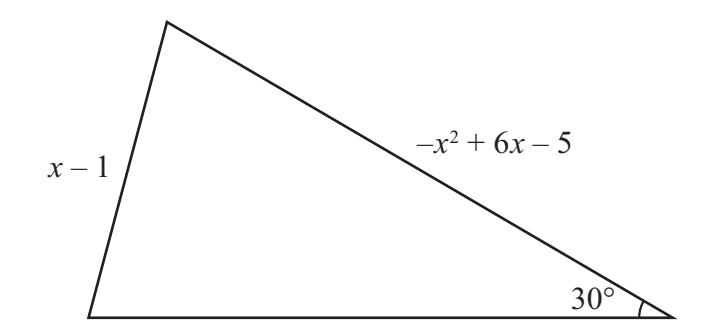
Find the complete set of values of \(x\) for which there are two non-congruent triangles with the side lengths and angle as shown in the diagram.
A
\(1 < x < 3\)
B
\(1 < x < 4\)
C
\(1 < x < 5\)
\(3 < x < 4\)
Correct Answer
E
\(3 < x < 5\)
F
\(4 < x < 5\)
Explanation
We first require that the lengths shown are both positive; \(x - 1 > 0\) if and only if \(x > 1\), and \(-x^2 + 6x - 5 = -(x-5)(x-1) > 0\) if and only if \(1 < x < 5\). Therefore we require \(1 < x < 5\) to ensure both lengths are positive.
There are two non-congruent triangles when the side marked \(x - 1\) can be drawn in two configurations:
This is possible when the following conditions are satisfied:
- \(x-1 < -x^2 + 6x-5\) (otherwise one of the possibilities will lie to the right of the \(30°\) angle in the above diagram)
- \(x - 1 > (-x^2 + 6x - 5) \sin 30°\) (so that the distance from the end of the \(-x^2 + 6x - 5\) side to the base is at least \(x - 1\), making it possible to form a triangle; if there is equality here, then the dashed circle will be tangent to the base of the triangle, and there will only be one possibility)
The first inequality rearranges as \(x^2 - 5x + 4 < 0\), which factorises as \((x-1)(x-4) < 0\), giving \(1 < x < 4\).
The second equality, using \(\sin 30° = \dfrac{1}{2}\), becomes \(2x-2 > -x^2 + 6x-5\), so \(x^2 -4x+ 3 > 0\). This factorises as \((x-1)(x-3) > 0\), so \(x < 1\) or \(x > 3\).
Requiring both of these inequalities to hold thus gives \(3 < x < 4\); this also satifies the positivity requirement we started with \((1 < x < 5)\), and so the answer is option D.
18
Curve Sketching
Wrong
It is given that
\(f(x) = x^2 (x-1)^2 (x-2)\)
\(g(x) = -p (x-q)^2 (x-r)^2\)
where \(p\), \(q\) and \(r\) are positive and \(q < r\)
Find the set of values of \(q\) and \(r\) that guarantees the greatest number of distinct real solutions of the equation \(f(x) = g(x)\) for all \(p\).
A
\(q < 1\) and \(r < 1\)
\(q < 1\) and \(1 < r < 2\)
Correct Answer
C
\(q < 1\) and \(r > 2\)
D
\(1 < q < 2\) and \(1 < r < 2\)
E
\(1 < q < 2\) and \(r > 2\)
F
\(q > 2\) and \(r > 2\)
Explanation
The equation \(f(x) = g(x)\) is a polynomial equation with degree 5, so has at most 5 distinct real solutions; we wish there to be 5 such solutions for all values of \(p\).
We would have fewer than 5 distinct real solutions if we either have a square factor of the form \((x - a)^2\) for some \(a\), or if the graph of \(y = f(x) - g(x)\) has fewer than four turning (stationary) points, or if this graph has a minimum point above the \(x\)-axis or a maximum point below it, for then it would not cross the \(x\)-axis 5 times.
Let us write
$
h(x) = f(x) - g(x) = x^2(x-1)^2(x-2) + p(x-q)^2(x-r)^2
$
We can try expanding and differentiating this, but that looks horrible. Let us think about the above description, though, remembering that there need to be 5 distinct real solutions for all values of \(p\).
The graph of \(y = f(x) = x^2(x-1)^2(x-2)\) intersects the \(x\)-axis at \(x = 0\) (where it is tangent to the axis, because it is a double root), \(x = 1\) (likewise) and \(x = 2\), and it is positive when \(x > 2\) and negative or zero when \(x < 2\), so the graph looks like this:
The graph of \(y = g(x) = -p(x-q)^2(x-r)^2\) has two points of intersection with the \(x\)-axis, one at \(x = q\) and one at \(x = r\), and at both of these points, the graph is tangent to the axis. (In the case \(q = r\), there is just one point of tangency.) The graph is entirely below or touching the \(x\)-axis as we are given that \(p > 0\). It looks like this:
If \(r > 2\), then the graph of \(y = g(x)\) will entirely miss one of the "valleys" of \(y = f(x)\) if \(p\) is large, as it will if \(r < 1\); in this case, there would be at most three points of intersection for large \(p\). So we must have \(1 < r < 2\). If \(1 < q < r\), then it will miss the left valley for large enough \(p\), so we must have \(0 < q < 1\) and \(1 < r < 2\). In this case, the graph of \(y = g(x)\) must intersect both valleys twice as \(g(1) < 0\):
This sketch shows four points of intersection, and we are looking for five. But the graph of \(y = f(x)\) tends to \(-oo\) as \(x\) tends to \(-oo\) far faster that \(y = g(x)\), regardless of the value of \(p\), as \(y = f(x)\) is a quintic but \(y = g(x)\) is only a quartic. So there will always be another point of intersection with \(x < 0\).
Hence the correct answer is option B.
Note that there is actually a small simplification in the above argument. We showed that we cannot have \(1 < q < r\) and deduced that we must have \(0 < q < 1\). But what about the possibility \(q = 1\)? In that case, there would be a double root at \(x = 1\), and so there would not be five distinct roots, hence we cannot have \(q = 1\). But what about \(r\)? We showed that we cannot have \(r > 2\) or \(r < 1\). If \(r = 1\), we have the same problem, but what about \(r = 2\) and \(0 < q < 1\)? In this case, it is still true that the equation has five distinct real solutions for all positive \(p\), as \(x = 2\) is only a single root of \(f(x) = 0\). So the full set is actually \(q < 1\) and \(1 < r \leq 2\).
19
Counting and Probabilities
Wrong
Circle \(C_1\) is defined as \(x^2 + y^2 = 25\)
A second circle \(C_2\) has radius 4 and centre \((a, b)\) where
\(-2 \leq a \leq 2\) and \(-3 \leq b \leq 3\)
If the centre of \(C_2\) is equally likely to be located anywhere within the given range, what is the probability that \(C_2\) intersects \(C_1\) ?
A
\(\dfrac{1}{25}\)
B
\(\dfrac{9}{25}\)
C
\(\dfrac{16}{25}\)
D
\(\dfrac{6 - \pi}{6}\)
E
\(\dfrac{16 - \pi}{24}\)
\(\dfrac{24 - \pi}{24}\)
Correct Answer
Explanation
Note first that the region where the centre of \(C_2\) may lie is entirely within the circle \(C_1\), as \(2^2 + 3^2 = 13 < 25\).
As the radius of \(C_1\) is 5, the circle \(C_2\) will intersect \(C_1\) if and only if the centre of \(C_2\) is at least a distance of 1 from the origin (the centre of \(C_1\)). This is because in this case, a line from the centre of \(C_1\) passing through the centre of \(C_2\) will reach the circle \(C_1\) before (or as) it reaches the circle \(C_2\), but a line from the centre of \(C_1\) in the opposite direction will reach \(C_2\) first. If, though, the centre of \(C_2\) is at a distance of less than 1 from the origin, the furthest point on \(C_2\) from the origin will be at a distance of less than \(1 + 4 = 5\) from the origin, so \(C_2\) lies entirely inside \(C_1\).
The area of the allowed \((a, b)\) region is \(4 \times 6 = 24\). The \((a, b)\) region where the circles do not intersect is a circle of radius 1, with area \(\pi\), lying entirely within the allowed region, so the region where the circles do intersect has area \(24 - \pi\).
Thus the probability of intersection is \((24 - \pi)/24\), which is option F.
20
Curve Sketching
Wrong
\(n\) is the number of points of intersection of the graphs
\(y = |x^2 - a^2|\) and \(y = a^2 |x - 1|\)
where \(a\) is a real number.
What is the smallest value of \(n\) that is **not** possible?
A
\(n = 1\)
\(n = 2\)
Correct Answer
C
\(n = 3\)
D
\(n = 4\)
E
\(n = 5\)
Explanation
The graph \(y = |x^2 - a^2|\) intersects the \(x\)-axis at \(\pm a\). The graph \(y = a^2|x - 1|\) intersects the \(x\)-axis at \(x = 1\). Replacing \(a\) with \(-a\) does not change the equations, so we may as well assume that \(a \geq 0\).
Here is a sketch of the graphs with \(a = 2\); we note that the graphs always intersect at \(x = 0\) (and \(y = a^2\) there):
We immediately see that when \(a > 1\), there will be 4 points of intersection: the graph \(y = a^2|x-1|\) is below the "hill" at \((1, 0)\), so intersects it twice as \(x\) moves away from \(x = 1\), and then intersects the quadratic \(y = x^2 - a^2\) for some \(x < -a\) and some \(x > a\) as the quadratic grows faster than the linear \(y = -a^2(x - 1)\) or \(y = a^2(x - 1)\) in these regions.
What happens when \(a = 1\)? In this case, the equations become \(y = |x^2 - 1|\) and \(y = x - 1\). The derivative of the quadratic \(y = x^2 - 1\) is \(2x\), so the gradient is just over 2 when \(x\) is just over 1. (There is no gradient at the point \(x = 1\).) Therefore the graph looks like this:
We see that we have lost one point of intersection: there are now only three points of intersection.
What happens if \(0 < a < 1\)? Now the vertex of \(y = a^2|x-1|\) will be to the right of \(x = a\), where the quadratic meets the axis, and so there will be no points of intersection there -- the quadratic grows too quickly to meet the linear function for \(x > 1\). (To be more precise: the gradient of the quadratic to the right of \(x = a\) is \(2x > 2a > a^2\), so the quadratic will be growing faster than the linear function.)
On the left of \(x = a\), we have one point of intersection to the left of \(x = -a\) as before. There is also a point of intersection at \((0, a^2)\). Since this is the vertex of the quadratic, the linear function must go below the "hill", giving another two points of intersection, yielding four points of intersection in total:
There is one remaining case to consider: \(a = 0\). In this case, the graphs become \(y = |x^2| = x^2\) and \(y = 0\), and these graphs have a single point of intersection at the origin.
Therefore the possible numbers of points of intersection are 1, 3 and 4, and the smallest number not possible is \(n = 2\), option B.
Score History (Last 2)
0%
7/26
0%
7/29
| # | Date | Score | Accuracy | |
|---|---|---|---|---|
| Current | 2026-07-29 15:35 | 0 / 20 | 0% | |
| 2 | 2026-07-26 01:00 | 0 / 20 | 0% | View |