TMUA 2022 Paper 1

20 questions

0 / 20
TMUA 2022 Paper 1 0/20
1 Trigonometric Equations · Level 3
How many real solutions are there to the equation \(2 \cos^4 \theta - 5 \cos^2 \theta + 3 = 0\) in the interval \(0 \leq \theta \leq 2 \pi\) ?
A
1
B
2
C
3
D
4
E
5
F
6
G
7
H
8
2 Coordinate Geometry · Level 3
Find the complete set of values of \(p\) for which the equation \(x^2 - 2 p x + y^2 - 6 y - p^2 + 8 p + 9 = 0\) describes a circle in the \(x y\)-plane.
A
\(p < -\dfrac{9}{4}\)
B
\(0 < p < 4\)
C
\(-1 < p < 9\)
D
\(p < 0\) or \(p > 4\)
E
\(p < -1\) or \(p > 9\)
F
all real values of \(p\)
3 Integration · Level 3
Given the following statements about a function f - \(f''(x) = a\) for all \(x\) - \(f(0) = 1\), \(f(1) = 2\) find the value of \(a\).
A
\(-6\)
B
\(-3\)
C
\(-2\)
D
\(2\)
E
\(3\)
F
\(6\)
4 Plane Geometry · Level 3
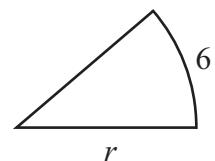
These sectors of circles are similar. The arc length of the smaller sector is 6. The difference between the areas of the sectors is 21. Find the positive difference between the perimeters of the sectors.
question image
A
4.5
B
7
C
8
D
9
E
10.5
F
14
G
15
5 Sequences and Series · Level 3
The terms \(x_n\) of a sequence follow the rule \(x_{n+1} = \dfrac{x_n + p}{x_n + q}\) where \(p\) and \(q\) are real numbers. Given that \(x_1 = 3\), \(x_2 = 5\), and \(x_3 = 7\), find the value of \(x_4\)
A
\(-5\)
B
\(5\)
C
\(\dfrac{51}{7}\)
D
\(\dfrac{15}{2}\)
E
\(\dfrac{23}{3}\)
F
\(9\)
G
\(11\)
H
\(13\)
6 Integration · Level 3
Given that \(\displaystyle\int_{\log_2 5}^{\log_2 20} x d x = \log_2 M\) what is the value of \(M\)?
A
4
B
15
C
16
D
20
E
25
F
100
G
10000
7 Integration · Level 3
Find the finite area enclosed between the line \(y = 0\) and the curve \(y = x^2 - 4 |x| - 12\)
A
\(\dfrac{128}{3}\)
B
\(\dfrac{176}{3}\)
C
\(\dfrac{256}{3}\)
D
\(108\)
E
\(144\)
F
\(288\)
8 Sequences and Series · Level 3
A geometric sequence has first term \(a\) and common ratio \(r\), where \(a\) and \(r\) are positive integers and \(r\) is greater than 1. The sum of the first \(n\) terms of this sequence is denoted by \(S_n\) It is given that the terms of the sequence satisfy \(S_30 - S_20 = k S_10\) for some positive integer \(k\). What is the smallest possible value of \(k\) ?
A
\(2^{10}\)
B
\(2^{20}\)
C
\(2^{30}\)
D
\(\dfrac{2^{10}}{2^{10} - 1}\)
E
\(2^{10} (2^{10} - 1)\)
9 Algebraic Manipulations · Level 3
This question is about pairs of functions f and g that satisfy \(f(x) - g(x) = 2 \sin x\) \(f(x) g(x) = \cos^2 x\) for all real numbers \(x\). Across all solutions for \(f(x)\), what is the minimum value that \(f(x)\) attains for any \(x\)?
A
\(1 - \sqrt{2}\)
B
\(-1 - \sqrt{2}\)
C
\(0\)
D
\(-1\)
E
\(-2\)
F
\(-3\)
G
\(-4\)
10 Functions and Their Graphs · Level 3
A sequence of translations is applied to the graph of \(y = x^3\) Which of the following graphs could be the result of this sequence of translations? I \(\ y = x^3 - 3 x^2 + 9 x - 27\) II \(\ y = x^3 - 9 x^2 + 27 x - 3\) III \(\ y = 27 x^3 - 9 x^2 + x - 3\)
A
none of them
B
I only
C
II only
D
III only
E
I and II only
F
I and III only
G
II and III only
H
I, II and III
11 Exponentials and Logarithms · Level 3
Evaluate \(\displaystyle\sum_{n=1}^{100} \log_10 (3^{1-n})\)
A
\(-4950 \log_10 3\)
B
\(4950 \log_10 3\)
C
\(-5050 \log_10 3\)
D
\(5050 \log_10 3\)
E
\(1 - 4950 \log_10 3\)
F
\(1 + 4950 \log_10 3\)
G
\(1 - 5050 \log_10 3\)
H
\(1 + 5050 \log_10 3\)
12 Functions and Their Graphs · Level 3
A family of quadratic curves is given by \(y_k = 2 \left(x - \dfrac{k}{2}\right)^2 + \dfrac{k^2}{2} + 4 k + 3\) where \(k\) is any real number and \(y_k\) is a function of \(x\). All these curves are sketched, and the point with the lowest \(y\)-coordinate among all the curves \(y_k\) is \((a, b)\). Find the value of \(a + b\)
A
\(-1\)
B
\(-3\)
C
\(-5\)
D
\(-7\)
E
\(-9\)
13 Algebraic Manipulations · Level 3
Given that \(\left(a^3 + \dfrac{2}{b^3}\right) \left(\dfrac{2}{a^3} - b^3\right) = \sqrt{2}\) where \(a\) and \(b\) are real numbers, what is the least value of \(a b\)?
A
\(-\sqrt{2}\)
B
\(\sqrt{2}\)
C
\(-2 \sqrt{2}\)
D
\(2 \sqrt{2}\)
E
\(-\dfrac{\sqrt{2}}{2}\)
F
\(\dfrac{\sqrt{2}}{2}\)
G
\(-2^{\dfrac{1}{6}}\)
H
\(2^{\dfrac{1}{6}}\)
14 Plane Geometry · Level 3
A circle has centre \(O\) and radius 6. \(P\), \(Q\) and \(R\) are points on the circumference with angle \(\text{POQ} = \dfrac{2 \pi}{3}\) The area of the triangle \(\text{POQ}\) is \(9 \sqrt{3}\) What is the greatest possible area of triangle \(\text{PRQ}\)?
A
\(18 + 9 \sqrt{3}\)
B
\(18 \sqrt{3}\)
C
\(27 + 9 \sqrt{3}\)
D
\(27 \sqrt{3}\)
E
\(36 + 9 \sqrt{3}\)
F
\(36 \sqrt{3}\)
15 Differentiation · Level 3
A rectangle is drawn in the region enclosed by the curves \(p\) and \(q\), where \(p(x) = 8 - 2 x^2\) \(q(x) = x^2 - 2\) such that the sides of the rectangle are parallel to the \(x\)- and \(y\)-axes. What is the maximum possible area of the rectangle?
A
\(\dfrac{26}{9}\)
B
\(\dfrac{52}{9}\)
C
\(\dfrac{4 \sqrt{6}}{3}\)
D
\(\dfrac{8 \sqrt{6}}{3}\)
E
\(4 \sqrt{2}\)
F
\(8 \sqrt{2}\)
G
\(\dfrac{20 \sqrt{10}}{9}\)
H
\(\dfrac{40 \sqrt{10}}{9}\)
16 Equations · Level 3
The solutions to \(7 x^4 - 6 x^2 + 1 = 0\) are \(\pm \cos \theta\) and \(\pm \cos \beta\). Which one of the following equations has solutions \(\pm \sin \theta\) and \(\pm \sin \beta\) ?
A
\(7 x^4 - 8 x^2 - 5 = 0\)
B
\(7 x^4 - 8 x^2 + 2 = 0\)
C
\(7 x^4 - 6 x^2 - 2 = 0\)
D
\(7 x^4 - 6 x^2 + 1 = 0\)
E
\(7 x^4 + 6 x^2 - 1 = 0\)
F
\(7 x^4 + 6 x^2 + 5 = 0\)
17 Plane Geometry · Level 3
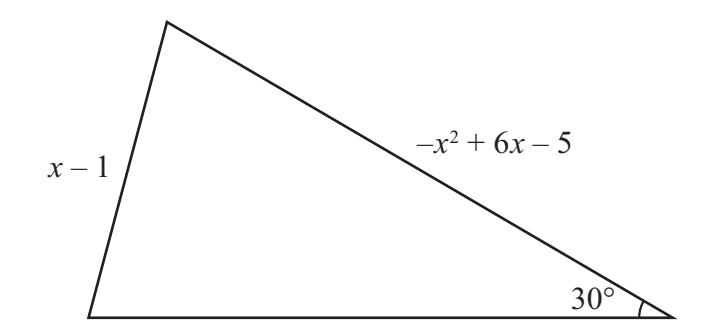
Find the complete set of values of \(x\) for which there are two non-congruent triangles with the side lengths and angle as shown in the diagram.
question image
A
\(1 < x < 3\)
B
\(1 < x < 4\)
C
\(1 < x < 5\)
D
\(3 < x < 4\)
E
\(3 < x < 5\)
F
\(4 < x < 5\)
18 Curve Sketching · Level 3
It is given that \(f(x) = x^2 (x-1)^2 (x-2)\) \(g(x) = -p (x-q)^2 (x-r)^2\) where \(p\), \(q\) and \(r\) are positive and \(q < r\) Find the set of values of \(q\) and \(r\) that guarantees the greatest number of distinct real solutions of the equation \(f(x) = g(x)\) for all \(p\).
A
\(q < 1\) and \(r < 1\)
B
\(q < 1\) and \(1 < r < 2\)
C
\(q < 1\) and \(r > 2\)
D
\(1 < q < 2\) and \(1 < r < 2\)
E
\(1 < q < 2\) and \(r > 2\)
F
\(q > 2\) and \(r > 2\)
19 Counting and Probabilities · Level 3
Circle \(C_1\) is defined as \(x^2 + y^2 = 25\) A second circle \(C_2\) has radius 4 and centre \((a, b)\) where \(-2 \leq a \leq 2\) and \(-3 \leq b \leq 3\) If the centre of \(C_2\) is equally likely to be located anywhere within the given range, what is the probability that \(C_2\) intersects \(C_1\) ?
A
\(\dfrac{1}{25}\)
B
\(\dfrac{9}{25}\)
C
\(\dfrac{16}{25}\)
D
\(\dfrac{6 - \pi}{6}\)
E
\(\dfrac{16 - \pi}{24}\)
F
\(\dfrac{24 - \pi}{24}\)
20 Curve Sketching · Level 3
\(n\) is the number of points of intersection of the graphs \(y = |x^2 - a^2|\) and \(y = a^2 |x - 1|\) where \(a\) is a real number. What is the smallest value of \(n\) that is **not** possible?
A
\(n = 1\)
B
\(n = 2\)
C
\(n = 3\)
D
\(n = 4\)
E
\(n = 5\)

Answered: 0 / 20

0 / 20