시험 완료
|
Stewart 9e Section 2.9: Linear Approximations and Differentials
0.0%
0/54
문제별 결과
1
Linearization
오답률 100%
오답
Find the linearization \(L(x)\) of the function at \(a\): \(f(x) = x^3 - x^2 + 3\), \(a = -2\).
내 답안
-2t^3/sqrt(1-t^4) dt
정답
\(L(x) = 16 x + 23\)
위 정답과 비교하여 채점하세요:
해설
\(f'(x) = 3 x^2 - 2 x\). At \(a = -2\): \(f(-2) = -8 - 4 + 3 = -9\) and \(f'(-2) = 12 + 4 = 16\). Hence \(L(x) = f(-2) + f'(-2)(x - (-2)) = -9 + 16(x + 2) = 16 x + 23\).
2
Linearization
오답률 100%
오답
Find the linearization \(L(x)\) of the function at \(a\): \(f(x) = \cos(2 x)\), \(a = \dfrac{\pi}{6}\).
(미작성)
정답
\(L(x) = \dfrac{1}{2} - \sqrt{3} \left(x - \dfrac{\pi}{6}\right)\)
위 정답과 비교하여 채점하세요:
해설
\(f\left(\dfrac{\pi}{6}\right) = \cos\left(\dfrac{\pi}{3}\right) = \dfrac{1}{2}\). \(f'(x) = -2 \sin(2 x)\), so \(f'\left(\dfrac{\pi}{6}\right) = -2 \sin\left(\dfrac{\pi}{3}\right) = -2 \left(\dfrac{\sqrt{3}}{2}\right) = -\sqrt{3}\). Hence \(L(x) = \dfrac{1}{2} - \sqrt{3}\left(x - \dfrac{\pi}{6}\right)\).
3
Linearization
오답률 100%
오답
Find the linearization \(L(x)\) of the function at \(a\): \(f(x) = \sqrt[3]{x}\), \(a = 8\).
(미작성)
정답
\(L(x) = 2 + (x - 8)/12\)
위 정답과 비교하여 채점하세요:
해설
\(f(8) = \sqrt[3]{8} = 2\). \(f'(x) = \left(\dfrac{1}{3}\right) x^{-\dfrac{2}{3}}\), so \(f'(8) = \left(\dfrac{1}{3}\right)\left(\dfrac{1}{4}\right) = \dfrac{1}{12}\). Hence \(L(x) = 2 + \left(\dfrac{1}{12}\right)(x - 8)\).
4
Linearization
오답률 100%
오답
Find the linearization \(L(x)\) of the function at \(a\): \(f(x) = \dfrac{2}{\sqrt{x^2 - 5}}\), \(a = 3\).
(미작성)
정답
\(L(x) = 1 - \left(\dfrac{3}{4}\right)(x - 3)\)
위 정답과 비교하여 채점하세요:
해설
\(f(3) = \dfrac{2}{\sqrt{4}} = 1\). Writing \(f(x) = 2(x^2 - 5)^{-\dfrac{1}{2}}\), by the chain rule \(f'(x) = 2 \cdot \left(-\dfrac{1}{2}\right)(x^2 - 5)^{-\dfrac{3}{2}}(2 x) = -2 x/(x^2 - 5)^{\dfrac{3}{2}}\). At \(x = 3\): \(f'(3) = -6/(4)^{\dfrac{3}{2}} = -\dfrac{6}{8} = -\dfrac{3}{4}\). Hence \(L(x) = 1 - \left(\dfrac{3}{4}\right)(x - 3)\).
5
Linear Approximation
오답률 100%
오답
Find the linear approximation of the function \(f(x) = \sqrt{1 - x}\) at \(a = 0\) and use it to approximate the numbers \(\sqrt{0.9}\) and \(\sqrt{0.99}\). Illustrate by graphing \(f\) and the tangent line.
(미작성)
정답
\(L(x) = 1 - \dfrac{x}{2}\); \(\sqrt{0.9} \approx 0.95\), \(\sqrt{0.99} \approx 0.995\).
위 정답과 비교하여 채점하세요:
해설
\(f(0) = 1\) and \(f'(x) = -1/(2 \sqrt{1 - x})\), so \(f'(0) = -\dfrac{1}{2}\). Hence \(L(x) = 1 - \dfrac{x}{2}\). Now \(\sqrt{0.9} = \sqrt{1 - 0.1} \approx 1 - 0.\dfrac{1}{2} = 0.95\) and \(\sqrt{0.99} = \sqrt{1 - 0.01} \approx 1 - 0.\dfrac{01}{2} = 0.995\).
6
Linear Approximation
오답률 100%
오답
Find the linear approximation of the function \(g(x) = \sqrt[3]{1 + x}\) at \(a = 0\) and use it to approximate the numbers \(\sqrt[3]{0.95}\) and \(\sqrt[3]{1.1}\). Illustrate by graphing \(g\) and the tangent line.
(미작성)
정답
\(L(x) = 1 + \dfrac{x}{3}\); \(\sqrt[3]{0.95} \approx 0.9833\), \(\sqrt[3]{1.1} \approx 1.0333\).
위 정답과 비교하여 채점하세요:
해설
\(g(0) = 1\) and \(g'(x) = \left(\dfrac{1}{3}\right)(1 + x)^{-\dfrac{2}{3}}\), so \(g'(0) = \dfrac{1}{3}\). Hence \(L(x) = 1 + \dfrac{x}{3}\). Now \(\sqrt[3]{0.95} = \sqrt[3]{1 + (-0.05)} \approx 1 - 0.\dfrac{05}{3} \approx 0.9833\) and \(\sqrt[3]{1.1} = \sqrt[3]{1 + 0.1} \approx 1 + 0.\dfrac{1}{3} \approx 1.0333\).
7
Linear Approximation Accuracy
오답률 100%
오답
Verify the given linear approximation at \(a = 0\): \(\sqrt[4]{1 + 2 x} \approx 1 + \left(\dfrac{1}{2}\right) x\). Then determine the values of \(x\) for which the linear approximation is accurate to within \(0.1\).
(미작성)
정답
Verified. Accurate within \(0.1\) for approximately \(-0.69 < x < 1.09\).
위 정답과 비교하여 채점하세요:
해설
Let \(f(x) = (1 + 2 x)^{\dfrac{1}{4}}\). Then \(f(0) = 1\) and \(f'(x) = \left(\dfrac{1}{4}\right)(1 + 2 x)^{-\dfrac{3}{4}}(2) = 1/(2 (1 + 2 x)^{\dfrac{3}{4}})\), so \(f'(0) = \dfrac{1}{2}\). Hence \(L(x) = 1 + \dfrac{x}{2}\), verifying the approximation. Graphing \(y = (1 + 2 x)^{\dfrac{1}{4}}\) and \(y = 1 + \dfrac{x}{2} \pm 0.1\) shows the linearization is within \(0.1\) of the function for approximately \(-0.69 < x < 1.09\).
8
Linear Approximation Accuracy
오답률 100%
오답
Verify the given linear approximation at \(a = 0\): \((1 + x)^{-3} \approx 1 - 3 x\). Then determine the values of \(x\) for which the linear approximation is accurate to within \(0.1\).
(미작성)
정답
Verified. Accurate within \(0.1\) for approximately \(-0.116 < x < 0.144\).
위 정답과 비교하여 채점하세요:
해설
Let \(f(x) = (1 + x)^{-3}\). Then \(f(0) = 1\) and \(f'(x) = -3 (1 + x)^{-4}\), so \(f'(0) = -3\). Hence \(L(x) = 1 - 3 x\), verifying the approximation. Solving \(|(1 + x)^{-3} - (1 - 3 x)| < 0.1\) graphically gives approximately \(-0.116 < x < 0.144\).
9
Linear Approximation Accuracy
오답률 100%
오답
Verify the given linear approximation at \(a = 0\): \(1/(1 + 2 x)^4 \approx 1 - 8 x\). Then determine the values of \(x\) for which the linear approximation is accurate to within \(0.1\).
(미작성)
정답
Verified. Accurate within \(0.1\) for approximately \(-0.045 < x < 0.055\).
위 정답과 비교하여 채점하세요:
해설
Let \(f(x) = (1 + 2 x)^{-4}\). Then \(f(0) = 1\) and \(f'(x) = -8 (1 + 2 x)^{-5}\), so \(f'(0) = -8\). Hence \(L(x) = 1 - 8 x\), verifying the approximation. Graphical analysis of \(|(1 + 2 x)^{-4} - (1 - 8 x)| < 0.1\) gives approximately \(-0.045 < x < 0.055\).
10
Linear Approximation Accuracy
오답률 100%
오답
Verify the given linear approximation at \(a = 0\): \(\tan x \approx x\). Then determine the values of \(x\) for which the linear approximation is accurate to within \(0.1\).
(미작성)
정답
Verified. Accurate within \(0.1\) for approximately \(-0.63 < x < 0.63\).
위 정답과 비교하여 채점하세요:
해설
Let \(f(x) = \tan x\). Then \(f(0) = 0\) and \(f'(x) = \sec^2 x\), so \(f'(0) = 1\). Hence \(L(x) = x\), verifying the approximation. Solving \(|\tan x - x| < 0.1\) graphically gives approximately \(-0.63 < x < 0.63\).
11
Differentials
오답률 100%
오답
Find the differential of the function: \(y = (x^2 - 3)^{-2}\).
(미작성)
정답
\(d y = -4 x/(x^2 - 3)^3 d x\)
위 정답과 비교하여 채점하세요:
해설
Using the chain rule, \(\dfrac{d y}{d x} = -2 (x^2 - 3)^{-3} (2 x) = -4 x/(x^2 - 3)^3\). Hence \(d y = -4 x/(x^2 - 3)^3 d x\).
12
Differentials
오답률 100%
오답
Find the differential of the function: \(y = \sqrt{1 - t^4}\).
(미작성)
정답
\(d y = -2 t^3/\sqrt{1 - t^4} d t\)
위 정답과 비교하여 채점하세요:
해설
Writing \(y = (1 - t^4)^{\dfrac{1}{2}}\), the chain rule gives \(\dfrac{d y}{d t} = \left(\dfrac{1}{2}\right)(1 - t^4)^{-\dfrac{1}{2}}(-4 t^3) = -2 t^3/\sqrt{1 - t^4}\). Hence \(d y = -2 t^3/\sqrt{1 - t^4} d t\).
13
Differentials
오답률 100%
오답
Find the differential of the function: \(y = \dfrac{1 + 2 u}{1 + 3 u}\).
(미작성)
정답
\(d y = -1/(1 + 3 u)^2 d u\)
위 정답과 비교하여 채점하세요:
해설
By the quotient rule, \(\dfrac{d y}{d u} = \dfrac{2 (1 + 3 u) - (1 + 2 u)(3)}{1 + 3 u}^2 = \dfrac{2 + 6 u - 3 - 6 u}{1 + 3 u}^2 = -1/(1 + 3 u)^2\). Hence \(d y = -1/(1 + 3 u)^2 d u\).
14
Differentials
오답률 100%
오답
Find the differential of the function: \(y = \theta^2 \sin(2 \theta)\).
(미작성)
정답
\(d y = (2 \theta \sin(2 \theta) + 2 \theta^2 \cos(2 \theta)) d \theta\)
위 정답과 비교하여 채점하세요:
해설
By the product and chain rules, \(\dfrac{d y}{d \theta} = 2 \theta \sin(2 \theta) + \theta^2 (2 \cos(2 \theta)) = 2 \theta \sin(2 \theta) + 2 \theta^2 \cos(2 \theta) = 2 \theta (\sin(2 \theta) + \theta \cos(2 \theta))\). Hence \(d y = 2 \theta (\sin(2 \theta) + \theta \cos(2 \theta)) d \theta\).
15
Differentials
오답률 100%
오답
Find the differential of the function: \(y = 1/(x^2 - 3 x)\).
(미작성)
정답
\(d y = \dfrac{3 - 2 x}{x^2 - 3 x}^2 d x\)
위 정답과 비교하여 채점하세요:
해설
Writing \(y = (x^2 - 3 x)^{-1}\), the chain rule gives \(\dfrac{d y}{d x} = -(x^2 - 3 x)^{-2}(2 x - 3) = \dfrac{3 - 2 x}{x^2 - 3 x}^2\). Hence \(d y = \dfrac{3 - 2 x}{x^2 - 3 x}^2 d x\).
16
Differentials
오답률 100%
오답
Find the differential of the function: \(y = \sqrt{1 + \cos \theta}\).
(미작성)
정답
\(d y = -\sin \theta/(2 \sqrt{1 + \cos \theta}) d \theta\)
위 정답과 비교하여 채점하세요:
해설
Writing \(y = (1 + \cos \theta)^{\dfrac{1}{2}}\), the chain rule gives \(\dfrac{d y}{d \theta} = \left(\dfrac{1}{2}\right)(1 + \cos \theta)^{-\dfrac{1}{2}}(-\sin \theta) = -\sin \theta/(2 \sqrt{1 + \cos \theta})\). Hence \(d y = -\sin \theta/(2 \sqrt{1 + \cos \theta}) d \theta\).
17
Differentials
오답률 100%
오답
Find the differential of the function: \(y = \sqrt{t \cos t}\).
(미작성)
정답
\(d y = \dfrac{\cos t - t \sin t}{2 \sqrt{t \cos t}} d t\)
위 정답과 비교하여 채점하세요:
해설
Writing \(y = (t \cos t)^{\dfrac{1}{2}}\) and using the chain and product rules: \(\dfrac{d y}{d t} = \left(\dfrac{1}{2}\right)(t \cos t)^{-\dfrac{1}{2}} (\cos t - t \sin t) = \dfrac{\cos t - t \sin t}{2 \sqrt{t \cos t}}\). Hence \(d y = \dfrac{\cos t - t \sin t}{2 \sqrt{t \cos t}} d t\).
18
Differentials
오답률 100%
오답
Find the differential of the function: \(y = \left(\dfrac{1}{x}\right) \sin x\).
(미작성)
정답
\(d y = (x \cos x - \sin x)/x^2 d x\)
위 정답과 비교하여 채점하세요:
해설
Writing \(y = \sin \dfrac{x}{x}\), by the quotient rule \(\dfrac{d y}{d x} = (x \cos x - \sin x)/x^2\). Hence \(d y = (x \cos x - \sin x)/x^2 d x\).
19
Differentials - Evaluation
오답률 100%
오답
Let \(y = \tan x\). (a) Find the differential \(d y\). (b) Evaluate \(d y\) for \(x = \dfrac{\pi}{4}\) and \(d x = -0.1\).
(미작성)
정답
(a) \(d y = \sec^2 x d x\). (b) \(d y = -0.2\).
위 정답과 비교하여 채점하세요:
해설
(a) \(\dfrac{d y}{d x} = \sec^2 x\), so \(d y = \sec^2 x d x\). (b) \(\sec\left(\dfrac{\pi}{4}\right) = \sqrt{2}\), so \(\sec^2\left(\dfrac{\pi}{4}\right) = 2\). Hence \(d y = 2(-0.1) = -0.2\).
20
Differentials - Evaluation
오답률 100%
오답
Let \(y = \cos(\pi x)\). (a) Find the differential \(d y\). (b) Evaluate \(d y\) for \(x = \dfrac{1}{2}\) and \(d x = -0.02\).
(미작성)
정답
(a) \(d y = -\pi \sin(\pi x) d x\). (b) \(d y = 0.02 \pi \approx 0.0628\).
위 정답과 비교하여 채점하세요:
해설
(a) \(\dfrac{d y}{d x} = -\pi \sin(\pi x)\), so \(d y = -\pi \sin(\pi x) d x\). (b) \(\sin\left(\dfrac{\pi}{2}\right) = 1\), so \(d y = -\pi (1)(-0.02) = 0.02 \pi \approx 0.0628\).
21
Differentials - Evaluation
오답률 100%
오답
Let \(y = \sqrt{3 + x^2}\). (a) Find the differential \(d y\). (b) Evaluate \(d y\) for \(x = 1\) and \(d x = -0.1\).
(미작성)
정답
(a) \(d y = \dfrac{x}{\sqrt{3 + x^2}} d x\). (b) \(d y = -0.05\).
위 정답과 비교하여 채점하세요:
해설
(a) \(\dfrac{d y}{d x} = \dfrac{x}{\sqrt{3 + x^2}}\), so \(d y = \dfrac{x}{\sqrt{3 + x^2}} d x\). (b) At \(x = 1\): \(\sqrt{4} = 2\), so \(d y = \left(\dfrac{1}{2}\right)(-0.1) = -0.05\).
22
Differentials - Evaluation
오답률 100%
오답
Let \(y = \dfrac{x + 1}{x - 1}\). (a) Find the differential \(d y\). (b) Evaluate \(d y\) for \(x = 2\) and \(d x = 0.05\).
(미작성)
정답
(a) \(d y = -2/(x - 1)^2 d x\). (b) \(d y = -0.1\).
위 정답과 비교하여 채점하세요:
해설
(a) By the quotient rule, \(\dfrac{d y}{d x} = \dfrac{(x - 1) - (x + 1)}{x - 1}^2 = -2/(x - 1)^2\). So \(d y = -2/(x - 1)^2 d x\). (b) At \(x = 2\): \((x - 1)^2 = 1\), so \(d y = -2 (0.05) = -0.1\).
23
Increment vs Differential
오답률 100%
오답
Compute \(\Delta y\) and \(d y\) for \(y = x^2 - 4 x\), \(x = 3\), \(\Delta x = 0.5\). Then sketch a diagram showing the line segments with lengths \(d x\), \(d y\), and \(\Delta y\).
(미작성)
정답
\(\Delta y = 1.25\), \(d y = 1\).
위 정답과 비교하여 채점하세요:
해설
\(f(3) = 9 - 12 = -3\) and \(f(3.5) = 12.25 - 14 = -1.75\), so \(\Delta y = -1.75 - (-3) = 1.25\). The differential is \(d y = (2 x - 4) d x = (6 - 4)(0.5) = 1\). The diagram shows \(d x\) along the \(x\)-axis and the tangent rise \(d y = 1\) vs. the actual curve rise \(\Delta y = 1.25\).
24
Increment vs Differential
오답률 100%
오답
Compute \(\Delta y\) and \(d y\) for \(y = x - x^3\), \(x = 0\), \(\Delta x = -0.3\). Then sketch a diagram showing the line segments with lengths \(d x\), \(d y\), and \(\Delta y\).
(미작성)
정답
\(\Delta y = -0.273\), \(d y = -0.3\).
위 정답과 비교하여 채점하세요:
해설
\(f(0) = 0\) and \(f(-0.3) = -0.3 - (-0.027) = -0.273\), so \(\Delta y = -0.273\). The differential is \(d y = (1 - 3 x^2) d x = (1)(-0.3) = -0.3\).
25
Increment vs Differential
오답률 100%
오답
Compute \(\Delta y\) and \(d y\) for \(y = \sqrt{x - 2}\), \(x = 3\), \(\Delta x = 0.8\). Then sketch a diagram showing the line segments with lengths \(d x\), \(d y\), and \(\Delta y\).
(미작성)
정답
\(\Delta y \approx 0.3416\), \(d y = 0.4\).
위 정답과 비교하여 채점하세요:
해설
\(f(3) = \sqrt{1} = 1\) and \(f(3.8) = \sqrt{1.8} \approx 1.3416\), so \(\Delta y \approx 0.3416\). The differential is \(d y = 1/(2 \sqrt{x - 2}) d x = \left(\dfrac{1}{2}\right)(0.8) = 0.4\).
26
Increment vs Differential
오답률 100%
오답
Compute \(\Delta y\) and \(d y\) for \(y = x^3\), \(x = 1\), \(\Delta x = 0.5\). Then sketch a diagram showing the line segments with lengths \(d x\), \(d y\), and \(\Delta y\).
(미작성)
정답
\(\Delta y = 2.375\), \(d y = 1.5\).
위 정답과 비교하여 채점하세요:
해설
\(f(1) = 1\) and \(f(1.5) = 3.375\), so \(\Delta y = 2.375\). The differential is \(d y = 3 x^2 d x = 3 (1)(0.5) = 1.5\).
27
Comparing Delta y and dy
오답률 100%
오답
Compare the values of \(\Delta y\) and \(d y\) for \(f(x) = x^4 - x + 1\) if \(x\) changes from 1 to 1.05. What if \(x\) changes from 1 to 1.01? Does the approximation \(\Delta y \approx d y\) become better as \(\Delta x\) gets smaller?
(미작성)
정답
\(x: 1 \rightarrow 1.05\): \(\Delta y \approx 0.16551\), \(d y = 0.15\). \(x: 1 \rightarrow 1.01\): \(\Delta y \approx 0.03060\), \(d y = 0.03\). Yes, the approximation improves.
위 정답과 비교하여 채점하세요:
해설
\(f(1) = 1\) and \(d y = (4 x^3 - 1) d x = 3 d x\) at \(x = 1\). (a) \(f(1.05) = (1.05)^4 - 1.05 + 1 \approx 1.16551\), \(\Delta y \approx 0.16551\); \(d y = 3 (0.05) = 0.15\). (b) \(f(1.01) \approx 1.03060\), \(\Delta y \approx 0.03060\); \(d y = 3 (0.01) = 0.03\). The relative discrepancy \(|\Delta y - d y|/|\Delta y|\) is smaller for the smaller \(\Delta x\), so the approximation improves.
28
Comparing Delta y and dy
오답률 100%
오답
Compare the values of \(\Delta y\) and \(d y\) for \(f(x) = (x^3 + 3)^2\) if \(x\) changes from 1 to 1.05. What if \(x\) changes from 1 to 1.01? Does the approximation \(\Delta y \approx d y\) become better as \(\Delta x\) gets smaller?
(미작성)
정답
\(x: 1 \rightarrow 1.05\): \(\Delta y \approx 1.2858\), \(d y = 1.2\). \(x: 1 \rightarrow 1.01\): \(\Delta y \approx 0.2433\), \(d y = 0.24\). Yes.
위 정답과 비교하여 채점하세요:
해설
\(f(1) = 16\) and \(d y = 2 (x^3 + 3)(3 x^2) d x = 24 d x\) at \(x = 1\). (a) \(f(1.05) = (1.157625 + 3)^2 \approx 17.2858\), \(\Delta y \approx 1.2858\); \(d y = 24 (0.05) = 1.2\). (b) \(f(1.01) \approx 16.2433\), \(\Delta y \approx 0.2433\); \(d y = 24 (0.01) = 0.24\). The approximation improves as \(\Delta x\) decreases.
29
Comparing Delta y and dy
오답률 100%
오답
Compare the values of \(\Delta y\) and \(d y\) for \(f(x) = \sqrt{5 - x}\) if \(x\) changes from 1 to 1.05. What if \(x\) changes from 1 to 1.01? Does the approximation \(\Delta y \approx d y\) become better as \(\Delta x\) gets smaller?
(미작성)
정답
\(x: 1 \rightarrow 1.05\): \(\Delta y \approx -0.01254\), \(d y = -0.0125\). \(x: 1 \rightarrow 1.01\): \(\Delta y \approx -0.00250\), \(d y = -0.0025\). Yes.
위 정답과 비교하여 채점하세요:
해설
\(f(1) = 2\) and \(d y = -1/(2 \sqrt{5 - x}) d x = -\left(\dfrac{1}{4}\right) d x\) at \(x = 1\). (a) \(f(1.05) = \sqrt{3.95} \approx 1.98746\), \(\Delta y \approx -0.01254\); \(d y = -\left(\dfrac{1}{4}\right)(0.05) = -0.0125\). (b) \(f(1.01) = \sqrt{3.99} \approx 1.99750\), \(\Delta y \approx -0.00250\); \(d y = -\left(\dfrac{1}{4}\right)(0.01) = -0.0025\). The approximation improves.
30
Comparing Delta y and dy
오답률 100%
오답
Compare the values of \(\Delta y\) and \(d y\) for \(f(x) = 1/(x^2 + 1)\) if \(x\) changes from 1 to 1.05. What if \(x\) changes from 1 to 1.01? Does the approximation \(\Delta y \approx d y\) become better as \(\Delta x\) gets smaller?
(미작성)
정답
\(x: 1 \rightarrow 1.05\): \(\Delta y \approx -0.02438\), \(d y = -0.025\). \(x: 1 \rightarrow 1.01\): \(\Delta y \approx -0.00498\), \(d y = -0.005\). Yes.
위 정답과 비교하여 채점하세요:
해설
\(f(1) = \dfrac{1}{2}\) and \(d y = -2 x/(x^2 + 1)^2 d x = -\left(\dfrac{1}{2}\right) d x\) at \(x = 1\). (a) \(f(1.05) = \dfrac{1}{2}.1025 \approx 0.47562\), \(\Delta y \approx -0.02438\); \(d y = -\left(\dfrac{1}{2}\right)(0.05) = -0.025\). (b) \(f(1.01) \approx 0.49502\), \(\Delta y \approx -0.00498\); \(d y = -\left(\dfrac{1}{2}\right)(0.01) = -0.005\). The approximation improves.
31
Estimation - Linear Approximation
오답률 100%
오답
Use a linear approximation (or differentials) to estimate the given number: \((1.999)^4\).
(미작성)
정답
\((1.999)^4 \approx 15.968\)
위 정답과 비교하여 채점하세요:
해설
Let \(f(x) = x^4\) at \(a = 2\). Then \(f(2) = 16\) and \(f'(2) = 4 (2)^3 = 32\), so \(L(x) = 16 + 32(x - 2)\). Hence \((1.999)^4 = f(1.999) \approx 16 + 32(-0.001) = 15.968\).
32
Estimation - Linear Approximation
오답률 100%
오답
Use a linear approximation (or differentials) to estimate the given number: \(\dfrac{1}{4}.002\).
(미작성)
정답
\(\dfrac{1}{4}.002 \approx 0.249875\)
위 정답과 비교하여 채점하세요:
해설
Let \(f(x) = \dfrac{1}{x}\) at \(a = 4\). Then \(f(4) = \dfrac{1}{4}\) and \(f'(4) = -\dfrac{1}{16}\), so \(L(x) = \dfrac{1}{4} - \left(\dfrac{1}{16}\right)(x - 4)\). Hence \(\dfrac{1}{4}.002 \approx \dfrac{1}{4} - \left(\dfrac{1}{16}\right)(0.002) = 0.25 - 0.000125 = 0.249875\).
33
Estimation - Linear Approximation
오답률 100%
오답
Use a linear approximation (or differentials) to estimate the given number: \(\sqrt[3]{1001}\).
(미작성)
정답
\(\sqrt[3]{1001} \approx 10.00333\)
위 정답과 비교하여 채점하세요:
해설
Let \(f(x) = x^{\dfrac{1}{3}}\) at \(a = 1000\). Then \(f(1000) = 10\) and \(f'(1000) = \left(\dfrac{1}{3}\right)(1000)^{-\dfrac{2}{3}} = \dfrac{1}{300}\), so \(L(x) = 10 + (x - 1000)/300\). Hence \(\sqrt[3]{1001} \approx 10 + \dfrac{1}{300} \approx 10.00333\).
34
Estimation - Linear Approximation
오답률 100%
오답
Use a linear approximation (or differentials) to estimate the given number: \(\sqrt{100.5}\).
(미작성)
정답
\(\sqrt{100.5} \approx 10.025\)
위 정답과 비교하여 채점하세요:
해설
Let \(f(x) = \sqrt{x}\) at \(a = 100\). Then \(f(100) = 10\) and \(f'(100) = \dfrac{1}{20}\), so \(L(x) = 10 + (x - 100)/20\). Hence \(\sqrt{100.5} \approx 10 + 0.\dfrac{5}{20} = 10.025\).
35
Estimation - Linear Approximation
오답률 100%
오답
Use a linear approximation (or differentials) to estimate the given number: \(\tan 2^{\circ}\).
(미작성)
정답
\(\tan 2^{\circ} \approx \dfrac{\pi}{90} \approx 0.0349\)
위 정답과 비교하여 채점하세요:
해설
Convert to radians: \(2^{\circ} = \dfrac{\pi}{90}\) rad. Let \(f(x) = \tan x\) at \(a = 0\). Then \(f(0) = 0\) and \(f'(0) = \sec^2 0 = 1\), so \(L(x) = x\). Hence \(\tan\left(\dfrac{\pi}{90}\right) \approx \dfrac{\pi}{90} \approx 0.0349\).
36
Estimation - Linear Approximation
오답률 100%
오답
Use a linear approximation (or differentials) to estimate the given number: \(\cos 29^{\circ}\).
(미작성)
정답
\(\cos 29^{\circ} \approx \dfrac{\sqrt{3}}{2} + \dfrac{\pi}{360} \approx 0.8747\)
위 정답과 비교하여 채점하세요:
해설
Note \(29^{\circ} = 30^{\circ} - 1^{\circ}\), so \(29^{\circ} = \dfrac{\pi}{6} - \dfrac{\pi}{180}\) rad. Let \(f(x) = \cos x\) at \(a = \dfrac{\pi}{6}\). Then \(f\left(\dfrac{\pi}{6}\right) = \dfrac{\sqrt{3}}{2}\) and \(f'\left(\dfrac{\pi}{6}\right) = -\sin\left(\dfrac{\pi}{6}\right) = -\dfrac{1}{2}\), so \(L(x) = \dfrac{\sqrt{3}}{2} - \left(\dfrac{1}{2}\right)\left(x - \dfrac{\pi}{6}\right)\). Hence \(\cos 29^{\circ} \approx \dfrac{\sqrt{3}}{2} - \left(\dfrac{1}{2}\right)\left(-\dfrac{\pi}{180}\right) = \dfrac{\sqrt{3}}{2} + \dfrac{\pi}{360} \approx 0.8660 + 0.00873 \approx 0.8747\).
37
Explanation - Linear Approximation
오답률 100%
오답
Explain, in terms of linear approximations or differentials, why the approximation \(\sec 0.08 \approx 1\) is reasonable.
(미작성)
정답
The linearization of \(f(x) = \sec x\) at \(a = 0\) is \(L(x) = 1\), so \(\sec 0.08 \approx 1\).
위 정답과 비교하여 채점하세요:
해설
Let \(f(x) = \sec x\). Then \(f(0) = 1\) and \(f'(x) = \sec x \tan x\), so \(f'(0) = 1 \cdot 0 = 0\). The linearization at \(a = 0\) is \(L(x) = 1 + 0 \cdot x = 1\). Since \(0.08\) is close to \(0\), \(\sec 0.08 \approx L(0.08) = 1\).
38
Explanation - Linear Approximation
오답률 100%
오답
Explain, in terms of linear approximations or differentials, why the approximation \(\sqrt{4.02} \approx 2.005\) is reasonable.
(미작성)
정답
The linearization of \(f(x) = \sqrt{x}\) at \(a = 4\) gives \(L(4.02) = 2 + 0.\dfrac{02}{4} = 2.005\).
위 정답과 비교하여 채점하세요:
해설
Let \(f(x) = \sqrt{x}\). Then \(f(4) = 2\) and \(f'(x) = 1/(2 \sqrt{x})\), so \(f'(4) = \dfrac{1}{4}\). The linearization at \(a = 4\) is \(L(x) = 2 + \left(\dfrac{1}{4}\right)(x - 4)\). Since \(4.02\) is close to \(4\), \(\sqrt{4.02} \approx L(4.02) = 2 + (0.02)/4 = 2.005\).
39
Error Estimation - Cube
오답률 100%
오답
The edge of a cube was found to be 30 cm with a possible error in measurement of 0.1 cm. Use differentials to estimate the maximum possible error, relative error, and percentage error in computing (a) the volume of the cube and (b) the surface area of the cube.
(미작성)
정답
(a) Max error \(\approx 270 \text{cm}^3\); relative error \(= 0.01\); percentage error \(= 1%\). (b) Max error \(= 36 \text{cm}^2\); relative error \(\approx 0.00667\); percentage error \(\approx 0.67%\).
위 정답과 비교하여 채점하세요:
해설
Let \(x\) be the edge length. (a) \(V = x^3\), so \(d V = 3 x^2 d x\). At \(x = 30\), \(d x = 0.1\): \(d V = 3 (900)(0.1) = 270 \text{cm}^3\). Relative error: \((d V)/V = 3 (d x)/x = 3(0.1)/30 = 0.01\), or \(1%\). (b) \(S = 6 x^2\), so \(d S = 12 x d x = 12 (30)(0.1) = 36 \text{cm}^2\). Relative error: \((d S)/S = 2 (d x)/x = 2(0.1)/30 \approx 0.00667\), or about \(0.67%\).
40
Error Estimation - Disk
오답률 100%
오답
The radius of a circular disk is given as 24 cm with a maximum error in measurement of 0.2 cm. (a) Use differentials to estimate the maximum error in the calculated area of the disk. (b) What is the relative error and the percentage error?
(미작성)
정답
(a) Max error \(\approx 9.6 \pi \approx 30.16 \text{cm}^2\). (b) Relative error \(\approx 0.0167\); percentage error \(\approx 1.67%\).
위 정답과 비교하여 채점하세요:
해설
\(A = \pi r^2\), so \(d A = 2 \pi r d r\). At \(r = 24\), \(d r = 0.2\): \(d A = 2 \pi (24)(0.2) = 9.6 \pi \approx 30.16 \text{cm}^2\). Relative error: \((d A)/A = 2 (d r)/r = 2(0.2)/24 \approx 0.0167\), or about \(1.67%\).
41
Error Estimation - Sphere
오답률 100%
오답
The circumference of a sphere was measured to be 84 cm with a possible error of 0.5 cm. (a) Use differentials to estimate the maximum error in the calculated surface area. What is the relative error? (b) Use differentials to estimate the maximum error in the calculated volume. What is the relative error?
(미작성)
정답
(a) Max error \(\approx \dfrac{84}{\pi} \approx 26.74 \text{cm}^2\); relative error \(= \dfrac{1}{84} \approx 0.0119\). (b) Max error \(= \dfrac{1764}{p}i^2 \approx 178.79 \text{cm}^3\); relative error \(\approx 0.0179\).
위 정답과 비교하여 채점하세요:
해설
Let \(C\) denote circumference, so \(r = C/(2 \pi)\) and \(d r = \dfrac{d C}{2 \pi}\). (a) \(S = 4 \pi r^2 = C^2/\pi\). Then \(d S = \left(2 \dfrac{C}{\pi}\right) d C = (2 (84)/\pi)(0.5) = \dfrac{84}{\pi} \approx 26.74 \text{cm}^2\). Relative error: \((d S)/S = 2 (d C)/C = 2 (0.5)/84 = \dfrac{1}{84} \approx 0.0119\). (b) \(V = \left(\dfrac{4}{3}\right) \pi r^3 = C^3/(6 \pi^2)\). Then \(d V = (C^2/(2 \pi^2)) d C = (84^2/(2 \pi^2))(0.5) = \dfrac{1764}{p}i^2 \approx 178.79 \text{cm}^3\). Relative error: \((d V)/V = 3 (d C)/C = 3 (0.5)/84 = 1.\dfrac{5}{84} \approx 0.0179\).
42
Error Estimation - Paint Volume
오답률 100%
오답
Use differentials to estimate the amount of paint needed to apply a coat of paint 0.05 cm thick to a hemispherical dome with diameter 50 m.
(미작성)
정답
Approximately \(0.625 \pi \approx 1.96 \text{m}^3\).
위 정답과 비교하여 채점하세요:
해설
The dome has radius \(r = 25\) m. The hemisphere's volume is \(V = \left(\dfrac{2}{3}\right) \pi r^3\), so \(d V = 2 \pi r^2 d r\). The paint thickness is \(d r = 0.05 \text{cm} = 0.0005 \text{m}\). Hence \(d V = 2 \pi (25)^2 (0.0005) = 0.625 \pi \approx 1.96 \text{m}^3\).
43
Differentials - Cylindrical Shell
오답률 100%
오답
(a) Use differentials to find a formula for the approximate volume of a thin cylindrical shell with height \(h\), inner radius \(r\), and thickness \(\Delta r\). (b) What is the error involved in using the formula from part (a)?
(미작성)
정답
(a) \(V \approx 2 \pi r h \Delta r\). (b) Error \(= \pi h (\Delta r)^2\).
위 정답과 비교하여 채점하세요:
해설
(a) The cylinder volume is \(V = \pi r^2 h\). Treating \(h\) as constant and using the differential, \(d V = 2 \pi r h d r\). So the shell's volume is approximately \(2 \pi r h \Delta r\). (b) The exact shell volume is \(\pi h ((r + \Delta r)^2 - r^2) = \pi h (2 r \Delta r + (\Delta r)^2)\). Subtracting the approximation \(2 \pi r h \Delta r\) leaves an error of \(\pi h (\Delta r)^2\).
44
Error Estimation - Right Triangle
오답률 100%
오답
One side of a right triangle is known to be 20 cm long and the opposite angle is measured as \(30^{\circ}\), with a possible error of \(\pm 1^{\circ}\). (a) Use differentials to estimate the error in computing the length of the hypotenuse. (b) What is the percentage error?
(미작성)
정답
(a) Approximately \(\pm (2 \pi \sqrt{3})/9 \approx \pm 1.21 \text{cm}\). (b) Approximately \(3%\).
위 정답과 비교하여 채점하세요:
해설
Let \(\theta\) denote the opposite angle and \(h\) the hypotenuse. Since \(\sin \theta = \dfrac{20}{h}\), we have \(h = \dfrac{20}{\sin} \theta\), so \(\dfrac{d h}{d \theta} = -20 \cos \dfrac{\theta}{si}n^2 \theta\). At \(\theta = \dfrac{\pi}{6}\): \(\cos\left(\dfrac{\pi}{6}\right) = \dfrac{\sqrt{3}}{2}\) and \(\sin^2\left(\dfrac{\pi}{6}\right) = \dfrac{1}{4}\). With \(d \theta = \pm 1^{\circ} = \pm \dfrac{\pi}{180}\) rad: \(d h = -20 \dfrac{\dfrac{\sqrt{3}}{2}}{\dfrac{1}{4}} \left(\pm \dfrac{\pi}{180}\right) = \mp (2 \pi \sqrt{3})/9 \approx \mp 1.21 \text{cm}\). (b) At \(\theta = \dfrac{\pi}{6}\), \(h = 20/\left(\dfrac{1}{2}\right) = 40 \text{cm}\). Percentage error \(\approx 1.\dfrac{21}{40} \approx 0.03\), or about \(3%\).
45
Application - Ohm's Law
오답률 100%
오답
If a current \(I\) passes through a resistor with resistance \(R\), Ohm's Law states that the voltage drop is \(V = R I\). If \(V\) is constant and \(R\) is measured with a certain error, use differentials to show that the relative error in calculating \(I\) is approximately the same (in magnitude) as the relative error in \(R\).
(미작성)
정답
\(|(d I)/I| = |(d R)/R|\).
위 정답과 비교하여 채점하세요:
해설
Since \(V\) is constant, \(I = \dfrac{V}{R}\). Differentiating, \(\dfrac{d I}{d R} = -V/R^2\), so \(d I = -(V/R^2) d R\). Then \((d I)/I = \dfrac{-(V/R^2) d R}{\dfrac{V}{R}} = -(d R)/R\). Taking absolute values, \(|(d I)/I| = |(d R)/R|\), which means the relative error in \(I\) matches the relative error in \(R\) in magnitude.
46
Application - Poiseuille's Law
오답률 100%
오답
When blood flows along a blood vessel, the flux \(F\) (the volume of blood per unit time that flows past a given point) is proportional to the fourth power of the radius \(R\) of the blood vessel: \(F = k R^4\). Show that the relative change in \(F\) is about four times the relative change in \(R\). How will a \(5%\) increase in the radius affect the flow of blood?
(미작성)
정답
\((d F)/F = 4 (d R)/R\); a \(5%\) increase in \(R\) produces about a \(20%\) increase in \(F\).
위 정답과 비교하여 채점하세요:
해설
Since \(F = k R^4\), \(\dfrac{d F}{d R} = 4 k R^3\), so \(d F = 4 k R^3 d R\). Then \((d F)/F = \dfrac{4 k R^3 d R}{k R^4} = 4 (d R)/R\). Hence the relative change in \(F\) is approximately four times the relative change in \(R\). A \(5%\) increase in \(R\) \(((d R)/R = 0.05)\) gives \((d F)/F \approx 4 (0.05) = 0.20\), or a \(20%\) increase in flow.
47
Differential Rules - Proof
오답률 100%
오답
Establish the following rules for working with differentials (where \(c\) denotes a constant and \(u\) and \(v\) are functions of \(x\)): (a) \(d c = 0\), (b) \(d(c u) = c d u\), (c) \(d(u + v) = d u + d v\), (d) \(d(u v) = u d v + v d u\), (e) \(d\left(\dfrac{u}{v}\right) = (v d u - u d v)/v^2\), (f) \(d(x^n) = n x^{n-1} d x\).
(미작성)
정답
Each rule follows directly from the corresponding derivative rule.
위 정답과 비교하여 채점하세요:
해설
(a) If \(f(x) = c\), then \(f'(x) = 0\), so \(d c = 0 d x = 0\). (b) \((c u)' = c u'\), so \(d(c u) = c u' d x = c d u\). (c) \((u + v)' = u' + v'\), so \(d(u + v) = (u' + v') d x = u' d x + v' d x = d u + d v\). (d) By the product rule, \((u v)' = u' v + u v'\), so \(d(u v) = (u' v + u v') d x = v (u' d x) + u (v' d x) = v d u + u d v\). (e) By the quotient rule, \(\left(\dfrac{u}{v}\right)' = (u' v - u v')/v^2\), so \(d\left(\dfrac{u}{v}\right) = (u' v - u v')/v^2 d x = (v d u - u d v)/v^2\). (f) \((x^n)' = n x^{n-1}\), so \(d(x^n) = n x^{n-1} d x\).
48
Application - Pendulum
오답률 100%
오답
In physics textbooks, the period \(T\) of a pendulum of length \(L\) is often given as \(T \approx 2 \pi \sqrt{\dfrac{L}{g}}\), provided that the pendulum swings through a relatively small arc. In the course of deriving this formula, the equation \(a_T = -g \sin \theta\) for the tangential acceleration of the bob of the pendulum is obtained, and then \(\sin \theta\) is replaced by \(\theta\) with the remark that for small angles, \(\theta\) (in radians) is very close to \(\sin \theta\). (a) Verify the linear approximation at 0 for the sine function: \(\sin \theta \approx \theta\). (b) If \(\theta = \dfrac{\pi}{18}\) (equivalent to \(10^{\circ}\)) and we approximate \(\sin \theta\) by \(\theta\), what is the percentage error? (c) Use a graph to determine the values of \(\theta\) for which \(\sin \theta\) and \(\theta\) differ by less than \(2%\). What are the values in degrees?
(미작성)
정답
(a) Verified: \(L(\theta) = \theta\). (b) Approximately \(0.51%\). (c) Approximately \(|\theta| < 0.344 \text{rad}\), equivalent to \(|\theta| < 19.7^{\circ}\).
위 정답과 비교하여 채점하세요:
해설
(a) Let \(f(\theta) = \sin \theta\). Then \(f(0) = 0\) and \(f'(0) = \cos 0 = 1\), so \(L(\theta) = \theta\), verifying \(\sin \theta \approx \theta\) for \(\theta\) near \(0\). (b) \(\sin\left(\dfrac{\pi}{18}\right) \approx 0.17365\) and \(\dfrac{\pi}{18} \approx 0.17453\). Percentage error \(= |\dfrac{\pi}{18} - \sin\left(\dfrac{\pi}{18}\right)|/\sin\left(\dfrac{\pi}{18}\right) \approx 0.00507\), or about \(0.51%\). (c) Graphing \(y = (\theta - \sin \theta)/\sin \theta\) and locating where \(|y| < 0.02\) gives approximately \(|\theta| < 0.344 \text{rad}\), which corresponds to \(|\theta| < 0.344 \cdot \left(\dfrac{180}{\pi}\right) \approx 19.7^{\circ}\).
49
Linear Approximation from Graph
오답률 100%
오답
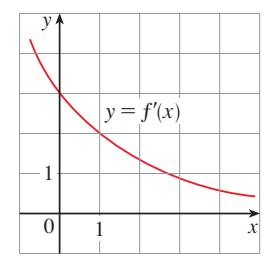
Suppose that the only information we have about a function \(f\) is that \(f(1) = 5\) and the graph of its derivative is as shown. (a) Use a linear approximation to estimate \(f(0.9)\) and \(f(1.1)\). (b) Are your estimates in part (a) too large or too small? Explain.
(미작성)
정답
(a) From the graph \(f'(1) \approx 2\): \(f(0.9) \approx 4.8\) and \(f(1.1) \approx 5.2\). (b) Estimates are too large because \(f'\) is decreasing near \(x = 1\) (so \(f\) is concave down), making the tangent line lie above the curve.
위 정답과 비교하여 채점하세요:
해설
(a) Reading \(f'(1) \approx 2\) from the graph, the linearization is \(L(x) = f(1) + f'(1)(x - 1) = 5 + 2 (x - 1)\). So \(f(0.9) \approx L(0.9) = 5 + 2 (-0.1) = 4.8\) and \(f(1.1) \approx L(1.1) = 5 + 2 (0.1) = 5.2\). (b) Since the graph of \(f'\) is decreasing at \(x = 1\), we have \(f''(1) < 0\), so \(f\) is concave down near \(x = 1\). The tangent line therefore lies above the graph of \(f\), making both estimates too large.
50
Linear Approximation - Concavity Check
오답률 100%
오답
Suppose that we don't have a formula for \(g(x)\) but we know that \(g(2) = -4\) and \(g'(x) = \sqrt{x^2 + 5}\) for all \(x\). (a) Use a linear approximation to estimate \(g(1.95)\) and \(g(2.05)\). (b) Are your estimates in part (a) too large or too small? Explain.
(미작성)
정답
(a) \(g(1.95) \approx -4.15\) and \(g(2.05) \approx -3.85\). (b) Estimates are too small because \(g\) is concave up near \(x = 2\), so the tangent line lies below the curve.
위 정답과 비교하여 채점하세요:
해설
(a) \(g'(2) = \sqrt{4 + 5} = 3\), so \(L(x) = -4 + 3 (x - 2)\). Hence \(g(1.95) \approx L(1.95) = -4 + 3 (-0.05) = -4.15\) and \(g(2.05) \approx L(2.05) = -4 + 3 (0.05) = -3.85\). (b) Computing \(g''(x) = \dfrac{x}{\sqrt{x^2 + 5}}\), we have \(g''(2) = \dfrac{2}{3} > 0\), so \(g\) is concave up near \(x = 2\). The tangent line lies below the curve, so both estimates underestimate the true values.
51
Example - Linearization and Linear Approximation
오답률 100%
오답
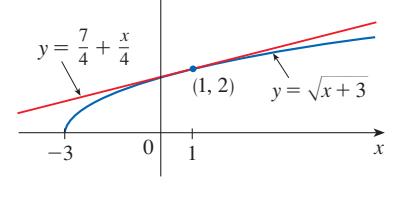
Find the linearization \(L(x)\) of the function \(f(x) = \sqrt{x + 3}\) at \(a = 1\) and use it to approximate the numbers \(\sqrt{3.98}\) and \(\sqrt{4.05}\). Are these approximations overestimates or underestimates?
(미작성)
정답
\(L(x) = \dfrac{7}{4} + \dfrac{x}{4}\); \(\sqrt{3.98} \approx 1.995\), \(\sqrt{4.05} \approx 2.0125\); both are overestimates.
위 정답과 비교하여 채점하세요:
해설
We have \(f'(x) = 1/(2 \sqrt{x + 3})\), so \(f(1) = 2\) and \(f'(1) = \dfrac{1}{4}\). The linearization is \(L(x) = f(1) + f'(1)(x - 1) = 2 + \left(\dfrac{1}{4}\right)(x - 1) = \dfrac{7}{4} + \dfrac{x}{4}\). The corresponding linear approximation is \(\sqrt{x + 3} \approx \dfrac{7}{4} + \dfrac{x}{4}\) when \(x\) is near 1. So \(\sqrt{3.98} = \sqrt{0.98 + 3} \approx \dfrac{7}{4} + 0.\dfrac{98}{4} = 1.995\) and \(\sqrt{4.05} = \sqrt{1.05 + 3} \approx \dfrac{7}{4} + 1.\dfrac{05}{4} = 2.0125\). Both are overestimates because the tangent line lies above the curve \(y = \sqrt{x + 3}\).
52
Example - Accuracy of Linear Approximation
오답률 100%
오답
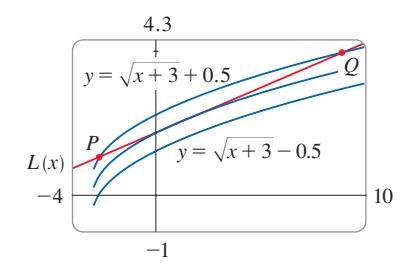
For what values of \(x\) is the linear approximation \(\sqrt{x + 3} \approx \dfrac{7}{4} + \dfrac{x}{4}\) accurate to within \(0.5\)? What about accuracy to within \(0.1\)?
(미작성)
정답
Accurate within \(0.5\) for \(-2.6 < x < 8.6\); accurate within \(0.1\) for \(-1.1 < x < 3.9\).
위 정답과 비교하여 채점하세요:
해설
Accuracy to within \(0.5\) means \(|\sqrt{x + 3} - \left(\dfrac{7}{4} + \dfrac{x}{4}\right)| < 0.5\), equivalently \(\sqrt{x + 3} - 0.5 < \dfrac{7}{4} + \dfrac{x}{4} < \sqrt{x + 3} + 0.5\). Graphing \(y = \sqrt{x + 3} \pm 0.5\) together with the tangent line \(y = \dfrac{7}{4} + \dfrac{x}{4}\) shows that the line lies between the two curves when approximately \(-2.66 < x < 8.66\). Rounding inward gives \(-2.6 < x < 8.6\). Similarly, requiring accuracy within \(0.1\) gives approximately \(-1.1 < x < 3.9\).
53
Example - Differentials vs Increment
오답률 100%
오답
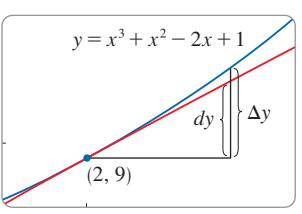
Compare the values of \(\Delta y\) and \(d y\) if \(y = f(x) = x^3 + x^2 - 2x + 1\) and \(x\) changes (a) from 2 to 2.05 and (b) from 2 to 2.01.
(미작성)
정답
(a) \(\Delta y = 0.717625\), \(d y = 0.7\). (b) \(\Delta y = 0.140701\), \(d y = 0.14\). The approximation \(\Delta y \approx d y\) improves as \(\Delta x\) decreases.
위 정답과 비교하여 채점하세요:
해설
We have \(f(2) = 8 + 4 - 4 + 1 = 9\) and \(d y = f'(x) d x = (3 x^2 + 2 x - 2) d x\). At \(x = 2\), \(d y = [3(4) + 4 - 2] d x = 14 d x\). (a) \(f(2.05) = (2.05)^3 + (2.05)^2 - 2(2.05) + 1 = 9.717625\), so \(\Delta y = f(2.05) - f(2) = 0.717625\). With \(d x = 0.05\): \(d y = 14(0.05) = 0.7\). (b) \(f(2.01) = (2.01)^3 + (2.01)^2 - 2(2.01) + 1 = 9.140701\), so \(\Delta y = 0.140701\). With \(d x = 0.01\): \(d y = 14(0.01) = 0.14\). Note \(d y\) is much easier to compute than \(\Delta y\), and the approximation \(\Delta y \approx d y\) becomes better as \(\Delta x\) becomes smaller.
54
Example - Error Estimation with Differentials
오답률 100%
오답
The radius of a sphere was measured and found to be 21 cm with a possible error in measurement of at most 0.05 cm. What is the maximum error in using this value of the radius to compute the volume of the sphere?
(미작성)
정답
Maximum error \(\approx 277 \text{cm}^3\) (relative error \(\approx 0.7%\)).
위 정답과 비교하여 채점하세요:
해설
The sphere has volume \(V = \left(\dfrac{4}{3}\right) \pi r^3\), so \(d V = 4 \pi r^2 d r\). With \(r = 21\) and \(d r = 0.05\): \(d V = 4 \pi (21)^2 (0.05) = 4 \pi (441)(0.05) \approx 277 \text{cm}^3\). The relative error is \((\Delta V)/V \approx (d V)/V = \dfrac{4 \pi r^2 d r}{\left(\dfrac{4}{3}\right) \pi r^3} = 3 (d r)/r = 3(0.05)/21 \approx 0.0071\), so the percentage error in the volume is about \(0.7%\) (compared to \(0.24%\) in the radius).