시험 완료
|
TMUA 2020 Paper 2
0.0%
0/20
단원별 정답률
Integration
약점
0/4 · 0%
Trigonometric Functions
약점
0/2 · 0%
Logic of Arguments
약점
0/2 · 0%
Basis of Logic
약점
0/2 · 0%
Sequences and Series
약점
0/2 · 0%
Equations
약점
0/1 · 0%
Curve Sketching
약점
0/1 · 0%
Plane Geometry
약점
0/1 · 0%
Mathematical Proofs
약점
0/1 · 0%
Inequalities
약점
0/1 · 0%
Coordinate Geometry
약점
0/1 · 0%
Statistics
약점
0/1 · 0%
Polynomials
약점
0/1 · 0%
약점 단원을 집중 연습으로 보강하세요.
약점 연습하기 →문제별 결과
1
Equations
오답
Find the complete set of values of \(k\) for which the line \(y = x - 2\) crosses or touches the curve \(y = x^2 + k x + 2\)
A
\(-1 \leq k \leq 3\)
B
\(-3 \leq k \leq 5\)
C
\(-4 \leq k \leq 4\)
D
\(k \leq -1\) or \(k \geq 3\)
\(k \leq -3\) or \(k \geq 5\)
정답
F
\(k \leq -4\) or \(k \geq 4\)
해설
The line crosses or touches the curve where the two equations give the same \(y\) for some \(x\), so set them equal:
$
x - 2 = x^2 + k x + 2
$
Rearranging gives a quadratic in \(x\):
$
x^2 + (k -
1) x + 4 = 0 $ The line crosses or touches the curve exactly when this quadratic has at least one real solution, which happens when its discriminant is non-negative. $ (k - 1)^2 - 4 (1) (4) >= 0 $ $ (k - 1)^2 >= 16 $ Taking square roots (remembering both branches): $ k - 1 <= -4 " or " k - 1 >= 4 $ $ k <= -3 " or " k >= 5 $ So the complete set of values is \(k \leq -3\) or \(k \geq 5\), which is option E.
1) x + 4 = 0 $ The line crosses or touches the curve exactly when this quadratic has at least one real solution, which happens when its discriminant is non-negative. $ (k - 1)^2 - 4 (1) (4) >= 0 $ $ (k - 1)^2 >= 16 $ Taking square roots (remembering both branches): $ k - 1 <= -4 " or " k - 1 >= 4 $ $ k <= -3 " or " k >= 5 $ So the complete set of values is \(k \leq -3\) or \(k \geq 5\), which is option E.
2
Trigonometric Functions
오답
Given that \(\tan \theta = 2\) and \(180^{\circ} < \theta < 360^{\circ}\), find the value of \(\cos \theta\)
A
\(\sqrt{3}\)
B
\(-\sqrt{3}\)
C
\(\dfrac{\sqrt{3}}{2}\)
D
\(-\dfrac{\sqrt{3}}{2}\)
E
\(\dfrac{\sqrt{5}}{5}\)
\(-\dfrac{\sqrt{5}}{5}\)
정답
G
\(\dfrac{2 \sqrt{5}}{5}\)
H
\(-\dfrac{2 \sqrt{5}}{5}\)
해설
Since \(\tan \theta = 2\) is positive, \(\theta\) lies in a quadrant where tangent is positive. In the range \(180^{\circ} < \theta < 360^{\circ}\), tangent is positive only in the third quadrant, \(180^{\circ} < \theta < 270^{\circ}\). In this quadrant both \(\sin \theta\) and \(\cos \theta\) are negative.
Using \(\tan \theta = 2 = \dfrac{\text{opposite}}{\text{adjacent}}\), form a right triangle with opposite side \(2\) and adjacent side \(1\), giving hypotenuse:
$
sqrt(2^2 + 1^2) = sqrt(5)
$
So the reference values are \(\sin \theta = \dfrac{2}{\sqrt{5}}\) and \(\cos \theta = \dfrac{1}{\sqrt{5}}\) before applying the sign for the third quadrant. Since \(\cos \theta\) is negative there:
$
cos theta = -frac(1, sqrt(5)) = -frac(sqrt(5),
5) $ This matches option F.
5) $ This matches option F.
3
Logic of Arguments
오답
A student makes the following claim:
For all integers \(n\), the expression \(4 \left(\dfrac{9 n + 1}{2} - \dfrac{3 n - 1}{2}\right)\) is divisible by 3.
Here is the student's argument:
(I) \(4 \left(\dfrac{9 n + 1}{2} - \dfrac{3 n - 1}{2}\right) = 2 (2 \left(\dfrac{9 n + 1}{2} - \dfrac{3 n - 1}{2}\right))\)
(II) \(= 2 (9 n + 1 - 3 n - 1)\)
(III) \(= 2 (6 n)\)
(IV) \(= 12 n\)
(V) \(= 3 (4 n)\)
(VI) which is always a multiple of 3.
So the expression \(4 \left(\dfrac{9 n + 1}{2} - \dfrac{3 n - 1}{2}\right)\) is always divisible by 3.
Which one of the following is true?
A
The argument is correct.
B
The argument is incorrect, and the first error occurs on line (I).
The argument is incorrect, and the first error occurs on line (II).
정답
D
The argument is incorrect, and the first error occurs on line (III).
E
The argument is incorrect, and the first error occurs on line (IV).
F
The argument is incorrect, and the first error occurs on line (V).
G
The argument is incorrect, and the first error occurs on line (VI).
해설
Check each line of the argument by simplifying the original expression correctly.
Line (I) just rewrites \(4X\) as \(2(2X)\), which is a valid algebraic identity, so line (I) is correct.
Now check line (II), where \(2\) is distributed into the bracket:
$
2 (frac(9 n + 1,
2) - frac(3 n - 1, 2)) = 2 dot frac(9 n + 1,
2) - 2 dot frac(3 n - 1,
2) = (9 n +
1) - (3 n -
1) $ Expanding the subtraction correctly requires distributing the minus sign over both terms of \((3n - 1)\): $ (9 n +
1) - (3 n -
1) = 9 n + 1 - 3 n + 1 = 6 n + 2 $ However, the student's line (II) states this equals \(9n + 1 - 3n - 1\), which incorrectly keeps the sign of the \(-1\) unchanged instead of flipping it to \(+1\). This is a sign error in distributing the negative sign. As a check, the correct value of the full expression is: $ 4 (frac(9 n + 1,
2) - frac(3 n - 1, 2)) = 2 (6 n +
2) = 12 n + 4 $ which is still divisible by... not always by 3 for every integer \(n\) (e.g. \(n = 1\) gives \(16\), not a multiple of 3), so the student's claim itself is also false — but the question only asks where the argument's first error occurs. Since line (I) is valid and the mistake first appears in line (II), the first error occurs on line (II), which is option C.
2) - frac(3 n - 1, 2)) = 2 dot frac(9 n + 1,
2) - 2 dot frac(3 n - 1,
2) = (9 n +
1) - (3 n -
1) $ Expanding the subtraction correctly requires distributing the minus sign over both terms of \((3n - 1)\): $ (9 n +
1) - (3 n -
1) = 9 n + 1 - 3 n + 1 = 6 n + 2 $ However, the student's line (II) states this equals \(9n + 1 - 3n - 1\), which incorrectly keeps the sign of the \(-1\) unchanged instead of flipping it to \(+1\). This is a sign error in distributing the negative sign. As a check, the correct value of the full expression is: $ 4 (frac(9 n + 1,
2) - frac(3 n - 1, 2)) = 2 (6 n +
2) = 12 n + 4 $ which is still divisible by... not always by 3 for every integer \(n\) (e.g. \(n = 1\) gives \(16\), not a multiple of 3), so the student's claim itself is also false — but the question only asks where the argument's first error occurs. Since line (I) is valid and the mistake first appears in line (II), the first error occurs on line (II), which is option C.
4
Basis of Logic
오답
Consider the following statement:
Every positive integer \(N\) that is greater than 6 can be written as the sum of two non-prime integers that are greater than 1.
Which of the following is/are counterexample(s) to this statement?
I. \(N = 5\)
II. \(N = 7\)
III. \(N = 9\)
I. \(N = 5\)
II. \(N = 7\)
III. \(N = 9\)
A
none of them
B
I only
C
II only
D
III only
E
I and II only
F
I and III only
II and III only
정답
H
I, II and III
해설
The statement claims that every positive integer \(N > 6\) can be written as the sum of two non-prime integers that are each greater than 1. A counterexample must be a value of \(N\) for which the statement applies (so \(N > 6\)) but for which no such decomposition exists.
Statement I: \(N = 5\). Since \(5\) is not greater than \(6\), the statement makes no claim about it at all, so \(N = 5\) cannot be a counterexample regardless of whether it can be split into two non-primes. I is not a counterexample.
Statement II: \(N = 7\). The only ways to write \(7\) as a sum of two integers greater than 1 are
$
7 = 2 + 5 = 3 + 4
$
In \(2+5\), both \(2\) and \(5\) are prime; in \(3+4\), \(3\) is prime. Every decomposition contains a prime, so \(7\) cannot be written as a sum of two non-primes greater than 1. II is a counterexample.
Statement III: \(N = 9\). The ways to write \(9\) as a sum of two integers greater than 1 are
$
9 = 2 + 7 = 3 + 6 = 4 + 5
$
Here \(2\) and \(7\) are prime, \(3\) is prime, and \(5\) is prime — every decomposition contains at least one prime. So \(9\) cannot be written as a sum of two non-primes greater than 1 either. III is a counterexample.
So the counterexamples are II and III only, which is the correct answer.
5
Curve Sketching
오답
Which one of the following shows the graph of
\(y = \dfrac{2^x}{1 + 2^x}\)
(Dotted lines indicate asymptotes.)
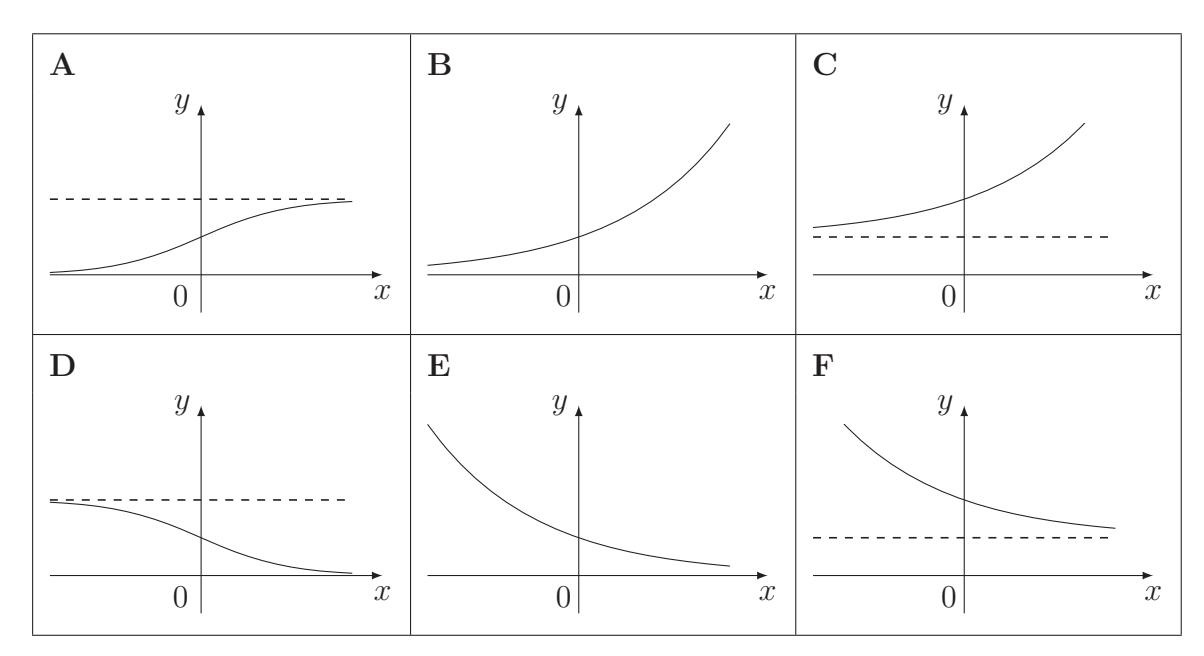
Increasing S-shaped (logistic) curve rising from 0 up to a positive horizontal asymptote
정답
B
Increasing exponential-type curve with no asymptote, growing without bound
C
Increasing curve approaching a horizontal asymptote below the x-axis as x decreases
D
Decreasing S-shaped curve falling from a positive horizontal asymptote down to 0
E
Decreasing exponential-type curve approaching 0
F
Decreasing curve approaching a positive horizontal asymptote from above
해설
Consider
$
y = frac(2^x, 1 + 2^x)
$
Behaviour as \(x \rightarrow -\infty\): \(2^x \rightarrow 0^+\), so
$
y -> frac(0,
1) = 0 $ Behaviour as \(x \rightarrow +\infty\): dividing numerator and denominator by \(2^x\) gives $ y = frac(1, 2^(-x) +
1) $ and since \(2^{-x} \rightarrow 0\) as \(x \rightarrow \infty\), \(y \rightarrow 1\). Monotonicity: writing \(y = 1 - \dfrac{1}{1+2^x}\), the derivative is $ frac(d y, d
x) = frac(ln 2 dot 2^x, (1+2^x)^2) $ which is positive for every real \(x\), since \(2^x > 0\) and \(\ln 2 > 0\). So \(y\) is strictly increasing for all \(x\), running from a horizontal asymptote at \(y = 0\) as \(x \rightarrow -\infty\) up to a horizontal asymptote at \(y = 1\) as \(x \rightarrow +\infty\). This is exactly an increasing S-shaped (logistic) curve rising from \(0\) up to a positive horizontal asymptote, which is option A.
1) = 0 $ Behaviour as \(x \rightarrow +\infty\): dividing numerator and denominator by \(2^x\) gives $ y = frac(1, 2^(-x) +
1) $ and since \(2^{-x} \rightarrow 0\) as \(x \rightarrow \infty\), \(y \rightarrow 1\). Monotonicity: writing \(y = 1 - \dfrac{1}{1+2^x}\), the derivative is $ frac(d y, d
x) = frac(ln 2 dot 2^x, (1+2^x)^2) $ which is positive for every real \(x\), since \(2^x > 0\) and \(\ln 2 > 0\). So \(y\) is strictly increasing for all \(x\), running from a horizontal asymptote at \(y = 0\) as \(x \rightarrow -\infty\) up to a horizontal asymptote at \(y = 1\) as \(x \rightarrow +\infty\). This is exactly an increasing S-shaped (logistic) curve rising from \(0\) up to a positive horizontal asymptote, which is option A.
6
Integration
오답
The function \(f(x)\) is defined for all real values of \(x\).
Which of the following conditions on \(f(x)\) is/are necessary to ensure that
\(\displaystyle\int_{-5}^0 f(x) d x = \displaystyle\int_{0}^{5} f(x) d x\)
Condition I: \(f(x) = f(-x)\) for \(-5 \leq x \leq 5\)
Condition II: \(f(x) = c\) for \(-5 \leq x \leq 5\), where \(c\) is a constant
Condition III: \(f(x) = -f(-x)\) for \(-5 \leq x \leq 5\)
none of them
정답
B
I only
C
II only
D
III only
E
I and II only
F
I and III only
G
II and III only
H
I, II and III
해설
We need to determine which of Conditions I, II, III are necessary for
$
integral_(-5)^0 f(x) d x = integral_0^5 f(x) d x
$
A condition is necessary only if the equality can never hold unless that condition is satisfied. To test this, it is enough to find one function \(f\) for which the two integrals are equal but which satisfies none of I, II,
III. Define $ f(x) = cases( 1 & "if" -5 <= x < 0, frac(2x,
5) & "if" 0 <= x <= 5 ) $ Then $ integral_(-5)^0 f(x) d x = integral_(-5)^0 1 d x = 5 $ and $ integral_0^5 f(x) d x = integral_0^5 frac(2x,
5) d x = frac(1,5)[x^2]_0^5 = 5 $ so the two integrals are equal. However, check the three conditions on \([-5,5]\): at \(x=1\), \(f(1) = frac(2,5)\) while \(f(-1) = 1\), so \(f(1) \neq f(-1)\) (Condition I, evenness, fails) and \(f(1) \neq -f(-1) = -1\) (Condition III, oddness, fails). Also \(f\) takes different values (\(1\) and \(frac(2,5)\)), so it is not constant (Condition II fails). Since the integrals are equal even though none of I, II, III hold, none of these conditions is necessary. The correct answer is A: none of them.
III. Define $ f(x) = cases( 1 & "if" -5 <= x < 0, frac(2x,
5) & "if" 0 <= x <= 5 ) $ Then $ integral_(-5)^0 f(x) d x = integral_(-5)^0 1 d x = 5 $ and $ integral_0^5 f(x) d x = integral_0^5 frac(2x,
5) d x = frac(1,5)[x^2]_0^5 = 5 $ so the two integrals are equal. However, check the three conditions on \([-5,5]\): at \(x=1\), \(f(1) = frac(2,5)\) while \(f(-1) = 1\), so \(f(1) \neq f(-1)\) (Condition I, evenness, fails) and \(f(1) \neq -f(-1) = -1\) (Condition III, oddness, fails). Also \(f\) takes different values (\(1\) and \(frac(2,5)\)), so it is not constant (Condition II fails). Since the integrals are equal even though none of I, II, III hold, none of these conditions is necessary. The correct answer is A: none of them.
7
Plane Geometry
오답
Consider the following conditions on a parallelogram \(P Q R S\), labelled anticlockwise:
I. length of \(P Q\) = length of \(Q R\)
II. The diagonal \(P R\) intersects the diagonal \(Q S\) at right angles
III. \(\angle P Q R = \angle Q R S\) Which of these conditions is/are individually sufficient for the parallelogram \(P Q R S\) to be a square?
I. length of \(P Q\) = length of \(Q R\)
II. The diagonal \(P R\) intersects the diagonal \(Q S\) at right angles
III. \(\angle P Q R = \angle Q R S\) Which of these conditions is/are individually sufficient for the parallelogram \(P Q R S\) to be a square?
A
I sufficient: yes, II sufficient: yes, III sufficient: yes
B
I sufficient: yes, II sufficient: yes, III sufficient: no
C
I sufficient: yes, II sufficient: no, III sufficient: yes
D
I sufficient: yes, II sufficient: no, III sufficient: no
E
I sufficient: no, II sufficient: yes, III sufficient: yes
F
I sufficient: no, II sufficient: yes, III sufficient: no
G
I sufficient: no, II sufficient: no, III sufficient: yes
I sufficient: no, II sufficient: no, III sufficient: no
정답
해설
In parallelogram \(P Q R S\) (anticlockwise), sides \(P Q\) and \(S R\) are parallel and opposite, and \(Q R\) is a transversal, so angles \(\angle P Q R\) and \(\angle Q R S\) are co-interior (same-side interior) angles and therefore satisfy
$
angle P Q R + angle Q R S = 180 degree
$
Condition I: \(P Q = Q R\) means two adjacent sides are equal, which (combined with the parallelogram property that opposite sides are equal) makes all four sides equal — this gives a rhombus, not necessarily a square. A rhombus with unequal angles (e.g. \(60^{\circ}\) and \(120^{\circ}\)) satisfies I but is not a square. So I is not sufficient.
Condition II: the diagonals of a parallelogram meeting at right angles is precisely the condition for a rhombus (this is a standard characterisation: diagonals perpendicular \u21d4 all sides equal). Again a non-square rhombus satisfies this, so II is not sufficient.
Condition III: using the relation above, \(\angle P Q R + \angle Q R S = 180^{\circ}\). If also \(\angle P Q R = \angle Q R S\), then each equals \(90^{\circ}\). Since opposite angles of a parallelogram are equal and consecutive angles are supplementary, all four angles equal \(90^{\circ}\), giving a rectangle. But a non-square rectangle (sides of different lengths) also satisfies III, so III is not sufficient either.
Therefore none of I, II, III is individually sufficient for \(P Q R S\) to be a square, so the answer is H (I: no, II: no, III: no).
8
Mathematical Proofs
오답
A student is asked to prove whether the following statement \((*)\) is true or false:
\((*)\) For all real numbers \(a\) and \(b\), \(|a + b| < |a| + |b|\)
The student's proof is as follows:
Statement \((*)\) is false. A counterexample is \(a = 3\), \(b = 4\), as \(|3 + 4| = 7\) and \(|3| + |4| = 7\), but \(7 < 7\) is false.
Which of the following best describes the student's proof?
A
The statement \((*)\) is true, and the student's proof is not correct.
B
The statement \((*)\) is false, but the student's proof is not correct: the counterexample is not valid.
C
The statement \((*)\) is false, but the student's proof is not correct: the student needs to give all the values of \(a\) and \(b\) where \(|a + b| < |a| + |b|\) is false.
D
The statement \((*)\) is false, but the student's proof is not correct: the student should have instead stated that for all real numbers \(a\) and \(b\), \(|a + b| \leq |a| + |b|\).
The statement \((*)\) is false, and the student's proof is fully correct.
정답
해설
The statement \((*)\) claims that for all real numbers \(a\) and \(b\),
$
abs(a +
b) < abs(a) + abs(b) $ This is a universally quantified statement ("for all \(a, b\)"), and to disprove a universal statement it is logically sufficient to exhibit a single counterexample where the inequality fails. The student chose \(a = 3\), \(b = 4\). Then $ abs(a +
b) = abs(7) = 7, quad abs(a) + abs(b) = abs(3) + abs(4) = 7 $ Since \(7 < 7\) is false, the inequality \(|a+b| < |a| + |b|\) fails for this particular pair, which is exactly what is needed: it shows the statement does not hold for all real \(a, b\), so \((*)\) is false. This single valid counterexample is a complete and correct disproof — the student does not need to list every pair of values where the inequality fails (option C is unnecessary), the counterexample itself is valid (ruling out B), and there is no requirement to restate the correct (non-strict) triangle inequality \(|a+b| \leq |a| + |b|\) as part of disproving \((*)\) (ruling out D). The statement \((*)\) is indeed false (ruling out A). So the statement is false and the student's proof is fully correct — answer E.
b) < abs(a) + abs(b) $ This is a universally quantified statement ("for all \(a, b\)"), and to disprove a universal statement it is logically sufficient to exhibit a single counterexample where the inequality fails. The student chose \(a = 3\), \(b = 4\). Then $ abs(a +
b) = abs(7) = 7, quad abs(a) + abs(b) = abs(3) + abs(4) = 7 $ Since \(7 < 7\) is false, the inequality \(|a+b| < |a| + |b|\) fails for this particular pair, which is exactly what is needed: it shows the statement does not hold for all real \(a, b\), so \((*)\) is false. This single valid counterexample is a complete and correct disproof — the student does not need to list every pair of values where the inequality fails (option C is unnecessary), the counterexample itself is valid (ruling out B), and there is no requirement to restate the correct (non-strict) triangle inequality \(|a+b| \leq |a| + |b|\) as part of disproving \((*)\) (ruling out D). The statement \((*)\) is indeed false (ruling out A). So the statement is false and the student's proof is fully correct — answer E.
9
Trigonometric Functions
오답
A student wishes to evaluate the function \(f(x) = x \sin x\), where \(x\) is in radians, but has a calculator that only works in degrees.
What could the student type into their calculator to correctly evaluate \(f(4)\) ?
A
\((\pi \times 4 \div 180) \times \sin(4)\)
B
\((\pi \times 4 \div 180) \times \sin(\pi \times 4 \div 180)\)
C
\(4 \times \sin(\pi \times 4 \div 180)\)
D
\((180 \times 4 \div \pi) \times \sin(4)\)
E
\((180 \times 4 \div \pi) \times \sin(180 \times 4 \div \pi)\)
\(4 \times \sin(180 \times 4 \div \pi)\)
정답
해설
We want \(f(4) = 4 \sin(4)\), where the sine is evaluated with the angle \(4\) measured in radians, but the calculator's \(\sin\) function only accepts degrees.
The factor \(x = 4\) that multiplies \(\sin x\) is just a plain real number (not an angle being fed into a trig function), so it is entered as \(4\) with no conversion.
For the argument inside \(\sin\), the calculator will interpret whatever number is typed as degrees. To make it evaluate \(\sin\) of \(4\) radians correctly, we must first convert \(4\) radians into the equivalent number of degrees, then feed that value into the (degree-mode) \(\sin\) function:
$
4 " radians" = 4 times frac(180, pi) " degrees"
$
Entering this converted value into \(\sin\) gives the degree-mode calculator the correct equivalent angle, so
$
sin_("degree mode")( 180 times 4 div pi ) = sin_("radian")(4)
$
Hence the correct expression to type is
$
4 times sin(180 times 4 div pi)
$
This multiplies the plain number \(4\) by the degree-mode sine of the degree-equivalent of \(4\) radians, which numerically equals \(4 \sin(4)\) with \(4\) in radians. This is option F (the choice \(4 \times \sin(180 \times 4 \div \pi)\)); the other options either convert in the wrong direction (\(\pi \times 4 \div 180\), which would be used if the input were already in degrees) or fail to convert the argument of \(\sin\) at all.
10
Inequalities
오답
The real numbers \(a\), \(b\), \(c\) and \(d\) satisfy both
\(0 < a + b < c + d\)
and
\(0 < a + c < b + d\)
Which of the following inequalities must be true?
I. \(a < d\)
II. \(b < c\)
III. \(a + b + c + d > 0\)
I. \(a < d\)
II. \(b < c\)
III. \(a + b + c + d > 0\)
A
none of them
B
I only
C
II only
D
III only
E
I and II only
I and III only
정답
G
II and III only
H
I, II and III
해설
Add the two given inequalities together:
$
(a+b) + (a+c) < (c+d) + (b+d)
$
which simplifies to \(2a + b + c < b + c + 2d\), so \(2a < 2d\), giving \(a < d\). So statement I must be true.
For statement III, from \(0 < a+b\) and \(a+b < c+d\) we get \(c+d > 0\) as well. Adding the two positive quantities,
$
(a+b) + (c+d) > 0
$
so \(a+b+c+d > 0\). So statement III must be true.
For statement II, try \(a=0\), \(b=1\), \(c=1\), \(d=1\). Then \(a+b = 1\) and \(c+d = 2\), so \(0 < 1 < 2\) holds; also \(a+c = 1\) and \(b+d = 2\), so \(0 < 1 < 2\) holds. Both given conditions are satisfied, but \(b = c\), so \(b < c\) is false. Hence statement II need not be true.
Therefore only I and III must be true, which is option F.
11
Coordinate Geometry
오답
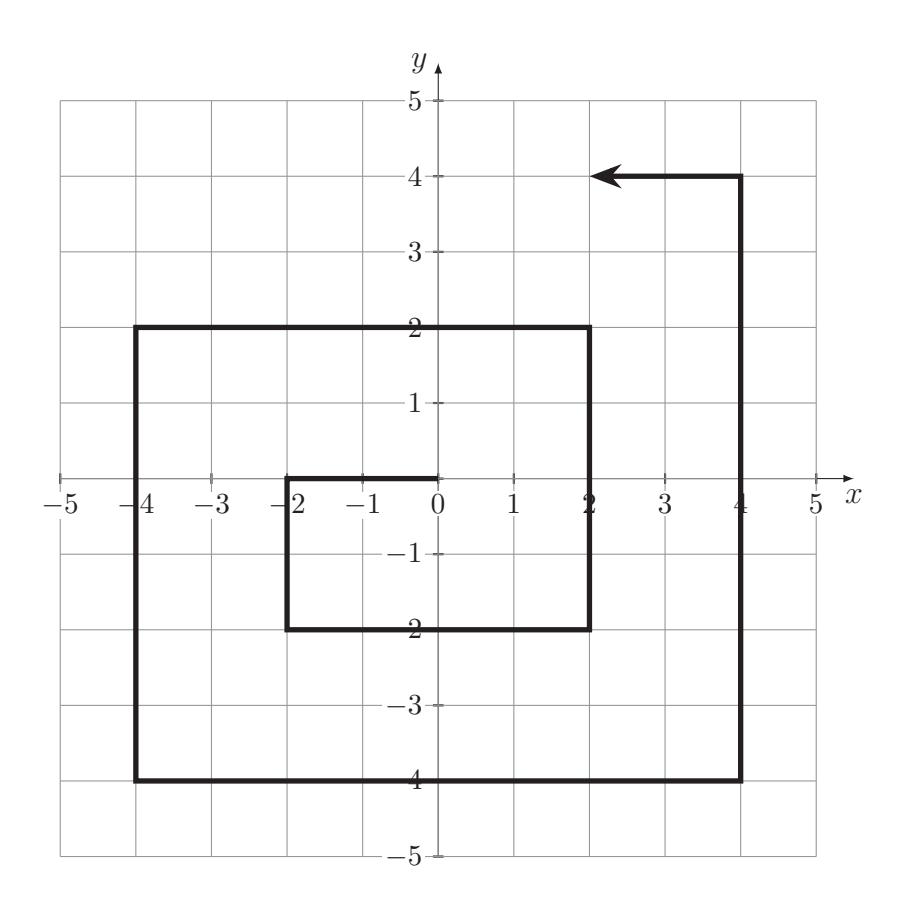
A spiral line is drawn as shown.
This spiral pattern continues indefinitely.
Which one of the following points is not on the spiral line?
A
\((99, 100)\)
B
\((99, -100)\)
C
\((-99, 100)\)
D
\((-99, -100)\)
E
\((100, 99)\)
F
\((100, -99)\)
\((-100, 99)\)
정답
H
\((-100, -99)\)
해설
The spiral is built from straight horizontal and vertical segments that spiral outward through lattice points, with each successive arm one unit longer than the last. Because the numbers 99 and 100 are large, it helps to replace them with a small odd/even pair that sits in the same position in the pattern, say 3 and 4, and see which of the corresponding points lie on the spiral.
Tracing the spiral out to this stage shows both
$
(3,-4) \text{ and } (4,-3)
$
lying on the lower-right arm of the spiral (one on the horizontal leg, one on the vertical leg that meets it), and both
$
(-4,-3) \text{ and } (-3,-4)
$
lying on the lower-left arm in the same way. However, at the top-left corner of this loop the spiral turns one step early: the horizontal arm along the top only reaches as far as \((-3,4)\), and the vertical arm down the left-hand side only starts from \((-4,-3)\) upward as far as \((-4,3)\) is not reached — the point \((-4,3)\) falls exactly in the gap left at the corner where the spiral turns, so it is not on the spiral line.
The same gap occurs at every loop of the spiral, one step further out each time. Scaling this pattern up to 99 and 100 (99 playing the role of 3, and 100 playing the role of 4), the corresponding gap point is
$
(-100, 99)
$
All the other listed points — \((99,100)\), \((99,-100)\), \((-99,100)\), \((-99,-100)\), \((100,99)\), \((100,-99)\) and \((-100,-99)\) — sit on the straight arms of the spiral in the same way that \((3,-4)\), \((4,-3)\), \((-3,4)\), \((-4,-3)\) and \((-3,-4)\) do in the small example, while \((-100,99)\) is the one that falls into the corner gap, just as \((-4,3)\) did.
Therefore the point that is not on the spiral line is
$
(-100, 99)
$
which is option G.
12
Integration
오답
Which one of A–F correctly completes the following statement?
Given that \(a < b\), and \(f(x) > 0\) for all \(x\) with \(a < x < b\), the trapezium rule produces an overestimate for \(\displaystyle\int_{a}^{b} f(x) d x\) ...
A
... if \(f'(x) > 0\) and \(f''(x) < 0\) for all \(x\) with \(a < x < b\)
B
... only if \(f'(x) > 0\) and \(f''(x) < 0\) for all \(x\) with \(a < x < b\)
C
... if and only if \(f'(x) > 0\) and \(f''(x) < 0\) for all \(x\) with \(a < x < b\)
... if \(f'(x) < 0\) and \(f''(x) > 0\) for all \(x\) with \(a < x < b\)
정답
E
... only if \(f'(x) < 0\) and \(f''(x) > 0\) for all \(x\) with \(a < x < b\)
F
... if and only if \(f'(x) < 0\) and \(f''(x) > 0\) for all \(x\) with \(a < x < b\)
해설
The trapezium rule replaces the curve \(y = f(x)\) on each subinterval with a straight chord joining the endpoints, and uses the area under that chord as the estimate for the area under the curve.
The key fact is that the sign of \(f''(x)\) alone determines whether this substitution over- or under-estimates the integral, regardless of whether \(f\) is increasing or decreasing:
If \(f''(x) > 0\) on \((a, b)\), then \(f\) is convex there, so the graph of \(f\) always lies on or below any chord joining two points on the curve. This means the trapezium (area under the chord) contains the true area under the curve, so
\( text(trapezium estimate) \geq \displaystyle\int_{a}^{b} f(x) d x, \)
with equality only if \(f\) is linear. So \(f''(x) > 0\) produces an overestimate whether \(f\) is increasing \((f'(x) > 0)\) or decreasing \((f'(x) < 0)\).
Now check each condition:
Condition D states \(f'(x) < 0\) and \(f''(x) > 0\). Since \(f''(x) > 0\) guarantees an overestimate on its own, this condition is sufficient: whenever it holds, the trapezium rule does overestimate. So "if \(f'(x) < 0\) and \(f''(x) > 0\)" is a true statement.
However, it is not a necessary condition, because an overestimate also occurs when \(f'(x) > 0\) and \(f''(x) > 0\) (an increasing convex function) — this case gives an overestimate too, but does not satisfy \(f'(x) < 0\). So there exist functions producing an overestimate for which the stated condition (D's hypothesis) fails, ruling out "only if" and "if and only if" versions of this condition (E and the option using \(f'<0, f''>0\) with "if and only if").
This eliminates E (only if) since the condition is not necessary, and rules out the "if and only if" variant for the same reason. It also confirms D is correct as an "if" statement, since the hypothesis is sufficient (though not necessary) for an overestimate.
By the same convexity argument, options A/B/C (which use \(f'(x) > 0, f''(x) < 0\), i.e. an increasing concave function) describe a case where the chord lies below the curve, giving an underestimate, not an overestimate — so A, B, C are all false.
Therefore the correct completion is D: the trapezium rule produces an overestimate if \(f'(x) < 0\) and \(f''(x) > 0\) for all \(x\) with \(a < x < b\).
13
Integration
오답
\(f(x)\) is a function for which
\(\displaystyle\int_{0}^{3} (f(x))^2 d x + \displaystyle\int_{0}^{3} f(x) d x = \displaystyle\int_{0}^{1} f(x) d x\)
Which of the following claims about \(f(x)\) is/are necessarily true?
I. \(f(x) \leq 0\) for some \(x\) with \(1 \leq x \leq 3\)
II. \(\displaystyle\int_{0}^{3} f(x) d x \leq \displaystyle\int_{0}^{1} f(x) d x\)
I. \(f(x) \leq 0\) for some \(x\) with \(1 \leq x \leq 3\)
II. \(\displaystyle\int_{0}^{3} f(x) d x \leq \displaystyle\int_{0}^{1} f(x) d x\)
A
neither of them
B
I only
C
II only
I and II
정답
해설
Rearranging the given equation isolates the integral of \(f(x)^2\):
$
integral_0^3 (f(x))^2 d x = integral_0^1 f(x) d x - integral_0^3 f(x) d x = -integral_1^3 f(x) d x
$
Since \((f(x))^2 \geq 0\) for all \(x\), the left-hand side satisfies \(\displaystyle\int_{0}^{3} (f(x))^2 d x \geq 0\), so
$
integral_1^3 f(x) d x <= 0
$
Statement I: If \(f(x) > 0\) held for every \(x\) in \([1,3]\), then \(\displaystyle\int_{1}^{3} f(x) d x\) would be strictly positive, contradicting \(\displaystyle\int_{1}^{3} f(x) d x \leq 0\). So \(f(x) \leq 0\) for at least one \(x\) in \([1,3]\). Statement I is necessarily true.
Statement II: From the original equation,
$
integral_0^3 f(x) d x = integral_0^1 f(x) d x - integral_0^3 (f(x))^2 d x
$
Since \(\displaystyle\int_{0}^{3} (f(x))^2 d x \geq 0\), subtracting it can only decrease or keep equal the value of \(\displaystyle\int_{0}^{1} f(x) d x\). Hence
$
integral_0^3 f(x) d x <= integral_0^1 f(x) d x
$
Statement II is necessarily true.
Both I and II must hold, so the answer is D.
14
Sequences and Series
오답
An arithmetic sequence \(T\) has first term \(a\) and common difference \(d\), where \(a\) and \(d\) are non-zero integers.
Property \(P\) is:
For some positive integer \(m\), the sum of the first \(m\) terms of the sequence is equal to the sum of the first \(2 m\) terms of the sequence.
For example, when \(a = 11\) and \(d = -2\), the sequence \(T\) has property \(P\), because
\(11 + 9 + 7 + 5 = 11 + 9 + 7 + 5 + 3 + 1 + (-1) + (-3)\)
i.e. the sum of the first 4 terms equals the sum of the first 8 terms.
Which of the following statements is/are true?
I. For \(T\) to have property \(P\), it is sufficient that \(a d < 0\).
II. For \(T\) to have property \(P\), it is necessary that \(d\) is even.
I. For \(T\) to have property \(P\), it is sufficient that \(a d < 0\).
II. For \(T\) to have property \(P\), it is necessary that \(d\) is even.
neither of them
정답
B
I only
C
II only
D
I and II
해설
Using \(S_n = \dfrac{n}{2}(2a+(n-1)d)\), property \(P\) holds when \(S_m = S_2m\) for some positive integer \(m\):
$
m(2a+(2m-1)d) = frac(m,2)(2a+(m-1)d)
$
Dividing by \(m\) and multiplying by 2:
$
4a+2(2m-1)d = 2a+(m-1)d
$
$
2a + (3m-1)d = 0
$
So \(T\) has property \(P\) exactly when there is a positive integer \(m\) satisfying
$
a = -frac((3m-1)d,
2) $ Statement I claims \(ad<0\) is sufficient. Test \(a=2\), \(d=-1\), which satisfies \(ad<0\). Then \(2a+(3m-1)d=0\) gives \(4-(3m-1)=0\), so \(3m=5\), and \(m=frac(5,3)\) is not a positive integer. No positive integer \(m\) works, so this sequence does not have property \(P\) even though \(ad<0\). Hence \(ad<0\) is not sufficient, and statement I is false. Statement II claims \(d\) even is necessary. Test \(a=-1\), \(d=1\) (an odd, nonzero \(d\)): the sequence is \(-1, 0, 1, 2, ...\), so \(S_1 = -1\) and \(S_2 = -1+0 = -1\), giving \(S_1 = S_2\) with \(m=1\). Property \(P\) holds with \(d\) odd, so \(d\) being even is not necessary, and statement II is false. Since both I and II are false, the answer is A: neither of them.
2) $ Statement I claims \(ad<0\) is sufficient. Test \(a=2\), \(d=-1\), which satisfies \(ad<0\). Then \(2a+(3m-1)d=0\) gives \(4-(3m-1)=0\), so \(3m=5\), and \(m=frac(5,3)\) is not a positive integer. No positive integer \(m\) works, so this sequence does not have property \(P\) even though \(ad<0\). Hence \(ad<0\) is not sufficient, and statement I is false. Statement II claims \(d\) even is necessary. Test \(a=-1\), \(d=1\) (an odd, nonzero \(d\)): the sequence is \(-1, 0, 1, 2, ...\), so \(S_1 = -1\) and \(S_2 = -1+0 = -1\), giving \(S_1 = S_2\) with \(m=1\). Property \(P\) holds with \(d\) odd, so \(d\) being even is not necessary, and statement II is false. Since both I and II are false, the answer is A: neither of them.
15
Sequences and Series
오답
Which one of the following is a necessary and sufficient condition for
\(\displaystyle\sum_{k=1}^n \sin\left(\dfrac{k \pi}{3}\right) = \dfrac{\sqrt{3}}{2}\)
to be true?
A
\(n = 1\)
B
\(n\) is a multiple of 3
C
\(n\) is a multiple of 6
\(n\) is 1 more than a multiple of 3
정답
E
\(n\) is 1 more than a multiple of 6
F
\(n\) is 1 more than a multiple of 6 or \(n\) is 2 more than a multiple of 6
해설
The terms \(\sin\left(\dfrac{k \pi}{3}\right)\) repeat with period 6, taking the values
$
frac(sqrt(3), 2), space frac(sqrt(3), 2), space 0, space -frac(sqrt(3), 2), space -frac(sqrt(3), 2), space 0
$
for \(k = 1, 2, 3, 4, 5, 6\), and this block of six values sums to 0. So the partial sum \(S_n = \displaystyle\sum_{k=1}^n \sin\left(\dfrac{k \pi}{3}\right)\) also has period 6 in \(n\): \(S_n = S_{n \mod 6}\) (using the representative in \(\{0, 1, ..., 5\}\), with \(S_0 = 0\)).
Computing one full period of partial sums:
$
S_1 = frac(sqrt(3), 2), quad S_2 = sqrt(3), quad S_3 = sqrt(3), quad S_4 = frac(sqrt(3), 2), quad S_5 = 0, quad S_6 = 0
$
So \(S_n = \dfrac{\sqrt{3}}{2}\) exactly when \(n \equiv 1\) or \(n \equiv 4 \ (\mod 6)\), and \(S_n\) never equals \(\dfrac{\sqrt{3}}{2}\) for the other residues.
The residues \(n \equiv 1 \ (\mod 6)\) and \(n \equiv 4 \ (\mod 6)\) together are precisely the integers \(n = 3m + 1\) for integer \(m \geq 0\) (taking \(m\) even gives residue 1 mod 6, \(m\) odd gives residue 4 mod 6). That is, \(S_n = \dfrac{\sqrt{3}}{2}\) if and only if \(n\) is 1 more than a multiple of 3.
This matches option D. (Options A, B, C, E, and the sixth option all fail: for instance \(n=4\) satisfies the equation but is not 1 more than a multiple of 6, ruling out E; and \(n=2\) is a multiple of neither 3 nor 6 relevant form yet \(S_2 = \sqrt{3} eq.not \dfrac{\sqrt{3}}{2}\), ruling out looser conditions like B and C.)
16
Integration
오답
The Fundamental Theorem of Calculus (FTC) tells us that for any polynomial \(f\):
\(\dfrac{d}{d x} (\displaystyle\int_{0}^{x} f(t) d t) = f(x)\)
A student calculates \(\dfrac{d}{d x} \displaystyle\int_{x}^{2 x} t^2 d t\) as follows:
(I) \(\displaystyle\int_{x}^{2 x} t^2 d t = \displaystyle\int_{0}^{2 x} t^2 d t - \displaystyle\int_{0}^{x} t^2 d t\)
(II) By FTC, \(\dfrac{d}{d x} (\displaystyle\int_{0}^{x} t^2 d t) = x^2\)
(III) By FTC, \(\dfrac{d}{d x} (\displaystyle\int_{0}^{2 x} t^2 d t) = (2 x)^2 = 4 x^2\)
(IV) So \(\dfrac{d}{d x} (\displaystyle\int_{x}^{2 x} t^2 d t) = 4 x^2 - x^2\)
(V) giving \(\dfrac{d}{d x} (\displaystyle\int_{x}^{2 x} t^2 d t) = 3 x^2\)
Which of the following best describes the student's calculation?
A
The calculation is completely correct.
B
The calculation is incorrect, and the first error occurs on line (I).
C
The calculation is incorrect, and the first error occurs on line (II).
The calculation is incorrect, and the first error occurs on line (III).
정답
E
The calculation is incorrect, and the first error occurs on line (IV).
F
The calculation is incorrect, and the first error occurs on line (V).
해설
The rule stated at the top, \(\dfrac{d}{d x} (\displaystyle\int_{0}^{x} f(t) d t) = f(x)\), only applies when the upper limit of integration is \(x\) itself. In line (III) the upper limit is \(2x\), not \(x\), so this rule cannot be applied directly — the chain rule is needed instead.
In general, if \(g(x) = \displaystyle\int_{0}^{h(x}) f(t) d t\), then by FTC combined with the chain rule:
$
g'(x) = f(h(x)) dot h'(x)
$
Here \(f(t) = t^2\) and \(h(x) = 2x\), so \(h'(x) = 2\). Applying the chain rule correctly:
$
frac(d, d
x) (integral_0^(2
x) t^2 d t) = (2x)^2 dot 2 = 8 x^2 $ The student instead wrote \(\dfrac{d}{d x} (\displaystyle\int_{0}^{2 x} t^2 d t) = (2 x)^2 = 4 x^2\) in line (III), omitting the factor of \(h'(x) = 2\) from the chain rule. This is the first error in the calculation. Line (II) is correct, since the upper limit there is \(x\) itself, so the basic FTC rule applies directly and gives \(x^2\). Using the correct value from line (III), the true derivative would be: $ frac(d, d
x) (integral_x^(2
x) t^2 d t) = 8 x^2 - x^2 = 7 x^2 $ Since the first error occurs on line (III), the correct answer is D.
x) (integral_0^(2
x) t^2 d t) = (2x)^2 dot 2 = 8 x^2 $ The student instead wrote \(\dfrac{d}{d x} (\displaystyle\int_{0}^{2 x} t^2 d t) = (2 x)^2 = 4 x^2\) in line (III), omitting the factor of \(h'(x) = 2\) from the chain rule. This is the first error in the calculation. Line (II) is correct, since the upper limit there is \(x\) itself, so the basic FTC rule applies directly and gives \(x^2\). Using the correct value from line (III), the true derivative would be: $ frac(d, d
x) (integral_x^(2
x) t^2 d t) = 8 x^2 - x^2 = 7 x^2 $ Since the first error occurs on line (III), the correct answer is D.
17
Statistics
오답
There are two sets of three integers.
The first set of three integers has a mean of 10 and a median of 8.
The second set of three integers has a mean of 12 and a median of 9.
What is the smallest possible range of the set of all six integers?
A
8
B
10
C
11
D
12
14
정답
F
15
해설
Write the first set in order as \(p_1 < 8 < r_1\) (the median is 8), so
$
p_1 + 8 + r_1 = 30 quad ⇒ quad p_1 + r_1 = 22.
$
Write the second set in order as \(p_2 < 9 < r_2\) (the median is 9), so
$
p_2 + 9 + r_2 = 36 quad ⇒ quad p_2 + r_2 = 27.
$
All six integers are distinct. Since \(p_1 < 8\) and \(p_2 < 9\), both are integers with \(p_1 \leq 7\) and \(p_2 \leq 8\); but \(p_2 = 8\) would repeat the first set's median, so in fact \(p_2 \leq 7\) as well. Also \(p_1 \neq p_2\), since all six values are different.
To make the overall range as small as possible, the smallest of the six numbers, \(\min(p_1, p_2)\), should be as large as possible, and the largest of the six, \(\max(r_1, r_2)\), should be as small as possible.
The two smallest values \(p_1, p_2\) can take (distinct, each at most
7) are 6 and 7. Since \(r_2 = 27 - p_2\) starts from a bigger total than \(r_1 = 22 - p_1\), it is better to give the larger of these two numbers, 7, to \(p_2\), so that the naturally larger tail \(r_2\) is reduced the most: $ p_2 = 7 ⇒ r_2 = 20, quad p_1 = 6 ⇒ r_1 = 16. $ (Swapping them instead, \(p_1 = 7, p_2 = 6\), gives \(r_1 = 15, r_2 = 21\), and a range of \(21 - 6 = 15\), which is worse.) This choice gives the sets \(\{6, 8, 16\}\) and \(\{7, 9, 20\}\). Checking: \(6+8+16=30\) with median 8, and \(7+9+20=36\) with median 9, as required. All six integers, \(6, 7, 8, 9, 16, 20\), are distinct. The combined range is $ 20 - 6 = 14. $ Any other valid choice either drops the minimum below 6 or pushes the maximum above 20, giving a larger range. So the smallest possible range is \(14\), answer E.
7) are 6 and 7. Since \(r_2 = 27 - p_2\) starts from a bigger total than \(r_1 = 22 - p_1\), it is better to give the larger of these two numbers, 7, to \(p_2\), so that the naturally larger tail \(r_2\) is reduced the most: $ p_2 = 7 ⇒ r_2 = 20, quad p_1 = 6 ⇒ r_1 = 16. $ (Swapping them instead, \(p_1 = 7, p_2 = 6\), gives \(r_1 = 15, r_2 = 21\), and a range of \(21 - 6 = 15\), which is worse.) This choice gives the sets \(\{6, 8, 16\}\) and \(\{7, 9, 20\}\). Checking: \(6+8+16=30\) with median 8, and \(7+9+20=36\) with median 9, as required. All six integers, \(6, 7, 8, 9, 16, 20\), are distinct. The combined range is $ 20 - 6 = 14. $ Any other valid choice either drops the minimum below 6 or pushes the maximum above 20, giving a larger range. So the smallest possible range is \(14\), answer E.
18
Polynomials
오답
In this question, \(f(x) = a x^3 + b x^2 + c x + d\) and \(g(x) = p x^3 + q x^2 + r x + s\) are cubic polynomials.
If \(f(x) - g(x) > 0\) for every real \(x\), which of the following is/are necessarily true?
I. \(a > p\)
II. if \(b = q\) then \(c = r\)
III. \(d > s\)
I. \(a > p\)
II. if \(b = q\) then \(c = r\)
III. \(d > s\)
A
none of them
B
I only
C
II only
D
III only
E
I and II only
F
I and III only
II and III only
정답
H
I, II and III
해설
Let \(h(x) = f(x) - g(x) = (a-p)x^3 + (b-q)x^2 + (c-r)x + (d-s)\). The condition is \(h(x) > 0\) for every real \(x\).
First consider the leading term. If \(a \neq p\), then \(h(x)\) is a genuine cubic. Every cubic polynomial takes all real values (as \(x \rightarrow -\infty\) it tends to \(+\infty\) or \(-\infty\), and to the opposite as \(x \rightarrow +\infty\)), so it must take negative values somewhere. This contradicts \(h(x) > 0\) for all \(x\). Hence \(a = p\) necessarily, which means statement I \((a > p)\) is false — in fact \(a\) and \(p\) must be equal.
With \(a = p\), \(h(x)\) reduces to the quadratic (or lower degree) expression
$
h(x) = (b-q)x^2 + (c-r)x + (d-s).
$
Statement II: Suppose \(b = q\). Then
$
h(x) = (c-r)x + (d-s),
$
which is a linear function of \(x\) unless \(c = r\). A nonzero linear function is unbounded below on one side, so it cannot stay positive for all real \(x\). Therefore \(c - r = 0\), i.e. \(c = r\), is forced. So statement II is necessarily true.
Statement III: Consider two cases.
Case 1: \(b = q\). From the argument above, \(c = r\) as well, so \(h(x) = d - s\), a constant. For this to be positive for all \(x\), we need \(d - s > 0\), i.e. \(d > s\).
Case 2: \(b \neq q\). Then \(h(x)\) is a genuine quadratic that is positive for every real \(x\), which requires the leading coefficient \(b - q > 0\) and a negative discriminant:
$
(c-r)^2 - 4(b-q)(d-s) < 0.
$
Rearranging,
$
4(b-q)(d-s) > (c-r)^2 >= 0.
$
Since \(b - q > 0\), dividing gives
$
d - s > frac((c-r)^2, 4(b-q)) >= 0,
$
so \(d > s\) in this case too.
In both cases \(d > s\) is forced, so statement III is necessarily true.
Since I is false while II and III are necessarily true, the correct choice is II and III only, which is option G.
19
Logic of Arguments
오답
Nine people are sitting in the squares of a 3 by 3 grid, one in each square, as shown. Two people are called neighbours if they are sitting in squares that share a side. (People in diagonally adjacent squares, which only have a point in common, are not called neighbours.)
Each of the nine people in the grid is either a truth-teller who always tells the truth, or a liar who always lies.
Every person in the grid says: 'My neighbours are all liars'.
Given only this information, what are the smallest number and the largest number of people who could be telling the truth?
A
smallest: 1, largest: 4
B
smallest: 2, largest: 4
C
smallest: 2, largest: 5
D
smallest: 3, largest: 4
smallest: 3, largest: 5
정답
F
smallest: 4, largest: 4
G
smallest: 4, largest: 5
H
smallest: 5, largest: 5
해설
Label the nine seats:
1 2 3
4 5 6
7 8 9
where adjacency means sharing a side (e.g. 1 is adjacent to 2 and 4, but not to 5).
If a person is a truth-teller (T), their statement 'my neighbours are all liars' must be true, so every neighbour of a T is a liar (L). This means no two T's can be adjacent.
If a person is a liar (L), their statement is false, so it is NOT true that all their neighbours are liars — meaning at least one neighbour of every L must be a T.
So the set of truth-tellers must be an independent set (no two adjacent) that also dominates every liar (every liar has a T neighbour).
Largest number of truth-tellers:
Try the corners plus the centre: seats 1, 3, 5, 7, 9. None of these seats share a side with another in the set (corners only touch edge-seats and the centre only touches edge-seats), so this is a valid independent set. Each remaining seat (2, 4, 6,
8) is adjacent to two of these seats, so every liar has a truth-telling neighbour — consistent. This gives 5 truth-tellers. Could 6 work? In a 3-by-3 grid, colouring seats like a checkerboard gives 5 seats of one colour and 4 of the other; no two same-colour seats are adjacent, and any independent set has size at most 5 (the larger colour class). So 6 truth-tellers is impossible, and the largest possible number is 5. Smallest number of truth-tellers: Try seats 2, 4, 9. Check independence: 2 and 4 do not share a side, 2 and 9 do not share a side, 4 and 9 do not share a side — independent. Check domination: $ seat 1: "neighbours" 2, 4 -> 2 in T seat 3: "neighbours" 2, 6 -> 2 in T seat 5: "neighbours" 2, 4, 6, 8 -> 2, 4 in T seat 6: "neighbours" 3, 5, 9 -> 9 in T seat 7: "neighbours" 4, 8 -> 4 in T seat 8: "neighbours" 5, 7, 9 -> 9 in T $ Every liar has a truth-telling neighbour, so this works with only 3 truth-tellers. Could 2 work? Each seat 'covers' itself plus its own neighbours: a corner covers 3 seats, an edge-seat covers 4, and the centre covers 5. Two seats can cover at most 5 + 4 = 9 seats in total, but the centre and any edge-seat are adjacent to each other, so they cannot both be truth-tellers (that would break the independence requirement). The best independent (non-adjacent) pairs are centre-plus-corner (covering at most 5 + 3 = 8, with overlap actually giving only 6 distinct seats) or corner-plus-corner (covering at most 3 + 3 = 6 seats). Neither reaches all 9 seats, so 2 truth-tellers can never dominate the whole grid. Hence the smallest possible number is 3. So the smallest number of truth-tellers is 3 and the largest is 5, giving answer E.
8) is adjacent to two of these seats, so every liar has a truth-telling neighbour — consistent. This gives 5 truth-tellers. Could 6 work? In a 3-by-3 grid, colouring seats like a checkerboard gives 5 seats of one colour and 4 of the other; no two same-colour seats are adjacent, and any independent set has size at most 5 (the larger colour class). So 6 truth-tellers is impossible, and the largest possible number is 5. Smallest number of truth-tellers: Try seats 2, 4, 9. Check independence: 2 and 4 do not share a side, 2 and 9 do not share a side, 4 and 9 do not share a side — independent. Check domination: $ seat 1: "neighbours" 2, 4 -> 2 in T seat 3: "neighbours" 2, 6 -> 2 in T seat 5: "neighbours" 2, 4, 6, 8 -> 2, 4 in T seat 6: "neighbours" 3, 5, 9 -> 9 in T seat 7: "neighbours" 4, 8 -> 4 in T seat 8: "neighbours" 5, 7, 9 -> 9 in T $ Every liar has a truth-telling neighbour, so this works with only 3 truth-tellers. Could 2 work? Each seat 'covers' itself plus its own neighbours: a corner covers 3 seats, an edge-seat covers 4, and the centre covers 5. Two seats can cover at most 5 + 4 = 9 seats in total, but the centre and any edge-seat are adjacent to each other, so they cannot both be truth-tellers (that would break the independence requirement). The best independent (non-adjacent) pairs are centre-plus-corner (covering at most 5 + 3 = 8, with overlap actually giving only 6 distinct seats) or corner-plus-corner (covering at most 3 + 3 = 6 seats). Neither reaches all 9 seats, so 2 truth-tellers can never dominate the whole grid. Hence the smallest possible number is 3. So the smallest number of truth-tellers is 3 and the largest is 5, giving answer E.
20
Basis of Logic
오답
\(x\) is a real number and \(f\) is a function.
Given that exactly one of the following statements is true, which one is it?
A
\(x \geq 0\) only if \(f(x) < 0\)
B
\(x < 0\) if \(f(x) \geq 0\)
\(x \geq 0\) only if \(f(x) \geq 0\)
정답
D
\(f(x) < 0\) if \(x < 0\)
E
\(f(x) \geq 0\) only if \(x \geq 0\)
F
\(f(x) \geq 0\) if and only if \(x < 0\)
해설
Let \(P\) stand for "\(x \geq 0\)" and \(Q\) stand for "\(f(x) \geq 0\)", so that \(not P\) is "\(x < 0\)" and \(not Q\) is "\(f(x) < 0\)". Each option is a conditional statement about \(P\) and \(Q\) (assumed to hold for every real \(x\)):
A. \(P \rightarrow not Q\)
B. \(Q \rightarrow not P\)
C. \(P \rightarrow Q\)
D. \(not P \rightarrow not Q\)
E. \(Q \rightarrow P\)
6. \(Q <\rightarrow not P\)
Statement B, \(Q \rightarrow not P\), is the contrapositive of statement A, \(P \rightarrow not Q\) (a conditional and its contrapositive are logically equivalent). So A and B always have the same truth value.
Statement D, \(not P \rightarrow not Q\), has contrapositive \(Q \rightarrow P\), which is exactly statement E. So D and E always have the same truth value.
Since exactly one of the six statements is true, neither of these two matched pairs can contain the true statement: if one member of a pair were true, its logically equivalent partner would also be true, giving two true statements instead of one. Hence A, B, D, E must all be false, and the single true statement is either C or the sixth statement.
Now suppose the sixth statement, \(Q <\rightarrow not P\), were true. This biconditional splits into two conditionals, one of which is \(P \rightarrow not Q\) — but that is exactly statement A. So if the sixth statement were true, A would also be true, again giving two true statements. This contradicts the fact that exactly one statement is true, so the sixth statement cannot be the true one.
By elimination, statement C, \(P \rightarrow Q\) ("\(x \geq 0\) only if \(f(x) \geq 0\)"), must be the true one.
This is consistent: take the constant function \(f(x) = 1\). Then \(Q\) ("\(f(x) \geq 0\)") holds for every \(x\), so C is true for all \(x\). Checking the rest: at \(x = 0\), \(P\) holds but \(not Q\) fails, so A (and hence B) is false; at \(x = -1\), \(Q\) holds but \(P\) fails, so E (and hence D) is false, and \(Q <\rightarrow not P\) also fails there since \(Q\) is true while \(not P\) is false at, say, \(x=1\). So exactly C holds, confirming the answer.
The correct statement is C.
다시 풀기
점수 변화 (최근 3회)
0%
7/26
0%
7/27
0%
7/28