Question 1
Find the value of \(\displaystyle\int_{1}^{4} \dfrac{3 - 2x}{x \sqrt{x}} d x\)
Question 2
An arithmetic progression has first term \(a\) and common difference \(d\).
The sum of the first 5 terms is equal to the sum of the first 8 terms.
Which one of the following expresses the relationship between \(a\) and \(d\)?
The sum of the first 5 terms is equal to the sum of the first 8 terms.
Which one of the following expresses the relationship between \(a\) and \(d\)?
Question 3
Find the shortest distance between the two circles with equations:
\((x + 2)^2 + (y - 3)^2 = 18\), \((x - 7)^2 + (y + 6)^2 = 2\)
\((x + 2)^2 + (y - 3)^2 = 18\), \((x - 7)^2 + (y + 6)^2 = 2\)
Question 4
Consider the simultaneous equations \(3x^2 + 2x y = 4\), \(x + y = a\) where \(a\) is a real constant.
Find the complete set of values of \(a\) for which the equations have two distinct real solutions for \(x\).
Find the complete set of values of \(a\) for which the equations have two distinct real solutions for \(x\).
Question 5
The function \(f\) is defined by \(f(x) = x^3 + a x^2 + b x + c\). \(a\), \(b\) and \(c\) take the values 1, 2 and 3 with no two of them being equal and not necessarily in this order.
The remainder when \(f(x)\) is divided by \((x + 2)\) is \(R\).
The remainder when \(f(x)\) is divided by \((x + 3)\) is \(S\).
What is the largest possible value of \(R - S\)?
The remainder when \(f(x)\) is divided by \((x + 2)\) is \(R\).
The remainder when \(f(x)\) is divided by \((x + 3)\) is \(S\).
What is the largest possible value of \(R - S\)?
Question 6
Find the number of solutions of the equation \(x \sin 2x = \cos 2x\) with \(0 \leq x \leq 2 \pi\).
Question 7
The non-zero constant \(k\) is chosen so that the coefficients of \(x^6\) in the expansions of \((1 + k x^2)^7\) and \((k + x)^{10}\) are equal.
What is the value of \(k\)?
What is the value of \(k\)?
Question 8
The sum to infinity of a geometric progression is 6.
The sum to infinity of the squares of each term in the progression is 12.
Find the sum to infinity of the cubes of each term in the progression.
The sum to infinity of the squares of each term in the progression is 12.
Find the sum to infinity of the cubes of each term in the progression.
Question 9
Find the complete set of values of the constant \(c\) for which the cubic equation \(2x^3 - 3x^2 - 12x + c = 0\) has three distinct real solutions.
Question 10
\(x\) and \(y\) satisfy \(|2 - x| \leq 6\) and \(|y + 2| \leq 4\).
What is the greatest possible value of \(|x y|\)?
What is the greatest possible value of \(|x y|\)?
Question 11
The line \(y = m x + 5\), where \(m > 0\), is normal to the curve \(y = 10 - x^2\) at the point \((p, q)\).
What is the value of \(p\)?
What is the value of \(p\)?
Question 12
A curve has equation \(y = f(x)\), where \(f(x) = x (x - p)(x - q)(r - x)\) with \(0 < p < q < r\).
You are given that:
\(\displaystyle\int_{0}^{r} f(x) d x = 0\), \(\displaystyle\int_{0}^{q} f(x) d x = -2\), \(\displaystyle\int_{p}^{r} f(x) d x = -3\)
What is the total area enclosed by the curve and the \(x\)-axis for \(0 \leq x \leq r\)?
You are given that:
\(\displaystyle\int_{0}^{r} f(x) d x = 0\), \(\displaystyle\int_{0}^{q} f(x) d x = -2\), \(\displaystyle\int_{p}^{r} f(x) d x = -3\)
What is the total area enclosed by the curve and the \(x\)-axis for \(0 \leq x \leq r\)?
Question 13
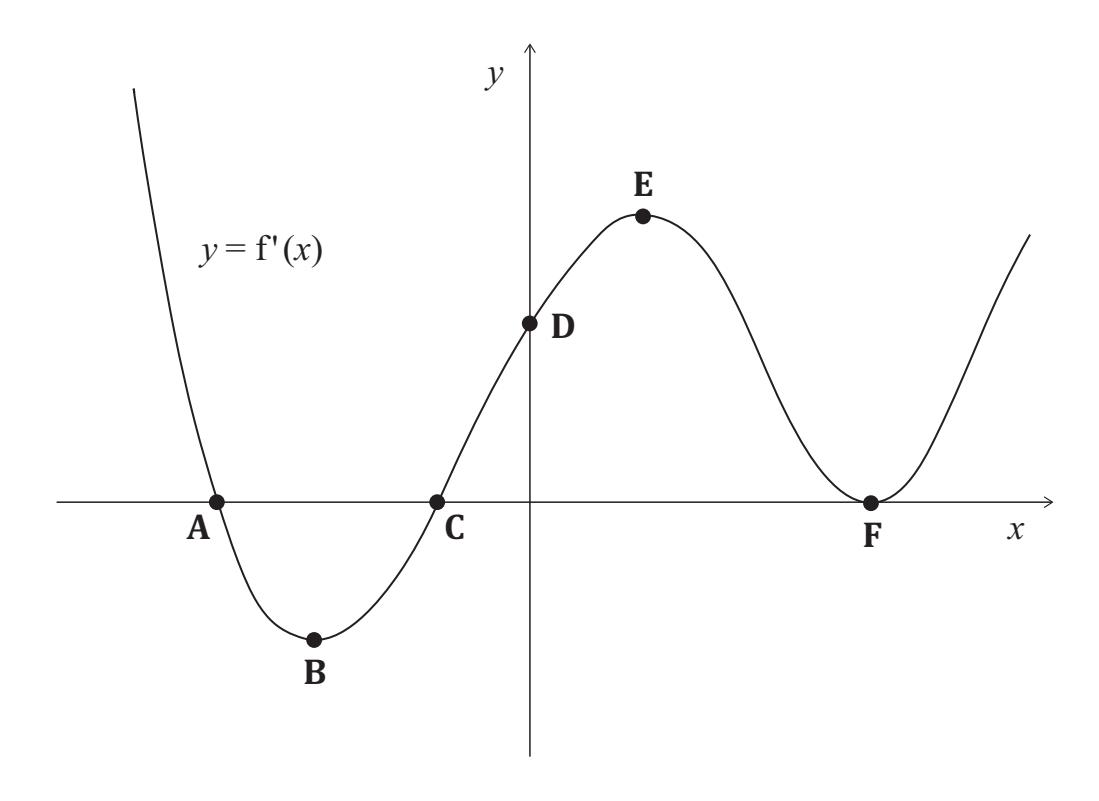
The function \(f(x)\) has derivative \(f'(x)\).
The diagram below shows the graph of \(y = f'(x)\).
Which point corresponds to a local minimum of \(f(x)\)?
The diagram below shows the graph of \(y = f'(x)\).
Which point corresponds to a local minimum of \(f(x)\)?
Question 14
The line \(y = m x + 4\) passes through the points \((3, \log_2 p)\) and \((\log_2 p, 4)\).
What are the possible values of \(p\)?
What are the possible values of \(p\)?
Question 15
Find the sum of the real solutions of the equation:
\(3^x - (\sqrt{3})^{x+4} + 20 = 0\)
\(3^x - (\sqrt{3})^{x+4} + 20 = 0\)
Question 16
The curve \(C\) has equation \(y = x^2 + b x + 2\), where \(b \geq 0\).
Find the value of \(b\) that minimises the distance between the origin and the stationary point of the curve \(C\).
Find the value of \(b\) that minimises the distance between the origin and the stationary point of the curve \(C\).
Question 17
There are two sets of data: the mean of the first set is 15, and the mean of the second set is 20.
One of the pieces of data from the first set is exchanged with one of the pieces of data from the second set.
As a result, the mean of the first set of data increases from 15 to 16, and the mean of the second set of data decreases from 20 to 17.
What is the mean of the set made by combining all the data?
Question 18
What is the smallest positive value of \(a\) for which the line \(x = a\) is a line of symmetry of the graph of \(y = \sin\left(2x - \dfrac{4 \pi}{3}\right)\)?
Question 19
A triangle \(A B C\) is to be drawn with \(A B = 10\) cm, \(B C = 7\) cm and the angle at \(A\) equal to \(\theta\), where \(\theta\) is a certain specified angle.
Of the two possible triangles that could be drawn, the larger triangle has three times the area of the smaller one.
What is the value of \(\cos \theta\)?
Of the two possible triangles that could be drawn, the larger triangle has three times the area of the smaller one.
What is the value of \(\cos \theta\)?
Question 20
Find the value of \(\sin^2 0^{\circ} + \sin^2 1^{\circ} + \sin^2 2^{\circ} + \sin^2 3^{\circ} + ... + \sin^2 87^{\circ} + \sin^2 88^{\circ} + \sin^2 89^{\circ} + \sin^2 90^{\circ}\)