나가기

AMC 12A

25문제

75:00
0 / 25
1 Algebra · Level 1
Andy and Betsy both live in Mathville. Andy leaves Mathville on his bicycle at 1:30, traveling due north at a steady 8 miles per hour. Betsy leaves on her bicycle from the same point at 2:30, traveling due east at a steady 12 miles per hour. At what time will they be exactly the same distance from their common starting point?
A
3:30
B
3:45
C
4:00
D
4:15
E
4:30
2 Algebra · Level 1
A box contains 10 pounds of a nut mix that is 50 percent peanuts, 20 percent cashews, and 30 percent almonds. A second nut mix containing 20 percent peanuts, 40 percent cashews, and 40 percent almonds is added to the box resulting in a new nut mix that is 40 percent peanuts. How many pounds of cashews are now in the box?
A
3.5
B
4
C
4.5
D
5
E
6
3 Algebra · Level 2
A team of students is going to compete against a team of teachers in a trivia contest. The total number of students and teachers is 15. Ash, a cousin of one of the students, wants to join the contest. If Ash plays with the students, the average age on that team will increase from 12 to 14. If Ash plays with the teachers, the average age on that team will decrease from 55 to 52. How old is Ash?
A
28
B
29
C
30
D
32
E
33
4 Logic · Level 2
Agnes writes the following four statements on a blank piece of paper. • At least one of these statements is true. • At least two of these statements are true. • At least two of these statements are false. • At least one of these statements is false. Each statement is either true or false. How many false statements did Agnes write on the paper?
A
0
B
1
C
2
D
3
E
4
5 Geometry · Level 2
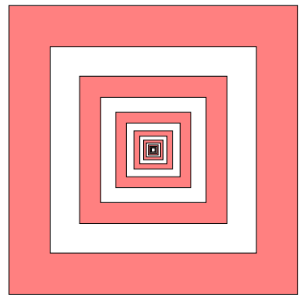
In the figure below, the outside square contains infinitely many squares, each of them with the same center and sides parallel to the outside square. The ratio of the side length of a square to the side length of the next inner square is \(k\), where \(0 < k < 1\). The spaces between squares are alternately shaded, as shown in the figure (which is not necessarily drawn to scale). The area of the shaded portion of the figure is 64% of the area of the original square. What is \(k\)?
문제 이미지
A
\(\dfrac{3}{5}\)
B
\(\dfrac{16}{25}\)
C
\(\dfrac{2}{3}\)
D
\(\dfrac{3}{4}\)
E
\(\dfrac{4}{5}\)
6 Counting · Level 2
Six chairs are arranged around a round table. Two students and two teachers randomly select four of the chairs to sit in. What is the probability that the two students will sit in two adjacent chairs and the two teachers will also sit in two adjacent chairs?
A
\(\dfrac{1}{6}\)
B
\(\dfrac{1}{5}\)
C
\(\dfrac{2}{9}\)
D
\(\dfrac{3}{13}\)
E
\(\dfrac{1}{4}\)
7 Algebra · Level 2
In a certain alien world, the maximum running speed \(v\) of an organism is dependent on its number of toes \(n\) and number of eyes \(m\). The relationship can be expressed as \(v = k n^a m^b\) centimeters per hour, where \(k\), \(a\), and \(b\) are integer constants. In a population where all organisms have 5 toes, \(\log v = 4 + 2\log m\); and in a population where all organisms have 25 eyes, \(\log v = 4 + 4\log n\), where the logarithms are base 10. What is \(k + a + b\)?
A
20
B
21
C
22
D
23
E
24
8 Geometry · Level 3
Pentagon \(A B C D E\) is inscribed in a circle, and \(\angle B E C = \angle C E D = 30^{\circ}\). Let \(\overline{A C}\) and \(\overline{B D}\) intersect at point \(F\), and suppose that \(A B = 9\) and \(A D = 24\). What is \(B F\)?
A
\(\dfrac{57}{11}\)
B
\(\dfrac{59}{11}\)
C
\(\dfrac{60}{11}\)
D
\(\dfrac{61}{11}\)
E
\(\dfrac{63}{11}\)
9 Algebra · Level 3
Let \(w\) be the complex number \(2 + i\), where \(i = \sqrt{-1}\). What real number \(r\) has the property that \(r\), \(w\), and \(w^2\) are three collinear points in the complex plane?
A
\(\dfrac{3}{4}\)
B
1
C
\(\dfrac{7}{5}\)
D
\(\dfrac{3}{2}\)
E
\(\dfrac{5}{3}\)
10 Geometry · Level 3
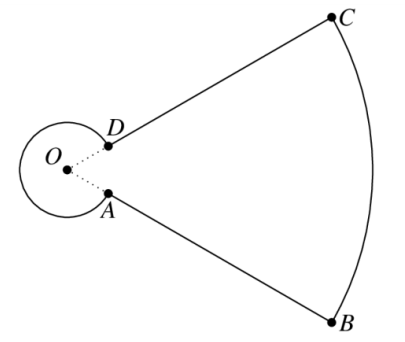
In the figure shown below, major arc \(\widehat{A D}\) and minor arc \(\widehat{B C}\) have the same center, \(O\). Also, \(A\) lies between \(O\) and \(B\), and \(D\) lies between \(O\) and \(C\). Major arc \(\widehat{A D}\), minor arc \(\widehat{B C}\), and each of the two segments \(\overline{A B}\) and \(\overline{C D}\) have length \(2\pi\). What is the distance from \(O\) to \(A\)?
문제 이미지
A
1
B
\(1 - \pi + \sqrt{\pi^2 + 1}\)
C
\(\dfrac{\pi}{2}\)
D
\(\dfrac{\sqrt{\pi^2 + 1}}{2}\)
E
2
11 Geometry · Level 3
The orthocenter of a triangle is the concurrent intersection of the three (possibly extended) altitudes. What is the sum of the coordinates of the orthocenter of the triangle whose vertices are \(A(2, 31)\), \(B(8, 27)\), and \(C(18, 27)\)?
A
5
B
17
C
\(10 + 4\sqrt{17} + 2\sqrt{13}\)
D
\(\dfrac{113}{3}\)
E
54
12 Algebra · Level 3
The harmonic mean of a collection of numbers is the reciprocal of the arithmetic mean of the reciprocals of the numbers in the collection. For example, the harmonic mean of 4, 4, 5 is \(\dfrac{1}{\dfrac{1}{3}\left(\dfrac{1}{4}+\dfrac{1}{4}+\dfrac{1}{5}\right)} = \dfrac{30}{7}\). What is the harmonic mean of all the real roots of the 4050th degree polynomial \(\displaystyle\prod_{k=1}^{2025}(k x^2-4x-3) = (x^2-4x-3)(2x^2-4x-3)(3x^2-4x-3)...(2025x^2-4x-3)\)?
A
\(-\dfrac{5}{3}\)
B
\(-\dfrac{3}{2}\)
C
\(-\dfrac{6}{5}\)
D
\(-\dfrac{5}{6}\)
E
\(-\dfrac{2}{3}\)
13 Counting · Level 3
Let \(C = \{1, 2, 3, ..., 13\}\). Let \(N\) be the greatest integer such that there exists a subset of \(C\) with \(N\) elements that does not contain five consecutive integers. Suppose \(N\) integers are chosen at random from \(C\) without replacement. What is the probability that the chosen elements do not include five consecutive integers?
A
\(\dfrac{3}{130}\)
B
\(\dfrac{3}{143}\)
C
\(\dfrac{5}{143}\)
D
\(\dfrac{1}{26}\)
E
\(\dfrac{5}{78}\)
14 Geometry · Level 4
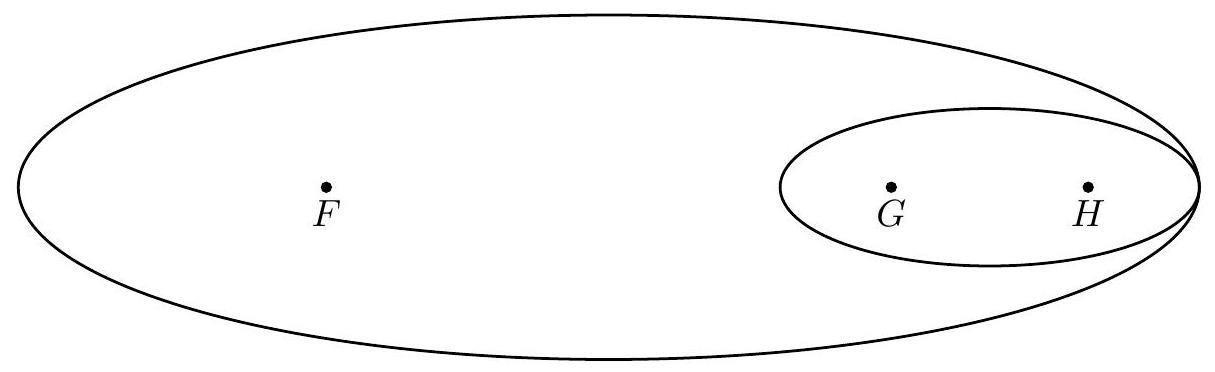
Points \(F\), \(G\), and \(H\) are collinear with \(G\) between \(F\) and \(H\). The ellipse with foci at \(G\) and \(H\) is internally tangent to the ellipse with foci at \(F\) and \(G\), as shown below. The two ellipses have the same eccentricity \(e\), and the ratio of their areas is 2025. (Recall that the eccentricity of an ellipse is \(e = \dfrac{c}{a}\), where \(c\) is the distance from the center to a focus, and \(2a\) is the length of the major axis.) What is \(e\)?
문제 이미지
A
\(\dfrac{3}{5}\)
B
\(\dfrac{16}{25}\)
C
\(\dfrac{4}{5}\)
D
\(\dfrac{22}{23}\)
E
\(\dfrac{44}{45}\)
15 Number Theory · Level 3
A set of numbers is called sum-free if whenever \(x\) and \(y\) are (not necessarily distinct) elements of the set, \(x + y\) is not an element of the set. For example, \(\{1, 4, 6\}\) and the empty set are sum-free, but \(\{2, 4, 5\}\) is not. What is the greatest possible number of elements in a sum-free subset of \(\{1, 2, 3, ..., 20\}\)?
A
8
B
9
C
10
D
11
E
12
16 Geometry · Level 3
Triangle \(\triangle A B C\) has side lengths \(A B = 80\), \(B C = 45\), and \(A C = 75\). The bisector \(\angle B\) and the altitude to side \(\overline{A B}\) intersect at point \(P\). What is \(B P\)?
A
18
B
19
C
20
D
21
E
22
17 Algebra · Level 3
The polynomial \((z + i)(z + 2i)(z + 3i) + 10\) has three roots in the complex plane, where \(i = \sqrt{-1}\). What is the area of the triangle formed by these three roots?
A
6
B
8
C
10
D
12
E
14
18 Number Theory · Level 4
How many ordered triples \((x, y, z)\) of different positive integers less than or equal to 8 satisfy \(x y > z\), \(x z > y\), and \(y z > x\)?
A
36
B
84
C
186
D
336
E
486
19 Algebra · Level 4
Let \(a\), \(b\), and \(c\) be the roots of the polynomial \(x^3 + k x + 1\). What is the sum \(a^3b^2 + a^2b^3 + b^3c^2 + b^2c^3 + c^3a^2 + c^2a^3\)?
A
\(-k\)
B
\(-k+1\)
C
1
D
\(k-1\)
E
\(k\)
20 Geometry · Level 4
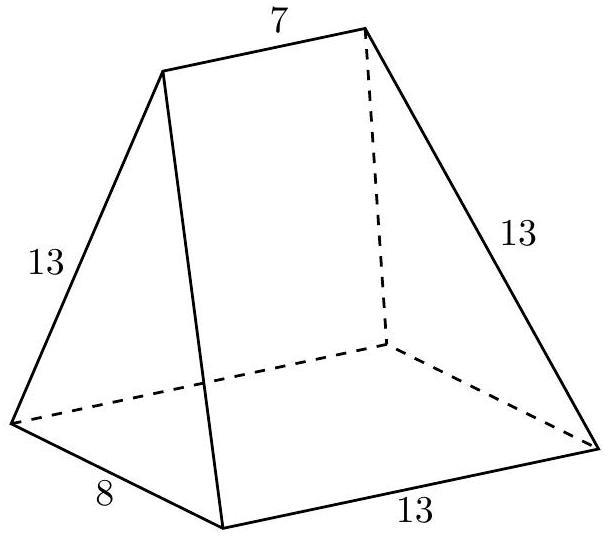
The base of the pentahedron shown below is a \(13 \times 8\) rectangle, and its lateral faces are two isosceles triangles with base of length 8 and congruent sides of length 13, and two isosceles trapezoids with bases of length 7 and 13 and nonparallel sides of length 13. What is the volume of the pentahedron?
문제 이미지
A
416
B
520
C
528
D
676
E
832
21 Algebra · Level 4
There is a unique ordered triple \((a, k, m)\) of nonnegative integers such that \(\dfrac{4^a + 4^{a+k} + 4^{a+2k} + ... + 4^{a+m k}}{2^a + 2^{a+k} + 2^{a+2k} + ... + 2^{a+m k}} = 964\). What is \(a + k + m\)?
A
8
B
9
C
10
D
11
E
12
22 Counting · Level 4
Three real numbers are chosen independently and uniformly at random between 0 and 1. What is the probability that the greatest of these three numbers is greater than 2 times each of the other two numbers? (In other words, if the chosen numbers are \(a \geq b \geq c\), then \(a > 2b\).)
A
\(\dfrac{1}{12}\)
B
\(\dfrac{1}{9}\)
C
\(\dfrac{1}{8}\)
D
\(\dfrac{1}{6}\)
E
\(\dfrac{1}{4}\)
23 Counting · Level 4
Call a positive integer fair if no digit is used more than once, it has no 0s, and no digit is adjacent to two greater digits. For example, 196, 23, and 12463 are fair, but 1546, 320, and 34321 are not. How many fair positive integers are there?
A
511
B
2584
C
9841
D
17711
E
19682
24 Geometry · Level 5
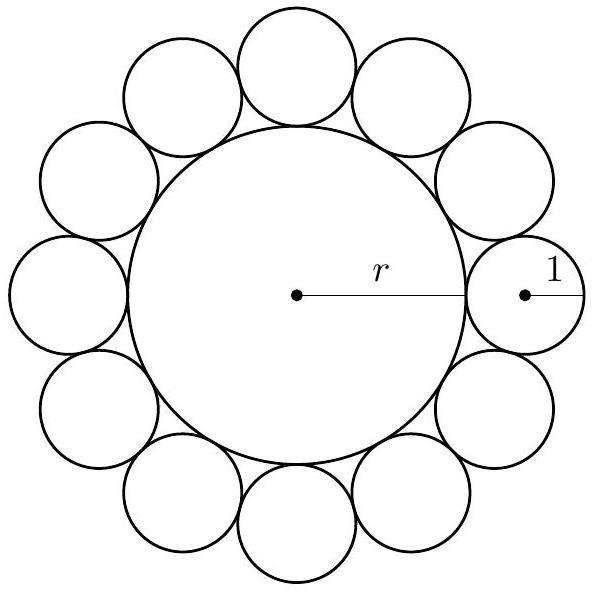
A circle of radius \(r\) is surrounded by 12 circles of radius 1 externally tangent to the central circle and sequentially tangent to each other, as shown. Then \(r\) can be written as \(\sqrt{a} + \sqrt{b} + c\), where \(a\), \(b\), \(c\) are integers. What is \(a + b + c\)?
문제 이미지
A
3
B
5
C
7
D
9
E
11
25 Algebra · Level 5
Polynomials \(P(x)\) and \(Q(x)\) each have degree 3 and leading coefficient 1, and their roots are all elements of \(\{1, 2, 3, 4, 5\}\). The function \(f(x) = \dfrac{P(x)}{Q(x)}\) has the property that there exist real numbers \(a < b < c < d\) such that the set of all real numbers \(x\) such that \(f(x) \leq 0\) consists of the closed interval \([a, b]\) together with the open interval \((c, d)\). How many functions \(f(x)\) are possible?
A
7
B
9
C
11
D
12
E
13

답변 완료: 0 / 25