Stewart Precalc 6e Section 2.4: Average Rate of Change of a Function

32 questions

--:--
0 / 32
Stewart Precalc 6e Section 2.4: Average Rate of Change of a Function 0/32
1 Concept Review · Level 1
If you travel 100 miles in two hours, then your average speed for the trip is average speed = ____ = ____
2 Concept Review · Level 1
The average rate of change of a function \(f\) between \(x = a\) and \(x = b\) is average rate of change = ____
3 Concept Review · Level 1
The average rate of change of the function \(f(x) = x^2\) between \(x = 1\) and \(x = 5\) is average rate of change = ____ = ____
4 Concept Review · Level 1
(a) The average rate of change of a function \(f\) between \(x = a\) and \(x = b\) is the slope of the ____ line between \((a, f(a))\) and \((b, f(b))\).
(b) The average rate of change of the linear function \(f(x) = 3 x + 5\) between any two points is ____.

Enter your answer directly below each part above.

5 Average Rate of Change · Level 2
\(f(x) = 3 x - 2\); \(x = 2\), \(x = 3\)
6 Average Rate of Change · Level 2
\(g(x) = 5 + \dfrac{1}{2} x\); \(x = 1\), \(x = 5\)
7 Average Rate of Change · Level 2
\(h(t) = t^2 + 2 t\); \(t = -1\), \(t = 4\)
8 Average Rate of Change · Level 2
\(f(z) = 1 - 3 z^2\); \(z = -2\), \(z = 0\)
9 Average Rate of Change · Level 2
\(f(x) = x^3 - 4 x^2\); \(x = 0\), \(x = 10\)
10 Average Rate of Change · Level 2
\(f(x) = x + x^4\); \(x = -1\), \(x = 3\)
11 Average Rate of Change - Difference Quotient · Level 3
\(f(x) = 3 x^2\); \(x = 2\), \(x = 2 + h\)
12 Average Rate of Change - Difference Quotient · Level 3
\(f(x) = 4 - x^2\); \(x = 1\), \(x = 1 + h\)
13 Average Rate of Change - Difference Quotient · Level 3
\(g(x) = \dfrac{1}{x}\); \(x = 1\), \(x = a\)
14 Average Rate of Change - Difference Quotient · Level 3
\(g(x) = \dfrac{2}{x + 1}\); \(x = 0\), \(x = h\)
15 Average Rate of Change - Difference Quotient · Level 3
\(f(t) = \dfrac{2}{t}\); \(t = a\), \(t = a + h\)
16 Average Rate of Change - Difference Quotient · Level 3
\(f(t) = \sqrt{t}\); \(t = a\), \(t = a + h\)
17 Linear Function - Constant Rate of Change · Level 3
A linear function is given.
(a) Find the average rate of change of the function between \(x = a\) and \(x = a + h\).
(b) Show that the average rate of change is the same as the slope of the line. \(f(x) = \dfrac{1}{2} x + 3\)

Enter your answer directly below each part above.

18 Linear Function - Constant Rate of Change · Level 3
A linear function is given.
(a) Find the average rate of change of the function between \(x = a\) and \(x = a + h\).
(b) Show that the average rate of change is the same as the slope of the line. \(g(x) = -4 x + 2\)

Enter your answer directly below each part above.

19 Application - Changing Water Levels · Level 2
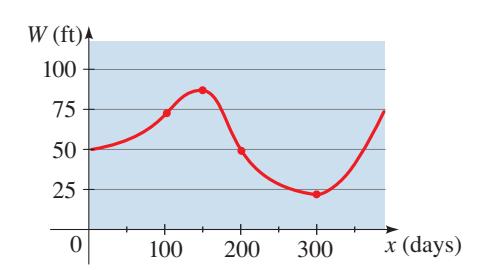
Changing Water Levels. The graph shows the depth of water \(W\) in a reservoir over a one-year period as a function of the number of days \(x\) since the beginning of the year. What was the average rate of change of \(W\) between \(x = 100\) and \(x = 200\)?
question image
20 Application - Population Growth and Decline · Level 2
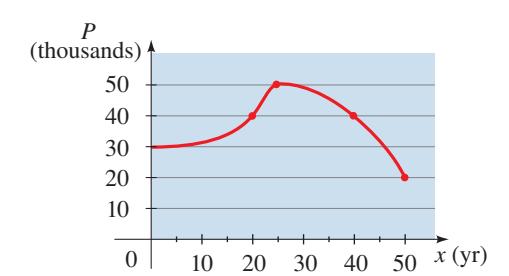
Population Growth and Decline. The graph shows the population \(P\) in a small industrial city from 1950 to 2000. The variable \(x\) represents the number of years since 1950.
question image
(a) What was the average rate of change of \(P\) between \(x = 20\) and \(x = 40\)?
(b) Interpret the value of the average rate of change that you found in part (a).

Enter your answer directly below each part above.

21 Application - Population Growth and Decline · Level 2
Population Growth and Decline. The table gives the population in a small coastal community for the period 1997–2006. Figures shown are for January 1 in each year. Year: Population 1997: 624 1998: 856 1999: 1336 2000: 1578 2001: 1591 2002: 1483 2003: 994 2004: 826 2005: 801 2006: 745
(a) What was the average rate of change of population between 1998 and 2001?
(b) What was the average rate of change of population between 2002 and 2004?
(c) For what period of time was the population increasing?
(d) For what period of time was the population decreasing?

Enter your answer directly below each part above.

22 Application - CD Player Sales · Level 2
CD Player Sales. The table shows the number of CD players sold in a small electronics store in the years 1993–2003. Year: CD players sold 1993: 512 1994: 520 1995: 413 1996: 410 1997: 468 1998: 510 1999: 590 2000: 607 2001: 732 2002: 612 2003: 584
(a) What was the average rate of change of sales between 1993 and 2003?
(b) What was the average rate of change of sales between 1993 and 1994?
(c) What was the average rate of change of sales between 1994 and 1996?
(d) Between which two successive years did CD player sales increase most quickly? Decrease most quickly?

Enter your answer directly below each part above.

23 Application - Book Collection · Level 2
Book Collection. Between 1980 and 2000, a rare book collector purchased books for his collection at the rate of 40 books per year. Use this information to complete the following table. (Note that not every year is given in the table.) Year: Number of books 1980: 420 1981: 460 1982: ____ 1985: ____ 1990: ____ 1992: ____ 1995: ____ 1997: ____ 1998: ____ 1999: ____ 2000: 1220
24 Application - Cooling Soup · Level 2
Cooling Soup. When a bowl of hot soup is left in a room, the soup eventually cools down to room temperature. The temperature \(T\) of the soup is a function of time \(t\). The table gives the temperature (in \(^{\circ}\)F) of a bowl of soup \(t\) minutes after it was set on the table. \(t\) (min): \(T\) (\(^{\circ}\)F) 0: 200 5: 172 10: 150 15: 133 20: 119 25: 108 30: 100 35: 94 40: 89 50: 81 60: 77 90: 72 120: 70 150: 70 Find the average rate of change of the temperature of the soup over the first 20 minutes and over the next 20 minutes. During which interval did the soup cool off more quickly?
25 Application - Number of Farms · Level 2
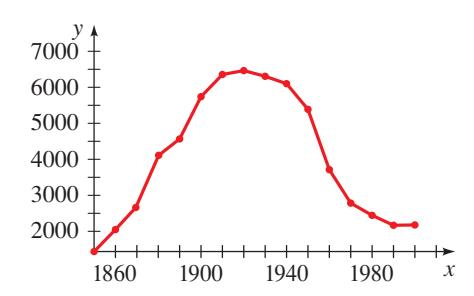
The graph shows the number of farms in the United States from 1860 to 2000.
question image
(a) Estimate the average rate of change in the number of farms between (i) 1860 and 1890 and (ii) 1950 and 1970.
(b) In which decade did the number of farms experience the greatest average rate of decline?

Enter your answer directly below each part above.

26 Discovery - 100-Meter Race · Level 3
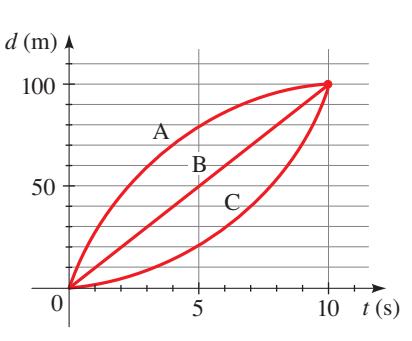
100-Meter Race. A 100-m race ends in a three-way tie for first place. The graph shows distance as a function of time for each of the three winners.
question image
(a) Find the average speed for each winner.
(b) Describe the differences between the ways in which the three runners ran the race.

Enter your answer directly below each part above.

27 Discovery - Linear Functions Have Constant Rate of Change · Level 4
Linear Functions Have Constant Rate of Change. If \(f(x) = m x + b\) is a linear function, then the average rate of change of \(f\) between any two real numbers \(x_1\) and \(x_2\) is average rate of change \(= \dfrac{f(x_2) - f(x_1)}{x_2 - x_1}\) Calculate this average rate of change to show that it is the same as the slope \(m\).
28 Discovery - Functions with Constant Rate of Change Are Linear · Level 4
Functions with Constant Rate of Change Are Linear. If the function \(f\) has the same average rate of change \(c\) between any two points, then for the points \(a\) and \(x\) we have \(c = \dfrac{f(x) - f(a)}{x - a}\) Rearrange this expression to show that \(f(x) = c x + (f(a) - c a)\) and conclude that \(f\) is a linear function.
29 Example - Calculating the Average Rate of Change · Level 2
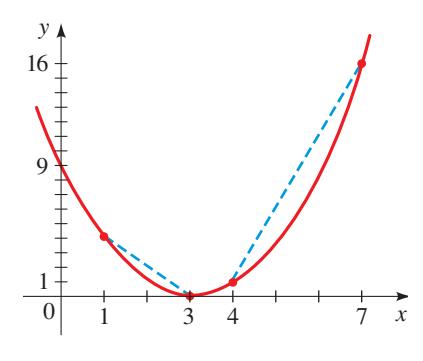
For the function \(f(x) = (x - 3)^2\), whose graph is shown in Figure 2, find the average rate of change between the following points: (a) \(x = 1\) and \(x = 3\). (b) \(x = 4\) and \(x = 7\).
question image
30 Example - Average Speed of a Falling Object · Level 3
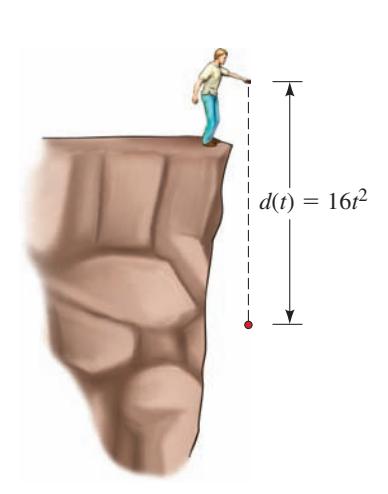
If an object is dropped from a high cliff or a tall building, then the distance it has fallen after \(t\) seconds is given by the function \(d(t) = 16 t^2\). Find its average speed (average rate of change) over the following intervals: (a) Between \(1\) s and \(5\) s. (b) Between \(t = a\) and \(t = a + h\).
question image
31 Example - Average Rate of Temperature Change · Level 2
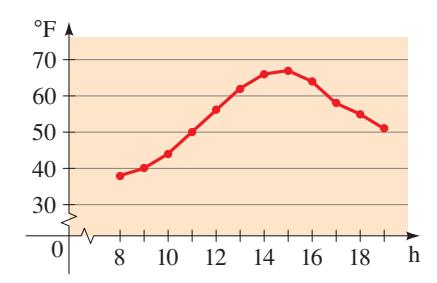
The table gives the outdoor temperatures observed by a science student on a spring day: 8:00 a.m. = 38°F, 9:00 a.m. = 40°F, 10:00 a.m. = 44°F, 11:00 a.m. = 50°F, 12:00 noon = 56°F, 1:00 p.m. = 62°F, 2:00 p.m. = 66°F, 3:00 p.m. = 67°F, 4:00 p.m. = 64°F, 5:00 p.m. = 58°F, 6:00 p.m. = 55°F, 7:00 p.m. = 51°F. Draw a graph of the data, and find the average rate of change of temperature between the following times: (a) 8:00 a.m. and 9:00 a.m. (b) 1:00 p.m. and 3:00 p.m. (c) 4:00 p.m. and 7:00 p.m.
question image
32 Example - Linear Functions Have Constant Rate of Change · Level 2
Let \(f(x) = 3 x - 5\). Find the average rate of change of \(f\) between the following points.
(a) \(x = 0\) and \(x = 1\)
(b) \(x = 3\) and \(x = 7\)
(c) \(x = a\) and \(x = a + h\) What conclusion can you draw from your answers?

Enter your answer directly below each part above.

Answered: 0 / 32