Stewart 9th Section 3.4: Limits at Infinity; Horizontal Asymptotes

89 questions

--:--
0 / 89
Stewart 9th Section 3.4: Limits at Infinity; Horizontal Asymptotes 0/89
1 Conceptual · Level 1
Explain in your own words the meaning of each of the following.
(a) \(\operatorname*{lim}\limits_{x \rightarrow \infty} f(x) = 5\)
(b) \(\operatorname*{lim}\limits_{x \rightarrow -\infty} f(x) = 3\)

Enter your answer directly below each part above.

2 Conceptual - asymptotes · Level 1
(a) Can the graph of \(y = f(x)\) intersect a vertical asymptote? Can it intersect a horizontal asymptote? Illustrate by sketching graphs.
(b) How many horizontal asymptotes can the graph of \(y = f(x)\) have? Sketch graphs to illustrate the possibilities.

Enter your answer directly below each part above.

3 Reading limits from graph · Level 2
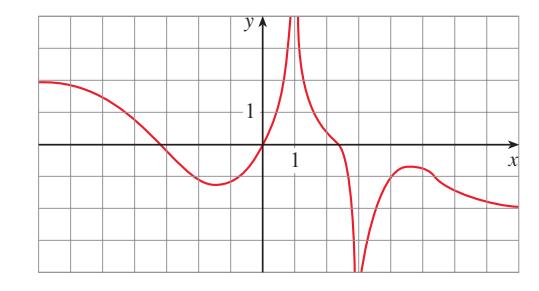
For the function \(f\) whose graph is given, state the following.
question image
(a) \(\operatorname*{lim}\limits_{x \rightarrow \infty} f(x)\)
(b) \(\operatorname*{lim}\limits_{x \rightarrow -\infty} f(x)\)
(c) \(\operatorname*{lim}\limits_{x \rightarrow 1} f(x)\)
(d) \(\operatorname*{lim}\limits_{x \rightarrow 3} f(x)\)
(e) The equations of the asymptotes

Enter your answer directly below each part above.

4 Reading limits from graph · Level 2
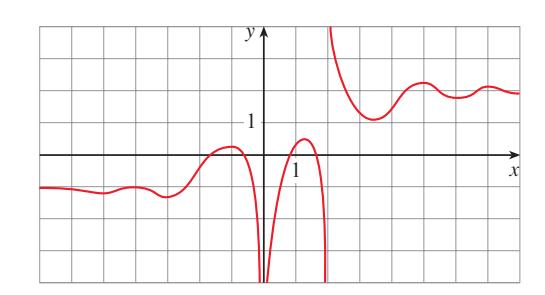
For the function \(g\) whose graph is given, state the following.
question image
(a) \(\operatorname*{lim}\limits_{x \rightarrow \infty} g(x)\)
(b) \(\operatorname*{lim}\limits_{x \rightarrow -\infty} g(x)\)
(c) \(\operatorname*{lim}\limits_{x \rightarrow 0} g(x)\)
(d) \(\operatorname*{lim}\limits_{x \rightarrow 2^-} g(x)\)
(e) \(\operatorname*{lim}\limits_{x \rightarrow 2^+} g(x)\)
(f) The equations of the asymptotes

Enter your answer directly below each part above.

5 Numerical estimation · Level 2
Guess the value of the limit \(\operatorname*{lim}\limits_{x \rightarrow \infty} \dfrac{x^2}{2^x}\) by evaluating the function \(f(x) = x^2 / 2^x\) for \(x = 0, 1, 2, 3, 4, 5, 6, 7, 8, 9, 10, 20, 50\), and \(100\). Then use a graph of \(f\) to support your guess.
6 Numerical estimation · Level 2
(a) Use a graph of \(f(x) = \left(1 - \dfrac{2}{x}\right)^x\) to estimate the value of \(\operatorname*{lim}\limits_{x \rightarrow \infty} f(x)\) correct to two decimal places.
(b) Use a table of values of \(f(x)\) to estimate the limit to four decimal places.

Enter your answer directly below each part above.

7 Justified limit · Level 2
Evaluate the limit and justify each step by indicating the appropriate properties of limits. \(\operatorname*{lim}\limits_{x \rightarrow \infty} \dfrac{2 x^2 - 7}{5 x^2 + x - 3}\)
8 Justified limit · Level 3
Evaluate the limit and justify each step by indicating the appropriate properties of limits. \(\operatorname*{lim}\limits_{x \rightarrow \infty} \sqrt{\dfrac{9 x^3 + 8 x - 4}{3 - 5 x + x^3}}\)
9 Limit at infinity · Level 1
\( \operatorname*{lim}\limits_{x \rightarrow \infty} \dfrac{4 x + 3}{5 x - 1} \)
10 Limit at infinity · Level 1
\( \operatorname*{lim}\limits_{x \rightarrow \infty} \dfrac{-2}{3 x + 7} \)
11 Limit at infinity · Level 2
\( \operatorname*{lim}\limits_{t \rightarrow -\infty} \dfrac{3 t^2 + t}{t^3 - 4 t + 1} \)
12 Limit at infinity · Level 2
\( \operatorname*{lim}\limits_{t \rightarrow -\infty} \dfrac{6 t^2 + t - 5}{9 - 2 t^2} \)
13 Limit at infinity · Level 2
\( \operatorname*{lim}\limits_{r \rightarrow \infty} \dfrac{r - r^3}{2 - r^2 + 3 r^3} \)
14 Limit at infinity · Level 2
\( \operatorname*{lim}\limits_{x \rightarrow \infty} \dfrac{3 x^3 - 8 x + 2}{4 x^3 - 5 x^2 - 2} \)
15 Limit at infinity · Level 2
\( \operatorname*{lim}\limits_{x \rightarrow \infty} \dfrac{4 - \sqrt{x}}{2 + \sqrt{x}} \)
16 Limit at infinity · Level 2
\( \operatorname*{lim}\limits_{u \rightarrow -\infty} \dfrac{(u^2 + 1)(2 u^2 - 1)}{(u^2 + 2)^2} \)
17 Limit at infinity · Level 2
\( \operatorname*{lim}\limits_{x \rightarrow \infty} \dfrac{\sqrt{x + 3 x^2}}{4 x - 1} \)
18 Limit at infinity · Level 2
\( \operatorname*{lim}\limits_{t \rightarrow \infty} \dfrac{t + 3}{\sqrt{2 t^2 - 1}} \)
19 Limit at infinity · Level 3
\( \operatorname*{lim}\limits_{x \rightarrow \infty} \dfrac{\sqrt{1 + 4 x^6}}{2 - x^3} \)
20 Limit at infinity · Level 3
\( \operatorname*{lim}\limits_{x \rightarrow -\infty} \dfrac{\sqrt{1 + 4 x^6}}{2 - x^3} \)
21 Limit at infinity · Level 2
\( \operatorname*{lim}\limits_{x \rightarrow -\infty} \dfrac{2 x^5 - x}{x^4 + 3} \)
22 Limit at infinity · Level 2
\( \operatorname*{lim}\limits_{q \rightarrow \infty} \dfrac{q^3 + 6 q - 4}{4 q^2 - 3 q + 3} \)
23 Limit at infinity · Level 1
\( \operatorname*{lim}\limits_{x \rightarrow \infty} \cos x \)
24 Limit at infinity · Level 2
\( \operatorname*{lim}\limits_{x \rightarrow -\infty} \dfrac{1 + x^6}{x^4 + 1} \)
25 Difference of radicals · Level 3
\( \operatorname*{lim}\limits_{t \rightarrow \infty} (\sqrt{25 t^2 + 2} - 5 t) \)
26 Sum involving radicals · Level 3
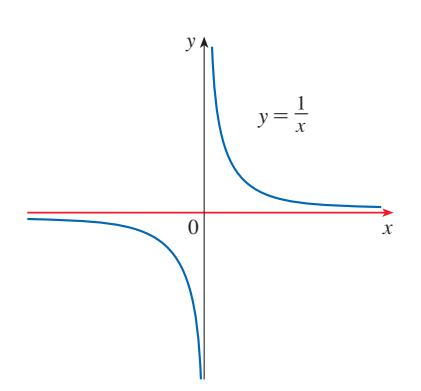
\( \operatorname*{lim}\limits_{x \rightarrow -\infty} (\sqrt{4 x^2 + 3 x} + 2 x) \)
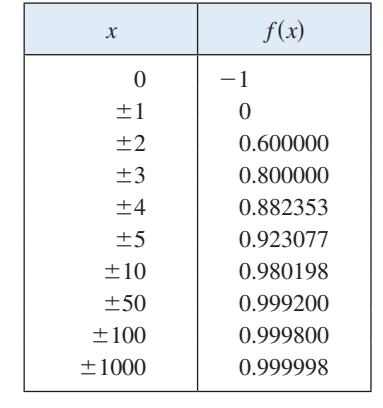
27 Difference of radicals · Level 3
\( \operatorname*{lim}\limits_{x \rightarrow \infty} (\sqrt{x^2 + a x} - \sqrt{x^2 + b x}) \)
28 Limit at infinity · Level 1
\( \operatorname*{lim}\limits_{x \rightarrow \infty} (x - \sqrt{x}) \)
29 Limit at infinity · Level 2
\( \operatorname*{lim}\limits_{x \rightarrow -\infty} (x^2 + 2 x^7) \)
30 Squeeze theorem · Level 2
\( \operatorname*{lim}\limits_{x \rightarrow \infty} \dfrac{\sin^2 x}{x^2 + 1} \)
31 Substitution limit · Level 2
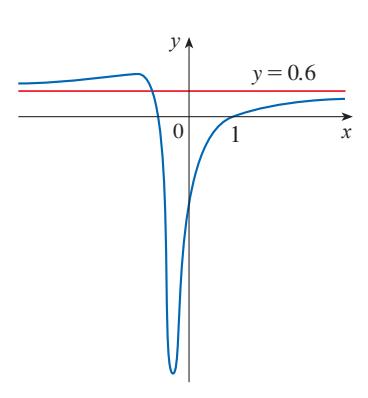
\( \operatorname*{lim}\limits_{x \rightarrow \infty} x \sin \dfrac{1}{x} \)
32 Substitution limit · Level 2
\( \operatorname*{lim}\limits_{x \rightarrow \infty} \sqrt{x} \sin \dfrac{1}{x} \)
33 Limit estimation and proof · Level 3
(a) Estimate the value of \(\operatorname*{lim}\limits_{x \rightarrow -\infty} (\sqrt{x^2 + x + 1} + x)\) by graphing the function \(f(x) = \sqrt{x^2 + x + 1} + x\).
(b) Use a table of values of \(f(x)\) to guess the value of the limit.
(c) Prove that your guess is correct.

Enter your answer directly below each part above.

34 Limit estimation and proof · Level 3
(a) Use a graph of \(f(x) = \sqrt{3 x^2 + 8 x + 6} - \sqrt{3 x^2 + 3 x + 1}\) to estimate the value of \(\operatorname*{lim}\limits_{x \rightarrow \infty} f(x)\) to one decimal place.
(b) Use a table of values of \(f(x)\) to estimate the limit to four decimal places.
(c) Find the exact value of the limit.

Enter your answer directly below each part above.

35 Asymptotes · Level 2
Find the horizontal and vertical asymptotes of each curve. \(y = \dfrac{5 + 4 x}{x + 3}\)
36 Asymptotes · Level 2
Find the horizontal and vertical asymptotes of each curve. \(y = \dfrac{2 x^2 + 1}{3 x^2 + 2 x - 1}\)
37 Asymptotes · Level 2
Find the horizontal and vertical asymptotes of each curve. \(y = \dfrac{2 x^2 + x - 1}{x^2 + x - 2}\)
38 Asymptotes · Level 2
Find the horizontal and vertical asymptotes of each curve. \(y = \dfrac{1 + x^4}{x^2 - x^4}\)
39 Asymptotes · Level 3
Find the horizontal and vertical asymptotes of each curve. \(y = \dfrac{x^3 - x}{x^2 - 6 x + 5}\)
40 Asymptotes · Level 3
Find the horizontal and vertical asymptotes of each curve. \(y = \dfrac{x - 9}{\sqrt{4 x^2 + 3 x + 2}}\)
41 Estimating asymptote · Level 3
Estimate the horizontal asymptote of the function \(f(x) = \dfrac{3 x^3 + 500 x^2}{x^3 + 500 x^2 + 100 x + 2000}\) by graphing \(f\) for \(-10 \leq x \leq 10\). Then calculate the equation of the asymptote by evaluating the limit. How do you explain the discrepancy?
42 Asymptotes by graph · Level 3
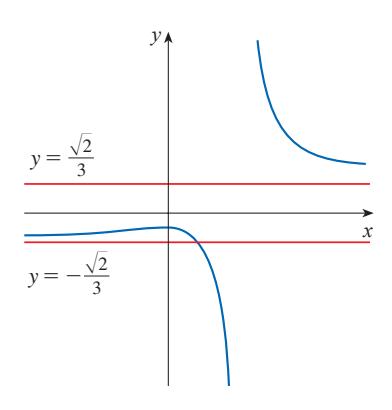
(a) Graph the function \(f(x) = \dfrac{\sqrt{2 x^2 + 1}}{3 x - 5}\). How many horizontal and vertical asymptotes do you observe? Use the graph to estimate the values of the limits \(\operatorname*{lim}\limits_{x \rightarrow \infty} \dfrac{\sqrt{2 x^2 + 1}}{3 x - 5}\) and \(\operatorname*{lim}\limits_{x \rightarrow -\infty} \dfrac{\sqrt{2 x^2 + 1}}{3 x - 5}\).
(b) By calculating values of \(f(x)\), give numerical estimates of the limits in part (a).
(c) Calculate the exact values of the limits in part (a).

Enter your answer directly below each part above.

43 Polynomial ratios · Level 2
Let \(P\) and \(Q\) be polynomials. Find \(\operatorname*{lim}\limits_{x \rightarrow \infty} \dfrac{P(x)}{Q(x)}\) if the degree of \(P\) is (a) less than the degree of \(Q\) and (b) greater than the degree of \(Q\).
44 Power functions · Level 2
Make a rough sketch of the curve \(y = x^n\) (\(n\) an integer) for the following five cases: (i) \(n = 0\) (ii) \(n > 0\), \(n\) odd (iii) \(n > 0\), \(n\) even (iv) \(n < 0\), \(n\) odd (v) \(n < 0\), \(n\) even Then use these sketches to find the following limits.
(a) \(\operatorname*{lim}\limits_{x \rightarrow 0^+} x^n\)
(b) \(\operatorname*{lim}\limits_{x \rightarrow 0^-} x^n\)
(c) \(\operatorname*{lim}\limits_{x \rightarrow \infty} x^n\)
(d) \(\operatorname*{lim}\limits_{x \rightarrow -\infty} x^n\)

Enter your answer directly below each part above.

45 Build a function · Level 3
Find a formula for a function \(f\) that satisfies the following conditions: \(\operatorname*{lim}\limits_{x \rightarrow \pm \infty} f(x) = 0\), \(\operatorname*{lim}\limits_{x \rightarrow 0} f(x) = -\infty\), \(f(2) = 0\), \(\operatorname*{lim}\limits_{x \rightarrow 3^-} f(x) = \infty\), \(\operatorname*{lim}\limits_{x \rightarrow 3^+} f(x) = -\infty\)
46 Build a function · Level 2
Find a formula for a function that has vertical asymptotes \(x = 1\) and \(x = 3\) and horizontal asymptote \(y = 1\).
47 Build a function · Level 4
A function \(f\) is a ratio of quadratic functions and has a vertical asymptote \(x = 4\) and just one \(x\)-intercept, \(x = 1\). It is known that \(f\) has a removable discontinuity at \(x = -1\) and \(\operatorname*{lim}\limits_{x \rightarrow -1} f(x) = 2\). Evaluate
(a) \(f(0)\)
(b) \(\operatorname*{lim}\limits_{x \rightarrow \infty} f(x)\)

Enter your answer directly below each part above.

48 Sketch from asymptotes · Level 3
Find the horizontal asymptotes of the curve and use them, together with concavity and intervals of increase and decrease, to sketch the curve. \(y = \dfrac{1 + 2 x^2}{1 + x^2}\)
49 Sketch from asymptotes · Level 3
Find the horizontal asymptotes of the curve and use them, together with concavity and intervals of increase and decrease, to sketch the curve. \(y = \dfrac{1 - x}{1 + x}\)
50 Sketch from asymptotes · Level 3
Find the horizontal asymptotes of the curve and use them, together with concavity and intervals of increase and decrease, to sketch the curve. \(y = \dfrac{x}{\sqrt{x^2 + 1}}\)
51 Sketch from asymptotes · Level 3
Find the horizontal asymptotes of the curve and use them, together with concavity and intervals of increase and decrease, to sketch the curve. \(y = \dfrac{x}{x^2 + 1}\)
52 Sketch using infinity limits · Level 2
Find the limits as \(x \rightarrow \infty\) and as \(x \rightarrow -\infty\). Use this information, together with intercepts, to give a rough sketch of the graph. \(y = 2 x^3 - x^4\)
53 Sketch using infinity limits · Level 2
Find the limits as \(x \rightarrow \infty\) and as \(x \rightarrow -\infty\). Use this information, together with intercepts, to give a rough sketch of the graph. \(y = x^4 - x^6\)
54 Sketch using infinity limits · Level 3
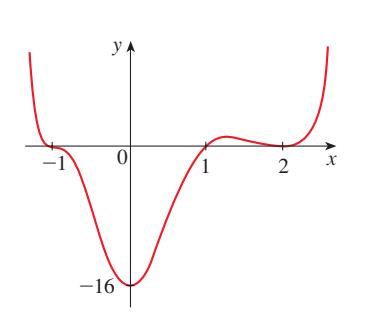
Find the limits as \(x \rightarrow \infty\) and as \(x \rightarrow -\infty\). Use this information, together with intercepts, to give a rough sketch of the graph. \(y = x^3 (x + 2)^2 (x - 1)\)
55 Sketch using infinity limits · Level 3
Find the limits as \(x \rightarrow \infty\) and as \(x \rightarrow -\infty\). Use this information, together with intercepts, to give a rough sketch of the graph. \(y = (3 - x)(1 + x)^2 (1 - x)^4\)
56 Sketch using infinity limits · Level 3
Find the limits as \(x \rightarrow \infty\) and as \(x \rightarrow -\infty\). Use this information, together with intercepts, to give a rough sketch of the graph. \(y = x^2 (x^2 - 1)^2 (x + 2)\)
57 Sketch from conditions · Level 2
Sketch the graph of a function that satisfies all of the given conditions. \(f(2) = 4\), \(f(-2) = -4\), \(\operatorname*{lim}\limits_{x \rightarrow -\infty} f(x) = 0\), \(\operatorname*{lim}\limits_{x \rightarrow \infty} f(x) = 2\)
58 Sketch from conditions · Level 3
Sketch the graph of a function that satisfies all of the given conditions. \(\operatorname*{lim}\limits_{x \rightarrow -\infty} f(x) = -\infty\), \(\operatorname*{lim}\limits_{x \rightarrow -2^-} f(x) = \infty\), \(\operatorname*{lim}\limits_{x \rightarrow -2^+} f(x) = -\infty\), \(\operatorname*{lim}\limits_{x \rightarrow 0} f(x) = \infty\), \(\operatorname*{lim}\limits_{x \rightarrow \infty} f(x) = \infty\)
59 Sketch from conditions · Level 3
Sketch the graph of a function that satisfies all of the given conditions. \(f'(2) = 0\), \(f(2) = -1\), \(f(0) = 0\), \(f'(x) < 0\) if \(0 < x < 2\), \(f'(x) > 0\) if \(x > 2\), \(f''(x) < 0\) if \(0 \leq x < 1\) or if \(x > 4\), \(f''(x) > 0\) if \(1 < x < 4\), \(\operatorname*{lim}\limits_{x \rightarrow \infty} f(x) = 1\), \(f(-x) = f(x)\) for all \(x\)
60 Sketch from conditions · Level 3
Sketch the graph of a function that satisfies all of the given conditions. \(f'(2) = 0\), \(f'(0) = 1\), \(f'(x) > 0\) if \(0 < x < 2\), \(f'(x) < 0\) if \(x > 2\), \(f''(x) < 0\) if \(0 < x < 4\), \(f''(x) > 0\) if \(x > 4\), \(\operatorname*{lim}\limits_{x \rightarrow \infty} f(x) = 0\), \(f(-x) = -f(x)\) for all \(x\)
61 Sketch from conditions · Level 3
Sketch the graph of a function that satisfies all of the given conditions. \(f(1) = f'(1) = 0\), \(\operatorname*{lim}\limits_{x \rightarrow 2^+} f(x) = \infty\), \(\operatorname*{lim}\limits_{x \rightarrow 2^-} f(x) = -\infty\), \(\operatorname*{lim}\limits_{x \rightarrow -\infty} f(x) = \infty\), \(\operatorname*{lim}\limits_{x \rightarrow \infty} f(x) = 0\), \(f''(x) > 0\) for \(x > 2\), \(f''(x) < 0\) for \(x < 0\) and for \(0 < x < 2\)
62 Sketch from conditions · Level 3
Sketch the graph of a function that satisfies all of the given conditions. \(g(0) = 0\), \(g''(x) < 0\) for \(x \neq 0\), \(\operatorname*{lim}\limits_{x \rightarrow -\infty} g(x) = \infty\), \(\operatorname*{lim}\limits_{x \rightarrow \infty} g(x) = -\infty\), \(\operatorname*{lim}\limits_{x \rightarrow 0^-} g'(x) = \infty\), \(\operatorname*{lim}\limits_{x \rightarrow 0^+} g'(x) = \infty\)
63 Squeeze theorem · Level 2
(a) Use the Squeeze Theorem to evaluate \(\operatorname*{lim}\limits_{x \rightarrow \infty} \dfrac{\sin x}{x}\).
(b) Graph \(f(x) = (\sin x)/x\). How many times does the graph cross the asymptote?

Enter your answer directly below each part above.

64 End behavior · Level 3
By the end behavior of a function we mean the behavior of its values as \(x \rightarrow \infty\) and as \(x \rightarrow -\infty\).
(a) Describe and compare the end behavior of the functions \(P(x) = 3 x^5 - 5 x^3 + 2 x\) and \(Q(x) = 3 x^5\) by graphing both functions in the viewing rectangles \([-2, 2]\) by \([-2, 2]\) and \([-10, 10]\) by \([-10000, 10000]\).
(b) Two functions are said to have the same end behavior if their ratio approaches \(1\) as \(x \rightarrow \infty\). Show that \(P\) and \(Q\) have the same end behavior.

Enter your answer directly below each part above.

65 Squeeze theorem application · Level 2
Find \(\operatorname*{lim}\limits_{x \rightarrow \infty} f(x)\) if \(\dfrac{4 x - 1}{x} < f(x) < \dfrac{4 x^2 + 3 x}{x^2}\) for all \(x > 5\).
66 Application - brine concentration · Level 2
(a) A tank contains \(5000\) L of pure water. Brine that contains \(30\) g of salt per liter of water is pumped into the tank at a rate of \(25\) L/min. Show that the concentration of salt after \(t\) minutes (in grams per liter) is \(C(t) = \dfrac{30 t}{200 + t}\).
(b) What happens to the concentration as \(t \rightarrow \infty\)?

Enter your answer directly below each part above.

67 Epsilon-N graph · Level 3
Use a graph to find a number \(N\) such that if \(x > N\) then \(|\dfrac{3 x^2 + 1}{2 x^2 + x + 1} - 1.5| < 0.05\).
68 Epsilon-N illustration · Level 3
For the limit \(\operatorname*{lim}\limits_{x \rightarrow \infty} \dfrac{1 - 3 x}{\sqrt{x^2 + 1}} = -3\), illustrate Definition 5 by finding values of \(N\) that correspond to \(\epsilon = 0.1\) and \(\epsilon = 0.05\).
69 Epsilon-N illustration · Level 3
For the limit \(\operatorname*{lim}\limits_{x \rightarrow -\infty} \dfrac{1 - 3 x}{\sqrt{x^2 + 1}} = 3\), illustrate Definition 6 by finding values of \(N\) that correspond to \(\epsilon = 0.1\) and \(\epsilon = 0.05\).
70 Infinite limit illustration · Level 3
For the limit \(\operatorname*{lim}\limits_{x \rightarrow \infty} \dfrac{3 x}{\sqrt{x - 3}} = \infty\), illustrate Definition 7 by finding a value of \(N\) that corresponds to \(M = 100\).
71 Epsilon-N proof · Level 3
(a) How large do we have to take \(x\) so that \(1/x^2 < 0.0001\)?
(b) Taking \(r = 2\) in Theorem 4, we have the statement \(\operatorname*{lim}\limits_{x \rightarrow \infty} \dfrac{1}{x^2} = 0\). Prove this directly using Definition 5.

Enter your answer directly below each part above.

72 Epsilon-N proof · Level 3
(a) How large do we have to take \(x\) so that \(\dfrac{1}{\sqrt{x}} < 0.0001\)?
(b) Taking \(r = \dfrac{1}{2}\) in Theorem 4, we have the statement \(\operatorname*{lim}\limits_{x \rightarrow \infty} \dfrac{1}{\sqrt{x}} = 0\). Prove this directly using Definition 5.

Enter your answer directly below each part above.

73 Epsilon-N proof · Level 3
Use Definition 6 to prove that \(\operatorname*{lim}\limits_{x \rightarrow -\infty} \dfrac{1}{x} = 0\).
74 Infinite limit proof · Level 3
Prove, using Definition 7, that \(\operatorname*{lim}\limits_{x \rightarrow \infty} x^3 = \infty\).
75 Limit transformation · Level 3
(a) Prove that \(\operatorname*{lim}\limits_{x \rightarrow \infty} f(x) = \operatorname*{lim}\limits_{t \rightarrow 0^+} f\left(\dfrac{1}{t}\right)\) and \(\operatorname*{lim}\limits_{x \rightarrow -\infty} f(x) = \operatorname*{lim}\limits_{t \rightarrow 0^-} f\left(\dfrac{1}{t}\right)\) assuming that these limits exist.
(b) Use part (a) and Exercise 63 to find \(\operatorname*{lim}\limits_{x \rightarrow 0^+} x \sin \dfrac{1}{x}\).

Enter your answer directly below each part above.

76 Precise definition · Level 3
Formulate a precise definition of \(\operatorname*{lim}\limits_{x \rightarrow -\infty} f(x) = -\infty\). Then use your definition to prove that \(\operatorname*{lim}\limits_{x \rightarrow -\infty} (1 + x^3) = -\infty\).
77 Example - reading limits from graph · Level 2
Find the infinite limits, limits at infinity, and asymptotes for the function \(f\) whose graph is shown in Figure 5.
question image
78 Example - limits of 1/x at infinity · Level 1
Find \(\operatorname*{lim}\limits_{x \rightarrow \infty} \dfrac{1}{x}\) and \(\operatorname*{lim}\limits_{x \rightarrow -\infty} \dfrac{1}{x}\).
question image
79 Example - rational function limit · Level 2
Evaluate the following limit and indicate which properties of limits are used at each stage. \(\operatorname*{lim}\limits_{x \rightarrow \infty} \dfrac{3 x^2 - x - 2}{5 x^2 + 4 x + 1}\)
question image
80 Example - horizontal asymptotes · Level 3
Find the horizontal asymptotes of the graph of the function \(f(x) = \dfrac{\sqrt{2 x^2 + 1}}{3 x - 5}\).
question image
81 Example - difference of radicals · Level 3
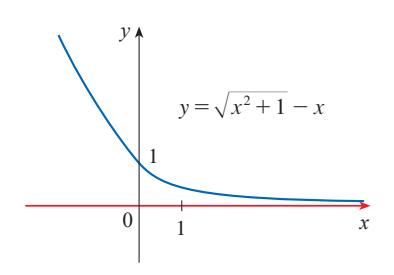
Compute \(\operatorname*{lim}\limits_{x \rightarrow \infty} (\sqrt{x^2 + 1} - x)\).
question image
82 Example - substitution · Level 2
Evaluate \(\operatorname*{lim}\limits_{x \rightarrow \infty} \sin \dfrac{1}{x}\).
83 Example - oscillating limit · Level 1
Evaluate \(\operatorname*{lim}\limits_{x \rightarrow \infty} \sin x\).
84 Example - infinite limits at infinity · Level 1
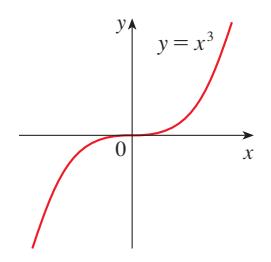
Find \(\operatorname*{lim}\limits_{x \rightarrow \infty} x^3\) and \(\operatorname*{lim}\limits_{x \rightarrow -\infty} x^3\).
question image
85 Example - polynomial at infinity · Level 2
Find \(\operatorname*{lim}\limits_{x \rightarrow \infty} (x^2 - x)\).
86 Example - rational function divergence · Level 2
Find \(\operatorname*{lim}\limits_{x \rightarrow \infty} \dfrac{x^2 + x}{3 - x}\).
87 Example - rough sketch of polynomial · Level 3
Sketch the graph of \(y = (x - 2)^4 (x + 1)^3 (x - 1)\) by finding its intercepts and its limits as \(x \rightarrow \infty\) and as \(x \rightarrow -\infty\).
question image
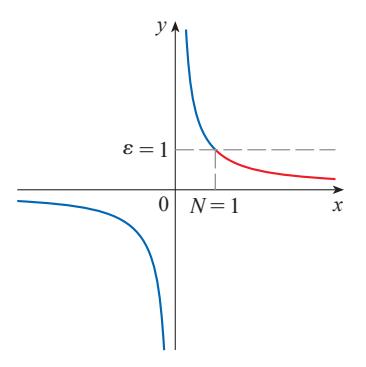
88 Example - epsilon-N from graph · Level 3
Use a graph to find a number \(N\) such that if \(x > N\) then \(|\dfrac{3 x^2 - x - 2}{5 x^2 + 4 x + 1} - 0.6| < 0.1\).
question image
89 Example - epsilon-N proof · Level 3
Use Definition 5 to prove that \(\operatorname*{lim}\limits_{x \rightarrow \infty} \dfrac{1}{x} = 0\).
question image

Answered: 0 / 89