Stewart Section 9.4: Models for Population Growth

25 questions

--:--
0 / 25
Stewart Section 9.4: Models for Population Growth 0/25
1 Logistic Growth · Level 3
A population grows according to the given logistic equation, where \(t\) is measured in weeks. \( \dfrac{d P}{d t} = 0.04 P \left(1 - \dfrac{P}{1200}\right), \quad P(0) = 60 \)
(a) What is the carrying capacity? What is the value of \(k\)?
(b) Write the solution of the equation.
(c) What is the population after 10 weeks?

Enter your answer directly below each part above.

2 Logistic Growth · Level 3
A population grows according to the given logistic equation, where \(t\) is measured in weeks. \( \dfrac{d P}{d t} = 0.02 P - 0.0004 P^2, \quad P(0) = 40 \)
(a) What is the carrying capacity? What is the value of \(k\)?
(b) Write the solution of the equation.
(c) What is the population after 10 weeks?

Enter your answer directly below each part above.

3 Logistic Growth · Level 3
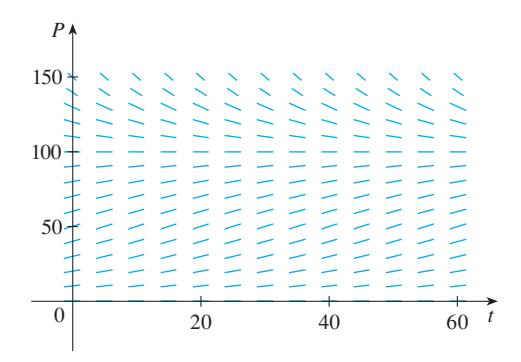
Suppose that a population develops according to the logistic equation \( \dfrac{d P}{d t} = 0.05 P - 0.0005 P^2 \) where \(t\) is measured in weeks.
question image
(a) What is the carrying capacity? What is the value of \(k\)?
(b) A direction field for this equation is shown. Where are the slopes close to 0? Where are they largest? Which solutions are increasing? Which solutions are decreasing?
(c) Use the direction field to sketch solutions for initial populations of 20, 40, 60, 80, 120, and 140. What do these solutions have in common? How do they differ? Which solutions have inflection points? At what population levels do they occur?
(d) What are the equilibrium solutions? How are the other solutions related to these solutions?

Enter your answer directly below each part above.

4 Logistic Growth · Level 3
Suppose that a population grows according to a logistic model with carrying capacity 6000 and \(k = 0.0015\) per year.
(a) Write the logistic differential equation for these data.
(b) Draw a direction field (either by hand or with a computer algebra system). What does it tell you about the solution curves?
(c) Use the direction field to sketch the solution curves for initial populations of 1000, 2000, 4000, and 8000. What can you say about the concavity of these curves? What is the significance of the inflection points?
(d) Program a calculator or computer to use Euler's method with step size \(h = 1\) to estimate the population after 50 years if the initial population is 1000.
(e) If the initial population is 1000, write a formula for the population after \(t\) years. Use it to find the population after 50 years and compare with your estimate in part (d).
(f) Graph the solution in part (e) and compare with the solution curve you sketched in part (c).

Enter your answer directly below each part above.

5 Logistic Growth - Applications · Level 3
The Pacific halibut fishery has been modeled by the differential equation \( \dfrac{d y}{d t} = k y \left(1 - \dfrac{y}{M}\right) \) where \(y(t)\) is the biomass (the total mass of the members of the population) in kilograms at time \(t\) (measured in years), the carrying capacity is estimated to be \(M = 8 \times 10^7\) kg, and \(k = 0.71\) per year.
(a) If \(y(0) = 2 \times 10^7\) kg, find the biomass a year later.
(b) How long will it take for the biomass to reach \(4 \times 10^7\) kg?

Enter your answer directly below each part above.

6 Logistic Growth · Level 3
Suppose a population \(P(t)\) satisfies \( \dfrac{d P}{d t} = 0.4 P - 0.001 P^2, \quad P(0) = 50 \) where \(t\) is measured in years.
(a) What is the carrying capacity?
(b) What is \(P'(0)\)?
(c) When will the population reach 50% of the carrying capacity?

Enter your answer directly below each part above.

7 Logistic Growth · Level 3
Suppose a population grows according to a logistic model with initial population 1000 and carrying capacity 10,000. If the population grows to 2500 after one year, what will the population be after another three years?
8 Logistic Growth - Data Fitting · Level 4
The table gives the number of yeast cells in a new laboratory culture.
Time (hours) 0 2 4 6 8 10 12 14 16 18
Yeast cells 18 39 80 171 336 509 597 640 664 672
(a) Plot the data and use the plot to estimate the carrying capacity for the yeast population.
(b) Use the data to estimate the initial relative growth rate.
(c) Find both an exponential model and a logistic model for these data.
(d) Compare the predicted values with the observed values, both in a table and with graphs. Comment on how well your models fit the data.
(e) Use your logistic model to estimate the number of yeast cells after 7 hours.

Enter your answer directly below each part above.

9 Logistic Growth - World Population · Level 4
The population of the world was about 6.1 billion in 2000. Birth rates around that time ranged from 35 to 40 million per year and death rates ranged from 15 to 20 million per year. Let's assume that the carrying capacity for world population is 20 billion.
(a) Write the logistic differential equation for these data. (Because the initial population is small compared to the carrying capacity, you can take \(k\) to be an estimate of the initial relative growth rate.)
(b) Use the logistic model to estimate the world population in the year 2010 and compare with the actual population of 6.9 billion.
(c) Use the logistic model to predict the world population in the years 2100 and 2500.

Enter your answer directly below each part above.

10 Logistic Growth - US Population · Level 4
(a) Assume that the carrying capacity for the US population is 800 million. Use it and the fact that the population was 282 million in 2000 to formulate a logistic model for the US population.
(b) Determine the value of \(k\) in your model by using the fact that the population in 2010 was 309 million.
(c) Use your model to predict the US population in the years 2100 and 2200.
(d) Use your model to predict the year in which the US population will exceed 500 million.

Enter your answer directly below each part above.

11 Logistic Growth - Rumor Spread · Level 3
One model for the spread of a rumor is that the rate of spread is proportional to the product of the fraction \(y\) of the population who have heard the rumor and the fraction who have not heard the rumor.
(a) Write a differential equation that is satisfied by \(y\).
(b) Solve the differential equation.
(c) A small town has 1000 inhabitants. At 8 AM, 80 people have heard a rumor. By noon half the town has heard it. At what time will 90% of the population have heard the rumor?

Enter your answer directly below each part above.

12 Logistic Growth - Fish Population · Level 3
Biologists stocked a lake with 400 fish and estimated the carrying capacity (the maximal population for the fish of that species in that lake) to be 10,000. The number of fish tripled in the first year.
(a) Assuming that the size of the fish population satisfies the logistic equation, find an expression for the size of the population after \(t\) years.
(b) How long will it take for the population to increase to 5000?

Enter your answer directly below each part above.

13 Logistic Growth - Inflection Point · Level 4
(a) Show that if \(P\) satisfies the logistic equation (4), then \( \dfrac{d^2 P}{d t^2} = k^2 P \left(1 - \dfrac{P}{M}\right)\left(1 - \dfrac{2P}{M}\right) \)
(b) Deduce that a population grows fastest when it reaches half its carrying capacity.

Enter your answer directly below each part above.

14 Logistic Growth - Families · Level 3
For a fixed value of \(M\) (say \(M = 10\)), the family of logistic functions given by Equation 7 depends on the initial value \(P_0\) and the proportionality constant \(k\). Graph several members of this family. How does the graph change when \(P_0\) varies? How does it change when \(k\) varies?
15 Logistic Growth - Japan Population · Level 4
The table gives the midyear population of Japan, in thousands, from 1960 to 2010.
Year 1960 1965 1970 1975 1980 1985 1990 1995 2000 2005 2010
Population 94,092 98,883 104,345 111,573 116,807 120,754 123,537 125,327 126,776 127,715 127,579
Use a calculator to fit both an exponential function and a logistic function to these data. Graph the data points and both functions, and comment on the accuracy of the models. [Hint: Subtract 94,000 from each of the population figures. Then, after obtaining a model from your calculator, add 94,000 to get your final model. It might be helpful to choose \(t = 0\) to correspond to 1960 or 1980.]
16 Logistic Growth - Norway Population · Level 4
The table gives the midyear population of Norway, in thousands, from 1960 to 2010.
Year 1960 1965 1970 1975 1980 1985 1990 1995 2000 2005 2010
Population 3581 3723 3877 4007 4086 4152 4242 4359 4492 4625 4891
Use a calculator to fit both an exponential function and a logistic function to these data. Graph the data points and both functions, and comment on the accuracy of the models. [Hint: Subtract 3500 from each of the population figures. Then, after obtaining a model from your calculator, add 3500 to get your final model. It might be helpful to choose \(t = 0\) to correspond to 1960.]
17 Population Growth - Emigration · Level 4
Consider a population \(P = P(t)\) with constant relative birth and death rates \(\alpha\) and \(\beta\), respectively, and a constant emigration rate \(m\), where \(\alpha\), \(\beta\), and \(m\) are positive constants. Assume that \(\alpha > \beta\). Then the rate of change of the population at time \(t\) is modeled by the differential equation \( \dfrac{d P}{d t} = k P - m, \quad \text{where} k = \alpha - \beta \)
(a) Find the solution of this equation that satisfies the initial condition \(P(0) = P_0\).
(b) What condition on \(m\) will lead to an exponential expansion of the population?
(c) What condition on \(m\) will result in a constant population? A population decline?
(d) In 1847, the population of Ireland was about 8 million and the difference between the relative birth and death rates was 1.6% of the population. Because of the potato famine in the 1840s and 1850s, about 210,000 inhabitants per year emigrated from Ireland. Was the population expanding or declining at that time?

Enter your answer directly below each part above.

18 Population Growth - Doomsday Equation · Level 4
Let \(c\) be a positive number. A differential equation of the form \( \dfrac{d y}{d t} = k y^{1 + c} \) where \(k\) is a positive constant, is called a doomsday equation because the exponent in the expression \(k y^{1 + c}\) is larger than the exponent 1 for natural growth.
(a) Determine the solution that satisfies the initial condition \(y(0) = y_0\).
(b) Show that there is a finite time \(t = T\) (doomsday) such that \(\operatorname*{lim}\limits_{t \rightarrow T^{-}} y(t) = \infty\).
(c) An especially prolific breed of rabbits has the growth term \(k y^{1.01}\). If 2 such rabbits breed initially and the warren has 16 rabbits after three months, then when is doomsday?

Enter your answer directly below each part above.

19 Logistic Growth - Harvesting · Level 4
Let's modify the logistic differential equation of Example 1 as follows: \( \dfrac{d P}{d t} = 0.08 P \left(1 - \dfrac{P}{1000}\right) - 15 \)
(a) Suppose \(P(t)\) represents a fish population at time \(t\), where \(t\) is measured in weeks. Explain the meaning of the final term in the equation (\(-15\)).
(b) Draw a direction field for this differential equation.
(c) What are the equilibrium solutions?
(d) Use the direction field to sketch several solution curves. Describe what happens to the fish population for various initial populations.
(e) Solve this differential equation explicitly, either by using partial fractions or with a computer algebra system. Use the initial populations 200 and 300. Graph the solutions and compare with your sketches in part (d).

Enter your answer directly below each part above.

20 Logistic Growth - Harvesting · Level 4
Consider the differential equation \( \dfrac{d P}{d t} = 0.08 P \left(1 - \dfrac{P}{1000}\right) - c \) as a model for a fish population, where \(t\) is measured in weeks and \(c\) is a constant.
(a) Use a CAS to draw direction fields for various values of \(c\).
(b) From your direction fields in part (a), determine the values of \(c\) for which there is at least one equilibrium solution. For what values of \(c\) does the fish population always die out?
(c) Use the differential equation to prove what you discovered graphically in part (b).
(d) What would you recommend for a limit to the weekly catch of this fish population?

Enter your answer directly below each part above.

21 Logistic Growth - Extinction · Level 5
There is considerable evidence to support the theory that for some species there is a minimum population \(m\) such that the species will become extinct if the size of the population falls below \(m\). This condition can be incorporated into the logistic equation by introducing the factor \(\left(1 - \dfrac{m}{P}\right)\). Thus the modified logistic model is given by the differential equation \( \dfrac{d P}{d t} = k P \left(1 - \dfrac{P}{M}\right)\left(1 - \dfrac{m}{P}\right) \)
(a) Use the differential equation to show that any solution is increasing if \(m < P < M\) and decreasing if \(0 < P < m\).
(b) For the case where \(k = 0.08\), \(M = 1000\), and \(m = 200\), draw a direction field and use it to sketch several solution curves. Describe what happens to the population for various initial populations. What are the equilibrium solutions?
(c) Solve the differential equation explicitly, either by using partial fractions or with a computer algebra system. Use the initial population \(P_0\).
(d) Use the solution in part (c) to show that if \(P_0 < m\), then the species will become extinct. [Hint: Show that the numerator in your expression for \(P(t)\) is 0 for some value of \(t\).]

Enter your answer directly below each part above.

22 Gompertz Growth · Level 4
Another model for a growth function for a limited population is given by the Gompertz function, which is a solution of the differential equation \( \dfrac{d P}{d t} = c \ln\left(\dfrac{M}{P}\right) P \) where \(c\) is a constant and \(M\) is the carrying capacity.
(a) Solve this differential equation.
(b) Compute \(\operatorname*{lim}\limits_{t \rightarrow \infty} P(t)\).
(c) Graph the Gompertz growth function for \(M = 1000\), \(P_0 = 100\), and \(c = 0.05\), and compare it with the logistic function in Example 2. What are the similarities? What are the differences?
(d) We know from Exercise 13 that the logistic function grows fastest when \(P = \dfrac{M}{2}\). Use the Gompertz differential equation to show that the Gompertz function grows fastest when \(P = \dfrac{M}{e}\).

Enter your answer directly below each part above.

23 Seasonal Growth · Level 4
In a seasonal-growth model, a periodic function of time is introduced to account for seasonal variations in the rate of growth. Such variations could, for example, be caused by seasonal changes in the availability of food.
(a) Find the solution of the seasonal-growth model \( \dfrac{d P}{d t} = k P \cos(r t - \phi), \quad P(0) = P_0 \) where \(k\), \(r\), and \(\phi\) are positive constants.
(b) By graphing the solution for several values of \(k\), \(r\), and \(\phi\), explain how the values of \(k\), \(r\), and \(\phi\) affect the solution. What can you say about \(\operatorname*{lim}\limits_{t \rightarrow \infty} P(t)\)?

Enter your answer directly below each part above.

24 Seasonal Growth · Level 4
Suppose we alter the differential equation in Exercise 23 as follows: \( \dfrac{d P}{d t} = k P \cos^2 (r t - \phi), \quad P(0) = P_0 \)
(a) Solve this differential equation with the help of a table of integrals or a CAS.
(b) Graph the solution for several values of \(k\), \(r\), and \(\phi\). How do the values of \(k\), \(r\), and \(\phi\) affect the solution? What can you say about \(\operatorname*{lim}\limits_{t \rightarrow \infty} P(t)\) in this case?

Enter your answer directly below each part above.

25 Logistic Growth - Hyperbolic Tangent · Level 4
Graphs of logistic functions (Figures 2 and
3) look suspiciously similar to the graph of the hyperbolic tangent function. Explain the similarity by showing that the logistic function given by Equation 7 can be written as \( P(t) = \dfrac{1}{2} M [1 + \tanh(\dfrac{1}{2} k (t - c))] \) where \(c = (\ln A) / k\). Thus the logistic function is really just a shifted hyperbolic tangent.

Answered: 0 / 25