Stewart Section 10.2: Calculus with Parametric Curves

74 questions

--:--
0 / 74
Stewart Section 10.2: Calculus with Parametric Curves 0/74
1 Parametric Curves - Derivatives · Level 2
Find \(\dfrac{d y}{d x}\). \(x = \dfrac{t}{1 + t}\), \(y = \sqrt{1 + t}\)
2 Parametric Curves - Derivatives · Level 2
Find \(\dfrac{d y}{d x}\). \(x = t e^t\), \(y = t + \sin t\)
3 Parametric Curves - Tangent Lines · Level 3
Find an equation of the tangent to the curve at the point corresponding to the given value of the parameter. \(x = t^3 + 1\), \(y = t^4 + t\); \(t = -1\)
4 Parametric Curves - Tangent Lines · Level 3
Find an equation of the tangent to the curve at the point corresponding to the given value of the parameter. \(x = \sqrt{t}\), \(y = t^2 - 2t\); \(t = 4\)
5 Parametric Curves - Tangent Lines · Level 3
Find an equation of the tangent to the curve at the point corresponding to the given value of the parameter. \(x = t \cos t\), \(y = t \sin t\); \(t = \pi\)
6 Parametric Curves - Tangent Lines · Level 3
Find an equation of the tangent to the curve at the point corresponding to the given value of the parameter. \(x = e^t \sin \pi t\), \(y = e^{2t}\); \(t = 0\)
7 Parametric Curves - Tangent Lines · Level 3
Find an equation of the tangent to the curve at the given point by two methods: (a) without eliminating the parameter and (b) by first eliminating the parameter. \(x = 1 + \ln t\), \(y = t^2 + 2\); \((1, 3)\)
8 Parametric Curves - Tangent Lines · Level 3
Find an equation of the tangent to the curve at the given point by two methods: (a) without eliminating the parameter and (b) by first eliminating the parameter. \(x = 1 + \sqrt{t}\), \(y = e^{t^2}\); \((2, e)\)
9 Parametric Curves - Tangent Lines · Level 3
Find an equation of the tangent to the curve at the given point. Then graph the curve and the tangent. \(x = t^2 - t\), \(y = t^2 + t + 1\); \((0, 3)\)
10 Parametric Curves - Tangent Lines · Level 3
Find an equation of the tangent to the curve at the given point. Then graph the curve and the tangent. \(x = \sin \pi t\), \(y = t^2 + t\); \((0, 2)\)
11 Parametric Curves - Second Derivatives · Level 3
Find \(\dfrac{d y}{d x}\) and \(\dfrac{d^2 y}{d x^2}\). For which values of \(t\) is the curve concave upward? \(x = t^2 + 1\), \(y = t^2 + t\)
12 Parametric Curves - Second Derivatives · Level 3
Find \(\dfrac{d y}{d x}\) and \(\dfrac{d^2 y}{d x^2}\). For which values of \(t\) is the curve concave upward? \(x = t^3 + 1\), \(y = t^2 - t\)
13 Parametric Curves - Second Derivatives · Level 3
Find \(\dfrac{d y}{d x}\) and \(\dfrac{d^2 y}{d x^2}\). For which values of \(t\) is the curve concave upward? \(x = e^t\), \(y = t e^{-t}\)
14 Parametric Curves - Second Derivatives · Level 3
Find \(\dfrac{d y}{d x}\) and \(\dfrac{d^2 y}{d x^2}\). For which values of \(t\) is the curve concave upward? \(x = t^2 + 1\), \(y = e^t - 1\)
15 Parametric Curves - Second Derivatives · Level 3
Find \(\dfrac{d y}{d x}\) and \(\dfrac{d^2 y}{d x^2}\). For which values of \(t\) is the curve concave upward? \(x = t - \ln t\), \(y = t + \ln t\)
16 Parametric Curves - Second Derivatives · Level 3
Find \(\dfrac{d y}{d x}\) and \(\dfrac{d^2 y}{d x^2}\). For which values of \(t\) is the curve concave upward? \(x = \cos t\), \(y = \sin 2t\), \(0 < t < \pi\)
17 Parametric Curves - Horizontal/Vertical Tangents · Level 3
Find the points on the curve where the tangent is horizontal or vertical. If you have a graphing device, graph the curve to check your work. \(x = t^3 - 3t\), \(y = t^2 - 3\)
18 Parametric Curves - Horizontal/Vertical Tangents · Level 3
Find the points on the curve where the tangent is horizontal or vertical. If you have a graphing device, graph the curve to check your work. \(x = t^3 - 3t\), \(y = t^3 - 3t^2\)
19 Parametric Curves - Horizontal/Vertical Tangents · Level 3
Find the points on the curve where the tangent is horizontal or vertical. If you have a graphing device, graph the curve to check your work. \(x = \cos \theta\), \(y = \cos 3 \theta\)
20 Parametric Curves - Horizontal/Vertical Tangents · Level 3
Find the points on the curve where the tangent is horizontal or vertical. If you have a graphing device, graph the curve to check your work. \(x = e^{\sin \theta}\), \(y = e^{\cos \theta}\)
21 Parametric Curves - Optimization · Level 3
Use a graph to estimate the coordinates of the rightmost point on the curve \(x = t - t^6\), \(y = e^t\). Then use calculus to find the exact coordinates.
22 Parametric Curves - Optimization · Level 3
Use a graph to estimate the coordinates of the lowest point and the leftmost point on the curve \(x = t^4 - 2t\), \(y = t + t^4\). Then find the exact coordinates.
23 Parametric Curves - Graphing · Level 3
Graph the curve in a viewing rectangle that displays all the important aspects of the curve. \(x = t^4 - 2t^3 - 2t^2\), \(y = t^3 - t\)
24 Parametric Curves - Graphing · Level 3
Graph the curve in a viewing rectangle that displays all the important aspects of the curve. \(x = t^4 + 4t^3 - 8t^2\), \(y = 2t^2 - t\)
25 Parametric Curves - Tangent Lines · Level 4
Show that the curve \(x = \cos t\), \(y = \sin t \cos t\) has two tangents at \((0, 0)\) and find their equations. Sketch the curve.
26 Parametric Curves - Tangent Lines · Level 4
Graph the curve \(x = -2 \cos t\), \(y = \sin t + \sin 2t\) to discover where it crosses itself. Then find equations of both tangents at that point.
27 Parametric Curves - Tangent Lines · Level 3
(a) Find the slope of the tangent line to the trochoid \(x = r \theta - d \sin \theta\), \(y = r - d \cos \theta\) in terms of \(\theta\). (See Exercise 10.1.40.)
(b) Show that if \(d < r\), then the trochoid does not have a vertical tangent.

Enter your answer directly below each part above.

28 Parametric Curves - Tangent Lines · Level 3
(a) Find the slope of the tangent to the astroid \(x = a \cos^3 \theta\), \(y = a \sin^3 \theta\) in terms of \(\theta\).
(b) At what points is the tangent horizontal or vertical?
(c) At what points does the tangent have slope 1 or \(-1\)?

Enter your answer directly below each part above.

29 Parametric Curves - Tangent Lines · Level 3
At what point(s) on the curve \(x = 3t^2 + 1\), \(y = t^3 - 1\) does the tangent line have slope \(\dfrac{1}{2}\)?
30 Parametric Curves - Tangent Lines · Level 4
Find equations of the tangents to the curve \(x = 3t^2 + 1\), \(y = 2t^3 + 1\) that pass through the point \((4, 3)\).
31 Parametric Curves - Area · Level 3
Use the parametric equations of an ellipse, \(x = a \cos \theta\), \(y = b \sin \theta\), \(0 \leq \theta \leq 2 \pi\), to find the area that it encloses.
32 Parametric Curves - Area · Level 3
Find the area enclosed by the curve \(x = t^2 - 2t\), \(y = \sqrt{t}\) and the \(y\)-axis.
33 Parametric Curves - Area · Level 3
Find the area enclosed by the \(x\)-axis and the curve \(x = t^3 + 1\), \(y = 2t - t^2\).
34 Parametric Curves - Area · Level 4
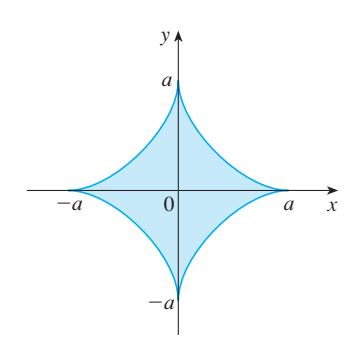
Find the area of the region enclosed by the astroid \(x = a \cos^3 \theta\), \(y = a \sin^3 \theta\).
question image
35 Parametric Curves - Area · Level 3
Find the area under one arch of the trochoid of Exercise 10.1.40 for the case \(d < r\).
36 Parametric Curves - Area and Volume · Level 4
Let \(cal(R)\) be the region enclosed by the loop of the curve in Example 1.
(a) Find the area of \(cal(R)\).
(b) If \(cal(R)\) is rotated about the \(x\)-axis, find the volume of the resulting solid.
(c) Find the centroid of \(cal(R)\).

Enter your answer directly below each part above.

37 Parametric Curves - Arc Length · Level 3
Set up an integral that represents the length of the curve. Then use your calculator to find the length correct to four decimal places. \(x = t + e^{-t}\), \(y = t - e^{-t}\), \(0 \leq t \leq 2\)
38 Parametric Curves - Arc Length · Level 3
Set up an integral that represents the length of the curve. Then use your calculator to find the length correct to four decimal places. \(x = t^2 - t\), \(y = t^4\), \(1 \leq t \leq 4\)
39 Parametric Curves - Arc Length · Level 3
Set up an integral that represents the length of the curve. Then use your calculator to find the length correct to four decimal places. \(x = t - 2 \sin t\), \(y = 1 - 2 \cos t\), \(0 \leq t \leq 4 \pi\)
40 Parametric Curves - Arc Length · Level 3
Set up an integral that represents the length of the curve. Then use your calculator to find the length correct to four decimal places. \(x = t + \sqrt{t}\), \(y = t - \sqrt{t}\), \(0 \leq t \leq 1\)
41 Parametric Curves - Arc Length · Level 3
Find the exact length of the curve. \(x = 1 + 3t^2\), \(y = 4 + 2t^3\), \(0 \leq t \leq 1\)
42 Parametric Curves - Arc Length · Level 3
Find the exact length of the curve. \(x = e^t - t\), \(y = 4 e^{\dfrac{t}{2}}\), \(0 \leq t \leq 2\)
43 Parametric Curves - Arc Length · Level 3
Find the exact length of the curve. \(x = t \sin t\), \(y = t \cos t\), \(0 \leq t \leq 1\)
44 Parametric Curves - Arc Length · Level 3
Find the exact length of the curve. \(x = 3 \cos t - \cos 3t\), \(y = 3 \sin t - \sin 3t\), \(0 \leq t \leq \pi\)
45 Parametric Curves - Arc Length · Level 3
Graph the curve and find its exact length. \(x = e^t \cos t\), \(y = e^t \sin t\), \(0 \leq t \leq \pi\)
46 Parametric Curves - Arc Length · Level 4
Graph the curve and find its exact length. \(x = \cos t + \ln\left(\tan \dfrac{1}{2} t\right)\), \(y = \sin t\), \(\dfrac{\pi}{4} \leq t \leq 3 \dfrac{\pi}{4}\)
47 Parametric Curves - Arc Length · Level 3
Graph the curve \(x = \sin t + \sin 1.5t\), \(y = \cos t\) and find its length correct to four decimal places.
48 Parametric Curves - Arc Length · Level 4
Find the length of the loop of the curve \(x = 3t - t^3\), \(y = 3t^2\).
49 Parametric Curves - Arc Length · Level 3
Use Simpson's Rule with \(n = 6\) to estimate the length of the curve \(x = t - e^t\), \(y = t + e^t\), \(-6 \leq t \leq 6\).
50 Parametric Curves - Arc Length · Level 3
In Exercise 10.1.43 you were asked to derive the parametric equations \(x = 2a \cot \theta\), \(y = 2a \sin^2 \theta\) for the curve called the witch of Maria Agnesi. Use Simpson's Rule with \(n = 4\) to estimate the length of the arc of this curve given by \(\dfrac{\pi}{4} \leq \theta \leq \dfrac{\pi}{2}\).
51 Parametric Curves - Distance · Level 3
Find the distance traveled by a particle with position \((x, y)\) as \(t\) varies in the given time interval. Compare with the length of the curve. \(x = \sin^2 t\), \(y = \cos^2 t\), \(0 \leq t \leq 3 \pi\)
52 Parametric Curves - Distance · Level 3
Find the distance traveled by a particle with position \((x, y)\) as \(t\) varies in the given time interval. Compare with the length of the curve. \(x = \cos^2 t\), \(y = \cos t\), \(0 \leq t \leq 4 \pi\)
53 Parametric Curves - Arc Length · Level 4
Show that the total length of the ellipse \(x = a \sin \theta\), \(y = b \cos \theta\), \(a > b > 0\), is \(L = 4a \displaystyle\int_{0}^{\dfrac{\pi}{2}} \sqrt{1 - e^2 \sin^2 \theta} d \theta\) where \(e\) is the eccentricity of the ellipse (\(e = \dfrac{c}{a}\), where \(c = \sqrt{a^2 - b^2}\)).
54 Parametric Curves - Arc Length · Level 3
Find the total length of the astroid \(x = a \cos^3 \theta\), \(y = a \sin^3 \theta\), where \(a > 0\).
55 Parametric Curves - Arc Length · Level 3
(a) Graph the epitrochoid with equations \(x = 11 \cos t - 4 \cos\left(\dfrac{11t}{2}\right)\) \(y = 11 \sin t - 4 \sin\left(\dfrac{11t}{2}\right)\) What parameter interval gives the complete curve?
(b) Use your CAS to find the approximate length of this curve.

Enter your answer directly below each part above.

56 Parametric Curves - Cornu Spiral · Level 4
A curve called Cornu's spiral is defined by the parametric equations \(x = C(t) = \displaystyle\int_{0}^{t} \cos(\pi u^2/2) d u\) \(y = S(t) = \displaystyle\int_{0}^{t} \sin(\pi u^2/2) d u\) where \(C\) and \(S\) are the Fresnel functions.
(a) Graph this curve. What happens as \(t \rightarrow \infty\) and as \(t \rightarrow -\infty\)?
(b) Find the length of Cornu's spiral from the origin to the point with parameter value \(t\).

Enter your answer directly below each part above.

57 Parametric Curves - Surface Area · Level 3
Set up an integral that represents the area of the surface obtained by rotating the given curve about the \(x\)-axis. Then use your calculator to find the surface area correct to four decimal places. \(x = t \sin t\), \(y = t \cos t\), \(0 \leq t \leq \dfrac{\pi}{2}\)
58 Parametric Curves - Surface Area · Level 3
Set up an integral that represents the area of the surface obtained by rotating the given curve about the \(x\)-axis. Then use your calculator to find the surface area correct to four decimal places. \(x = \sin t\), \(y = \sin 2t\), \(0 \leq t \leq \dfrac{\pi}{2}\)
59 Parametric Curves - Surface Area · Level 3
Set up an integral that represents the area of the surface obtained by rotating the given curve about the \(x\)-axis. Then use your calculator to find the surface area correct to four decimal places. \(x = t + e^t\), \(y = e^{-t}\), \(0 \leq t \leq 1\)
60 Parametric Curves - Surface Area · Level 3
Set up an integral that represents the area of the surface obtained by rotating the given curve about the \(x\)-axis. Then use your calculator to find the surface area correct to four decimal places. \(x = t^2 - t^3\), \(y = t + t^4\), \(0 \leq t \leq 1\)
61 Parametric Curves - Surface Area · Level 3
Find the exact area of the surface obtained by rotating the given curve about the \(x\)-axis. \(x = t^3\), \(y = t^2\), \(0 \leq t \leq 1\)
62 Parametric Curves - Surface Area · Level 3
Find the exact area of the surface obtained by rotating the given curve about the \(x\)-axis. \(x = 2t^2 + \dfrac{1}{t}\), \(y = 8 \sqrt{t}\), \(1 \leq t \leq 3\)
63 Parametric Curves - Surface Area · Level 3
Find the exact area of the surface obtained by rotating the given curve about the \(x\)-axis. \(x = a \cos^3 \theta\), \(y = a \sin^3 \theta\), \(0 \leq \theta \leq \dfrac{\pi}{2}\)
64 Parametric Curves - Surface Area · Level 4
Graph the curve \(x = 2 \cos \theta - \cos 2 \theta\), \(y = 2 \sin \theta - \sin 2 \theta\) If this curve is rotated about the \(x\)-axis, find the exact area of the resulting surface. (Use your graph to help find the correct parameter interval.)
65 Parametric Curves - Surface Area · Level 3
Find the surface area generated by rotating the given curve about the \(y\)-axis. \(x = 3t^2\), \(y = 2t^3\), \(0 \leq t \leq 5\)
66 Parametric Curves - Surface Area · Level 3
Find the surface area generated by rotating the given curve about the \(y\)-axis. \(x = e^t - t\), \(y = 4 e^{\dfrac{t}{2}}\), \(0 \leq t \leq 1\)
67 Parametric Curves - Proof · Level 4
If \(f'\) is continuous and \(f'(t) \neq 0\) for \(a \leq t \leq b\), show that the parametric curve \(x = f(t)\), \(y = g(t)\), \(a \leq t \leq b\), can be put in the form \(y = F(x)\). [Hint: Show that \(f^{-1}\) exists.]
68 Parametric Curves - Proof · Level 4
Use Formula 1 to derive Formula 6 from Formula 8.2.5 for the case in which the curve can be represented in the form \(y = F(x)\), \(a \leq x \leq b\).
69 Parametric Curves - Curvature · Level 5
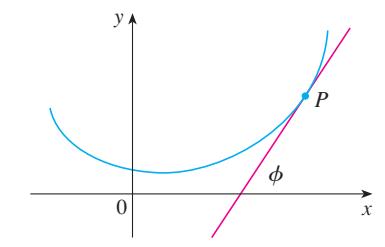
The curvature at a point \(P\) of a curve is defined as \(\kappa = |\dfrac{d \phi}{d s}|\) where \(\phi\) is the angle of inclination of the tangent line at \(P\).
question image
(a) For a parametric curve \(x = x(t)\), \(y = y(t)\), derive the formula \(\kappa = \dfrac{|\cdot(x) \cdot.double(y) - \cdot.double(x) \cdot(y)|}{[\cdot(x)^2 + \cdot(y)^2]^{\dfrac{3}{2}}}\)
(b) By regarding a curve \(y = f(x)\) as the parametric curve \(x = x\), \(y = f(x)\), show that the formula becomes \(\kappa = \dfrac{|\dfrac{d^2 y}{d x^2}|}{[1 + \left(\dfrac{d y}{d x}\right)^2]^{\dfrac{3}{2}}}\)

Enter your answer directly below each part above.

70 Parametric Curves - Curvature · Level 4
(a) Use the formula in Exercise 69(b) to find the curvature of the parabola \(y = x^2\) at the point \((1, 1)\).
(b) At what point does this parabola have maximum curvature?

Enter your answer directly below each part above.

71 Parametric Curves - Curvature · Level 4
Use the formula in Exercise 69(a) to find the curvature of the cycloid \(x = \theta - \sin \theta\), \(y = 1 - \cos \theta\) at the top of one of its arches.
72 Parametric Curves - Curvature · Level 4
(a) Show that the curvature at each point of a straight line is \(\kappa = 0\).
(b) Show that the curvature at each point of a circle of radius \(r\) is \(\kappa = \dfrac{1}{r}\).

Enter your answer directly below each part above.

73 Parametric Curves - Involute · Level 4
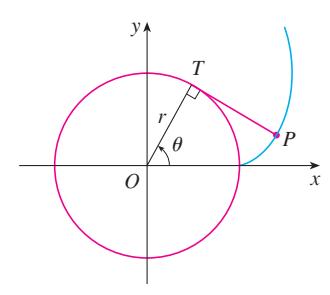
A string is wound around a circle and then unwound while being held taut. The curve traced by the point \(P\) at the end of the string is called the involute of the circle. If the circle has radius \(r\) and center \(O\) and the initial position of \(P\) is \((r, 0)\), and if the parameter \(\theta\) is chosen as in the figure, show that parametric equations of the involute are \(x = r(\cos \theta + \theta \sin \theta)\), \(y = r(\sin \theta - \theta \cos \theta)\)
question image
74 Parametric Curves - Application · Level 4
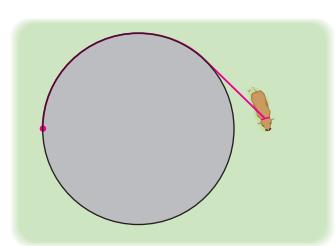
A cow is tied to a silo with radius \(r\) by a rope just long enough to reach the opposite side of the silo. Find the grazing area available for the cow.
question image

Answered: 0 / 74