Stewart Precalc 6e Section 13.1: Finding Limits Numerically and Graphically

39 questions

--:--
0 / 39
Stewart Precalc 6e Section 13.1: Finding Limits Numerically and Graphically 0/39
1 Concepts - Limit Definition · Level 1
When we write \(\operatorname*{lim}\limits_{x\rightarrow a} f(x) = L\) then, roughly speaking, the values of \(f(x)\) get closer and closer to the number ______ as the values of \(x\) get closer and closer to ______. To determine \(\operatorname*{lim}\limits_{x\rightarrow 5} \dfrac{x - 5}{x - 5}\), we try values for \(x\) closer and closer to ______ and find that the limit is ______.
2 Concepts - One-Sided Limits · Level 1
We write \(\operatorname*{lim}\limits_{x\rightarrow a^-} f(x) = L\) and say that the ______ of \(f(x)\) as \(x\) approaches \(a\) from the ______ (left/right) is equal to ______. To find the left-hand limit, we try values for \(x\) that are ______ (less/greater) than \(a\). A limit exists if and only if both the ______-hand and ______-hand limits exist and are ______.
3 Numerical Estimation · Level 2
Estimate the value of the limit by making a table of values. Check your work with a graph. \(\operatorname*{lim}\limits_{x\rightarrow 3} \dfrac{x^2 - x - 6}{x - 3}\)
4 Numerical Estimation - Table of Values · Level 2
Complete the table of values (to five decimal places) for \(x = 1.9, 1.99, 1.999, 2.001, 2.01, 2.1\), and use the table to estimate the value of the limit. \(\operatorname*{lim}\limits_{x\rightarrow 2} \dfrac{x - 2}{x^2 + x - 6}\)
5 Numerical Estimation - Table of Values · Level 2
Complete the table of values (to five decimal places) for \(x = 0.9, 0.99, 0.999, 1.001, 1.01, 1.1\), and use the table to estimate the value of the limit. \(\operatorname*{lim}\limits_{x\rightarrow 1} \dfrac{x - 1}{x^3 - 1}\)
6 Numerical Estimation - Table of Values · Level 2
Complete the table of values (to five decimal places) for \(x = -0.1, -0.01, -0.001, 0.001, 0.01, 0.1\), and use the table to estimate the value of the limit. \(\operatorname*{lim}\limits_{x\rightarrow 0} \dfrac{e^x - 1}{x}\)
7 Numerical Estimation - Table of Values · Level 2
Complete the table of values (to five decimal places) for \(x = \pm 1, \pm 0.5, \pm 0.1, \pm 0.05, \pm 0.01\), and use the table to estimate the value of the limit. \(\operatorname*{lim}\limits_{x\rightarrow 0} \dfrac{\sin x}{x}\)
8 Numerical Estimation - Table of Values · Level 2
Complete the table of values (to five decimal places) for \(x = 0.1, 0.01, 0.001, 0.0001, 0.00001\), and use the table to estimate the value of the limit. \(\operatorname*{lim}\limits_{x\rightarrow 0^+} x \ln(x)\)
9 Numerical Estimation with Graphing · Level 2
Use a table of values to estimate the value of the limit. Then use a graphing device to confirm your result graphically. \(\operatorname*{lim}\limits_{x\rightarrow -4} \dfrac{x + 4}{x^2 + 7x + 12}\)
10 Numerical Estimation with Graphing · Level 2
Use a table of values to estimate the value of the limit. Then use a graphing device to confirm your result graphically. \(\operatorname*{lim}\limits_{x\rightarrow 1} \dfrac{x^3 - 1}{x^2 - 1}\)
11 Numerical Estimation with Graphing · Level 3
Use a table of values to estimate the value of the limit. Then use a graphing device to confirm your result graphically. \(\operatorname*{lim}\limits_{x\rightarrow 0} \dfrac{5^x - 3^x}{x}\)
12 Numerical Estimation with Graphing · Level 2
Use a table of values to estimate the value of the limit. Then use a graphing device to confirm your result graphically. \(\operatorname*{lim}\limits_{x\rightarrow 0} \dfrac{\sqrt{x + 9} - 3}{x}\)
13 Numerical Estimation with Graphing · Level 3
Use a table of values to estimate the value of the limit. Then use a graphing device to confirm your result graphically. \(\operatorname*{lim}\limits_{x\rightarrow 1} \left(\dfrac{1}{\ln x} - \dfrac{1}{x - 1}\right)\)
14 Numerical Estimation with Graphing · Level 2
Use a table of values to estimate the value of the limit. Then use a graphing device to confirm your result graphically. \(\operatorname*{lim}\limits_{x\rightarrow 0} \dfrac{\tan 2x}{\tan 3x}\)
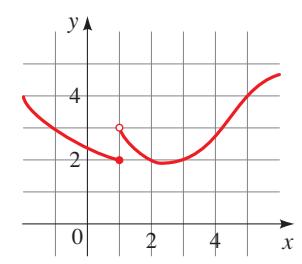
15 Limits from a Graph · Level 2
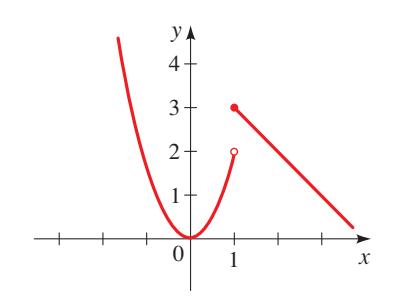
For the function \(f\) whose graph is given, state the value of the given quantity if it exists. If it does not exist, explain why. (a) \(\operatorname*{lim}\limits_{x\rightarrow 1^-} f(x)\); (b) \(\operatorname*{lim}\limits_{x\rightarrow 1^+} f(x)\); (c) \(\operatorname*{lim}\limits_{x\rightarrow 1} f(x)\); (d) \(\operatorname*{lim}\limits_{x\rightarrow 5} f(x)\); (e) \(f(5)\).
question image
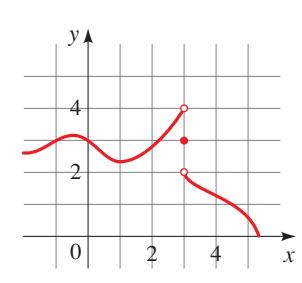
16 Limits from a Graph · Level 2
For the function \(f\) whose graph is given, state the value of the given quantity if it exists. If it does not exist, explain why. (a) \(\operatorname*{lim}\limits_{x\rightarrow 0} f(x)\); (b) \(\operatorname*{lim}\limits_{x\rightarrow 3^-} f(x)\); (c) \(\operatorname*{lim}\limits_{x\rightarrow 3^+} f(x)\); (d) \(\operatorname*{lim}\limits_{x\rightarrow 3} f(x)\); (e) \(f(3)\).
question image
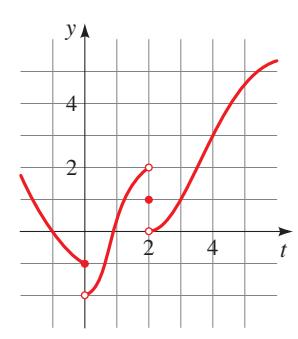
17 Limits from a Graph · Level 2
For the function \(g\) whose graph is given, state the value of the given quantity if it exists. If it does not exist, explain why. (a) \(\operatorname*{lim}\limits_{t\rightarrow 0^-} g(t)\); (b) \(\operatorname*{lim}\limits_{t\rightarrow 0^+} g(t)\); (c) \(\operatorname*{lim}\limits_{t\rightarrow 0} g(t)\); (d) \(\operatorname*{lim}\limits_{t\rightarrow 2^-} g(t)\); (e) \(\operatorname*{lim}\limits_{t\rightarrow 2^+} g(t)\); (f) \(\operatorname*{lim}\limits_{t\rightarrow 2} g(t)\); (g) \(g(2)\); (h) \(\operatorname*{lim}\limits_{t\rightarrow 4} g(t)\).
question image
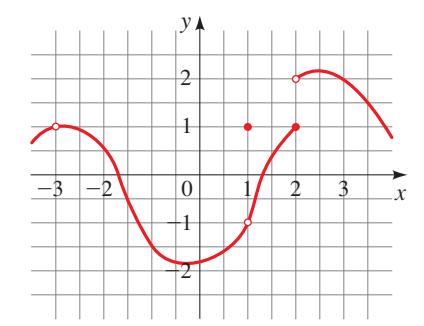
18 Limits from a Graph · Level 2
State the value of the limit, if it exists, from the given graph of \(f\). If it does not exist, explain why. (a) \(\operatorname*{lim}\limits_{x\rightarrow -3^-} f(x)\); (b) \(\operatorname*{lim}\limits_{x\rightarrow -3^+} f(x)\); (c) \(\operatorname*{lim}\limits_{x\rightarrow -3} f(x)\); (d) \(\operatorname*{lim}\limits_{x\rightarrow 0} f(x)\); (e) \(\operatorname*{lim}\limits_{x\rightarrow 2} f(x)\); (f) \(\operatorname*{lim}\limits_{x\rightarrow 5^-} f(x)\).
question image
19 Graphing Device · Level 3
Use a graphing device to determine whether the limit exists. If the limit exists, estimate its value to two decimal places. \(\operatorname*{lim}\limits_{x\rightarrow 1} \dfrac{x^3 + x^2 + 3x - 5}{2x^2 - 5x + 3}\)
20 Graphing Device · Level 3
Use a graphing device to determine whether the limit exists. If the limit exists, estimate its value to two decimal places. \(\operatorname*{lim}\limits_{x\rightarrow 0} \dfrac{x^2}{\cos 5x - \cos 4x}\)
21 Graphing Device · Level 3
Use a graphing device to determine whether the limit exists. If the limit exists, estimate its value to two decimal places. \(\operatorname*{lim}\limits_{x\rightarrow 0} \ln(\sin^2 x)\)
22 Graphing Device · Level 3
Use a graphing device to determine whether the limit exists. If the limit exists, estimate its value to two decimal places. \(\operatorname*{lim}\limits_{x\rightarrow 2} \dfrac{x^3 + 6x^2 - 5x + 1}{x^3 - x^2 - 8x + 12}\)
23 Graphing Device · Level 3
Use a graphing device to determine whether the limit exists. If the limit exists, estimate its value to two decimal places. \(\operatorname*{lim}\limits_{x\rightarrow 0} \cos\left(\dfrac{1}{x}\right)\)
24 Graphing Device · Level 3
Use a graphing device to determine whether the limit exists. If the limit exists, estimate its value to two decimal places. \(\operatorname*{lim}\limits_{x\rightarrow 0} \sin\left(\dfrac{2}{x}\right)\)
25 Graphing Device · Level 2
Use a graphing device to determine whether the limit exists. If the limit exists, estimate its value to two decimal places. \(\operatorname*{lim}\limits_{x\rightarrow 3} \dfrac{|x - 3|}{x - 3}\)
26 Graphing Device · Level 3
Use a graphing device to determine whether the limit exists. If the limit exists, estimate its value to two decimal places. \(\operatorname*{lim}\limits_{x\rightarrow 0} \dfrac{1}{1 + a^{\dfrac{1}{x}}}\)
27 Piecewise-Defined Function · Level 2
Graph the piecewise-defined function and use your graph to find the values of the limits, if they exist. \(f(x) = \begin{cases} x^2 & \quad \text{if } x \leq 2 \\ 6 - x & \quad \text{if } x > 2 \end{cases}\). (a) \(\operatorname*{lim}\limits_{x\rightarrow 2^-} f(x)\); (b) \(\operatorname*{lim}\limits_{x\rightarrow 2^+} f(x)\); (c) \(\operatorname*{lim}\limits_{x\rightarrow 2} f(x)\).
28 Piecewise-Defined Function · Level 2
Graph the piecewise-defined function and use your graph to find the values of the limits, if they exist. \(f(x) = \begin{cases} 2 & \quad \text{if } x < 0 \\ x + 1 & \quad \text{if } x \geq 0 \end{cases}\). (a) \(\operatorname*{lim}\limits_{x\rightarrow 0^-} f(x)\); (b) \(\operatorname*{lim}\limits_{x\rightarrow 0^+} f(x)\); (c) \(\operatorname*{lim}\limits_{x\rightarrow 0} f(x)\).
29 Piecewise-Defined Function · Level 2
Graph the piecewise-defined function and use your graph to find the values of the limits, if they exist. \(f(x) = \begin{cases} -x + 3 & \quad \text{if } x < -1 \\ 3 & \quad \text{if } x \geq -1 \end{cases}\). (a) \(\operatorname*{lim}\limits_{x\rightarrow -1^-} f(x)\); (b) \(\operatorname*{lim}\limits_{x\rightarrow -1^+} f(x)\); (c) \(\operatorname*{lim}\limits_{x\rightarrow -1} f(x)\).
30 Piecewise-Defined Function · Level 2
Graph the piecewise-defined function and use your graph to find the values of the limits, if they exist. \(f(x) = \begin{cases} 2x + 10 & \quad \text{if } x \leq -2 \\ -x + 4 & \quad \text{if } x > -2 \end{cases}\). (a) \(\operatorname*{lim}\limits_{x\rightarrow -2^-} f(x)\); (b) \(\operatorname*{lim}\limits_{x\rightarrow -2^+} f(x)\); (c) \(\operatorname*{lim}\limits_{x\rightarrow -2} f(x)\).
31 Discovery, Discussion, Writing - Function with Specified Limits · Level 3
A Function with Specified Limits. Sketch the graph of an example of a function \(f\) that satisfies all of the following conditions: \(\operatorname*{lim}\limits_{x\rightarrow 0^-} f(x) = 2\), \(\operatorname*{lim}\limits_{x\rightarrow 0^+} f(x) = 0\), \(\operatorname*{lim}\limits_{x\rightarrow 2} f(x) = 1\), \(f(0) = 2\), \(f(2) = 3\). How many such functions are there?
32 Discovery, Discussion, Writing - Graphing Calculator Pitfalls · Level 3
Graphing Calculator Pitfalls. (a) Evaluate \(h(x) = \dfrac{\tan x - x}{x^3}\) for \(x = 1, 0.5, 0.1, 0.05, 0.01\), and \(0.005\). (b) Guess the value of \(\operatorname*{lim}\limits_{x\rightarrow 0} \dfrac{\tan x - x}{x^3}\). (c) Evaluate \(h(x)\) for successively smaller values of \(x\) until you finally reach \(0\) values for \(h(x)\). Are you still confident that your guess in part (b) is correct? Explain why you eventually obtained \(0\) values. (d) Graph the function \(h\) in the viewing rectangle \([-1, 1]\) by \([0, 1]\). Then zoom in toward the point where the graph crosses the \(y\)-axis to estimate the limit of \(h(x)\) as \(x\) approaches \(0\). Continue to zoom in until you observe distortions in the graph of \(h\). Compare with your results in part (c).
33 Example - Estimating a Limit Numerically and Graphically · Level 2
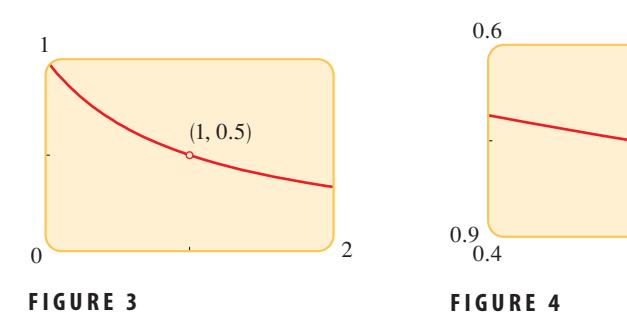
Estimate the value of the following limit by making a table of values. Check your work with a graph. \(\operatorname*{lim}\limits_{x\rightarrow 1} \dfrac{x-1}{x^2-1}\)
question image
34 Example - Finding a Limit from a Table · Level 3
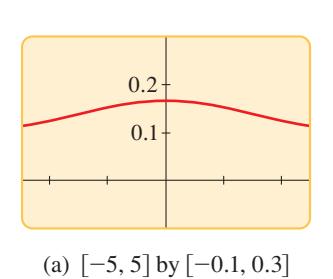
Find \(\operatorname*{lim}\limits_{t\rightarrow 0} \dfrac{\sqrt{t^2+9}-3}{t^2}\).
question image
35 Example - A Limit That Fails to Exist (Jump) · Level 2
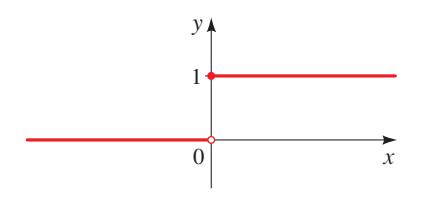
The Heaviside function \(H\) is defined by \(H(t) = \begin{cases} 0 & \quad \text{if } t < 0 \\ 1 & \quad \text{if } t \geq 0 \end{cases}\) This function, named after the electrical engineer Oliver Heaviside (1850–1925), can be used to describe an electric current that is switched on at time \(t = 0\). Find \(\operatorname*{lim}\limits_{t\rightarrow 0} H(t)\), if it exists.
question image
36 Example - A Limit That Fails to Exist (Oscillation) · Level 3
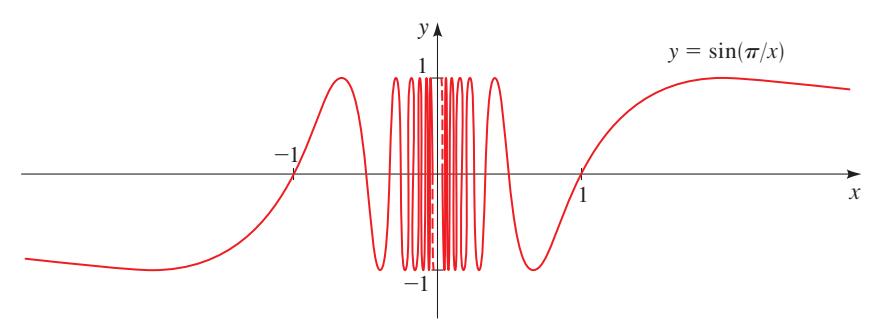
Find \(\operatorname*{lim}\limits_{x\rightarrow 0} \sin\left(\dfrac{\pi}{x}\right)\).
question image
37 Example - A Limit That Fails to Exist (Vertical Asymptote) · Level 2
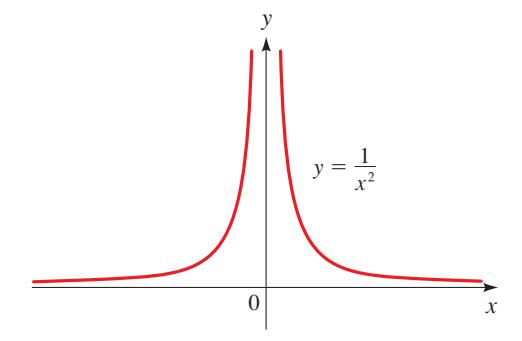
Find \(\operatorname*{lim}\limits_{x\rightarrow 0} \dfrac{1}{x^2}\) if it exists.
question image
38 Example - Limits from a Graph · Level 2
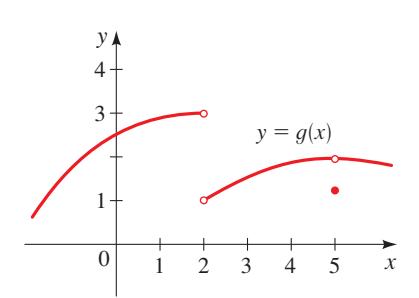
The graph of a function \(g\) is shown in the figure. Use it to state the values (if they exist) of the following: (a) \(\operatorname*{lim}\limits_{x\rightarrow 2^-} g(x)\), \(\operatorname*{lim}\limits_{x\rightarrow 2^+} g(x)\), \(\operatorname*{lim}\limits_{x\rightarrow 2} g(x)\); (b) \(\operatorname*{lim}\limits_{x\rightarrow 5^-} g(x)\), \(\operatorname*{lim}\limits_{x\rightarrow 5^+} g(x)\), \(\operatorname*{lim}\limits_{x\rightarrow 5} g(x)\).
question image
39 Example - A Piecewise-Defined Function · Level 2
Let \(f\) be the function defined by \(f(x) = \begin{cases} 2x^2 & \quad \text{if } x < 1 \\ 4 - x & \quad \text{if } x \geq 1 \end{cases}\). Graph \(f\), and use the graph to find: (a) \(\operatorname*{lim}\limits_{x\rightarrow 1^-} f(x)\); (b) \(\operatorname*{lim}\limits_{x\rightarrow 1^+} f(x)\); (c) \(\operatorname*{lim}\limits_{x\rightarrow 1} f(x)\).
question image

Answered: 0 / 39