Stewart Precalc 6e Section 4.2: The Natural Exponential Function

42 questions

--:--
0 / 42
Stewart Precalc 6e Section 4.2: The Natural Exponential Function 0/42
1 Exercise - Concepts · Level 1
The function \(f(x) = e^x\) is called the _____ exponential function. The number \(e\) is approximately equal to _____.
2 Exercise - Concepts · Level 1
In the formula \(A(t) = P e^{r t}\) for continuously compounded interest, the letters \(P\), \(r\), and \(t\) stand for _____, _____, and _____, respectively, and \(A(t)\) stands for _____. So if \$100 is invested at an interest rate of \(6%\) compounded continuously, then the amount after 2 years is _____.
3 Exercise - Skills · Level 1
Use a calculator to evaluate the function \(h(x) = e^x\) at the indicated values, rounded to three decimals: \(h(3)\), \(h(0.23)\), \(h(1)\), \(h(-2)\).
4 Exercise - Skills · Level 1
Use a calculator to evaluate the function \(h(x) = e^{-2 x}\) at the indicated values, rounded to three decimals: \(h(1)\), \(h(\sqrt{2})\), \(h(-3)\), \(h\left(\dfrac{1}{2}\right)\).
5 Exercise - Skills · Level 2
Complete the table of values for \(f(x) = 3 e^x\), rounded to two decimal places, and sketch a graph of the function (for \(x = -3, -2, -1, 0, 1, 2, 3\)).
6 Exercise - Skills · Level 2
Complete the table of values for \(f(x) = 2 e^{-0.5 x}\), rounded to two decimal places, and sketch a graph of the function (for \(x = -3, -2, -1, 0, 1, 2, 3\)).
7 Exercise - Skills · Level 2
Graph the function \(f(x) = -e^x\), not by plotting points, but by starting from the graph of \(y = e^x\). State the domain, range, and asymptote.
8 Exercise - Skills · Level 2
Graph the function \(y = 1 - e^x\), not by plotting points, but by starting from the graph of \(y = e^x\). State the domain, range, and asymptote.
9 Exercise - Skills · Level 2
Graph the function \(y = e^{-x} - 1\), not by plotting points, but by starting from the graph of \(y = e^x\). State the domain, range, and asymptote.
10 Exercise - Skills · Level 2
Graph the function \(f(x) = -e^{-x}\), not by plotting points, but by starting from the graph of \(y = e^x\). State the domain, range, and asymptote.
11 Exercise - Skills · Level 2
Graph the function \(f(x) = e^{x - 2}\), not by plotting points, but by starting from the graph of \(y = e^x\). State the domain, range, and asymptote.
12 Exercise - Skills · Level 2
Graph the function \(y = e^{x - 3} + 4\), not by plotting points, but by starting from the graph of \(y = e^x\). State the domain, range, and asymptote.
13 Exercise - Skills · Level 2
Graph the function \(h(x) = e^{x + 1} - 3\), not by plotting points, but by starting from the graph of \(y = e^x\). State the domain, range, and asymptote.
14 Exercise - Skills · Level 2
Graph the function \(g(x) = -e^{x - 1} - 2\), not by plotting points, but by starting from the graph of \(y = e^x\). State the domain, range, and asymptote.
15 Exercise - Skills · Level 3
The hyperbolic cosine function is defined by \( \cosh(x) = \dfrac{e^x + e^{-x}}{2} \)
(a) Sketch the graphs of the functions \(y = \dfrac{1}{2} e^x\) and \(y = \dfrac{1}{2} e^{-x}\) on the same axes, and use graphical addition to sketch the graph of \(y = \cosh(x)\).
(b) Use the definition to show that \(\cosh(-x) = \cosh(x)\).

Enter your answer directly below each part above.

16 Exercise - Skills · Level 3
The hyperbolic sine function is defined by \( \sinh(x) = \dfrac{e^x - e^{-x}}{2} \)
(a) Sketch the graph of this function using graphical addition as in Exercise 15.
(b) Use the definition to show that \(\sinh(-x) = -\sinh(x)\).

Enter your answer directly below each part above.

17 Exercise - Skills · Level 3
(a) Draw the graphs of the family of functions \( f(x) = \dfrac{a}{2} (e^{x slash a} + e^{-x slash a}) \) for \(a = 0.5, 1, 1.5,\) and \(2\).
(b) How does a larger value of \(a\) affect the graph?

Enter your answer directly below each part above.

18 Exercise - Skills · Level 4
Find the local maximum and minimum values of the function \(g(x) = x^x\) \((x > 0)\) and the value of \(x\) at which each occurs. State each answer correct to two decimal places.
19 Exercise - Skills · Level 4
Find the local maximum and minimum values of the function \(g(x) = e^x + e^{-3 x}\) and the value of \(x\) at which each occurs. State each answer correct to two decimal places.
20 Exercise - Applications · Level 2
Medical Drugs. When a certain medical drug is administered to a patient, the number of milligrams remaining in the patient's bloodstream after \(t\) hours is modeled by \( D(t) = 50 e^{-0.2 t} \) How many milligrams of the drug remain in the patient's bloodstream after 3 hours?
21 Exercise - Applications · Level 2
Radioactive Decay. A radioactive substance decays in such a way that the amount of mass remaining after \(t\) days is given by \( m(t) = 13 e^{-0.015 t} \) where \(m(t)\) is measured in kilograms.
(a) Find the mass at time \(t = 0\).
(b) How much of the mass remains after 45 days?

Enter your answer directly below each part above.

22 Exercise - Applications · Level 2
Radioactive Decay. Doctors use radioactive iodine as a tracer in diagnosing certain thyroid gland disorders. This type of iodine decays in such a way that the mass remaining after \(t\) days is given by \( m(t) = 6 e^{-0.087 t} \) where \(m(t)\) is measured in grams.
(a) Find the mass at time \(t = 0\).
(b) How much of the mass remains after 20 days?

Enter your answer directly below each part above.

23 Exercise - Applications · Level 3
Sky Diving. A sky diver jumps from a reasonable height above the ground. The air resistance she experiences is proportional to her velocity, and the constant of proportionality is \(0.2\). It can be shown that the downward velocity of the sky diver at time \(t\) is given by \( v(t) = 80 (1 - e^{-0.2 t}) \) where \(t\) is measured in seconds and \(v(t)\) is measured in feet per second (ft slash s).
(a) Find the initial velocity of the sky diver.
(b) Find the velocity after \(5\) s and after \(10\) s.
(c) Draw a graph of the velocity function \(v(t)\).
(d) The maximum velocity of a falling object with wind resistance is called its terminal velocity. From the graph in part (c) find the terminal velocity of this sky diver.

Enter your answer directly below each part above.

24 Exercise - Applications · Level 3
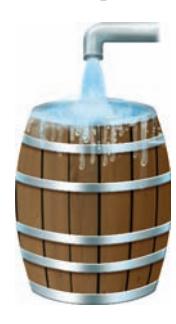
Mixtures and Concentrations. A 50-gallon barrel is filled completely with pure water. Salt water with a concentration of \(0.3\) lb slash gal is then pumped into the barrel, and the resulting mixture overflows at the same rate. The amount of salt in the barrel at time \(t\) is given by \( Q(t) = 15 (1 - e^{-0.04 t}) \) where \(t\) is measured in minutes and \(Q(t)\) is measured in pounds.
question image
(a) How much salt is in the barrel after \(5\) min?
(b) How much salt is in the barrel after \(10\) min?
(c) Draw a graph of the function \(Q(t)\).
(d) Use the graph in part (c) to determine the value that the amount of salt in the barrel approaches as \(t\) becomes large. Is this what you would expect?

Enter your answer directly below each part above.

25 Exercise - Applications · Level 3
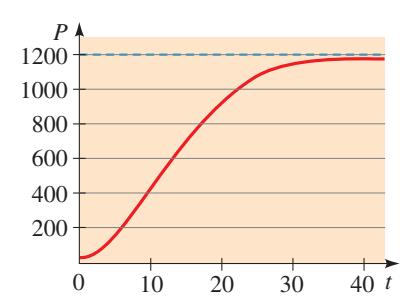
Logistic Growth. Animal populations are not capable of unrestricted growth because of limited habitat and food supplies. Under such conditions the population follows a logistic growth model: \( P(t) = \dfrac{d}{1 + k e^{-c t}} \) where \(c\), \(d\), and \(k\) are positive constants. For a certain fish population in a small pond \(d = 1200\), \(k = 11\), \(c = 0.2\), and \(t\) is measured in years. The fish were introduced into the pond at time \(t = 0\).
question image
(a) How many fish were originally put in the pond?
(b) Find the population after \(10\), \(20\), and \(30\) years.
(c) Evaluate \(P(t)\) for large values of \(t\). What value does the population approach as \(t \rightarrow \infty\)? Does the graph shown confirm your calculations?

Enter your answer directly below each part above.

26 Exercise - Applications · Level 3
Bird Population. The population of a certain species of bird is limited by the type of habitat required for nesting. The population behaves according to the logistic growth model \( n(t) = \dfrac{5600}{0.5 + 27.5 e^{-0.044 t}} \) where \(t\) is measured in years.
(a) Find the initial bird population.
(b) Draw a graph of the function \(n(t)\).
(c) What size does the population approach as time goes on?

Enter your answer directly below each part above.

27 Exercise - Applications · Level 3
World Population. The relative growth rate of world population has been decreasing steadily in recent years. On the basis of this, some population models predict that world population will eventually stabilize at a level that the planet can support. One such logistic model is \( P(t) = \dfrac{73.2}{6.1 + 5.9 e^{-0.02 t}} \) where \(t = 0\) is the year \(2000\) and population is measured in billions.
(a) What world population does this model predict for the year \(2200\)? For \(2300\)?
(b) Sketch a graph of the function \(P\) for the years \(2000\) to \(2500\).
(c) According to this model, what size does the world population seem to approach as time goes on?

Enter your answer directly below each part above.

28 Exercise - Applications · Level 2
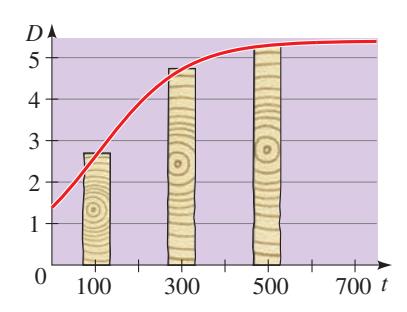
Tree Diameter. For a certain type of tree the diameter \(D\) (in feet) depends on the tree's age \(t\) (in years) according to the logistic growth model \( D(t) = \dfrac{5.4}{1 + 2.9 e^{-0.01 t}} \) Find the diameter of a 20-year-old tree.
question image
29 Exercise - Applications · Level 2
Compound Interest. An investment of \$7,000 is deposited into an account in which interest is compounded continuously at \(r = 3%\). Complete the table by filling in the amounts to which the investment grows for \(t = 1, 2, 3, 4, 5, 6\) years.
30 Exercise - Applications · Level 2
Compound Interest. An investment of \$7,000 is deposited into an account in which interest is compounded continuously for \(t = 10\) years. Complete the table by filling in the amounts to which the investment grows at the indicated rates: \(1%\), \(2%\), \(3%\), \(4%\), \(5%\), \(6%\).
31 Exercise - Applications · Level 2
Compound Interest. If \$2000 is invested at an interest rate of \(3.5%\) per year, compounded continuously, find the value of the investment after the given number of years.
(a) \(2\) years
(b) \(4\) years
(c) \(12\) years

Enter your answer directly below each part above.

32 Exercise - Applications · Level 2
Compound Interest. If \$3500 is invested at an interest rate of \(6.25%\) per year, compounded continuously, find the value of the investment after the given number of years.
(a) \(3\) years
(b) \(6\) years
(c) \(9\) years

Enter your answer directly below each part above.

33 Exercise - Applications · Level 3
Compound Interest. If \$600 is invested at an interest rate of \(2.5%\) per year, find the amount of the investment at the end of \(10\) years for the following compounding methods.
(a) Annually
(b) Semiannually
(c) Quarterly
(d) Continuously

Enter your answer directly below each part above.

34 Exercise - Applications · Level 2
Compound Interest. If \$8000 is invested in an account for which interest is compounded continuously, find the amount of the investment at the end of \(12\) years for the following interest rates.
(a) \(2%\)
(b) \(3%\)
(c) \(4.5%\)
(d) \(7%\)

Enter your answer directly below each part above.

35 Exercise - Applications · Level 3
Compound Interest. Which of the given interest rates and compounding periods would provide the better investment?
(a) \(2.5%\) per year, compounded semiannually
(b) \(2.25%\) per year, compounded monthly
(c) \(2%\) per year, compounded continuously

Enter your answer directly below each part above.

36 Exercise - Applications · Level 3
Compound Interest. Which of the given interest rates and compounding periods would provide the better investment?
(a) \(5.125%\) per year, compounded semiannually
(b) \(5%\) per year, compounded continuously

Enter your answer directly below each part above.

37 Exercise - Applications · Level 3
Investment. A sum of \$5000 is invested at an interest rate of \(9%\) per year, compounded continuously.
question image
(a) Find the value \(A(t)\) of the investment after \(t\) years.
(b) Draw a graph of \(A(t)\).
(c) Use the graph of \(A(t)\) to determine when this investment will amount to \$25,000.

Enter your answer directly below each part above.

38 Exercise - Discovery/Writing · Level 3
The Definition of \(e\). Illustrate the definition of the number \(e\) by graphing the curve \(y = (1 + 1 slash x)^x\) and the line \(y = e\) on the same screen, using the viewing rectangle \([0, 40]\) by \([0, 4]\).
39 Example - Evaluating the Exponential Function · Level 1
Use a calculator to evaluate each expression rounded to five decimal places.
(a) \(e^3\)
(b) \(2 e^{-0.53}\)
(c) \(e^{4.8}\)

Enter your answer directly below each part above.

40 Example - Transformations of the Exponential Function · Level 2
Sketch the graph of each function.
question image
(a) \(f(x) = e^{-x}\)
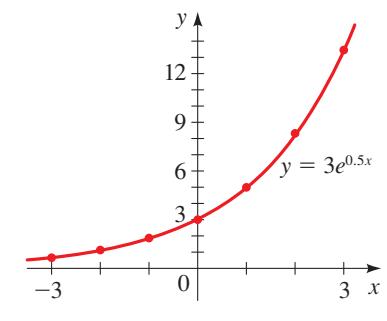
(b) \(g(x) = 3 e^{0.5 x}\)

Enter your answer directly below each part above.

41 Example - An Exponential Model for the Spread of a Virus · Level 3
An infectious disease begins to spread in a small city of population 10,000. After \(t\) days, the number of people who have succumbed to the virus is modeled by the function \( v(t) = \dfrac{10000}{5 + 1245 e^{-0.97 t}} \)
(a) How many infected people are there initially (at time \(t = 0\))?
(b) Find the number of infected people after one day, two days, and five days.
(c) Graph the function \(v\), and describe its behavior.

Enter your answer directly below each part above.

42 Example - Calculating Continuously Compounded Interest · Level 2
Find the amount after 3 years if \$1000 is invested at an interest rate of \(12%\) per year, compounded continuously.

Answered: 0 / 42