Stewart 9e Section 1.4: The Tangent and Velocity Problems

12 questions

--:--
0 / 12
Stewart 9e Section 1.4: The Tangent and Velocity Problems 0/12
1 Exercise - Secant Slopes from a Data Table · Level 2
A tank holds \(1000\) gallons of water, which drains from the bottom of the tank in half an hour. The values in the table show the volume \(V\) of water remaining in the tank (in gallons) after \(t\) minutes. \(t\) (min): \(5\), \(10\), \(15\), \(20\), \(25\), \(30\) \(V\) (gal): \(694\), \(444\), \(250\), \(111\), \(28\), \(0\)
(a) If \(P\) is the point \((15, 250)\) on the graph of \(V\), find the slopes of the secant lines \(P Q\) when \(Q\) is the point on the graph with \(t = 5, 10, 20, 25\), and \(30\).
(b) Estimate the slope of the tangent line at \(P\) by averaging the slopes of two secant lines.
(c) Use a graph of \(V\) to estimate the slope of the tangent line at \(P\). (This slope represents the rate at which the water is flowing from the tank after \(15\) minutes.)

Enter your answer directly below each part above.

2 Exercise - Walking Pace from Step Data · Level 2
A student bought a smartwatch that tracks the number of steps she walks throughout the day. The table shows the number of steps recorded \(t\) minutes after 3:00 PM on the first day she wore the watch. \(t\) (min): \(0\), \(10\), \(20\), \(30\), \(40\) Steps: \(3438\), \(4559\), \(5622\), \(6536\), \(7398\)
(a) Find the slopes of the secant lines corresponding to the given intervals of \(t\). What do these slopes represent? (i) \([0, 40]\) (ii) \([10, 20]\) (iii) \([20, 30]\)
(b) Estimate the student's walking pace, in steps per minute, at 3:20 PM by averaging the slopes of two secant lines.

Enter your answer directly below each part above.

3 Exercise - Tangent Line from Secant Slope Limits · Level 3
The point \(P(2, -1)\) lies on the curve \(y = 1/(1 - x)\).
(a) If \(Q\) is the point \((x, 1/(1 - x))\), find the slope of the secant line \(P Q\) (correct to six decimal places) for the following values of \(x\): (i) \(1.5\) (ii) \(1.9\) (iii) \(1.99\) (iv) \(1.999\) (v) \(2.5\) (vi) \(2.1\) (vii) \(2.01\) (viii) \(2.001\)
(b) Using the results of part (a), guess the value of the slope of the tangent line to the curve at \(P(2, -1)\).
(c) Using the slope from part (b), find an equation of the tangent line to the curve at \(P(2, -1)\).

Enter your answer directly below each part above.

4 Exercise - Tangent to a Cosine Curve · Level 3
The point \(P(0.5, 0)\) lies on the curve \(y = \cos(\pi x)\).
(a) If \(Q\) is the point \((x, \cos(\pi x))\), find the slope of the secant line \(P Q\) (correct to six decimal places) for the following values of \(x\): (i) \(0\) (ii) \(0.4\) (iii) \(0.49\) (iv) \(0.499\) (v) \(1\) (vi) \(0.6\) (vii) \(0.51\) (viii) \(0.501\)
(b) Using the results of part (a), guess the value of the slope of the tangent line to the curve at \(P(0.5, 0)\).
(c) Using the slope from part (b), find an equation of the tangent line to the curve at \(P(0.5, 0)\).
(d) Sketch the curve, two of the secant lines, and the tangent line.

Enter your answer directly below each part above.

5 Exercise - Average and Instantaneous Velocity (Falling Pebble) · Level 2
The deck of a bridge is suspended \(275\) feet above a river. If a pebble falls off the side of the bridge, the height (in feet) of the pebble above the water surface after \(t\) seconds is given by \(y = 275 - 16 t^2\).
(a) Find the average velocity of the pebble for the time period beginning when \(t = 4\) and lasting (i) \(0.1\) seconds (ii) \(0.05\) seconds (iii) \(0.01\) seconds
(b) Estimate the instantaneous velocity of the pebble after \(4\) seconds.

Enter your answer directly below each part above.

6 Exercise - Average and Instantaneous Velocity (Mars Rock) · Level 2
If a rock is thrown upward on the planet Mars with a velocity of \(10\) m/s, its height (in meters) \(t\) seconds later is given by \(y = 10 t - 1.86 t^2\).
(a) Find the average velocity over the given time intervals: (i) \([1, 2]\) (ii) \([1, 1.5]\) (iii) \([1, 1.1]\) (iv) \([1, 1.01]\) (v) \([1, 1.001]\)
(b) Estimate the instantaneous velocity when \(t = 1\).

Enter your answer directly below each part above.

7 Exercise - Velocity from a Position Table (Motorcyclist) · Level 2
The table shows the position of a motorcyclist after accelerating from rest. \(t\) (seconds): \(0\), \(1\), \(2\), \(3\), \(4\), \(5\), \(6\) \(s\) (feet): \(0\), \(4.9\), \(20.6\), \(46.5\), \(79.2\), \(124.8\), \(176.7\)
(a) Find the average velocity for each time period: (i) \([2, 4]\) (ii) \([3, 4]\) (iii) \([4, 5]\) (iv) \([4, 6]\)
(b) Use the graph of \(s\) as a function of \(t\) to estimate the instantaneous velocity when \(t = 3\).

Enter your answer directly below each part above.

8 Exercise - Instantaneous Velocity of a Sinusoidal Particle · Level 3
The displacement (in centimeters) of a particle moving back and forth along a straight line is given by the equation of motion \(s = 2 \sin(\pi t) + 3 \cos(\pi t)\), where \(t\) is measured in seconds.
(a) Find the average velocity during each time period: (i) \([1, 2]\) (ii) \([1, 1.1]\) (iii) \([1, 1.01]\) (iv) \([1, 1.001]\)
(b) Estimate the instantaneous velocity of the particle when \(t = 1\).

Enter your answer directly below each part above.

9 Exercise - Tangent to a Rapidly Oscillating Curve · Level 4
The point \(P(1, 0)\) lies on the curve \(y = \sin\left(10 \dfrac{\pi}{x}\right)\).
(a) If \(Q\) is the point \((x, \sin\left(10 \dfrac{\pi}{x}\right))\), find the slope of the secant line \(P Q\) (correct to four decimal places) for \(x = 2, 1.5, 1.4, 1.3, 1.2, 1.1, 0.5, 0.6, 0.7, 0.8\), and \(0.9\). Do the slopes appear to be approaching a limit?
(b) Use a graph of the curve to explain why the slopes of the secant lines in part (a) are not close to the slope of the tangent line at \(P\).
(c) By choosing appropriate secant lines, estimate the slope of the tangent line at \(P\).

Enter your answer directly below each part above.

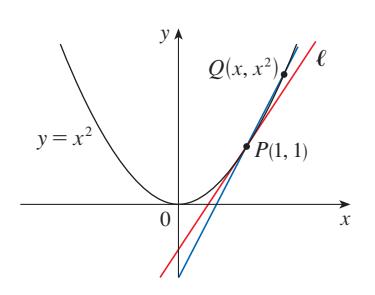
10 Example - Tangent Line to a Parabola · Level 2
Find an equation of the tangent line to the parabola \(y = x^2\) at the point \(P(1, 1)\).
question image
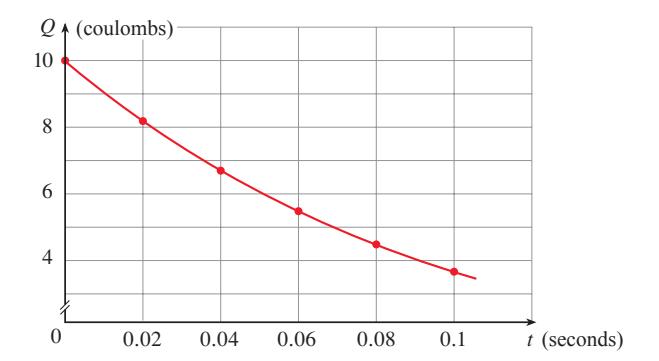
11 Example - Slope from Experimental Data · Level 3
A pulse laser operates by storing charge on a capacitor and releasing it suddenly when the laser is fired. The data in the table describe the charge \(Q\) (in coulombs) remaining on the capacitor at time \(t\) (in seconds after the laser is fired). \(t\): \(0\), \(0.02\), \(0.04\), \(0.06\), \(0.08\), \(0.10\) \(Q\): \(10\), \(8.187\), \(6.703\), \(5.488\), \(4.493\), \(3.676\) Use the data to estimate the slope of the tangent line to the graph at the point where \(t = 0.04\). (This slope represents the electric current, in amperes, flowing from the capacitor to the laser.)
question image
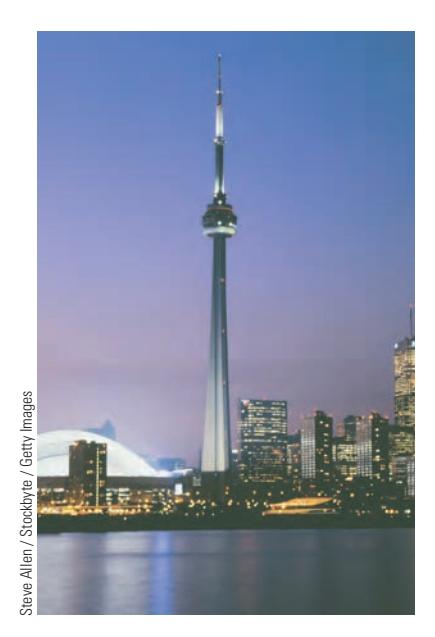
12 Example - Instantaneous Velocity (Free Fall) · Level 3
Suppose that a ball is dropped from the upper observation deck of the CN Tower in Toronto, \(450\) m above the ground. Using Galileo's free-fall equation \(s(t) = 4.9 t^2\) for the distance fallen (in meters) after \(t\) seconds, find the velocity of the ball after \(5\) seconds.
question image

Answered: 0 / 12