Stewart Section 12.4: The Cross Product

52 questions

--:--
0 / 52
Stewart Section 12.4: The Cross Product 0/52
1 Cross Product - Computation · Level 2
Find the cross product \(\mathbf{a} \times \mathbf{b}\) and verify that it is orthogonal to both \(\mathbf{a}\) and \(\mathbf{b}\). \(\mathbf{a} = \langle 2, 3, 0 \rangle\), \(\mathbf{b} = \langle 1, 0, 5 \rangle\)
2 Cross Product - Computation · Level 2
Find the cross product \(\mathbf{a} \times \mathbf{b}\) and verify that it is orthogonal to both \(\mathbf{a}\) and \(\mathbf{b}\). \(\mathbf{a} = \langle 4, 3, -2 \rangle\), \(\mathbf{b} = \langle 2, -1, 1 \rangle\)
3 Cross Product - Computation · Level 2
Find the cross product \(\mathbf{a} \times \mathbf{b}\) and verify that it is orthogonal to both \(\mathbf{a}\) and \(\mathbf{b}\). \(\mathbf{a} = 2 \mathbf{j} - 4 \mathbf{k}\), \(\mathbf{b} = -\mathbf{i} + 3 \mathbf{j} + \mathbf{k}\)
4 Cross Product - Computation · Level 2
Find the cross product \(\mathbf{a} \times \mathbf{b}\) and verify that it is orthogonal to both \(\mathbf{a}\) and \(\mathbf{b}\). \(\mathbf{a} = 3 \mathbf{i} + 3 \mathbf{j} - 3 \mathbf{k}\), \(\mathbf{b} = 3 \mathbf{i} - 3 \mathbf{j} + 3 \mathbf{k}\)
5 Cross Product - Computation · Level 3
Find the cross product \(\mathbf{a} \times \mathbf{b}\) and verify that it is orthogonal to both \(\mathbf{a}\) and \(\mathbf{b}\). \(\mathbf{a} = \dfrac{1}{2} \mathbf{i} + \dfrac{1}{3} \mathbf{j} + \dfrac{1}{4} \mathbf{k}\), \(\mathbf{b} = \mathbf{i} + 2 \mathbf{j} - 3 \mathbf{k}\)
6 Cross Product - Computation · Level 3
Find the cross product \(\mathbf{a} \times \mathbf{b}\) and verify that it is orthogonal to both \(\mathbf{a}\) and \(\mathbf{b}\). \(\mathbf{a} = t \mathbf{i} + \cos t \mathbf{j} + \sin t \mathbf{k}\), \(\mathbf{b} = \mathbf{i} - \sin t \mathbf{j} + \cos t \mathbf{k}\)
7 Cross Product - Computation · Level 3
Find the cross product \(\mathbf{a} \times \mathbf{b}\) and verify that it is orthogonal to both \(\mathbf{a}\) and \(\mathbf{b}\). \(\mathbf{a} = \langle t, 1, \dfrac{1}{t} \rangle\), \(\mathbf{b} = \langle t^2, t^2, 1 \rangle\)
8 Cross Product - Computation · Level 2
If \(\mathbf{a} = \mathbf{i} - 2 \mathbf{k}\) and \(\mathbf{b} = \mathbf{j} + \mathbf{k}\), find \(\mathbf{a} \times \mathbf{b}\). Sketch \(\mathbf{a}\), \(\mathbf{b}\), and \(\mathbf{a} \times \mathbf{b}\) as vectors starting at the origin.
9 Cross Product - Properties · Level 2
Find the vector, not with determinants, but by using properties of cross products. \((\mathbf{i} \times \mathbf{j}) \times \mathbf{k}\)
10 Cross Product - Properties · Level 2
Find the vector, not with determinants, but by using properties of cross products. \(\mathbf{k} \times (\mathbf{i} - 2 \mathbf{j})\)
11 Cross Product - Properties · Level 3
Find the vector, not with determinants, but by using properties of cross products. \((\mathbf{j} - \mathbf{k}) \times (\mathbf{k} - \mathbf{i})\)
12 Cross Product - Properties · Level 2
Find the vector, not with determinants, but by using properties of cross products. \((\mathbf{i} + \mathbf{j}) \times (\mathbf{i} - \mathbf{j})\)
13 Cross Product - Concepts · Level 3
State whether each expression is meaningful. If not, explain why. If so, state whether it is a vector or a scalar.
(a) \(\mathbf{a} \cdot (\mathbf{b} \times \mathbf{c})\)
(b) \(\mathbf{a} \times (\mathbf{b} \cdot \mathbf{c})\)
(c) \(\mathbf{a} \times (\mathbf{b} \times \mathbf{c})\)
(d) \(\mathbf{a} \cdot (\mathbf{b} \cdot \mathbf{c})\)
(e) \((\mathbf{a} \cdot \mathbf{b}) \times (\mathbf{c} \cdot \mathbf{d})\)
(f) \((\mathbf{a} \times \mathbf{b}) \cdot (\mathbf{c} \times \mathbf{d})\)

Enter your answer directly below each part above.

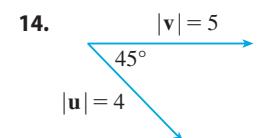
14 Cross Product - Geometric · Level 2
Find \(|\mathbf{u} \times \mathbf{v}|\) and determine whether \(\mathbf{u} \times \mathbf{v}\) is directed into the page or out of the page.
question image
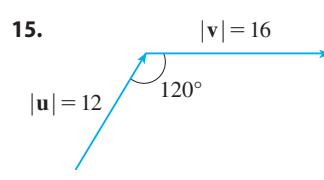
15 Cross Product - Geometric · Level 2
Find \(|\mathbf{u} \times \mathbf{v}|\) and determine whether \(\mathbf{u} \times \mathbf{v}\) is directed into the page or out of the page.
question image
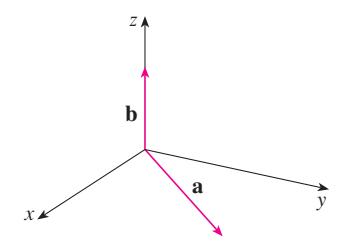
16 Cross Product - Geometric · Level 3
The figure shows a vector \(\mathbf{a}\) in the \(x y\)-plane and a vector \(\mathbf{b}\) in the direction of \(\mathbf{k}\). Their lengths are \(|\mathbf{a}| = 3\) and \(|\mathbf{b}| = 2\).
question image
(a) Find \(|\mathbf{a} \times \mathbf{b}|\).
(b) Use the right-hand rule to decide whether the components of \(\mathbf{a} \times \mathbf{b}\) are positive, negative, or 0.

Enter your answer directly below each part above.

17 Cross Product - Computation · Level 2
If \(\mathbf{a} = \langle 2, -1, 3 \rangle\) and \(\mathbf{b} = \langle 4, 2, 1 \rangle\), find \(\mathbf{a} \times \mathbf{b}\) and \(\mathbf{b} \times \mathbf{a}\).
18 Cross Product - Properties · Level 3
If \(\mathbf{a} = \langle 1, 0, 1 \rangle\), \(\mathbf{b} = \langle 2, 1, -1 \rangle\), and \(\mathbf{c} = \langle 0, 1, 3 \rangle\), show that \(\mathbf{a} \times (\mathbf{b} \times \mathbf{c}) \neq (\mathbf{a} \times \mathbf{b}) \times \mathbf{c}\).
19 Cross Product - Unit Vectors · Level 3
Find two unit vectors orthogonal to both \(\langle 3, 2, 1 \rangle\) and \(\langle -1, 1, 0 \rangle\).
20 Cross Product - Unit Vectors · Level 3
Find two unit vectors orthogonal to both \(\mathbf{i} - \mathbf{k}\) and \(\mathbf{i} + \mathbf{j}\).
21 Cross Product - Proof · Level 3
Show that \(\mathbf{0} \times \mathbf{a} = \mathbf{0} = \mathbf{a} \times \mathbf{0}\) for any vector \(\mathbf{a}\) in \(V_3\).
22 Cross Product - Proof · Level 3
Show that \((\mathbf{a} \times \mathbf{b}) \cdot \mathbf{b} = 0\) for all vectors \(\mathbf{a}\) and \(\mathbf{b}\) in \(V_3\).
23 Cross Product - Proof · Level 4
Prove the property of cross products (Theorem 11). Property 1: \(\mathbf{a} \times \mathbf{b} = -\mathbf{b} \times \mathbf{a}\)
24 Cross Product - Proof · Level 4
Prove the property of cross products (Theorem 11). Property 2: \((c \mathbf{a}) \times \mathbf{b} = c(\mathbf{a} \times \mathbf{b}) = \mathbf{a} \times (c \mathbf{b})\)
25 Cross Product - Proof · Level 4
Prove the property of cross products (Theorem 11). Property 3: \(\mathbf{a} \times (\mathbf{b} + \mathbf{c}) = \mathbf{a} \times \mathbf{b} + \mathbf{a} \times \mathbf{c}\)
26 Cross Product - Proof · Level 4
Prove the property of cross products (Theorem 11). Property 4: \((\mathbf{a} + \mathbf{b}) \times \mathbf{c} = \mathbf{a} \times \mathbf{c} + \mathbf{b} \times \mathbf{c}\)
27 Cross Product - Area · Level 3
Find the area of the parallelogram with vertices \(A(-3, 0)\), \(B(-1, 3)\), \(C(5, 2)\), and \(D(3, -1)\).
28 Cross Product - Area · Level 3
Find the area of the parallelogram with vertices \(P(1, 0, 2)\), \(Q(3, 3, 3)\), \(R(7, 5, 8)\), and \(S(5, 2, 7)\).
29 Cross Product - Area · Level 3
(a) Find a nonzero vector orthogonal to the plane through the points \(P\), \(Q\), and \(R\), and (b) find the area of triangle \(P Q R\). \(P(1, 0, 1)\), \(Q(-2, 1, 3)\), \(R(4, 2, 5)\)
30 Cross Product - Area · Level 3
(a) Find a nonzero vector orthogonal to the plane through the points \(P\), \(Q\), and \(R\), and (b) find the area of triangle \(P Q R\). \(P(0, 0, -3)\), \(Q(4, 2, 0)\), \(R(3, 3, 1)\)
31 Cross Product - Area · Level 3
(a) Find a nonzero vector orthogonal to the plane through the points \(P\), \(Q\), and \(R\), and (b) find the area of triangle \(P Q R\). \(P(0, -2, 0)\), \(Q(4, 1, -2)\), \(R(5, 3, 1)\)
32 Cross Product - Area · Level 3
(a) Find a nonzero vector orthogonal to the plane through the points \(P\), \(Q\), and \(R\), and (b) find the area of triangle \(P Q R\). \(P(2, -3, 4)\), \(Q(-1, -2, 2)\), \(R(3, 1, -3)\)
33 Cross Product - Volume · Level 3
Find the volume of the parallelepiped determined by the vectors \(\mathbf{a}\), \(\mathbf{b}\), and \(\mathbf{c}\). \(\mathbf{a} = \langle 1, 2, 3 \rangle\), \(\mathbf{b} = \langle -1, 1, 2 \rangle\), \(\mathbf{c} = \langle 2, 1, 4 \rangle\)
34 Cross Product - Volume · Level 3
Find the volume of the parallelepiped determined by the vectors \(\mathbf{a}\), \(\mathbf{b}\), and \(\mathbf{c}\). \(\mathbf{a} = \mathbf{i} + \mathbf{j}\), \(\mathbf{b} = \mathbf{i} + \mathbf{k}\), \(\mathbf{c} = \mathbf{i} + \mathbf{j} + \mathbf{k}\)
35 Cross Product - Volume · Level 3
Find the volume of the parallelepiped with adjacent edges \(P Q\), \(P R\), and \(P S\). \(P(-2, 1, 0)\), \(Q(2, 3, 2)\), \(R(1, 4, -1)\), \(S(3, 6, 1)\)
36 Cross Product - Volume · Level 3
Find the volume of the parallelepiped with adjacent edges \(P Q\), \(P R\), and \(P S\). \(P(3, 0, 1)\), \(Q(-1, 2, 5)\), \(R(5, 1, -1)\), \(S(0, 4, 2)\)
37 Cross Product - Coplanar · Level 3
Use the scalar triple product to verify that the vectors \(\mathbf{u} = \mathbf{i} + 5 \mathbf{j} - 2 \mathbf{k}\), \(\mathbf{v} = 3 \mathbf{i} - \mathbf{j}\), and \(\mathbf{w} = 5 \mathbf{i} + 9 \mathbf{j} - 4 \mathbf{k}\) are coplanar.
38 Cross Product - Coplanar · Level 3
Use the scalar triple product to determine whether the points \(A(1, 3, 2)\), \(B(3, -1, 6)\), \(C(5, 2, 0)\), and \(D(3, 6, -4)\) lie in the same plane.
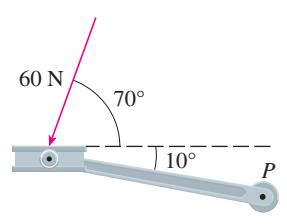
39 Cross Product - Torque · Level 3
A bicycle pedal is pushed by a foot with a 60-N force as shown. The shaft of the pedal is 18 cm long. Find the magnitude of the torque about \(P\).
question image
40 Cross Product - Torque · Level 3
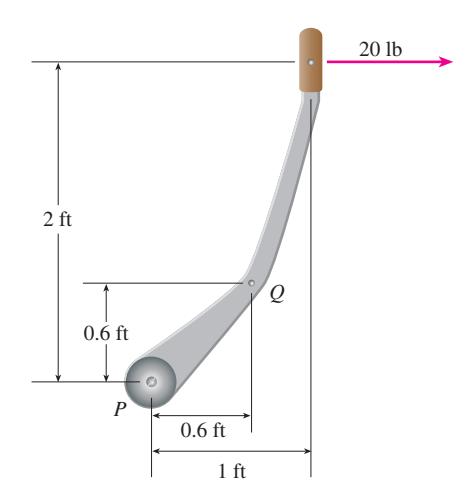
question image
(a) A horizontal force of 20 lb is applied to the handle of a gearshift lever as shown. Find the magnitude of the torque about the pivot point \(P\).
(b) Find the magnitude of the torque about \(P\) if the same force is applied at the elbow \(Q\) of the lever.

Enter your answer directly below each part above.

41 Cross Product - Torque · Level 3
A wrench 30 cm long lies along the positive \(y\)-axis and grips a bolt at the origin. A force is applied in the direction \(\langle 0, 3, -4 \rangle\) at the end of the wrench. Find the magnitude of the force needed to supply 100 N\(\cdot\)m of torque to the bolt.
42 Cross Product - Geometric · Level 4
Let \(\mathbf{v} = 5 \mathbf{j}\) and let \(\mathbf{u}\) be a vector with length 3 that starts at the origin and rotates in the \(x y\)-plane. Find the maximum and minimum values of the length of the vector \(\mathbf{u} \times \mathbf{v}\). In what direction does \(\mathbf{u} \times \mathbf{v}\) point?
43 Cross Product - Applications · Level 4
If \(\mathbf{a} \cdot \mathbf{b} = \sqrt{3}\) and \(\mathbf{a} \times \mathbf{b} = \langle 1, 2, 2 \rangle\), find the angle between \(\mathbf{a}\) and \(\mathbf{b}\).
44 Cross Product - Applications · Level 4
(a) Find all vectors \(\mathbf{v}\) such that \(\langle 1, 2, 1 \rangle \times \mathbf{v} = \langle 3, 1, -5 \rangle\)
(b) Explain why there is no vector \(\mathbf{v}\) such that \(\langle 1, 2, 1 \rangle \times \mathbf{v} = \langle 3, 1, 5 \rangle\)

Enter your answer directly below each part above.

45 Cross Product - Distance · Level 4
(a) Let \(P\) be a point not on the line \(L\) that passes through the points \(Q\) and \(R\). Show that the distance \(d\) from the point \(P\) to the line \(L\) is \(d = \dfrac{|\mathbf{a} \times \mathbf{b}|}{|\mathbf{a}|}\) where \(\mathbf{a} = \overrightarrow{Q R}\) and \(\mathbf{b} = \overrightarrow{Q P}\).
(b) Use the formula in part (a) to find the distance from the point \(P(1, 1, 1)\) to the line through \(Q(0, 6, 8)\) and \(R(-1, 4, 7)\).

Enter your answer directly below each part above.

46 Cross Product - Distance · Level 4
(a) Let \(P\) be a point not on the plane that passes through the points \(Q\), \(R\), and \(S\). Show that the distance \(d\) from \(P\) to the plane is \(d = \dfrac{|\mathbf{a} \cdot (\mathbf{b} \times \mathbf{c})|}{|\mathbf{a} \times \mathbf{b}|}\) where \(\mathbf{a} = \overrightarrow{Q R}\), \(\mathbf{b} = \overrightarrow{Q S}\), and \(\mathbf{c} = \overrightarrow{Q P}\).
(b) Use the formula in part (a) to find the distance from the point \(P(2, 1, 4)\) to the plane through the points \(Q(1, 0, 0)\), \(R(0, 2, 0)\), and \(S(0, 0, 3)\).

Enter your answer directly below each part above.

47 Cross Product - Proof · Level 4
Show that \(|\mathbf{a} \times \mathbf{b}|^2 = |\mathbf{a}|^2 |\mathbf{b}|^2 - (\mathbf{a} \cdot \mathbf{b})^2\).
48 Cross Product - Proof · Level 4
If \(\mathbf{a} + \mathbf{b} + \mathbf{c} = \mathbf{0}\), show that \(\mathbf{a} \times \mathbf{b} = \mathbf{b} \times \mathbf{c} = \mathbf{c} \times \mathbf{a}\)
49 Cross Product - Proof · Level 4
Prove that \((\mathbf{a} - \mathbf{b}) \times (\mathbf{a} + \mathbf{b}) = 2(\mathbf{a} \times \mathbf{b})\).
50 Cross Product - Proof · Level 5
Prove Property 6 of cross products, that is, \(\mathbf{a} \times (\mathbf{b} \times \mathbf{c}) = (\mathbf{a} \cdot \mathbf{c}) \mathbf{b} - (\mathbf{a} \cdot \mathbf{b}) \mathbf{c}\)
51 Cross Product - Proof · Level 5
Use Exercise 50 to prove that \(\mathbf{a} \times (\mathbf{b} \times \mathbf{c}) + \mathbf{b} \times (\mathbf{c} \times \mathbf{a}) + \mathbf{c} \times (\mathbf{a} \times \mathbf{b}) = \mathbf{0}\)
52 Cross Product - Proof · Level 5
Prove that \((\mathbf{a} \times \mathbf{b}) \cdot (\mathbf{c} \times \mathbf{d}) = \begin{pmatrix} \mathbf{a} \cdot \mathbf{c} & \mathbf{b} \cdot \mathbf{c} \\ \mathbf{a} \cdot \mathbf{d} & \mathbf{b} \cdot \mathbf{d} \end{pmatrix}\)

Answered: 0 / 52