Stewart Precalc 6e Chapter 4 Focus on Modeling: Fitting Exponential and Power Curves to Data

13 questions

--:--
0 / 13
Stewart Precalc 6e Chapter 4 Focus on Modeling: Fitting Exponential and Power Curves to Data 0/13
1 Modeling - U.S. Population (Exponential) · Level 3
The U.S. Constitution requires a census every 10 years. Census data for 1790-2000 (Year, Population in millions): (1790, 3.9), (1800, 5.3), (1810, 7.2), (1820, 9.6), (1830, 12.9), (1840, 17.1), (1850, 23.2), (1860, 31.4), (1870, 38.6), (1880, 50.2), (1890, 63.0), (1900, 76.2), (1910, 92.2), (1920, 106.0), (1930, 123.2), (1940, 132.2), (1950, 151.3), (1960, 179.3), (1970, 203.3), (1980, 226.5), (1990, 248.7), (2000, 281.4). (a) Make a scatter plot of the data. (b) Use a calculator to find an exponential model for the data. (c) Use your model to predict the population at the 2010 census. (d) Use your model to estimate the population in 1965. (e) Compare your answers from parts (c) and (d) to the values in the table. Do you think an exponential model is appropriate for these data?

question image
2 Modeling - A Falling Ball (Power) · Level 2
In a physics experiment, a lead ball is dropped from a height of 5 m. Students record the distance the ball has fallen every 0.1 s (Time s, Distance m): (0.1, 0.048), (0.2, 0.197), (0.3, 0.441), (0.4, 0.882), (0.5, 1.227), (0.6, 1.765), (0.7, 2.401), (0.8, 3.136), (0.9, 3.969), (1.0, 4.902). (a) Make a scatter plot of the data. (b) Use a calculator to find a power model. (c) Use your model to predict how far a dropped ball would fall in 3 s.
3 Modeling - Health-Care Expenditures (Exponential) · Level 3
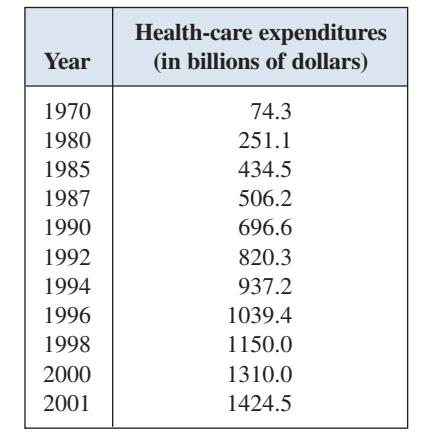
The U.S. health-care expenditures for 1970-2001 are given (with the scatter plot shown). (a) Does the scatter plot suggest an exponential model? (b) Make a table of \((t, \ln E)\) values and a scatter plot. Does the scatter plot appear to be linear? (c) Find the regression line for the data in part (b). (d) Use the results of part (c) to find an exponential model for the growth of health-care expenditures. (e) Use your model to predict the total health-care expenditures in 2009.
question image
4 Modeling - Half-Life of Radioactive Iodine (Exponential) · Level 3
A student is determining the half-life of radioactive iodine-131 by measuring the amount in a sample every 8 hours (Time h, Amount g): (0, 4.80), (8, 4.66), (16, 4.51), (24, 4.39), (32, 4.29), (40, 4.14), (48, 4.04). (a) Make a scatter plot of the data. (b) Use a calculator to find an exponential model. (c) Use your model to find the half-life of iodine-131.
5 Modeling - Beer-Lambert Law (Exponential) · Level 3
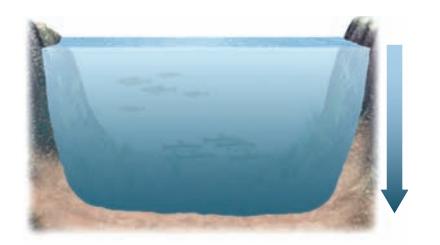
The Beer-Lambert Law states \(I = I_0 e^{-k x}\), where \(I_0\) is light intensity at the surface, \(k\) is the murkiness constant, and \(x\) is the depth. Data (Depth ft, Light intensity lm): (5, 13.0), (10, 7.6), (15, 4.5), (20, 2.7), (25, 1.8), (30, 1.1), (35, 0.5), (40, 0.3). (a) Use a graphing calculator to find an exponential function in the Beer-Lambert form to model these data. What are \(I_0\) and \(k\)? Hint: if the calculator gives \(I = a b^x\), convert using \(b^x = e^{x \ln b}\). (b) Make a scatter plot and graph the function. (c) If light intensity drops below 0.15 lumens, a certain species of algae cannot survive. Use your model to determine the depth below which there is insufficient light.
question image
6 Modeling - Forgetting Curves (Power vs Exponential) · Level 4
A psychologist asks volunteers to memorize a list of 100 words, then tests how many they can recall after various periods (Time, Words recalled): (15 min, 64.3), (1 h, 45.1), (8 h, 37.3), (1 day, 32.8), (2 days, 26.9), (3 days, 25.6), (5 days, 22.9). (a) Use a graphing calculator to find a power function \(y = a t^b\) that models the average number of words \(y\) remembered after \(t\) hours. Then find an exponential function \(y = a b^t\) to model the data. (b) Make a scatter plot of the data and graph both functions on your scatter plot. (c) Which of the two functions seems to provide the better model?
7 Modeling - Species-Area Relation (Power) · Level 3
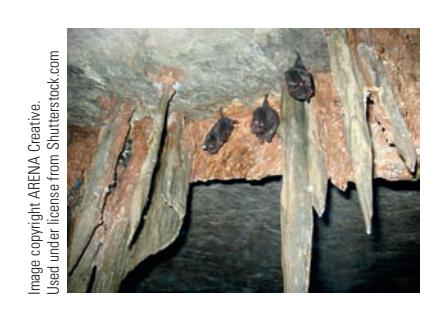
Areas of several caves in central Mexico and the number of bat species in each (Area in \(m^2\), Number of species): (18, 1), (19, 1), (58, 1), (60, 2), (128, 5), (187, 4), (344, 6), (511, 7). (a) Find a power function that models the data. (b) Draw a graph of the function and a scatter plot. Does the model fit the data well? (c) The cave El Sapo near Puebla, Mexico, has surface area \(A = 205\) \(m^2\). Use the model to estimate the number of bat species in that cave.
question image
8 Modeling - Auto Exhaust Emissions (Exponential) · Level 3
Cost of reducing automobile emissions by various percentages (Reduction in emissions %, Cost per car in dollars): (50, 45), (55, 55), (60, 62), (65, 70), (70, 80), (75, 90), (80, 100), (85, 200), (90, 375), (95, 600). Find an exponential model that captures the 'diminishing returns' trend of these data.
9 Modeling - Exponential or Power Model? · Level 3
Data points \((x, y)\): (2, 0.08), (4, 0.12), (6, 0.18), (8, 0.25), (10, 0.36), (12, 0.52), (14, 0.73), (16, 1.06). (a) Draw a scatter plot of the data. (b) Draw scatter plots of \((x, \ln y)\) and \((\ln x, \ln y)\). (c) Which is more appropriate for modeling this data: an exponential function or a power function? (d) Find an appropriate function to model the data.
10 Example - Exponential model for world population · Level 3
An Exponential Model for World Population. Table 1 gives the population of the world (in millions) in the 20th century, from 1900 to 2000 in 10-year intervals (1900: 1650; 1910: 1750; 1920: 1860; 1930: 2070; 1940: 2300; 1950: 2520; 1960: 3020; 1970: 3700; 1980: 4450; 1990: 5300; 2000: 6060).
question image
(a) Draw a scatter plot, and note that a linear model is not appropriate.
(b) Find an exponential function that models population growth.
(c) Draw a graph of the function that you found together with the scatter plot. How well does the model fit the data?
(d) Use the model that you found to predict world population in the year 2020.

Enter your answer directly below each part above.

11 Example - Power model for planetary periods (Kepler's Third Law) · Level 3
A Power Model for Planetary Periods. Table 2 gives the mean distance \(d\) of each planet from the sun in astronomical units (AU) and its period \(T\) in years (Mercury: \(d = 0.387\), \(T = 0.241\); Venus: \(0.723\), \(0.615\); Earth: \(1.000\), \(1.000\); Mars: \(1.523\), \(1.881\); Jupiter: \(5.203\), \(11.861\); Saturn: \(9.541\), \(29.457\); Uranus: \(19.190\), \(84.008\); Neptune: \(30.086\), \(164.784\); Pluto: \(39.507\), \(248.350\)).
question image
(a) Sketch a scatter plot. Is a linear model appropriate?
(b) Find a power function that models the data.
(c) Draw a graph of the function you found and the scatter plot on the same graph. How well does the model fit the data?
(d) Use the model that you found to calculate the period of an asteroid whose mean distance from the sun is 5 AU.

Enter your answer directly below each part above.

12 Example - An Exponential or Power Model? · Level 3
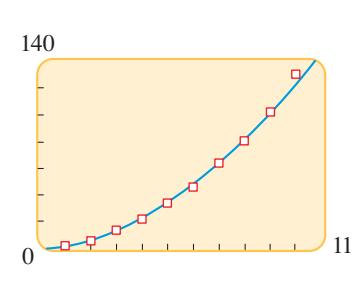
Data points \((x, y)\) are shown in Table 5: \(x\) values are 1, 2, 3, 4, 5, 6, 7, 8, 9, 10 with corresponding \(y\) values 2, 6, 14, 22, 34, 46, 64, 80, 102, 130. (a) Draw a scatter plot of the data. (b) Draw scatter plots of \((x, \ln y)\) and \((\ln x, \ln y)\). (c) Is an exponential function or a power function appropriate for modeling this data? (d) Find an appropriate function to model the data.
question image
13 Example - Logistic Model (Stocking a Pond with Catfish) · Level 3
A pond is initially stocked with 1000 catfish, and the fish population is then sampled at 15-week intervals. The population data are (Week, Catfish): (0, 1000), (15, 1500), (30, 3300), (45, 4400), (60, 6100), (75, 6900), (90, 7100), (105, 7800), (120, 7900). (a) Find an appropriate model for the data. (b) Make a scatter plot of the data and graph the model on the scatter plot. (c) How does the model predict that the fish population will change with time?

Answered: 0 / 13