Stewart Section 2.3: Calculating Limits

66 questions

--:--
0 / 66
Stewart Section 2.3: Calculating Limits 0/66
1 Limits - Calculating · Level 3
Given that \(\operatorname*{lim}\limits_{x \rightarrow 2} f(x) = 4\), \(\operatorname*{lim}\limits_{x \rightarrow 2} g(x) = -2\), \(\operatorname*{lim}\limits_{x \rightarrow 2} h(x) = 0\), find the limits that exist. If the limit does not exist, explain why.
(a) \(\operatorname*{lim}\limits_{x \rightarrow 2} [f(x) + 5g(x)]\)
(b) \(\operatorname*{lim}\limits_{x \rightarrow 2} [g(x)]^3\)
(c) \(\operatorname*{lim}\limits_{x \rightarrow 2} \sqrt{f(x)}\)
(d) \(\operatorname*{lim}\limits_{x \rightarrow 2} \dfrac{3f(x)}{g(x)}\)
(e) \(\operatorname*{lim}\limits_{x \rightarrow 2} \dfrac{g(x)}{h(x)}\)
(f) \(\operatorname*{lim}\limits_{x \rightarrow 2} \dfrac{g(x) h(x)}{f(x)}\)

Enter your answer directly below each part above.

2 Limits - Calculating · Level 3
The graphs of \(f\) and \(g\) are given. Use them to evaluate each limit, if it exists. If the limit does not exist, explain why.
(a) \(\operatorname*{lim}\limits_{x \rightarrow 2} [f(x) + g(x)]\)
(b) \(\operatorname*{lim}\limits_{x \rightarrow 0} [f(x) - g(x)]\)
(c) \(\operatorname*{lim}\limits_{x \rightarrow -1} [f(x) g(x)]\)
(d) \(\operatorname*{lim}\limits_{x \rightarrow 3} \dfrac{f(x)}{g(x)}\)
(e) \(\operatorname*{lim}\limits_{x \rightarrow 2} [x^2 f(x)]\)
(f) \(f(-1) + \operatorname*{lim}\limits_{x \rightarrow -1} g(x)\)

Enter your answer directly below each part above.

3 Limits - Calculating · Level 3
\(\operatorname*{lim}\limits_{x \rightarrow 0} (5x^3 - 3x^2 + x - 6)\)
4 Limits - Calculating · Level 3
\(\operatorname*{lim}\limits_{x \rightarrow -1} (x^4 - 3x)(x^2 + 5x + 3)\)
5 Limits - Calculating · Level 3
\(\operatorname*{lim}\limits_{t \rightarrow -2} \dfrac{t^4 - 2}{2t^2 - 3t + 2}\)
6 Limits - Calculating · Level 3
\(\operatorname*{lim}\limits_{u \rightarrow -2} \sqrt{u^4 + 3u + 6}\)
7 Limits - Calculating · Level 3
\(\operatorname*{lim}\limits_{x \rightarrow 8} (1 + \sqrt[3]{x})(2 - 6x^2 + x^3)\)
8 Limits - Calculating · Level 3
\(\operatorname*{lim}\limits_{t \rightarrow 2} \left(\dfrac{t^2 - 2}{t^3 - 3t + 5}\right)^2\)
9 Limits - Calculating · Level 3
\(\operatorname*{lim}\limits_{x \rightarrow -2} \sqrt{\dfrac{2x^2 + 1}{3x - 2}}\)
10 Limits - Calculating · Level 3
(a) What is wrong with the following equation? \(\dfrac{x^2 + x - 6}{x - 2} = x + 3\)
(b) In view of part (a), explain why the equation \(\operatorname*{lim}\limits_{x \rightarrow 2} \dfrac{x^2 + x - 6}{x - 2} = \operatorname*{lim}\limits_{x \rightarrow 2} (x + 3)\) is correct.

Enter your answer directly below each part above.

11 Limits - Calculating · Level 3
\(\operatorname*{lim}\limits_{x \rightarrow 5} \dfrac{x^2 - 6x + 5}{x - 5}\)
12 Limits - Calculating · Level 3
\(\operatorname*{lim}\limits_{x \rightarrow -3} \dfrac{x^2 + 3x}{x^2 - x - 12}\)
13 Limits - Calculating · Level 3
\(\operatorname*{lim}\limits_{x \rightarrow 5} \dfrac{x^2 - 5x + 6}{x - 5}\)
14 Limits - Calculating · Level 3
\(\operatorname*{lim}\limits_{x \rightarrow 4} \dfrac{x^2 + 3x}{x^2 - x - 12}\)
15 Limits - Calculating · Level 3
\(\operatorname*{lim}\limits_{x \rightarrow -1} \dfrac{x^2 - 4x}{x^2 - 3x - 4}\)
16 Limits - Calculating · Level 3
\(\operatorname*{lim}\limits_{x \rightarrow -1} \dfrac{2x^2 + 3x + 1}{x^2 - 2x - 3}\)
17 Limits - Calculating · Level 3
\(\operatorname*{lim}\limits_{x \rightarrow 0} \dfrac{(5 + h)^2 - 25}{h}\)
18 Limits - Calculating · Level 3
\(\operatorname*{lim}\limits_{h \rightarrow 0} \dfrac{(2 + h)^3 - 8}{h}\)
19 Limits - Calculating · Level 3
\(\operatorname*{lim}\limits_{x \rightarrow 1} \dfrac{x + 2}{x^2 + 8}\)
20 Limits - Calculating · Level 3
\(\operatorname*{lim}\limits_{t \rightarrow 1} \dfrac{t^4 - 1}{t^3 - 1}\)
21 Limits - Calculating · Level 3
\(\operatorname*{lim}\limits_{x \rightarrow -4} \dfrac{\sqrt{x + 8} - 2}{x + 4}\)
22 Limits - Calculating · Level 3
\(\operatorname*{lim}\limits_{x \rightarrow 2} \dfrac{\sqrt{4x + 1} - 3}{x - 2}\)
23 Limits - Calculating · Level 3
\(\operatorname*{lim}\limits_{h \rightarrow 0} \dfrac{(3 + h)^{-1} - 3^{-1}}{h}\)
24 Limits - Calculating · Level 3
\(\operatorname*{lim}\limits_{h \rightarrow 0} \dfrac{1/(h+3) - \dfrac{1}{3}}{h}\)
25 Limits - Calculating · Level 3
\(\operatorname*{lim}\limits_{x \rightarrow -1} \dfrac{x + 1}{\sqrt{x + 5} - 2}\)
26 Limits - Calculating · Level 3
\(\operatorname*{lim}\limits_{x \rightarrow 1} \dfrac{\sqrt{x} - x^2}{1 - \sqrt{x}}\)
27 Limits - Calculating · Level 3
\(\operatorname*{lim}\limits_{x \rightarrow 16} \dfrac{4 - \sqrt{x}}{16x - x^2}\)
28 Limits - Calculating · Level 3
\(\operatorname*{lim}\limits_{x \rightarrow 0} \dfrac{x^2 - 4x + 4}{x^3 - 3x^2 + 2x}\)
29 Limits - Calculating · Level 3
\(\operatorname*{lim}\limits_{t \rightarrow 0} \left(\dfrac{1}{t \sqrt{1 + t}} - \dfrac{1}{t}\right)\)
30 Limits - Calculating · Level 3
\(\operatorname*{lim}\limits_{x \rightarrow 0} \dfrac{x}{\sqrt{1 + 3x} - 1}\)
31 Limits - Calculating · Level 3
\(\operatorname*{lim}\limits_{h \rightarrow 0} \dfrac{(x + h)^2 - x^2}{h}\)
32 Limits - Calculating · Level 3
\(\operatorname*{lim}\limits_{h \rightarrow 0} \dfrac{1/(x + h)^2 - 1/x^2}{h}\)
33 Limits - Calculating · Level 3
(a) Estimate the value of \(\operatorname*{lim}\limits_{x \rightarrow 0} \dfrac{x}{\sqrt{1 + 3x} - 1}\) by graphing.
(b) Make a table of values for \(x\) close to 0.
(c) Use the Limit Laws to prove your guess is correct.

Enter your answer directly below each part above.

34 Limits - Calculating · Level 3
(a) Use a graph of \(f(x) = \dfrac{\sqrt{3 + x} - \sqrt{3}}{x}\) to estimate \(\operatorname*{lim}\limits_{x \rightarrow 0} f(x)\).
(b) Use a table of values to estimate to four decimal places.
(c) Use the Limit Laws to find the exact value.

Enter your answer directly below each part above.

35 Limits - Calculating · Level 3
Use the Squeeze Theorem to show that \(\operatorname*{lim}\limits_{x \rightarrow 0} x^2 \cos 20 \pi x = 0\).
36 Limits - Calculating · Level 3
Use the Squeeze Theorem to show that \(\operatorname*{lim}\limits_{x \rightarrow 0} \sqrt{x^3 + x^2} \sin\left(\dfrac{\pi}{x}\right) = 0\).
37 Limits - Calculating · Level 3
If \(4x - 9 \leq f(x) \leq x^2 - 4x + 7\) for \(x \geq 0\), find \(\operatorname*{lim}\limits_{x \rightarrow 4} f(x)\).
38 Limits - Calculating · Level 3
If \(2x \leq g(x) \leq x^4 - x^2 + 2\) for all \(x\), evaluate \(\operatorname*{lim}\limits_{x \rightarrow 1} g(x)\).
39 Limits - Calculating · Level 3
Prove that \(\operatorname*{lim}\limits_{x \rightarrow 0} x^4 \cos\left(\dfrac{2}{x}\right) = 0\).
40 Limits - Calculating · Level 3
Prove that \(\operatorname*{lim}\limits_{x \rightarrow 0} \sqrt{x} e^{\sin\left(\dfrac{\pi}{x}\right)} = 0\).
41 Limits - Calculating · Level 3
\(\operatorname*{lim}\limits_{x \rightarrow -4} (2x + |x - 4|)\)
42 Limits - Calculating · Level 3
\(\operatorname*{lim}\limits_{x \rightarrow 0^-} \dfrac{2x + 12}{|x + 6|}\)
43 Limits - Calculating · Level 3
\(\operatorname*{lim}\limits_{x \rightarrow 0^-} \dfrac{2x - 1}{|2x^3 - x^2|}\)
44 Limits - Calculating · Level 3
\(\operatorname*{lim}\limits_{x \rightarrow 0} \dfrac{2 - |x|}{2 + |x|}\)
45 Limits - Calculating · Level 3
\(\operatorname*{lim}\limits_{x \rightarrow 0^+} \left(\dfrac{1}{x} - 1/|x|\right)\)
46 Limits - Calculating · Level 3
\(\operatorname*{lim}\limits_{x \rightarrow 0} \left(\dfrac{1}{x} - 1/|x|\right)\)
47 Limits - Calculating · Level 3
The signum function is defined by \(\text{sgn} x = \begin{cases} -1 & \quad \text{if} x < 0 \\ 0 & \quad \text{if} x = 0 \\ 1 & \quad \text{if} x > 0 \end{cases}\)
(a) Sketch the graph.
(b) Find: (i) \(\operatorname*{lim}\limits_{x \rightarrow 0^+} \text{sgn} x\) (ii) \(\operatorname*{lim}\limits_{x \rightarrow 0^-} \text{sgn} x\) (iii) \(\operatorname*{lim}\limits_{x \rightarrow 0} \text{sgn} x\) (iv) \(\operatorname*{lim}\limits_{x \rightarrow 0} |\text{sgn} x|\)

Enter your answer directly below each part above.

48 Limits - Calculating · Level 3
Let \(g(x) = \text{sgn}(\sin x)\). Find limits at \(x = 0, \pi\) and determine where \(\operatorname*{lim}\limits_{x \rightarrow a} g(x)\) does not exist. Sketch a graph of \(g\).
49 Limits - Calculating · Level 3
Let \(g(x) = \dfrac{x^2 + x - 6}{|x - 2|}\). Find \(\operatorname*{lim}\limits_{x \rightarrow 2^+} g(x)\), \(\operatorname*{lim}\limits_{x \rightarrow 2^-} g(x)\). Does \(\operatorname*{lim}\limits_{x \rightarrow 2} g(x)\) exist? Sketch the graph.
50 Limits - Calculating · Level 3
Let \(f(x) = \begin{cases} x^2 + 1 & \quad \text{if} x < 1 \\ (x - 2)^2 & \quad \text{if} x \geq 1 \end{cases}\). Find \(\operatorname*{lim}\limits_{x \rightarrow 1^-} f(x)\) and \(\operatorname*{lim}\limits_{x \rightarrow 1^+} f(x)\). Does \(\operatorname*{lim}\limits_{x \rightarrow 1} f(x)\) exist? Sketch the graph.
51 Limits - Calculating · Level 3
Let \(B(t) = \begin{cases} 4 - \dfrac{1}{2} t & \quad \text{if} t < 2 \\ \sqrt{t + c} & \quad \text{if} t \geq 2 \end{cases}\). Find the value of \(c\) so that \(\operatorname*{lim}\limits_{t \rightarrow 2} B(t)\) exists.
52 Limits - Calculating · Level 3
Let \(g(x) = \begin{cases} x & \quad \text{if} x < 1 \\ 3 & \quad \text{if} x = 1 \\ 2 - x^2 & \quad \text{if} 1 < x \leq 2 \\ x - 3 & \quad \text{if} x > 2 \end{cases}\) Evaluate: (i)-(vi) limits at \(x = 1\) and \(x = 2\). Sketch the graph.
53 Limits - Calculating · Level 3
(a) If \(\lfloor x \rfloor\) denotes the greatest integer function, evaluate limits at \(x = -2\) and \(x = -2.4\).
(b) If \(n\) is integer, evaluate \(\operatorname*{lim}\limits_{x \rightarrow n^-} \lfloor x \rfloor\) and \(\operatorname*{lim}\limits_{x \rightarrow n^+} \lfloor x \rfloor\).
(c) For what values of \(a\) does \(\operatorname*{lim}\limits_{x \rightarrow a} \lfloor x \rfloor\) exist?

Enter your answer directly below each part above.

54 Limits - Calculating · Level 3
Let \(f(x) = \lfloor \cos x \rfloor\), \(-\pi \leq x \leq \pi\). Sketch the graph, evaluate limits, determine where \(\operatorname*{lim}\limits_{x \rightarrow a} f(x)\) exists.
55 Limits - Calculating · Level 3
If \(f(x) = \lfloor x \rfloor + \lfloor -x \rfloor\), show that \(\operatorname*{lim}\limits_{x \rightarrow 2} f(x)\) exists but is not equal to \(f(2)\).
56 Limits - Calculating · Level 3
In the theory of relativity, the Lorentz contraction formula \(L = L_0 \sqrt{1 - v^2/c^2}\) gives the length \(L\) as a function of velocity \(v\). Find \(\operatorname*{lim}\limits_{v \rightarrow c^-} L\) and interpret the result.
57 Limits - Calculating · Level 3
If \(p\) is a polynomial, show that \(\operatorname*{lim}\limits_{x \rightarrow a} p(x) = p(a)\).
58 Limits - Calculating · Level 3
If \(r\) is a rational function, use Exercise 57 to show that \(\operatorname*{lim}\limits_{x \rightarrow a} r(x) = r(a)\) for every \(a\) in the domain of \(r\).
59 Limits - Calculating · Level 3
If \(\operatorname*{lim}\limits_{x \rightarrow 1} \dfrac{f(x) - 8}{x - 1} = 10\), find \(\operatorname*{lim}\limits_{x \rightarrow 1} f(x)\).
60 Limits - Calculating · Level 3
If \(\operatorname*{lim}\limits_{x \rightarrow 0} \dfrac{f(x)}{x^2} = 5\), find (a) \(\operatorname*{lim}\limits_{x \rightarrow 0} f(x)\) and (b) \(\operatorname*{lim}\limits_{x \rightarrow 0} \dfrac{f(x)}{x}\).
61 Limits - Calculating · Level 3
If \(f(x) = \begin{cases} x^2 & \quad \text{if} x \text{is rational} \\ 0 & \quad \text{if} x \text{is irrational} \end{cases}\), prove that \(\operatorname*{lim}\limits_{x \rightarrow 0} f(x) = 0\).
62 Limits - Calculating · Level 3
Show by example that \(\operatorname*{lim}\limits_{x \rightarrow a} [f(x) + g(x)]\) may exist even though neither \(\operatorname*{lim}\limits_{x \rightarrow a} f(x)\) nor \(\operatorname*{lim}\limits_{x \rightarrow a} g(x)\) exists.
63 Limits - Calculating · Level 3
Show by example that \(\operatorname*{lim}\limits_{x \rightarrow a} [f(x) g(x)]\) may exist even though neither \(\operatorname*{lim}\limits_{x \rightarrow a} f(x)\) nor \(\operatorname*{lim}\limits_{x \rightarrow a} g(x)\) exists.
64 Limits - Calculating · Level 3
Evaluate \(\operatorname*{lim}\limits_{x \rightarrow 2} \dfrac{6 - x}{\sqrt{\sqrt{3x + 1} - 1}}\).
65 Limits - Calculating · Level 3
Is there a number \(a\) such that \(\operatorname*{lim}\limits_{x \rightarrow -2} \dfrac{3x^2 + a x + a + 3}{x^2 + x - 2}\) exists? If so, find \(a\) and the limit.
66 Limits - Calculating · Level 3
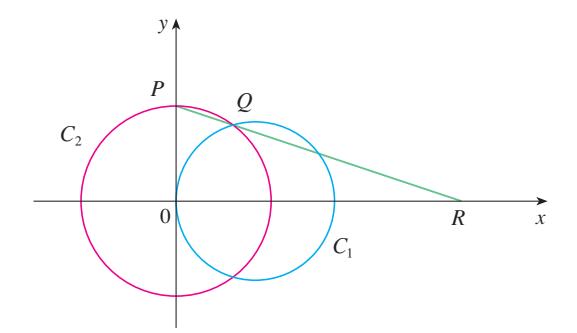
The figure shows a fixed circle \(C_1\) with equation \((x - 1)^2 + y^2 = 1\) and a shrinking circle \(C_2\) with radius \(r\) and center the origin. What happens to \(R\) as \(r \rightarrow 0^+\)?
question image

Answered: 0 / 66