Stewart 9e Section 2.7: Rates of Change in the Natural and Social Sciences

43 questions

--:--
0 / 43
Stewart 9e Section 2.7: Rates of Change in the Natural and Social Sciences 0/43
1 Exercise - Particle motion · Level 2
A particle moves according to the law of motion \(s = f(t) = t^3 - 9 t^2 + 24 t\), \(t \geq 0\), where \(t\) is in seconds and \(s\) in feet.
(a) Find the velocity at time \(t\).
(b) What is the velocity after 1 second?
(c) When is the particle at rest?
(d) When is the particle moving in the positive direction?
(e) Find the total distance traveled during the first 6 seconds.
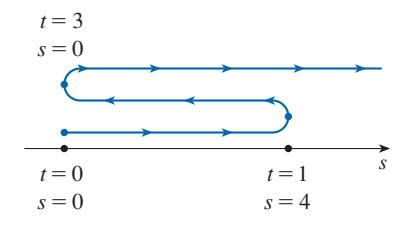
(f) Draw a diagram like Figure 2 to illustrate the motion of the particle. (g) Find the acceleration at time \(t\) and after 1 second. (h) Graph the position, velocity, and acceleration functions for \(0 \leq t \leq 6\). (i) When is the particle speeding up? When is it slowing down?

Enter your answer directly below each part above.

2 Exercise - Particle motion · Level 2
A particle moves according to the law of motion \(s = f(t) = 0.01 t^4 - 0.04 t^3\), \(t \geq 0\), where \(t\) is in seconds and \(s\) in feet.
(a) Find the velocity at time \(t\).
(b) What is the velocity after 1 second?
(c) When is the particle at rest?
(d) When is the particle moving in the positive direction?
(e) Find the total distance traveled during the first 6 seconds.
(f) Draw a diagram like Figure 2 to illustrate the motion of the particle. (g) Find the acceleration at time \(t\) and after 1 second. (h) Graph the position, velocity, and acceleration functions for \(0 \leq t \leq 6\). (i) When is the particle speeding up? When is it slowing down?

Enter your answer directly below each part above.

3 Exercise - Particle motion · Level 2
A particle moves according to the law of motion \(s = f(t) = \sin\left(\pi \dfrac{t}{2}\right)\), \(t \geq 0\), where \(t\) is in seconds and \(s\) in feet.
(a) Find the velocity at time \(t\).
(b) What is the velocity after 1 second?
(c) When is the particle at rest?
(d) When is the particle moving in the positive direction?
(e) Find the total distance traveled during the first 6 seconds.
(f) Draw a diagram like Figure 2 to illustrate the motion of the particle. (g) Find the acceleration at time \(t\) and after 1 second. (h) Graph the position, velocity, and acceleration functions for \(0 \leq t \leq 6\). (i) When is the particle speeding up? When is it slowing down?

Enter your answer directly below each part above.

4 Exercise - Particle motion · Level 3
A particle moves according to the law of motion \(s = f(t) = 9 t/(t^2 + 9)\), \(t \geq 0\), where \(t\) is in seconds and \(s\) in feet.
(a) Find the velocity at time \(t\).
(b) What is the velocity after 1 second?
(c) When is the particle at rest?
(d) When is the particle moving in the positive direction?
(e) Find the total distance traveled during the first 6 seconds.
(f) Draw a diagram like Figure 2 to illustrate the motion of the particle. (g) Find the acceleration at time \(t\) and after 1 second. (h) Graph the position, velocity, and acceleration functions for \(0 \leq t \leq 6\). (i) When is the particle speeding up? When is it slowing down?

Enter your answer directly below each part above.

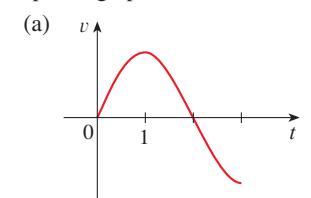
5 Exercise - Interpreting velocity graphs · Level 2
Graphs of the velocity functions of two particles are shown, where \(t\) is measured in seconds. When is each particle speeding up? When is it slowing down? Explain.
question image
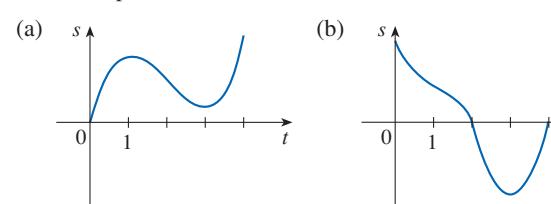
6 Exercise - Interpreting position graphs · Level 2
Graphs of the position functions of two particles are shown, where \(t\) is measured in seconds. When is the velocity of each particle positive? When is it negative? When is each particle speeding up? When is it slowing down? Explain.
question image
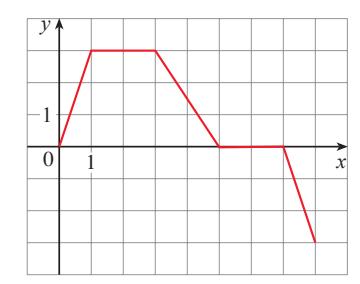
7 Exercise - Interpreting velocity graph · Level 2
Suppose that the graph of the velocity function of a particle is as shown in the figure, where \(t\) is measured in seconds. When is the particle traveling forward (in the positive direction)? When is it traveling backward? What is happening when \(5 < t < 7\)?
question image
8 Exercise - Sketching acceleration · Level 2
For the particle described in Exercise 7, sketch a graph of the acceleration function. When is the particle speeding up? When is it slowing down? When is it traveling at a constant speed?
9 Exercise - Projectile motion · Level 2
The height (in meters) of a projectile shot vertically upward from a point 2 m above ground level with an initial velocity of 24.5 m/s is \(h = 2 + 24.5 t - 4.9 t^2\) after \(t\) seconds.
(a) Find the velocity after 2 s and after 4 s.
(b) When does the projectile reach its maximum height?
(c) What is the maximum height?
(d) When does it hit the ground?
(e) With what velocity does it hit the ground?

Enter your answer directly below each part above.

10 Exercise - Projectile motion · Level 2
If a ball is thrown vertically upward with a velocity of 80 ft/s, then its height after \(t\) seconds is \(s = 80 t - 16 t^2\).
(a) What is the maximum height reached by the ball?
(b) What is the velocity of the ball when it is 96 ft above the ground on its way up? On its way down?

Enter your answer directly below each part above.

11 Exercise - Projectile on Mars · Level 2
If a rock is thrown vertically upward from the surface of Mars with velocity 15 m/s, its height after \(t\) seconds is \(h = 15 t - 1.86 t^2\).
(a) What is the velocity of the rock after 2 s?
(b) What is the velocity of the rock when its height is 25 m on its way up? On its way down?

Enter your answer directly below each part above.

12 Exercise - Velocity and acceleration · Level 3
A particle moves with position function \(s = t^4 - 4 t^3 - 20 t^2 + 20 t\), \(t \geq 0\).
(a) At what time does the particle have a velocity of 20 m/s?
(b) At what time is the acceleration 0? What is the significance of this value of \(t\)?

Enter your answer directly below each part above.

13 Exercise - Rate of change of area · Level 2
(a) A company makes computer chips from square wafers of silicon. A process engineer wants to keep the side length of a wafer very close to 15 mm and needs to know how the area \(A(x)\) of a wafer changes when the side length \(x\) changes. Find \(A'(15)\) and explain its meaning in this situation.
(b) Show that the rate of change of the area of a square with respect to its side length is half its perimeter. Try to explain geometrically why this is true by drawing a square whose side length \(x\) is increased by an amount \(\Delta x\). How can you approximate the resulting change in area \(\Delta A\) if \(\Delta x\) is small?

Enter your answer directly below each part above.

14 Exercise - Rate of change of volume · Level 2
(a) Sodium chlorate crystals are easy to grow in the shape of cubes by allowing a solution of water and sodium chlorate to evaporate slowly. If \(V\) is the volume of such a cube with side length \(x\), calculate \(\dfrac{d V}{d x}\) when \(x = 3\) mm and explain its meaning.
(b) Show that the rate of change of the volume of a cube with respect to its edge length is equal to half the surface area of the cube. Explain geometrically why this result is true by arguing by analogy with Exercise 13(b).

Enter your answer directly below each part above.

15 Exercise - Rate of change of circle area · Level 2
(a) Find the average rate of change of the area of a circle with respect to its radius \(r\) as \(r\) changes from (i) 2 to 3, (ii) 2 to 2.5, (iii) 2 to 2.1.
(b) Find the instantaneous rate of change when \(r = 2\).
(c) Show that the rate of change of the area of a circle with respect to its radius (at any \(r\)) is equal to the circumference of the circle. Try to explain geometrically why this is true by drawing a circle whose radius is increased by an amount \(\Delta r\). How can you approximate the resulting change in area \(\Delta A\) if \(\Delta r\) is small?

Enter your answer directly below each part above.

16 Exercise - Expanding circular ripple · Level 2
A stone is dropped into a lake, creating a circular ripple that travels outward at a speed of 60 cm/s. Find the rate at which the area within the circle is increasing after (a) 1 s, (b) 3 s, and (c) 5 s. What can you conclude?
17 Exercise - Spherical balloon · Level 2
A spherical balloon is being inflated. Find the rate of increase of the surface area \((S = 4 \pi r^2)\) with respect to the radius \(r\) when \(r\) is (a) 1 ft, (b) 2 ft, and (c) 3 ft. What conclusion can you make?
18 Exercise - Spherical cell volume · Level 2
(a) The volume of a growing spherical cell is \(V = \left(\dfrac{4}{3}\right) \pi r^3\), where the radius \(r\) is in micrometers (1 \(\mu\)m = \(10^{-6}\) m). Find the average rate of change of \(V\) with respect to \(r\) when \(r\) changes from (i) 5 to 8 \(\mu\)m, (ii) 5 to 6 \(\mu\)m, (iii) 5 to 5.1 \(\mu\)m.
(b) Find the instantaneous rate of change of \(V\) with respect to \(r\) when \(r = 5\) \(\mu\)m.
(c) Show that the rate of change of the volume of a sphere with respect to its radius is equal to its surface area. Explain geometrically why this result is true. Argue by analogy with Exercise 15(c).

Enter your answer directly below each part above.

19 Exercise - Linear density of a rod · Level 2
The mass of the part of a metal rod that lies between its left end and a point \(x\) meters to the right is \(3 x^2\) kg. Find the linear density (see Example
2) when \(x\) is (a) 1 m, (b) 2 m, and (c) 3 m. Where is the density the highest? The lowest?
20 Exercise - Torricelli's Law · Level 3
If a cylindrical water tank holds 5000 gallons, and the water drains from the bottom of the tank in 40 minutes, then Torricelli's Law gives the volume \(V\) of water remaining in the tank after \(t\) minutes as \(V = 5000 (1 - \left(\dfrac{1}{40}\right) t)^2\), \(0 \leq t \leq 40\) Find the rate at which water is draining from the tank after (a) 5 min, (b) 10 min, (c) 20 min, and (d) 40 min. At what time is the water flowing out the fastest? The slowest? Summarize your findings.
21 Exercise - Electric current · Level 2
The quantity of charge \(Q\) in coulombs (C) that has passed through a point in a wire up to time \(t\) (in seconds) is given by \(Q(t) = t^3 - 2 t^2 + 6 t + 2\). Find the current when (a) \(t = 0.5\) s and (b) \(t = 1\) s. (See Example 3. The unit of current is an ampere [1 A = 1 C/s].) At what time is the current lowest?
22 Exercise - Newton's Law of Gravitation · Level 3
Newton's Law of Gravitation says that the magnitude \(F\) of the force exerted by a body of mass \(m\) on a body of mass \(M\) is \(F = (G m M)/r^2\) where \(G\) is the gravitational constant and \(r\) is the distance between the bodies.
(a) Find \(\dfrac{d F}{d r}\) and explain its meaning. What does the minus sign indicate?
(b) Suppose it is known that the earth attracts an object with a force that decreases at the rate of 2 N/km when \(r = 20000\) km. How fast does this force change when \(r = 10000\) km?

Enter your answer directly below each part above.

23 Exercise - Relativistic force · Level 3
The force \(F\) acting on a body with mass \(m\) and velocity \(v\) is the rate of change of momentum: \(F = (d/(d t))(m v)\). If \(m\) is constant, this becomes \(F = m a\), where \(a = \dfrac{d v}{d t}\) is the acceleration. But in the theory of relativity, the mass of a particle varies with \(v\) as follows: \(m = \dfrac{m_0}{\sqrt{1 - v^2/c^2}}\), where \(m_0\) is the mass of the particle at rest and \(c\) is the speed of light. Show that \(F = \dfrac{m_0 a}{1 - v^2/c^2}^{\dfrac{3}{2}}\).
24 Exercise - Tides at Bay of Fundy · Level 3
Some of the highest tides in the world occur in the Bay of Fundy on the Atlantic Coast of Canada. At Hopewell Cape the water depth at low tide is about 2.0 m and at high tide it is about 12.0 m. The natural period of oscillation is a little more than 12 hours and on a day in June, high tide occurred at 6:45 AM. This helps explain the following model for the water depth \(D\) (in meters) as a function of the time \(t\) (in hours after midnight) on that day: \(D(t) = 7 + 5 \cos(0.503 (t - 6.75))\) How fast was the tide rising (or falling) at the following times?
(a) 3:00 AM
(b) 6:00 AM
(c) 9:00 AM
(d) Noon

Enter your answer directly below each part above.

25 Exercise - Boyle's Law and compressibility · Level 2
Boyle's Law states that when a sample of gas is compressed at a constant temperature, the product of the pressure and the volume remains constant: \(P V = C\).
(a) Find the rate of change of volume with respect to pressure.
(b) A sample of gas is in a container at low pressure and is steadily compressed at constant temperature for 10 minutes. Is the volume decreasing more rapidly at the beginning or the end of the 10 minutes? Explain.
(c) Prove that the isothermal compressibility (see Example
5) is given by \(\beta = \dfrac{1}{P}\).

Enter your answer directly below each part above.

26 Exercise - Reaction rate · Level 3
If, in Example 4, one molecule of the product C is formed from one molecule of the reactant A and one molecule of the reactant B, and the initial concentrations of A and B have a common value \([A] = [B] = a\) moles/L, then \([C] = a^2 k t/(a k t + 1)\) where \(k\) is a constant.
(a) Find the rate of reaction at time \(t\).
(b) Show that if \(x = [C]\), then \(\dfrac{d x}{d t} = k (a - x)^2\).

Enter your answer directly below each part above.

27 Exercise - World population growth · Level 3
The table gives the world population \(P(t)\), in millions, where \(t\) is measured in years and \(t = 0\) corresponds to the year 1900. t = 0: 1650; t = 10: 1750; t = 20: 1860; t = 30: 2070; t = 40: 2300; t = 50: 2560; t = 60: 3040; t = 70: 3710; t = 80: 4450; t = 90: 5280; t = 100: 6080; t = 110: 6870.
(a) Estimate the rate of population growth in 1920 and in 1980 by averaging the slopes of two secant lines.
(b) Use a graphing calculator or computer to find a cubic function (a third-degree polynomial) that models the data.
(c) Use your model in part (b) to find a model for the rate of population growth.
(d) Use part (c) to estimate the rates of growth in 1920 and 1980. Compare with your estimates in part (a).
(e) Estimate the rate of growth in 1985.

Enter your answer directly below each part above.

28 Exercise - Japanese marriage age · Level 3
The table shows how the average age of first marriage of Japanese women has varied since 1950. t = 1950: A = 23.0; 1955: 23.8; 1960: 24.4; 1965: 24.5; 1970: 24.2; 1975: 24.7; 1980: 25.2; 1985: 25.5; 1990: 25.9; 1995: 26.3; 2000: 27.0; 2005: 28.0; 2010: 28.8; 2015: 29.4.
(a) Use a graphing calculator or computer to model these data with a fourth-degree polynomial.
(b) Use part (a) to find a model for \(A'(t)\).
(c) Estimate the rate of change of marriage age for women in 1990.
(d) Graph the data points and the models for \(A\) and \(A'\).

Enter your answer directly below each part above.

29 Exercise - Blood flow · Level 3
Refer to the law of laminar flow given in Example 7. Consider a blood vessel with radius 0.01 cm, length 3 cm, pressure difference 3000 dynes/cm\(^2\), and viscosity \(\eta = 0.027\).
(a) Find the velocity of the blood along the centerline \(r = 0\), at radius \(r = 0.005\) cm, and at the wall \(r = R = 0.01\) cm.
(b) Find the velocity gradient at \(r = 0\), \(r = 0.005\), and \(r = 0.01\).
(c) Where is the velocity the greatest? Where is the velocity changing most?

Enter your answer directly below each part above.

30 Exercise - Vibrating string frequency · Level 3
The frequency of vibrations of a vibrating violin string is given by \(f = 1/(2 L) \sqrt{\dfrac{T}{\rho}}\) where \(L\) is the length of the string, \(T\) is its tension, and \(\rho\) is its linear density.
(a) Find the rate of change of the frequency with respect to (i) the length (when \(T\) and \(\rho\) are constant), (ii) the tension (when \(L\) and \(\rho\) are constant), and (iii) the linear density (when \(L\) and \(T\) are constant).
(b) The pitch of a note (how high or low the note sounds) is determined by the frequency \(f\). (The higher the frequency, the higher the pitch.) Use the signs of the derivatives in part (a) to determine what happens to the pitch of a note (i) when the effective length of a string is decreased by placing a finger on the string so a shorter portion of the string vibrates, (ii) when the tension is increased by turning a tuning peg, (iii) when the linear density is increased by switching to another string.

Enter your answer directly below each part above.

31 Exercise - Marginal cost · Level 2
Suppose that the cost (in dollars) for a company to produce \(x\) pairs of a new line of jeans is \(C(x) = 2000 + 3 x + 0.01 x^2 + 0.0002 x^3\)
(a) Find the marginal cost function.
(b) Find \(C'(100)\) and explain its meaning. What does it predict?
(c) Compare \(C'(100)\) with the cost of manufacturing the 101st pair of jeans.

Enter your answer directly below each part above.

32 Exercise - Marginal cost interpretation · Level 2
The cost function for a certain commodity is \(C(q) = 84 + 0.16 q - 0.0006 q^2 + 0.000003 q^3\)
(a) Find and interpret \(C'(100)\).
(b) Compare \(C'(100)\) with the cost of producing the 101st item.

Enter your answer directly below each part above.

33 Exercise - Average productivity · Level 3
If \(p(x)\) is the total value of the production when there are \(x\) workers in a plant, then the average productivity of the workforce at the plant is \(A(x) = p(x)/x\)
(a) Find \(A'(x)\). Why does the company want to hire more workers if \(A'(x) > 0\)?
(b) Show that \(A'(x) > 0\) if \(p'(x)\) is greater than the average productivity.

Enter your answer directly below each part above.

34 Exercise - Sensitivity of pupil response · Level 3
If \(R\) denotes the reaction of the body to some stimulus of strength \(x\), the sensitivity \(S\) is defined to be the rate of change of the reaction with respect to \(x\). A particular example is that when the brightness \(x\) of a light source is increased, the eye reacts by decreasing the area \(R\) of the pupil. The experimental formula \(R = \dfrac{40 + 24 x^{0.4}}{1 + 4 x^{0.4}}\) has been used to model the dependence of \(R\) on \(x\) when \(R\) is measured in square millimeters and \(x\) is measured in appropriate units of brightness.
(a) Find the sensitivity.
(b) Illustrate part (a) by graphing both \(R\) and \(S\) as functions of \(x\). Comment on the values of \(R\) and \(S\) at low levels of brightness. Is this what you would expect?

Enter your answer directly below each part above.

35 Exercise - Ideal gas law · Level 3
The gas law for an ideal gas at absolute temperature \(T\) (in kelvins), pressure \(P\) (in atmospheres), and volume \(V\) (in liters) is \(P V = n R T\), where \(n\) is the number of moles of the gas and \(R = 0.0821\) is the gas constant. Suppose that, at a certain instant, \(P = 8.0\) atm and is increasing at a rate of 0.10 atm/min and \(V = 10\) L and is decreasing at a rate of 0.15 L/min. Find the rate of change of \(T\) with respect to time at that instant if \(n = 10\) mol.
36 Example - Particle motion analysis · Level 2
The position of a particle is given by \(s = f(t) = t^3 - 6 t^2 + 9 t\), where \(t\) is in seconds and \(s\) in meters.
question image
(a) Find the velocity at time \(t\).
(b) What is the velocity after 2 s? After 4 s?
(c) When is the particle at rest?
(d) When is the particle moving forward (in the positive direction)?
(e) Draw a diagram to represent the motion of the particle.
(f) Find the total distance traveled during the first five seconds. (g) Find the acceleration at time \(t\) and after 4 s. (h) Graph the position, velocity, and acceleration functions for \(0 \leq t \leq 5\). (i) When is the particle speeding up? When is it slowing down?

Enter your answer directly below each part above.

37 Example - Linear density of a rod · Level 2
A nonhomogeneous rod has mass measured from its left end to a point \(x\) given by \(m = f(x) = \sqrt{x}\), where \(x\) is in meters and \(m\) in kilograms.
question image
(a) Find the average density of the part of the rod given by \(1 \leq x \leq 1.2\).
(b) Find the linear density \(\rho\) at \(x = 1\).

Enter your answer directly below each part above.

38 Example - Electric current as a rate of change · Level 2
Let \(\Delta Q\) be the net charge passing through a plane surface in a wire during a time interval \(\Delta t\). Express the instantaneous current \(I\) at a time \(t_1\) as a derivative.
question image
39 Example - Rate of chemical reaction · Level 2
For the reaction \(A + B \rightarrow C\), denote the concentrations (moles per liter) of A, B, C at time \(t\) by \([A]\), \([B]\), \([C]\). Define the instantaneous rate of reaction of product C as a derivative, and explain the relation \(- \dfrac{d[A]}{d t} = - \dfrac{d[B]}{d t} = \dfrac{d[C]}{d t}\) Then state the analogous relation for the general reaction \(a A + b B \rightarrow c C + d D\).
40 Example - Isothermal compressibility · Level 2
A sample of air at 25°C has volume \(V\) (in m\(^3\)) related to pressure \(P\) (in kPa) by \(V = 5.\dfrac{3}{P}\). The isothermal compressibility is \(\beta = -\dfrac{1}{V} \, \dfrac{d V}{d P}\). Find \(\dfrac{d V}{d P}\) and \(\beta\) at \(P = 50\) kPa.
41 Example - Bacteria population growth · Level 2
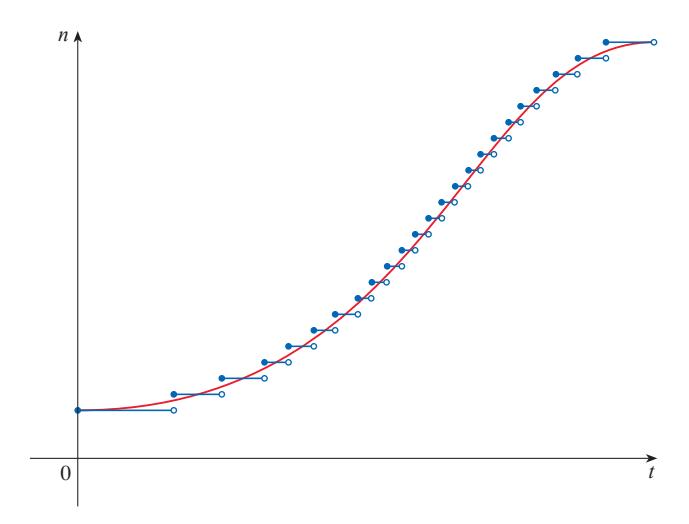
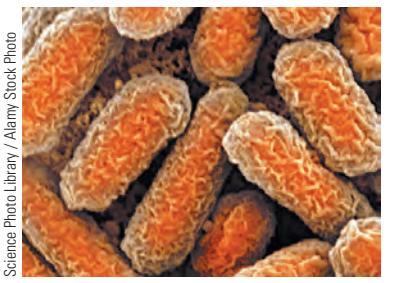
A bacteria population doubles every hour, starting from initial population \(n_0\) at \(t = 0\). With \(t\) in hours, write \(n(t)\) explicitly and explain why the instantaneous growth rate of a population \(n = f(t)\) is \(\dfrac{d n}{d t}\).
question image
42 Example - Blood flow velocity gradient · Level 3
By the law of laminar flow, the blood velocity at distance \(r\) from the central axis of a cylindrical artery of radius \(R\) and length \(l\) is \(v = P/(4 \eta l)(R^2 - r^2)\) where \(\eta\) is viscosity and \(P\) is the pressure difference. For a small artery take \(\eta = 0.027\), \(R = 0.008\) cm, \(l = 2\) cm, and \(P = 4000\) dynes/cm\(^2\).
question image
(a) Find \(v\) at \(r = 0.002\) cm.
(b) Find the velocity gradient \(\dfrac{d v}{d r}\) at \(r = 0.002\) cm and interpret.

Enter your answer directly below each part above.

43 Example - Marginal cost · Level 2
The cost (in dollars) of producing \(x\) items is \(C(x) = 10000 + 5 x + 0.01 x^2\).
(a) Find the marginal cost function \(C'(x)\).
(b) Find \(C'(500)\) and explain its meaning.
(c) Compare \(C'(500)\) with the actual cost of producing the 501st item.

Enter your answer directly below each part above.

Answered: 0 / 43