Stewart Precalc 6e Section 9.5: The Cross Product

16 questions

--:--
0 / 16
Stewart Precalc 6e Section 9.5: The Cross Product 0/16
1 Skills - Area of Triangle · Level 3
Find the area of \(\triangle P Q R\). \(P(1, 0, 1)\), \(Q(0, 1, 0)\), \(R(2, 3, 4)\)
2 Skills - Area of Triangle · Level 3
Find the area of \(\triangle P Q R\). \(P(2, 1, 0)\), \(Q(0, 0, -1)\), \(R(-4, 2, 0)\)
3 Skills - Area of Triangle · Level 3
Find the area of \(\triangle P Q R\). \(P(6, 0, 0)\), \(Q(0, -6, 0)\), \(R(0, 0, -6)\)
4 Skills - Area of Triangle · Level 3
Find the area of \(\triangle P Q R\). \(P(3, -2, 6)\), \(Q(-1, -4, -6)\), \(R(3, 4, 6)\)
5 Skills - Coplanar Vectors · Level 3
Use the scalar triple product to determine whether the vectors \(\mathbf{a}\), \(\mathbf{b}\), and \(\mathbf{c}\) are coplanar. \(\mathbf{a} = (1, 2, 3)\), \(\mathbf{b} = (-3, 2, 1)\), \(\mathbf{c} = (0, 8, 10)\)
6 Skills - Coplanar Vectors · Level 3
Use the scalar triple product to determine whether the vectors \(\mathbf{a}\), \(\mathbf{b}\), and \(\mathbf{c}\) are coplanar. \(\mathbf{a} = (3, 0, -4)\), \(\mathbf{b} = (1, 1, 1)\), \(\mathbf{c} = (7, 4, 0)\)
7 Skills - Coplanar Vectors · Level 3
Use the scalar triple product to determine whether the vectors \(\mathbf{a}\), \(\mathbf{b}\), and \(\mathbf{c}\) are coplanar. \(\mathbf{a} = (2, 3, -2)\), \(\mathbf{b} = (-1, 4, 0)\), \(\mathbf{c} = (3, -1, 3)\)
8 Skills - Coplanar Vectors · Level 3
Use the scalar triple product to determine whether the vectors \(\mathbf{a}\), \(\mathbf{b}\), and \(\mathbf{c}\) are coplanar. \(\mathbf{a} = (1, -1, 0)\), \(\mathbf{b} = (-1, 0, 1)\), \(\mathbf{c} = (0, -1, 1)\)
9 Skills - Coplanar Vectors · Level 3
Use the scalar triple product to determine whether the vectors \(\mathbf{a}\), \(\mathbf{b}\), and \(\mathbf{c}\) are coplanar. \(\mathbf{a} = \mathbf{i} - \mathbf{j} + \mathbf{k}\), \(\mathbf{b} = -\mathbf{j} + \mathbf{k}\), \(\mathbf{c} = \mathbf{i} + \mathbf{j} + \mathbf{k}\)
10 Skills - Coplanar Vectors · Level 3
Use the scalar triple product to determine whether the vectors \(\mathbf{a}\), \(\mathbf{b}\), and \(\mathbf{c}\) are coplanar. \(\mathbf{a} = 2 \mathbf{i} - 2 \mathbf{j} - 3 \mathbf{k}\), \(\mathbf{b} = 3 \mathbf{i} - \mathbf{j} - \mathbf{k}\), \(\mathbf{c} = 6 \mathbf{i}\)
11 Applications - Volume of a Fish Tank · Level 4
Volume of a Fish Tank. A fish tank in an avant-garde restaurant is in the shape of a parallelepiped with a rectangular base that is 300 cm long and 120 cm wide. The front and back faces are vertical, but the left and right faces are slanted at \(30^{\circ}\) from the vertical and measure 120 cm by 150 cm. (See the figure.)
question image
(a) Let \(\mathbf{a}\), \(\mathbf{b}\), and \(\mathbf{c}\) be the three vectors shown in the figure. Find \(\mathbf{a} \cdot (\mathbf{b} \times \mathbf{c})\). [Hint: Recall that \(\mathbf{u} \cdot \mathbf{v} = |\mathbf{u}| |\mathbf{v}| \cos \theta\) and \(|\mathbf{u} \times \mathbf{v}| = |\mathbf{u}| |\mathbf{v}| \sin \theta\).]
(b) What is the capacity of the tank in liters? [Note: \(1 \text{L} = 1000 \text{cm}^3\).]

Enter your answer directly below each part above.

12 Applications - Rubik's Tetrahedron · Level 4
Rubik's Tetrahedron. Rubik's Cube, a puzzle craze of the 1980s that remains popular to this day, inspired many similar puzzles. The one illustrated in the figure is called Rubik's Tetrahedron; it is in the shape of a regular tetrahedron, with each edge \(\sqrt{2}\) inches long. The volume of a regular tetrahedron is one-sixth the volume of the parallelepiped determined by any three edges that meet at a corner.
question image
(a) Use the triple product to find the volume of Rubik's Tetrahedron. [Hint: See Exercise 48 in Section 9.4, which gives the corners of a tetrahedron that has the same shape and size as Rubik's Tetrahedron.]
(b) Construct six identical regular tetrahedra using modeling clay. Experiment to see how they can be put together to create a parallelepiped that is determined by three edges of one of the tetrahedra (thus confirming the above statement about the volume of a regular tetrahedron).

Enter your answer directly below each part above.

13 Discovery - Order of Operations in Triple Product · Level 4
Order of Operations in the Triple Product. Given three vectors \(\mathbf{u}\), \(\mathbf{v}\), and \(\mathbf{w}\), their scalar triple product can be performed in six different orders: \(\mathbf{u} \cdot (\mathbf{v} \times \mathbf{w})\), \(\mathbf{u} \cdot (\mathbf{w} \times \mathbf{v})\), \(\mathbf{v} \cdot (\mathbf{u} \times \mathbf{w})\), \(\mathbf{v} \cdot (\mathbf{w} \times \mathbf{u})\), \(\mathbf{w} \cdot (\mathbf{u} \times \mathbf{v})\), \(\mathbf{w} \cdot (\mathbf{v} \times \mathbf{u})\)
(a) Calculate each of these six triple products for the vectors: \(\mathbf{u} = (0, 1, 1)\), \(\mathbf{v} = (1, 0, 1)\), \(\mathbf{w} = (1, 1, 0)\).
(b) On the basis of your observations in part (a), make a conjecture about the relationships between these six triple products.
(c) Prove the conjecture you made in part (b).

Enter your answer directly below each part above.

14 Example - Finding a cross product · Level 2
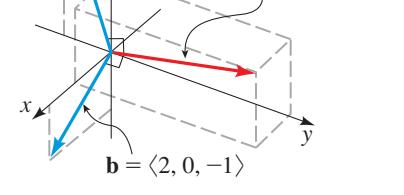
If \(\mathbf{a} = \langle 0, -1, 3 \rangle\) and \(\mathbf{b} = \langle 2, 0, -1 \rangle\), find \(\mathbf{a} \times \mathbf{b}\).
15 Example - Unit vector orthogonal to a plane · Level 3
If \(\mathbf{a} = -\mathbf{j} + 3 \mathbf{k}\) and \(\mathbf{b} = 2 \mathbf{i} - \mathbf{k}\), find a unit vector that is orthogonal to the plane containing the vectors \(\mathbf{a}\) and \(\mathbf{b}\).
question image
16 Example - Vector perpendicular to a plane through three points · Level 3
Find a vector perpendicular to the plane that passes through the points \(P(1, 4, 6)\), \(Q(-2, 5, -1)\), and \(R(1, -1, 1)\).

Answered: 0 / 16