Stewart Precalc 6e Chapter 4 Review

118 questions

--:--
0 / 118
Stewart Precalc 6e Chapter 4 Review 0/118
1 Exponential Function Values · Level 1
Use a calculator to find the indicated values of the exponential function, correct to three decimal places. \(f(x) = 5^x\); find \(f(-1.5)\), \(f(\sqrt{2})\), \(f(2.5)\).
2 Exponential Function Values · Level 1
Use a calculator to find the indicated values of the exponential function, correct to three decimal places. \(f(x) = 3 \cdot 2^x\); find \(f(-2.2)\), \(f(\sqrt{7})\), \(f(5.5)\).
3 Exponential Function Values · Level 1
Use a calculator to find the indicated values of the exponential function, correct to three decimal places. \(g(x) = 4 \cdot \left(\dfrac{2}{3}\right)^{x - 2}\); find \(g(-0.7)\), \(g(e)\), \(g(\pi)\).
4 Exponential Function Values · Level 1
Use a calculator to find the indicated values of the exponential function, correct to three decimal places. \(g(x) = \left(\dfrac{7}{4}\right) e^{x + 1}\); find \(g(-2)\), \(g(\sqrt{3})\), \(g(3.6)\).
5 Graph of Exponential Function · Level 2
Sketch the graph of the function. State the domain, range, and asymptote. \(f(x) = 3^{x - 2}\)
6 Graph of Exponential Function · Level 2
Sketch the graph of the function. State the domain, range, and asymptote. \(f(x) = 2^{-x + 1}\)
7 Graph of Exponential Function · Level 2
Sketch the graph of the function. State the domain, range, and asymptote. \(g(x) = 5 - 5^{-x}\)
8 Graph of Exponential Function · Level 2
Sketch the graph of the function. State the domain, range, and asymptote. \(g(x) = 3 + 2^{-x}\)
9 Graph of Logarithmic Function · Level 2
Sketch the graph of the function. State the domain, range, and asymptote. \(f(x) = \log_3(x - 1)\)
10 Graph of Logarithmic Function · Level 2
Sketch the graph of the function. State the domain, range, and asymptote. \(g(x) = \log(-x)\)
11 Graph of Logarithmic Function · Level 2
Sketch the graph of the function. State the domain, range, and asymptote. \(f(x) = 2 - \log_2 x\)
12 Graph of Logarithmic Function · Level 2
Sketch the graph of the function. State the domain, range, and asymptote. \(f(x) = 3 + \log_5(x + 4)\)
13 Graph of Exponential Function · Level 2
Sketch the graph of the function. State the domain, range, and asymptote. \(F(x) = e^x - 1\)
14 Graph of Exponential Function · Level 2
Sketch the graph of the function. State the domain, range, and asymptote. \(G(x) = \dfrac{1}{2} e^{x - 1}\)
15 Graph of Logarithmic Function · Level 2
Sketch the graph of the function. State the domain, range, and asymptote. \(g(x) = 2 \ln x\)
16 Graph of Logarithmic Function · Level 2
Sketch the graph of the function. State the domain, range, and asymptote. \(g(x) = \ln(x^2)\)
17 Domain of Function · Level 2
Find the domain of the function. \(f(x) = 10^{x^2} + \log(1 - 2 x)\)
18 Domain of Function · Level 2
Find the domain of the function. \(g(x) = \log(2 + x - x^2)\)
19 Domain of Function · Level 2
Find the domain of the function. \(h(x) = \ln(x^2 - 4)\)
20 Domain of Function · Level 2
Find the domain of the function. \(k(x) = \ln |x|\)
21 Exponential Form · Level 1
Write the equation in exponential form. \(\log_2 1024 = 10\)
22 Exponential Form · Level 1
Write the equation in exponential form. \(\log_6 37 = x\)
23 Exponential Form · Level 1
Write the equation in exponential form. \(\log x = y\)
24 Exponential Form · Level 1
Write the equation in exponential form. \(\ln c = 17\)
25 Logarithmic Form · Level 1
Write the equation in logarithmic form. \(2^6 = 64\)
26 Logarithmic Form · Level 1
Write the equation in logarithmic form. \(49^{-\dfrac{1}{2}} = \dfrac{1}{7}\)
27 Logarithmic Form · Level 1
Write the equation in logarithmic form. \(10^x = 74\)
28 Logarithmic Form · Level 1
Write the equation in logarithmic form. \(e^k = m\)
29 Evaluate Logarithm · Level 1
Evaluate the expression without using a calculator. \(\log_2 128\)
30 Evaluate Logarithm · Level 1
Evaluate the expression without using a calculator. \(\log_8 1\)
31 Evaluate Logarithm · Level 1
Evaluate the expression without using a calculator. \(10^{\log 45}\)
32 Evaluate Logarithm · Level 1
Evaluate the expression without using a calculator. \(\log 0.000001\)
33 Evaluate Logarithm · Level 1
Evaluate the expression without using a calculator. \(\ln(e^6)\)
34 Evaluate Logarithm · Level 1
Evaluate the expression without using a calculator. \(\ln(1/e^4)\)
35 Evaluate Logarithm · Level 1
Evaluate the expression without using a calculator. \(\log_3 \left(\dfrac{1}{27}\right)\)
36 Evaluate Logarithm · Level 1
Evaluate the expression without using a calculator. \(2^{\log_2 37}\)
37 Evaluate Logarithm · Level 2
Evaluate the expression without using a calculator. \(\log_5 \sqrt{5}\)
38 Evaluate Logarithm · Level 2
Evaluate the expression without using a calculator. \(e^{2 \ln 7}\)
39 Evaluate Logarithm · Level 2
Evaluate the expression without using a calculator. \(\log 25 + \log 4\)
40 Evaluate Logarithm · Level 2
Evaluate the expression without using a calculator. \(\log_3 \sqrt{243}\)
41 Evaluate Logarithm · Level 2
Evaluate the expression without using a calculator. \(\log_2 1.6 + \log_2 5\)
42 Evaluate Logarithm · Level 2
Evaluate the expression without using a calculator. \(\log_5 250 - \log_5 2\)
43 Evaluate Logarithm · Level 2
Evaluate the expression without using a calculator. \(\log_8 6 - \log_8 3 + \log_8 2\)
44 Evaluate Logarithm · Level 2
Evaluate the expression without using a calculator. \(\log \log 10^{100}\)
45 Expand Logarithm · Level 2
Expand the logarithmic expression. \(\log(A B^2 C^3)\)
46 Expand Logarithm · Level 2
Expand the logarithmic expression. \(\log_2 (x \sqrt{x^2 + 1})\)
47 Expand Logarithm · Level 2
Expand the logarithmic expression. \(\ln \sqrt{\dfrac{x^2 - 1}{x^2 + 1}}\)
48 Expand Logarithm · Level 2
Expand the logarithmic expression. \(\log(\dfrac{4 x^3}{y^2 (x - 1)^5})\)
49 Expand Logarithm · Level 3
Expand the logarithmic expression. \(\log_5 (\dfrac{x^2 (1 - 5 x)^{\dfrac{3}{2}}}{\sqrt{x^3 - x}})\)
50 Expand Logarithm · Level 3
Expand the logarithmic expression. \(\ln (\dfrac{\sqrt[3]{x^4 + 12}}{(x + 16) \sqrt{x - 3}})\)
51 Combine Logarithm · Level 2
Combine into a single logarithm. \(\log 6 + 4 \log 2\)
52 Combine Logarithm · Level 2
Combine into a single logarithm. \(\log x + \log(x^2 y) + 3 \log y\)
53 Combine Logarithm · Level 3
Combine into a single logarithm. \(\dfrac{3}{2} \log_2 (x - y) - 2 \log_2 (x^2 + y^2)\)
54 Combine Logarithm · Level 3
Combine into a single logarithm. \(\log_5 2 + \log_5 (x + 1) - \dfrac{1}{2} \log_5 (3 x + 7)\)
55 Combine Logarithm · Level 3
Combine into a single logarithm. \(\log(x - 2) + \log(x + 2) - \dfrac{1}{2} \log(x^2 + 4)\)
56 Combine Logarithm · Level 3
Combine into a single logarithm. \(\dfrac{1}{2} [\ln(x - 4) + 5 \ln(x^2 + 4 x)]\)
57 Solve Exponential Equation · Level 2
Solve the equation. Find the exact solution if possible; otherwise, use a calculator to approximate to two decimals. \(3^{2 x - 7} = 27\)
58 Solve Exponential Equation · Level 2
Solve the equation. Find the exact solution if possible; otherwise, use a calculator to approximate to two decimals. \(5^{4 - x} = \dfrac{1}{125}\)
59 Solve Exponential Equation · Level 2
Solve the equation. Find the exact solution if possible; otherwise, use a calculator to approximate to two decimals. \(2^{3 x - 5} = 7\)
60 Solve Exponential Equation · Level 2
Solve the equation. Find the exact solution if possible; otherwise, use a calculator to approximate to two decimals. \(10^{6 - 3 x} = 18\)
61 Solve Exponential Equation · Level 3
Solve the equation. Find the exact solution if possible; otherwise, use a calculator to approximate to two decimals. \(4^{1 - x} = 3^{2 x + 5}\)
62 Solve Exponential Equation · Level 2
Solve the equation. Find the exact solution if possible; otherwise, use a calculator to approximate to two decimals. \(e^{3 \dfrac{x}{4}} = 10\)
63 Solve Exponential Equation · Level 3
Solve the equation. Find the exact solution if possible; otherwise, use a calculator to approximate to two decimals. \(x^2 e^{2 x} + 2 x e^{2 x} = 8 e^{2 x}\)
64 Solve Exponential Equation · Level 3
Solve the equation. Find the exact solution if possible; otherwise, use a calculator to approximate to two decimals. \(3^{2 x} - 3^x - 6 = 0\)
65 Solve Logarithmic Equation · Level 2
Solve the equation. Find the exact solution if possible; otherwise, use a calculator to approximate to two decimals. \(\log_2(1 - x) = 4\)
66 Solve Logarithmic Equation · Level 2
Solve the equation. Find the exact solution if possible; otherwise, use a calculator to approximate to two decimals. \(\log x + \log(x + 1) = \log 12\)
67 Solve Logarithmic Equation · Level 2
Solve the equation. Find the exact solution if possible; otherwise, use a calculator to approximate to two decimals. \(\log_8(x + 5) - \log_8(x - 2) = 1\)
68 Solve Logarithmic Equation · Level 2
Solve the equation. Find the exact solution if possible; otherwise, use a calculator to approximate to two decimals. \(\ln(2 x - 3) + 1 = 0\)
69 Calculator Solution · Level 2
Use a calculator to find the solution of the equation, rounded to six decimal places. \(5^{-2 \dfrac{x}{3}} = 0.63\)
70 Calculator Solution · Level 2
Use a calculator to find the solution of the equation, rounded to six decimal places. \(2^{3 x - 5} = 7\)
71 Calculator Solution · Level 3
Use a calculator to find the solution of the equation, rounded to six decimal places. \(5^{2 x + 1} = 3^{4 x - 1}\)
72 Calculator Solution · Level 2
Use a calculator to find the solution of the equation, rounded to six decimal places. \(e^{-15 k} = 10000\)
73 Graph Analysis · Level 3
Draw a graph of the function and use it to determine the asymptotes and the local maximum and minimum values. \(y = e^{x / (x + 2)}\)
74 Graph Analysis · Level 3
Draw a graph of the function and use it to determine the asymptotes and the local maximum and minimum values. \(y = 10^x - 5^x\)
75 Graph Analysis · Level 3
Draw a graph of the function and use it to determine the asymptotes and the local maximum and minimum values. \(y = \log(x^3 - x)\)
76 Graph Analysis · Level 3
Draw a graph of the function and use it to determine the asymptotes and the local maximum and minimum values. \(y = 2 x^2 - \ln x\)
77 Approximate Solution · Level 3
Find the solutions of the equation, rounded to two decimal places. \(3 \log x = 6 - 2 x\)
78 Approximate Solution · Level 3
Find the solutions of the equation, rounded to two decimal places. \(4 - x^2 = e^{-2 x}\)
79 Inequality · Level 3
Solve the inequality graphically. \(\ln x > x - 2\)
80 Inequality · Level 3
Solve the inequality graphically. \(e^x < 4 x^2\)
81 Function Analysis · Level 3
Use a graph of \(f(x) = e^x - 3 e^{-x} - 4 x\) to find, approximately, the intervals on which \(f\) is increasing and on which \(f\) is decreasing.
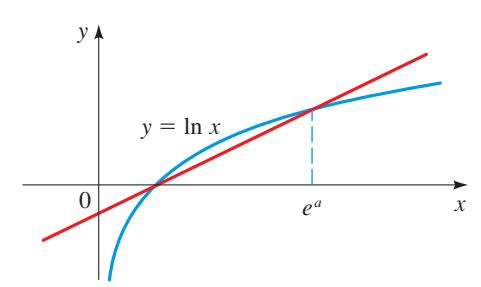
82 Find Equation from Graph · Level 2
Find an equation of the line shown in the figure.
question image
83 Change of Base · Level 2
Use the Change of Base Formula to evaluate the logarithm, rounded to six decimal places. \(\log_4 15\)
84 Change of Base · Level 2
Use the Change of Base Formula to evaluate the logarithm, rounded to six decimal places. \(\log_7\left(\dfrac{3}{4}\right)\)
85 Change of Base · Level 2
Use the Change of Base Formula to evaluate the logarithm, rounded to six decimal places. \(\log_9 0.28\)
86 Change of Base · Level 2
Use the Change of Base Formula to evaluate the logarithm, rounded to six decimal places. \(\log_{100} 250\)
87 Compare Logarithms · Level 2
Which is larger, \(\log_4 258\) or \(\log_5 620\)?
88 Inverse Function · Level 3
Find the inverse of the function \(f(x) = 2^{3^x}\) and state its domain and range.
89 Compound Interest · Level 2
If \$12,000 is invested at an interest rate of 10% per year, find the amount of the investment at the end of 3 years for each compounding method.
(a) Semiannually
(b) Monthly
(c) Daily
(d) Continuously

Enter your answer directly below each part above.

90 Compound Interest · Level 3
A sum of \$5000 is invested at an interest rate of \(8 \dfrac{1}{2}\)% per year, compounded semiannually.
(a) Find the amount of the investment after \(1 \dfrac{1}{2}\) years.
(b) After what period of time will the investment amount to \$7000?
(c) If interest were compounded continously instead of semiannually, how long would it take for the amount to grow to \$7000?

Enter your answer directly below each part above.

91 Compound Interest · Level 2
A money market account pays 5.2% annual interest, compounded daily. If \$100,000 is invested in this account, how long will it take for the account to accumulate \$10,000 in interest?
92 Compound Interest · Level 2
A retirement savings plan pays 4.5% interest, compounded continuously. How long will it take for an investment in this plan to double?
93 Annual Percentage Yield · Level 2
Determine the annual percentage yield (APY) for the given nominal annual interest rate and compounding frequency. 4.25%; daily
94 Annual Percentage Yield · Level 2
Determine the annual percentage yield (APY) for the given nominal annual interest rate and compounding frequency. 3.2%; monthly
95 Population Growth · Level 3
The stray-cat population in a small town grows exponentially. In 1999 the town had 30 stray cats, and the relative growth rate was 15% per year.
(a) Find a function that models the stray-cat population \(n(t)\) after \(t\) years.
(b) Find the projected population after 4 years.
(c) Find the number of years required for the stray-cat population to reach 500.

Enter your answer directly below each part above.

96 Bacteria Growth · Level 3
A culture contains 10,000 bacteria initially. After an hour the bacteria count is 25,000.
(a) Find the doubling period.
(b) Find the number of bacteria after 3 hours.

Enter your answer directly below each part above.

97 Radioactive Decay · Level 3
Uranium-234 has a half-life of \(2.7 \times 10^5\) years.
(a) Find the amount remaining from a 10-mg sample after a thousand years.
(b) How long will it take this sample to decompose until its mass is 7 mg?

Enter your answer directly below each part above.

98 Radioactive Decay · Level 3
A sample of bismuth-210 decayed to 33% of its original mass after 8 days.
(a) Find the half-life of this element.
(b) Find the mass remaining after 12 days.

Enter your answer directly below each part above.

99 Radioactive Decay · Level 3
The half-life of radium-226 is 1590 years.
(a) If a sample has a mass of 150 mg, find a function that models the mass that remains after \(t\) years.
(b) Find the mass that will remain after 1000 years.
(c) After how many years will only 50 mg remain?

Enter your answer directly below each part above.

100 Radioactive Decay · Level 3
The half-life of palladium-100 is 4 days. After 20 days a sample has been reduced to a mass of 0.375 g.
(a) What was the initial mass of the sample?
(b) Find a function that models the mass remaining after \(t\) days.
(c) What is the mass after 3 days?
(d) After how many days will only 0.15 g remain?

Enter your answer directly below each part above.

101 Population Growth from Graph · Level 3
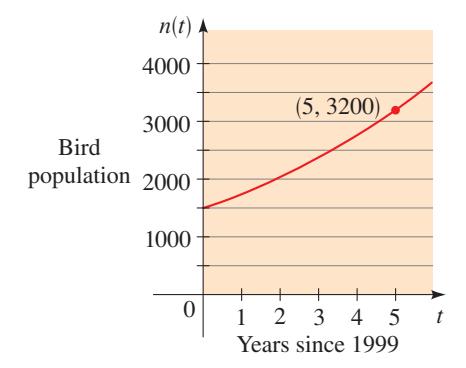
The graph shows the population of a rare species of bird, where \(t\) represents years since 1999 and \(n(t)\) is measured in thousands.
question image
(a) Find a function that models the bird population at time \(t\) in the form \(n(t) = n_0 e^{r t}\).
(b) What is the bird population expected to be in the year 2010?

Enter your answer directly below each part above.

102 Newton's Law of Cooling · Level 3
A car engine runs at a temperature of 190 degrees F. When the engine is turned off, it cools according to Newton's Law of Cooling with constant \(k = 0.0341\), where the time is measured in minutes. Find the time needed for the engine to cool to 90 degrees F if the surrounding temperature is 60 degrees F.
103 pH Scale · Level 1
The hydrogen ion concentration of fresh egg whites was measured as \([H^+] = 1.3 \times 10^{-8}\) M. Find the pH, and classify the substance as acidic or basic.
104 pH Scale · Level 1
The pH of lime juice is 1.9. Find the hydrogen ion concentration.
105 Richter Scale · Level 2
If one earthquake has magnitude 6.5 on the Richter scale, what is the magnitude of another quake that is 35 times as intense?
106 Decibel Scale · Level 2
The drilling of a jackhammer was measured at 132 dB. The sound of whispering was measured at 28 dB. Find the ratio of the intensity of the drilling to that of the whispering.
107 Concept Check - Exponential Function · Level 1
(a) Write an equation that defines the exponential function with base \(a\).
(b) What is the domain of this function?
(c) What is the range of this function?
(d) Sketch the general shape of the graph of the exponential function for each case. (i) \(a > 1\) (ii) \(0 < a < 1\)

Enter your answer directly below each part above.

108 Concept Check - Growth Rates · Level 1
If \(x\) is large, which function grows faster, \(y = 2^x\) or \(y = x^2\)?
109 Concept Check - Number e · Level 1
(a) How is the number \(e\) defined?
(b) What is the natural exponential function?

Enter your answer directly below each part above.

110 Concept Check - Logarithmic Function · Level 1
(a) How is the logarithmic function \(y = \log_a x\) defined?
(b) What is the domain of this function?
(c) What is the range of this function?
(d) Sketch the general shape of the graph of the function \(y = \log_a x\) if \(a > 1\).
(e) What is the natural logarithm?
(f) What is the common logarithm?

Enter your answer directly below each part above.

111 Concept Check - Laws of Logarithms · Level 1
State the three Laws of Logarithms.
112 Concept Check - Change of Base · Level 1
State the Change of Base Formula.
113 Concept Check - Solving Equations · Level 1
(a) How do you solve an exponential equation?
(b) How do you solve a logarithmic equation?

Enter your answer directly below each part above.

114 Concept Check - Compound Interest · Level 1
Suppose an amount \(P\) is invested at an interest rate \(r\) and \(A\) is the amount after \(t\) years.
(a) Write an expression for \(A\) if the interest is compounded \(n\) times per year.
(b) Write an expression for \(A\) if the interest is compounded continuously.

Enter your answer directly below each part above.

115 Concept Check - Population Growth · Level 1
The initial size of a population is \(n_0\) and the population grows exponentially.
(a) Write an expression for the population in terms of the doubling time \(a\).
(b) Write an expression for the population in terms of the relative growth rate \(r\).

Enter your answer directly below each part above.

116 Concept Check - Half-Life · Level 1
(a) What is the half-life of a radioactive substance?
(b) If a radioactive substance has initial mass \(m_0\) and half-life \(h\), write an expression for the mass \(m(t)\) remaining at time \(t\).

Enter your answer directly below each part above.

117 Concept Check - Newton's Law of Cooling · Level 1
What does Newton's Law of Cooling say?
118 Concept Check - Logarithmic Scales · Level 1
What do the pH scale, the Richter scale, and the decibel scale have in common? What do they measure?

Answered: 0 / 118