Stewart Section 2.5: Continuity

73 questions

--:--
0 / 73
Stewart Section 2.5: Continuity 0/73
1 Continuity - Definition · Level 2
Write an equation that expresses the fact that a function \(f\) is continuous at the number 4.
2 Continuity - Definition · Level 2
If \(f\) is continuous on \((-\infty, \infty)\), what can you say about its graph?
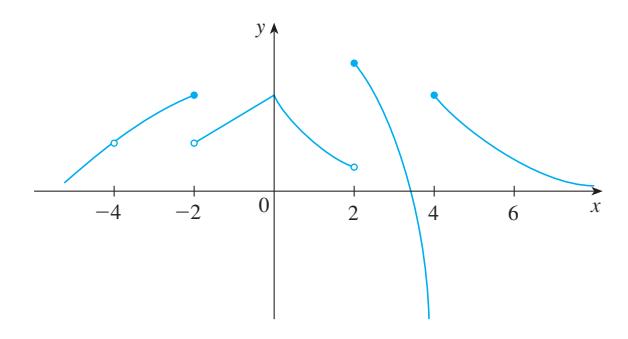
3 Continuity - Graph Analysis · Level 3
question image
(a) From the graph of \(f\), state the numbers at which \(f\) is discontinuous and explain why.
(b) For each of the numbers stated in part (a), determine whether \(f\) is continuous from the right, or from the left, or neither.

Enter your answer directly below each part above.

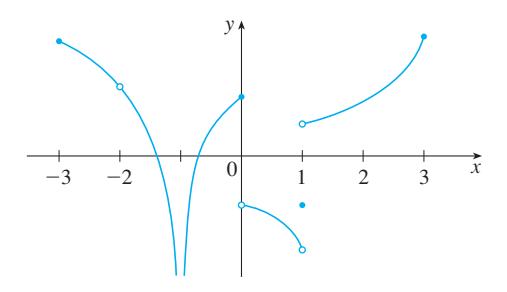
4 Continuity - Graph Analysis · Level 3
From the graph of \(g\), state the intervals on which \(g\) is continuous.
question image
5 Continuity - Sketching · Level 3
Sketch the graph of a function \(f\) that is continuous except for the stated discontinuity. Discontinuous, but continuous from the right, at 2
6 Continuity - Sketching · Level 3
Sketch the graph of a function \(f\) that is continuous except for the stated discontinuity. Discontinuities at \(-1\) and 4, but continuous from the left at \(-1\) and from the right at 4
7 Continuity - Sketching · Level 3
Sketch the graph of a function \(f\) that is continuous except for the stated discontinuity. Removable discontinuity at 3, jump discontinuity at 5
8 Continuity - Sketching · Level 3
Sketch the graph of a function \(f\) that is continuous except for the stated discontinuity. Neither left nor right continuous at \(-2\), continuous only from the left at 2
9 Continuity - Applied · Level 3
The toll \(T\) charged for driving on a certain stretch of a toll road is \$5 except during rush hours (between 7 AM and 10 AM and between 4 PM and 7 PM) when the toll is \$7.
(a) Sketch a graph of \(T\) as a function of the time \(t\), measured in hours past midnight.
(b) Discuss the discontinuities of this function and their significance to someone who uses the road.

Enter your answer directly below each part above.

10 Continuity - Applied · Level 3
Explain why each function is continuous or discontinuous.
(a) The temperature at a specific location as a function of time
(b) The temperature at a specific time as a function of the distance due west from New York City
(c) The altitude above sea level as a function of the distance due west from New York City
(d) The cost of a taxi ride as a function of the distance traveled
(e) The current in the circuit for the lights in a room as a function of time

Enter your answer directly below each part above.

11 Continuity - Definition Proof · Level 3
Use the definition of continuity and the properties of limits to show that the function is continuous at the given number \(a\). \(f(x) = (x + 2x^3)^4\), \(a = -1\)
12 Continuity - Definition Proof · Level 3
Use the definition of continuity and the properties of limits to show that the function is continuous at the given number \(a\). \(g(t) = \dfrac{t^2 + 5t}{2t + 1}\), \(a = 2\)
13 Continuity - Definition Proof · Level 3
Use the definition of continuity and the properties of limits to show that the function is continuous at the given number \(a\). \(p(v) = 2\sqrt{3v^2 + 1}\), \(a = 1\)
14 Continuity - Definition Proof · Level 3
Use the definition of continuity and the properties of limits to show that the function is continuous at the given number \(a\). \(f(x) = 3x^4 - 5x + \sqrt[3]{x^2 + 4}\), \(a = 2\)
15 Continuity - Interval Proof · Level 3
Use the definition of continuity and the properties of limits to show that the function is continuous on the given interval. \(f(x) = x + \sqrt{x - 4}\), \([4, \infty)\)
16 Continuity - Interval Proof · Level 3
Use the definition of continuity and the properties of limits to show that the function is continuous on the given interval. \(g(x) = \dfrac{x - 1}{3x + 6}\), \((-\infty, -2)\)
17 Continuity - Discontinuity · Level 3
Explain why the function is discontinuous at the given number \(a\). Sketch the graph of the function. \(f(x) = \dfrac{1}{x + 2}\), \(a = -2\)
18 Continuity - Discontinuity · Level 3
Explain why the function is discontinuous at the given number \(a\). Sketch the graph of the function. \(f(x) = \begin{cases} \dfrac{1}{x + 2} & \quad \text{if } x \neq -2 \\ 1 & \quad \text{if } x = -2 \end{cases}\), \(a = -2\)
19 Continuity - Discontinuity · Level 3
Explain why the function is discontinuous at the given number \(a\). Sketch the graph of the function. \(f(x) = \begin{cases} x + 3 & \quad \text{if } x \leq -1 \\ 2^x & \quad \text{if } x > -1 \end{cases}\), \(a = -1\)
20 Continuity - Discontinuity · Level 3
Explain why the function is discontinuous at the given number \(a\). Sketch the graph of the function. \(f(x) = \begin{cases} \dfrac{x^2 - x}{x^2 - 1} & \quad \text{if } x \neq 1 \\ 1 & \quad \text{if } x = 1 \end{cases}\), \(a = 1\)
21 Continuity - Discontinuity · Level 3
Explain why the function is discontinuous at the given number \(a\). Sketch the graph of the function. \(f(x) = \begin{cases} \cos x & \quad \text{if } x < 0 \\ 0 & \quad \text{if } x = 0 \\ 1 - x^2 & \quad \text{if } x > 0 \end{cases}\), \(a = 0\)
22 Continuity - Discontinuity · Level 3
Explain why the function is discontinuous at the given number \(a\). Sketch the graph of the function. \(f(x) = \begin{cases} \dfrac{2x^2 - 5x - 3}{x - 3} & \quad \text{if } x \neq 3 \\ 6 & \quad \text{if } x = 3 \end{cases}\), \(a = 3\)
23 Continuity - Removable Discontinuity · Level 3
How would you "remove the discontinuity" of \(f\)? In other words, how would you define \(f(2)\) in order to make \(f\) continuous at 2? \(f(x) = \dfrac{x^2 - x - 2}{x - 2}\)
24 Continuity - Removable Discontinuity · Level 3
How would you "remove the discontinuity" of \(f\)? In other words, how would you define \(f(2)\) in order to make \(f\) continuous at 2? \(f(x) = \dfrac{x^3 - 8}{x^2 - 4}\)
25 Continuity - Theorems · Level 3
Explain, using Theorems 4, 5, 7, and 9, why the function is continuous at every number in its domain. State the domain. \(F(x) = \dfrac{2x^2 - x - 1}{x^2 + 1}\)
26 Continuity - Theorems · Level 3
Explain, using Theorems 4, 5, 7, and 9, why the function is continuous at every number in its domain. State the domain. \(G(x) = \dfrac{x^2 + 1}{2x^2 - x - 1}\)
27 Continuity - Theorems · Level 3
Explain, using Theorems 4, 5, 7, and 9, why the function is continuous at every number in its domain. State the domain. \(Q(x) = \dfrac{\sqrt[3]{x - 2}}{x^3 - 2}\)
28 Continuity - Theorems · Level 3
Explain, using Theorems 4, 5, 7, and 9, why the function is continuous at every number in its domain. State the domain. \(R(t) = \dfrac{e^{\sin t}}{2 + \cos \pi t}\)
29 Continuity - Theorems · Level 3
Explain, using Theorems 4, 5, 7, and 9, why the function is continuous at every number in its domain. State the domain. \(A(t) = \arcsin(1 + 2t)\)
30 Continuity - Theorems · Level 3
Explain, using Theorems 4, 5, 7, and 9, why the function is continuous at every number in its domain. State the domain. \(B(x) = \dfrac{\tan x}{\sqrt{4 - x^2}}\)
31 Continuity - Theorems · Level 3
Explain, using Theorems 4, 5, 7, and 9, why the function is continuous at every number in its domain. State the domain. \(M(x) = \sqrt{1 + \dfrac{1}{x}}\)
32 Continuity - Theorems · Level 3
Explain, using Theorems 4, 5, 7, and 9, why the function is continuous at every number in its domain. State the domain. \(N(r) = \arctan(1 + e^{-r^2})\)
33 Continuity - Discontinuity Location · Level 4
Locate the discontinuities of the function and illustrate by graphing. \(y = \dfrac{1}{1 + e^{\dfrac{1}{x}}}\)
34 Continuity - Discontinuity Location · Level 4
Locate the discontinuities of the function and illustrate by graphing. \(y = \ln(\tan^2 x)\)
35 Continuity - Limit Evaluation · Level 3
Use continuity to evaluate the limit. \(\operatorname*{lim}\limits_{x \rightarrow 2} x \sqrt{20 - x^2}\)
36 Continuity - Limit Evaluation · Level 3
Use continuity to evaluate the limit. \(\operatorname*{lim}\limits_{x \rightarrow \pi} \sin(x + \sin x)\)
37 Continuity - Limit Evaluation · Level 3
Use continuity to evaluate the limit. \(\operatorname*{lim}\limits_{x \rightarrow 1} \ln\left(\dfrac{5 - x^2}{1 + x}\right)\)
38 Continuity - Limit Evaluation · Level 3
Use continuity to evaluate the limit. \(\operatorname*{lim}\limits_{x \rightarrow 4} 3^{\sqrt{x^2 - 2x - 4}}\)
39 Continuity - Continuity Proof · Level 4
Show that \(f\) is continuous on \((-\infty, \infty)\). \(f(x) = \begin{cases} 1 - x^2 & \quad \text{if } x \leq 1 \\ \ln x & \quad \text{if } x > 1 \end{cases}\)
40 Continuity - Continuity Proof · Level 4
Show that \(f\) is continuous on \((-\infty, \infty)\). \(f(x) = \begin{cases} \sin x & \quad \text{if } x < \dfrac{\pi}{4} \\ \cos x & \quad \text{if } x \geq \dfrac{\pi}{4} \end{cases}\)
41 Continuity - Piecewise Analysis · Level 4
Find the numbers at which \(f\) is discontinuous. At which of these numbers is \(f\) continuous from the right, from the left, or neither? Sketch the graph of \(f\). \(f(x) = \begin{cases} x^2 & \quad \text{if } x < -1 \\ x & \quad \text{if } -1 \leq x < 1 \\ \dfrac{1}{x} & \quad \text{if } x \geq 1 \end{cases}\)
42 Continuity - Piecewise Analysis · Level 4
Find the numbers at which \(f\) is discontinuous. At which of these numbers is \(f\) continuous from the right, from the left, or neither? Sketch the graph of \(f\). \(f(x) = \begin{cases} 2^x & \quad \text{if } x \leq 1 \\ 3 - x & \quad \text{if } 1 < x \leq 4 \\ \sqrt{x} & \quad \text{if } x > 4 \end{cases}\)
43 Continuity - Piecewise Analysis · Level 4
Find the numbers at which \(f\) is discontinuous. At which of these numbers is \(f\) continuous from the right, from the left, or neither? Sketch the graph of \(f\). \(f(x) = \begin{cases} x + 2 & \quad \text{if } x < 0 \\ e^x & \quad \text{if } 0 \leq x \leq 1 \\ 2 - x & \quad \text{if } x > 1 \end{cases}\)
44 Continuity - Applied · Level 4
The gravitational force exerted by the planet Earth on a unit mass at a distance \(r\) from the center of the planet is \(F(r) = \begin{cases} \dfrac{G M r}{R^3} & \quad \text{if } r < R \\ \dfrac{G M}{r^2} & \quad \text{if } r \geq R \end{cases}\) where \(M\) is the mass of Earth, \(R\) is its radius, and \(G\) is the gravitational constant. Is \(F\) a continuous function of \(r\)?
45 Continuity - Find Constants · Level 4
For what value of the constant \(c\) is the function \(f\) continuous on \((-\infty, \infty)\)? \(f(x) = \begin{cases} c x^2 + 2x & \quad \text{if } x < 2 \\ x^3 - c x & \quad \text{if } x \geq 2 \end{cases}\)
46 Continuity - Find Constants · Level 5
Find the values of \(a\) and \(b\) that make \(f\) continuous everywhere. \(f(x) = \begin{cases} \dfrac{x^2 - 4}{x - 2} & \quad \text{if } x < 2 \\ a x^2 - b x + 3 & \quad \text{if } 2 \leq x < 3 \\ 2x - a + b & \quad \text{if } x \geq 3 \end{cases}\)
47 Continuity - Properties · Level 4
Suppose \(f\) and \(g\) are continuous functions such that \(g(2) = 6\) and \(\operatorname*{lim}\limits_{x \rightarrow 2} [3f(x) + f(x) g(x)] = 36\). Find \(f(2)\).
48 Continuity - Composition · Level 4
Let \(f(x) = \dfrac{1}{x}\) and \(g(x) = 1/x^2\).
(a) Find \((f \circ g)(x)\).
(b) Is \(f \circ g\) continuous everywhere? Explain.

Enter your answer directly below each part above.

49 Continuity - Removable Discontinuity · Level 4
Which of the following functions \(f\) has a removable discontinuity at \(a\)? If the discontinuity is removable, find a function \(g\) that agrees with \(f\) for \(x \neq a\) and is continuous at \(a\).
(a) \(f(x) = \dfrac{x^4 - 1}{x - 1}\), \(a = 1\)
(b) \(f(x) = \dfrac{x^3 - x^2 - 2x}{x - 2}\), \(a = 2\)
(c) \(f(x) = \lfloor \sin x \rfloor\), \(a = \pi\)

Enter your answer directly below each part above.

50 Continuity - IVT · Level 4
Suppose that a function \(f\) is continuous on \([0, 1]\) except at 0.25 and that \(f(0) = 1\) and \(f(1) = 3\). Let \(N = 2\). Sketch two possible graphs of \(f\), one showing that \(f\) might not satisfy the conclusion of the Intermediate Value Theorem and one showing that \(f\) might still satisfy the conclusion of the Intermediate Value Theorem (even though it doesn't satisfy the hypothesis).
51 Continuity - IVT · Level 3
If \(f(x) = x^2 + 10 \sin x\), show that there is a number \(c\) such that \(f(c) = 1000\).
52 Continuity - IVT · Level 4
Suppose \(f\) is continuous on \([1, 5]\) and the only solutions of the equation \(f(x) = 6\) are \(x = 1\) and \(x = 4\). If \(f(2) = 8\), explain why \(f(3) > 6\).
53 Continuity - IVT Root · Level 3
Use the Intermediate Value Theorem to show that there is a root of the given equation in the specified interval. \(x^4 + x - 3 = 0\), \((1, 2)\)
54 Continuity - IVT Root · Level 3
Use the Intermediate Value Theorem to show that there is a root of the given equation in the specified interval. \(\ln x = x - \sqrt{x}\), \((2, 3)\)
55 Continuity - IVT Root · Level 3
Use the Intermediate Value Theorem to show that there is a root of the given equation in the specified interval. \(e^x = 3 - 2x\), \((0, 1)\)
56 Continuity - IVT Root · Level 3
Use the Intermediate Value Theorem to show that there is a root of the given equation in the specified interval. \(\sin x = x^2 - x\), \((1, 2)\)
57 Continuity - IVT Root · Level 4
(a) Prove that the equation has at least one real root.
(b) Use your calculator to find an interval of length 0.01 that contains a root. \(\cos x = x^3\)

Enter your answer directly below each part above.

58 Continuity - IVT Root · Level 4
(a) Prove that the equation has at least one real root.
(b) Use your calculator to find an interval of length 0.01 that contains a root. \(\ln x = 3 - 2x\)

Enter your answer directly below each part above.

59 Continuity - IVT Root · Level 4
(a) Prove that the equation has at least one real root.
(b) Use your graphing device to find the root correct to three decimal places. \(100 e^{-\dfrac{x}{100}} = 0.01 x^2\)

Enter your answer directly below each part above.

60 Continuity - IVT Root · Level 4
(a) Prove that the equation has at least one real root.
(b) Use your graphing device to find the root correct to three decimal places. \(\arctan x = 1 - x\)

Enter your answer directly below each part above.

61 Continuity - IVT Intercepts · Level 4
Prove, without graphing, that the graph of the function has at least two \(x\)-intercepts in the specified interval. \(y = \sin x^3\), \((1, 2)\)
62 Continuity - IVT Intercepts · Level 4
Prove, without graphing, that the graph of the function has at least two \(x\)-intercepts in the specified interval. \(y = x^2 - 3 + \dfrac{1}{x}\), \((0, 2)\)
63 Continuity - Proof · Level 5
Prove that \(f\) is continuous at \(a\) if and only if \(\operatorname*{lim}\limits_{h \rightarrow 0} f(a + h) = f(a)\)
64 Continuity - Proof · Level 5
To prove that sine is continuous, we need to show that \(\operatorname*{lim}\limits_{x \rightarrow a} \sin x = \sin a\) for every real number \(a\). By Exercise 63 an equivalent statement is that \(\operatorname*{lim}\limits_{h \rightarrow 0} \sin(a + h) = \sin a\) Use (6) to show that this is true.
65 Continuity - Proof · Level 5
Prove that cosine is a continuous function.
66 Continuity - Proof · Level 5
(a) Prove Theorem 4, part 3.
(b) Prove Theorem 4, part 5.

Enter your answer directly below each part above.

67 Continuity - Advanced · Level 5
For what values of \(x\) is \(f\) continuous? \(f(x) = \begin{cases} 0 & \quad \text{if } x \text{is rational} \\ 1 & \quad \text{if } x \text{is irrational} \end{cases}\)
68 Continuity - Advanced · Level 5
For what values of \(x\) is \(g\) continuous? \(g(x) = \begin{cases} 0 & \quad \text{if } x \text{is rational} \\ x & \quad \text{if } x \text{is irrational} \end{cases}\)
69 Continuity - IVT · Level 4
Is there a number that is exactly 1 more than its cube?
70 Continuity - IVT Proof · Level 5
If \(a\) and \(b\) are positive numbers, prove that the equation \(\dfrac{a}{x^3 + 2x^2 - 1} + \dfrac{b}{x^3 + x - 2} = 0\) has at least one solution in the interval \((-1, 1)\).
71 Continuity - Continuity Proof · Level 5
Show that the function \(f(x) = \begin{cases} x^4 \sin\left(\dfrac{1}{x}\right) & \quad \text{if } x \neq 0 \\ 0 & \quad \text{if } x = 0 \end{cases}\) is continuous on \((-\infty, \infty)\).
72 Continuity - Proof · Level 5
(a) Show that the absolute value function \(F(x) = |x|\) is continuous everywhere.
(b) Prove that if \(f\) is a continuous function on an interval, then so is \(|f|\).
(c) Is the converse of the statement in part (b) also true? In other words, if \(|f|\) is continuous, does it follow that \(f\) is continuous? If so, prove it. If not, find a counterexample.

Enter your answer directly below each part above.

73 Continuity - IVT Applied · Level 5
A Tibetan monk leaves the monastery at 7:00 AM and takes his usual path to the top of the mountain, arriving at 7:00 PM. The following morning, he starts at 7:00 AM at the top and takes the same path back, arriving at the monastery at 7:00 PM. Use the Intermediate Value Theorem to show that there is a point on the path that the monk will cross at exactly the same time of day on both days.

Answered: 0 / 73