Stewart Section 9.6: Predator-Prey Systems

12 questions

--:--
0 / 12
Stewart Section 9.6: Predator-Prey Systems 0/12
1 Predator-Prey - Classification · Level 3
For each predator-prey system, determine which of the variables, \(x\) or \(y\), represents the prey population and which represents the predator population. Is the growth of the prey restricted just by the predators or by other factors as well? Explain.
(a) \( \dfrac{d x}{d t} = -0.05x + 0.0001x y \) \( \dfrac{d y}{d t} = 0.1y - 0.005x y \)
(b) \( \dfrac{d x}{d t} = 0.2x - 0.0002x^2 - 0.006x y \) \( \dfrac{d y}{d t} = -0.015y + 0.00008x y \)

Enter your answer directly below each part above.

2 Species Interaction - Classification · Level 3
Each system of differential equations is a model for two species that either compete for the same resources or cooperate for mutual benefit. Decide whether each system describes cooperation or competition and explain why. Determine what effect an increase in one species has on the growth rate of the other.
(a) \( \dfrac{d x}{d t} = 0.12x - 0.0006x^2 + 0.00001x y \) \( \dfrac{d y}{d t} = 0.08y + 0.00004x y \)
(b) \( \dfrac{d x}{d t} = 0.15x - 0.0002x^2 - 0.0006x y \) \( \dfrac{d y}{d t} = 0.2y - 0.00008y^2 - 0.0002x y \)

Enter your answer directly below each part above.

3 Species Interaction - Competition · Level 3
The system of differential equations \( \dfrac{d x}{d t} = 0.5x - 0.004x^2 - 0.001x y \) \( \dfrac{d y}{d t} = 0.4y - 0.001y^2 - 0.002x y \) is a model for the populations of two species.
(a) Does the model describe cooperation, or competition, or a predator-prey relationship?
(b) Find the equilibrium solutions and explain their significance.

Enter your answer directly below each part above.

4 Predator-Prey - Three Species · Level 4
Lynx eat snowshoe hares and snowshoe hares eat woody plants like willows. Suppose that, in the absence of hares, the willow population will grow exponentially and the lynx population will decay exponentially. In the absence of lynx and willow, the hare population will decay exponentially. If \(L(t)\), \(H(t)\), and \(W(t)\) represent the populations of these three species at time \(t\), write a system of differential equations as a model for their dynamics. If the constants in your equation are all positive, explain why you have used plus or minus signs.
5 Phase Trajectories · Level 3
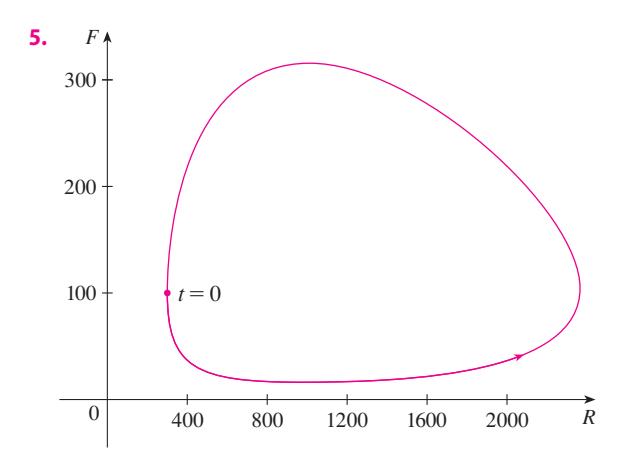
A phase trajectory is shown for populations of rabbits (\(R\)) and foxes (\(F\)).
question image
(a) Describe how each population changes as time goes by.
(b) Use your description to make a rough sketch of the graphs of \(R\) and \(F\) as functions of time.

Enter your answer directly below each part above.

6 Phase Trajectories · Level 3
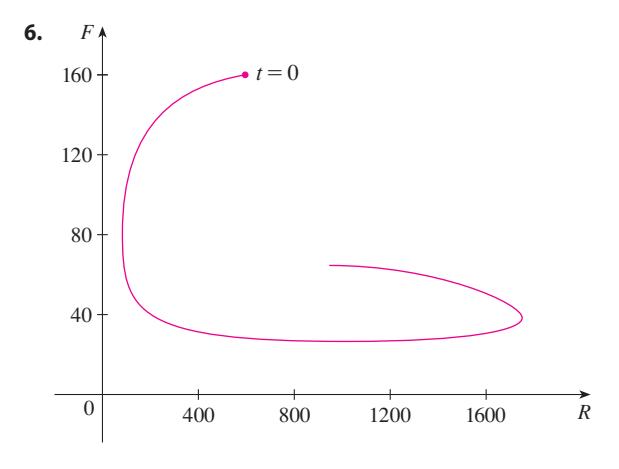
A phase trajectory is shown for populations of rabbits (\(R\)) and foxes (\(F\)).
question image
(a) Describe how each population changes as time goes by.
(b) Use your description to make a rough sketch of the graphs of \(R\) and \(F\) as functions of time.

Enter your answer directly below each part above.

7 Phase Trajectories · Level 3
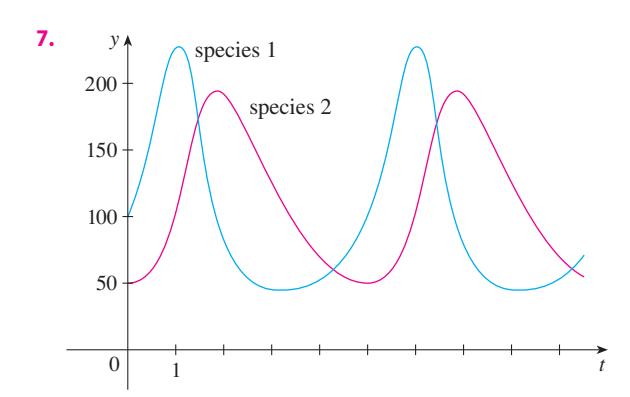
Graphs of populations of two species are shown. Use them to sketch the corresponding phase trajectory.
question image
8 Phase Trajectories · Level 3
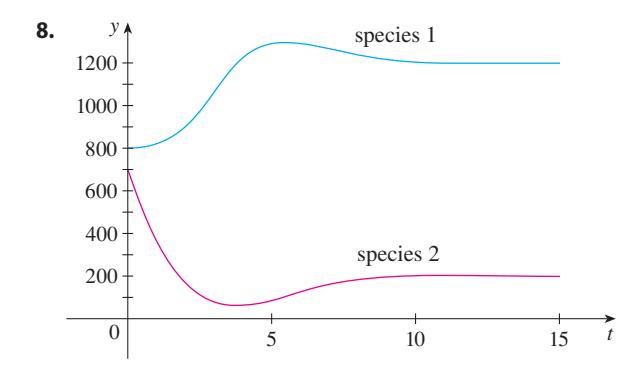
Graphs of populations of two species are shown. Use them to sketch the corresponding phase trajectory.
question image
9 Lotka-Volterra - Solving · Level 4
In Example 1(b) we showed that the rabbit and wolf populations satisfy the differential equation \( \dfrac{d W}{d R} = \dfrac{-0.02 W + 0.00002 R W}{0.08 R - 0.001 R W} \) By solving this separable differential equation, show that \( \dfrac{R^{0.02} W^{0.08}}{e^{0.00002 R} e^{0.001 W}} = C \) where \(C\) is a constant. It is impossible to solve this equation for \(W\) as an explicit function of \(R\) (or vice versa). If you have a computer algebra system that graphs implicitly defined curves, use this equation and your CAS to draw the solution curve that passes through the point \((1000, 40)\) and compare with Figure 3.
10 Lotka-Volterra - Aphids and Ladybugs · Level 3
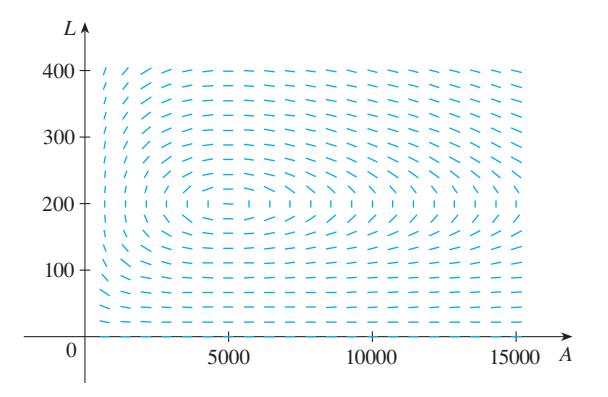
Populations of aphids and ladybugs are modeled by the equations \( \dfrac{d A}{d t} = 2A - 0.01 A L \) \( \dfrac{d L}{d t} = -0.5 L + 0.0001 A L \)
question image
(a) Find the equilibrium solutions and explain their significance.
(b) Find an expression for \(d \dfrac{L}{d} A\).
(c) The direction field for the differential equation in part (b) is shown. Use it to sketch a phase portrait. What do the phase trajectories have in common?
(d) Suppose that at time \(t = 0\) there are 1000 aphids and 200 ladybugs. Draw the corresponding phase trajectory and use it to describe how both populations change.
(e) Use part (d) to make rough sketches of the aphid and ladybug populations as functions of \(t\). How are the graphs related to each other?

Enter your answer directly below each part above.

11 Lotka-Volterra - Modified · Level 4
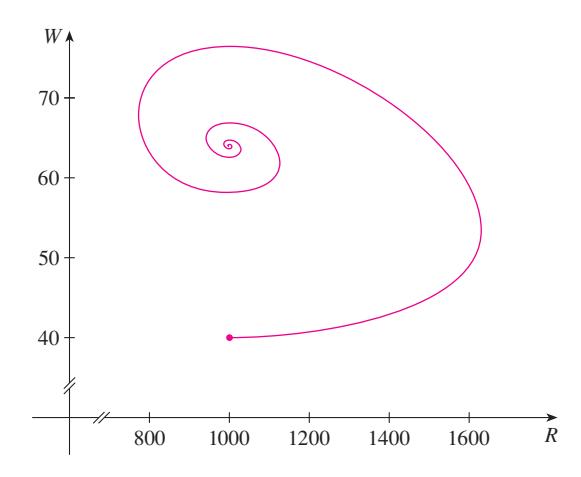
In Example 1 we used Lotka-Volterra equations to model populations of rabbits and wolves. Let's modify those equations as follows: \( \dfrac{d R}{d t} = 0.08 R (1 - 0.0002 R) - 0.001 R W \) \( \dfrac{d W}{d t} = -0.02 W + 0.00002 R W \)
question image
(a) According to these equations, what happens to the rabbit population in the absence of wolves?
(b) Find all the equilibrium solutions and explain their significance.
(c) The figure shows the phase trajectory that starts at the point \((1000, 40)\). Describe what eventually happens to the rabbit and wolf populations.
(d) Sketch graphs of the rabbit and wolf populations as functions of time.

Enter your answer directly below each part above.

12 Lotka-Volterra - Modified · Level 4
In Exercise 10 we modeled populations of aphids and ladybugs with a Lotka-Volterra system. Suppose we modify those equations as follows: \( \dfrac{d A}{d t} = 2A(1 - 0.0001 A) - 0.01 A L \) \( \dfrac{d L}{d t} = -0.5 L + 0.0001 A L \)
(a) In the absence of ladybugs, what does the model predict about the aphids?
(b) Find the equilibrium solutions.
(c) Find an expression for \(d \dfrac{L}{d} A\).
(d) Use a computer algebra system to draw a direction field for the differential equation in part (c). Then use the direction field to sketch a phase portrait. What do the phase trajectories have in common?
(e) Suppose that at time \(t = 0\) there are 1000 aphids and 200 ladybugs. Draw the corresponding phase trajectory and use it to describe how both populations change.
(f) Use part (e) to make rough sketches of the aphid and ladybug populations as functions of \(t\). How are the graphs related to each other?

Enter your answer directly below each part above.

Answered: 0 / 12