Stewart Precalc 6e Section 9.1: Vectors in Two Dimensions

80 questions

--:--
0 / 80
Stewart Precalc 6e Section 9.1: Vectors in Two Dimensions 0/80
1 Concepts · Level 1
question image
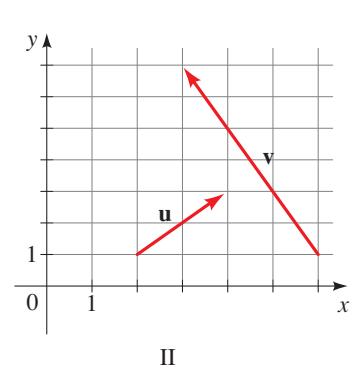
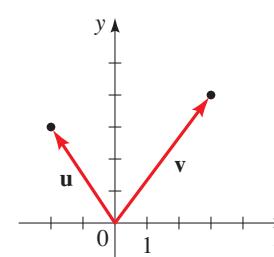
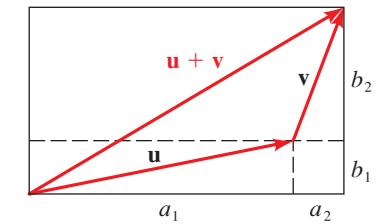
(a) A vector in the plane is a line segment with an assigned direction. In Figure I, the vector \(\mathbf{u}\) has initial point ___ and terminal point ___. Sketch the vectors \(2 \mathbf{u}\) and \(\mathbf{u} + \mathbf{v}\).
(b) A vector in a coordinate plane is expressed by using components. In Figure II, the vector \(\mathbf{u}\) has initial point \((_, _)\) and terminal point \((_, _)\). In component form we write \(\mathbf{u} = \langle _, _ \rangle\) and \(\mathbf{v} = \langle _, _ \rangle\). Then \(2 \mathbf{u} = \langle _, _ \rangle\) and \(\mathbf{u} + \mathbf{v} = \langle _, _ \rangle\).

Enter your answer directly below each part above.

2 Concepts · Level 1
question image
(a) The length of a vector \(\mathbf{w} = \langle a, b \rangle\) is \(|\mathbf{w}| = \) ___. So the length of the vector \(\mathbf{u}\) in Figure II is ___.
(b) If we know the length \(|\mathbf{w}|\) and direction \(\theta\) of a vector \(\mathbf{w}\), then we can express the vector in component form as \(\mathbf{w} = \) ___.

Enter your answer directly below each part above.

3 Skills - Sketch Vector · Level 1
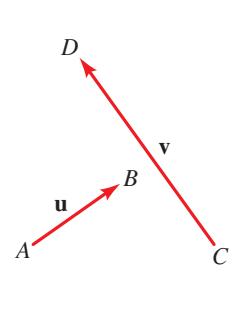
Sketch the vector indicated. (The vectors \(\mathbf{u}\) and \(\mathbf{v}\) are shown in the figure.) \(2 \mathbf{u}\)
question image
4 Skills - Sketch Vector · Level 1
Sketch the vector indicated. (The vectors \(\mathbf{u}\) and \(\mathbf{v}\) are shown in the figure.) \(- \mathbf{v}\)
5 Skills - Sketch Vector · Level 1
Sketch the vector indicated. (The vectors \(\mathbf{u}\) and \(\mathbf{v}\) are shown in the figure.) \(\mathbf{u} + \mathbf{v}\)
6 Skills - Sketch Vector · Level 1
Sketch the vector indicated. (The vectors \(\mathbf{u}\) and \(\mathbf{v}\) are shown in the figure.) \(\mathbf{u} - \mathbf{v}\)
7 Skills - Sketch Vector · Level 1
Sketch the vector indicated. (The vectors \(\mathbf{u}\) and \(\mathbf{v}\) are shown in the figure.) \(\mathbf{v} - 2 \mathbf{u}\)
8 Skills - Sketch Vector · Level 1
Sketch the vector indicated. (The vectors \(\mathbf{u}\) and \(\mathbf{v}\) are shown in the figure.) \(2 \mathbf{u} + \mathbf{v}\)
9 Skills - Component Form · Level 1
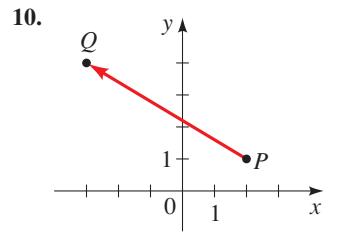
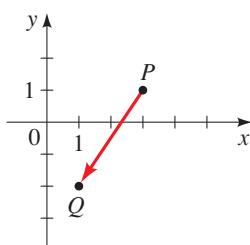
Express the vector with initial point \(P\) and terminal point \(Q\) in component form. (See figure.)
question image
10 Skills - Component Form · Level 1
Express the vector with initial point \(P\) and terminal point \(Q\) in component form. (See figure.)
11 Skills - Component Form · Level 1
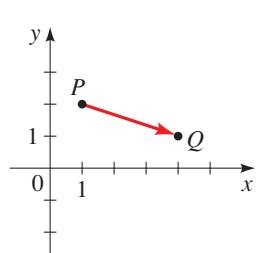
Express the vector with initial point \(P\) and terminal point \(Q\) in component form. (See figure.)
question image
12 Skills - Component Form · Level 1
Express the vector with initial point \(P\) and terminal point \(Q\) in component form. (See figure.)
question image
13 Skills - Component Form · Level 1
Express the vector with initial point \(P(3, 2)\) and terminal point \(Q(8, 9)\) in component form.
14 Skills - Component Form · Level 1
Express the vector with initial point \(P(1, 1)\) and terminal point \(Q(9, 9)\) in component form.
15 Skills - Component Form · Level 1
Express the vector with initial point \(P(5, 3)\) and terminal point \(Q(1, 0)\) in component form.
16 Skills - Component Form · Level 1
Express the vector with initial point \(P(-1, 3)\) and terminal point \(Q(-6, -1)\) in component form.
17 Skills - Component Form · Level 1
Express the vector with initial point \(P(-1, -1)\) and terminal point \(Q(-1, 1)\) in component form.
18 Skills - Component Form · Level 1
Express the vector with initial point \(P(-8, -6)\) and terminal point \(Q(-1, -1)\) in component form.
19 Skills - Terminal Point · Level 1
Sketch the given vector with initial point \((4, 3)\), and find the terminal point. \(\mathbf{u} = \langle 2, 4 \rangle\)
20 Skills - Terminal Point · Level 1
Sketch the given vector with initial point \((4, 3)\), and find the terminal point. \(\mathbf{u} = \langle -1, 2 \rangle\)
21 Skills - Terminal Point · Level 1
Sketch the given vector with initial point \((4, 3)\), and find the terminal point. \(\mathbf{u} = \langle 4, -3 \rangle\)
22 Skills - Terminal Point · Level 1
Sketch the given vector with initial point \((4, 3)\), and find the terminal point. \(\mathbf{u} = \langle -8, -1 \rangle\)
23 Skills - Sketch Representations · Level 1
Sketch representations of the given vector with initial points at \((0, 0)\), \((2, 3)\), and \((-3, 5)\). \(\mathbf{u} = \langle 3, 5 \rangle\)
24 Skills - Sketch Representations · Level 1
Sketch representations of the given vector with initial points at \((0, 0)\), \((2, 3)\), and \((-3, 5)\). \(\mathbf{u} = \langle 4, -6 \rangle\)
25 Skills - Sketch Representations · Level 1
Sketch representations of the given vector with initial points at \((0, 0)\), \((2, 3)\), and \((-3, 5)\). \(\mathbf{u} = \langle -7, 2 \rangle\)
26 Skills - Sketch Representations · Level 1
Sketch representations of the given vector with initial points at \((0, 0)\), \((2, 3)\), and \((-3, 5)\). \(\mathbf{u} = \langle 0, -9 \rangle\)
27 Skills - i and j Form · Level 1
Write the given vector in terms of \(\mathbf{i}\) and \(\mathbf{j}\). \(\mathbf{u} = \langle 1, 4 \rangle\)
28 Skills - i and j Form · Level 1
Write the given vector in terms of \(\mathbf{i}\) and \(\mathbf{j}\). \(\mathbf{u} = \langle -2, 10 \rangle\)
29 Skills - i and j Form · Level 1
Write the given vector in terms of \(\mathbf{i}\) and \(\mathbf{j}\). \(\mathbf{u} = \langle 3, 0 \rangle\)
30 Skills - i and j Form · Level 1
Write the given vector in terms of \(\mathbf{i}\) and \(\mathbf{j}\). \(\mathbf{u} = \langle 0, -5 \rangle\)
31 Skills - Vector Arithmetic · Level 2
Find \(2 \mathbf{u}\), \(-3 \mathbf{v}\), \(\mathbf{u} + \mathbf{v}\), and \(3 \mathbf{u} - 4 \mathbf{v}\). \(\mathbf{u} = \langle 2, 7 \rangle\), \(\mathbf{v} = \langle 3, 1 \rangle\)
32 Skills - Vector Arithmetic · Level 2
Find \(2 \mathbf{u}\), \(-3 \mathbf{v}\), \(\mathbf{u} + \mathbf{v}\), and \(3 \mathbf{u} - 4 \mathbf{v}\). \(\mathbf{u} = \langle -2, 5 \rangle\), \(\mathbf{v} = \langle 2, -8 \rangle\)
33 Skills - Vector Arithmetic · Level 2
Find \(2 \mathbf{u}\), \(-3 \mathbf{v}\), \(\mathbf{u} + \mathbf{v}\), and \(3 \mathbf{u} - 4 \mathbf{v}\). \(\mathbf{u} = \langle 0, -1 \rangle\), \(\mathbf{v} = \langle -2, 0 \rangle\)
34 Skills - Vector Arithmetic · Level 2
Find \(2 \mathbf{u}\), \(-3 \mathbf{v}\), \(\mathbf{u} + \mathbf{v}\), and \(3 \mathbf{u} - 4 \mathbf{v}\). \(\mathbf{u} = \mathbf{i}\), \(\mathbf{v} = -2 \mathbf{j}\)
35 Skills - Vector Arithmetic · Level 2
Find \(2 \mathbf{u}\), \(-3 \mathbf{v}\), \(\mathbf{u} + \mathbf{v}\), and \(3 \mathbf{u} - 4 \mathbf{v}\). \(\mathbf{u} = 2 \mathbf{i}\), \(\mathbf{v} = 3 \mathbf{i} - 2 \mathbf{j}\)
36 Skills - Vector Arithmetic · Level 2
Find \(2 \mathbf{u}\), \(-3 \mathbf{v}\), \(\mathbf{u} + \mathbf{v}\), and \(3 \mathbf{u} - 4 \mathbf{v}\). \(\mathbf{u} = \mathbf{i} + \mathbf{j}\), \(\mathbf{v} = \mathbf{i} - \mathbf{j}\)
37 Skills - Magnitudes · Level 2
Find \(|\mathbf{u}|\), \(|\mathbf{v}|\), \(|2 \mathbf{u}|\), \(|\dfrac{1}{2} \mathbf{v}|\), \(|\mathbf{u} + \mathbf{v}|\), \(|\mathbf{u} - \mathbf{v}|\), and \(|\mathbf{u}| - |\mathbf{v}|\). \(\mathbf{u} = 2 \mathbf{i} + \mathbf{j}\), \(\mathbf{v} = 3 \mathbf{i} - 2 \mathbf{j}\)
38 Skills - Magnitudes · Level 2
Find \(|\mathbf{u}|\), \(|\mathbf{v}|\), \(|2 \mathbf{u}|\), \(|\dfrac{1}{2} \mathbf{v}|\), \(|\mathbf{u} + \mathbf{v}|\), \(|\mathbf{u} - \mathbf{v}|\), and \(|\mathbf{u}| - |\mathbf{v}|\). \(\mathbf{u} = -2 \mathbf{i} + 3 \mathbf{j}\), \(\mathbf{v} = \mathbf{i} - 2 \mathbf{j}\)
39 Skills - Magnitudes · Level 2
Find \(|\mathbf{u}|\), \(|\mathbf{v}|\), \(|2 \mathbf{u}|\), \(|\dfrac{1}{2} \mathbf{v}|\), \(|\mathbf{u} + \mathbf{v}|\), \(|\mathbf{u} - \mathbf{v}|\), and \(|\mathbf{u}| - |\mathbf{v}|\). \(\mathbf{u} = \langle 10, -1 \rangle\), \(\mathbf{v} = \langle -2, -2 \rangle\)
40 Skills - Magnitudes · Level 2
Find \(|\mathbf{u}|\), \(|\mathbf{v}|\), \(|2 \mathbf{u}|\), \(|\dfrac{1}{2} \mathbf{v}|\), \(|\mathbf{u} + \mathbf{v}|\), \(|\mathbf{u} - \mathbf{v}|\), and \(|\mathbf{u}| - |\mathbf{v}|\). \(\mathbf{u} = \langle -6, 6 \rangle\), \(\mathbf{v} = \langle -2, -1 \rangle\)
41 Skills - Components from Magnitude and Direction · Level 2
Find the horizontal and vertical components of the vector with given length and direction, and write the vector in terms of \(\mathbf{i}\) and \(\mathbf{j}\). \(|\mathbf{v}| = 40\), \(\theta = 30^{\circ}\)
42 Skills - Components from Magnitude and Direction · Level 2
Find the horizontal and vertical components of the vector with given length and direction, and write the vector in terms of \(\mathbf{i}\) and \(\mathbf{j}\). \(|\mathbf{v}| = 50\), \(\theta = 120^{\circ}\)
43 Skills - Components from Magnitude and Direction · Level 2
Find the horizontal and vertical components of the vector with given length and direction, and write the vector in terms of \(\mathbf{i}\) and \(\mathbf{j}\). \(|\mathbf{v}| = 1\), \(\theta = 225^{\circ}\)
44 Skills - Components from Magnitude and Direction · Level 2
Find the horizontal and vertical components of the vector with given length and direction, and write the vector in terms of \(\mathbf{i}\) and \(\mathbf{j}\). \(|\mathbf{v}| = 800\), \(\theta = 125^{\circ}\)
45 Skills - Components from Magnitude and Direction · Level 2
Find the horizontal and vertical components of the vector with given length and direction, and write the vector in terms of \(\mathbf{i}\) and \(\mathbf{j}\). \(|\mathbf{v}| = 4\), \(\theta = 10^{\circ}\)
46 Skills - Components from Magnitude and Direction · Level 2
Find the horizontal and vertical components of the vector with given length and direction, and write the vector in terms of \(\mathbf{i}\) and \(\mathbf{j}\). \(|\mathbf{v}| = \sqrt{3}\), \(\theta = 300^{\circ}\)
47 Skills - Magnitude and Direction · Level 2
Find the magnitude and direction (in degrees) of the vector. \(\mathbf{v} = \langle 3, 4 \rangle\)
48 Skills - Magnitude and Direction · Level 2
Find the magnitude and direction (in degrees) of the vector. \(\mathbf{v} = \langle -\dfrac{\sqrt{2}}{2}, -\dfrac{\sqrt{2}}{2} \rangle\)
49 Skills - Magnitude and Direction · Level 2
Find the magnitude and direction (in degrees) of the vector. \(\mathbf{v} = \langle -12, 5 \rangle\)
50 Skills - Magnitude and Direction · Level 2
Find the magnitude and direction (in degrees) of the vector. \(\mathbf{v} = \langle 40, 9 \rangle\)
51 Skills - Magnitude and Direction · Level 2
Find the magnitude and direction (in degrees) of the vector. \(\mathbf{v} = \mathbf{i} + \sqrt{3} \mathbf{j}\)
52 Skills - Magnitude and Direction · Level 2
Find the magnitude and direction (in degrees) of the vector. \(\mathbf{v} = \mathbf{i} + \mathbf{j}\)
53 Applications - Components of a Force · Level 2
A man pushes a lawn mower with a force of 30 lb exerted at an angle of \(30^{\circ}\) to the ground. Find the horizontal and vertical components of the force.
54 Applications - Components of a Velocity · Level 2
A jet is flying in a direction N \(20^{\circ}\) E with a speed of 500 mi/h. Find the north and east components of the velocity.
55 Applications - Velocity · Level 2
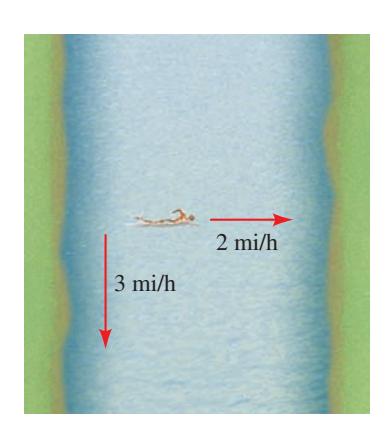
A river flows due south at 3 mi/h. A swimmer attempting to cross the river heads due east swimming at 2 mi/h relative to the water. Find the true velocity of the swimmer as a vector.
question image
56 Applications - Velocity · Level 3
Suppose that in Exercise 55 the current is flowing at 1.2 mi/h due south. In what direction should the swimmer head in order to arrive at a landing point due east of his starting point?
57 Applications - Velocity · Level 3
The speed of an airplane is 300 mi/h relative to the air. The wind is blowing due north with a speed of 30 mi/h. In what direction should the airplane head in order to arrive at a point due west of its location?
58 Applications - Velocity · Level 2
A migrating salmon heads in the direction N \(45^{\circ}\) E, swimming at 5 mi/h relative to the water. The prevailing ocean currents flow due east at 3 mi/h. Find the true velocity of the fish as a vector.
59 Applications - True Velocity of a Jet · Level 3
A pilot heads his jet due east. The jet has a speed of 425 mi/h relative to the air. The wind is blowing due north with a speed of 40 mi/h.
(a) Express the velocity of the wind as a vector in component form.
(b) Express the velocity of the jet relative to the air as a vector in component form.
(c) Find the true velocity of the jet as a vector.
(d) Find the true speed and direction of the jet.

Enter your answer directly below each part above.

60 Applications - True Velocity of a Jet · Level 3
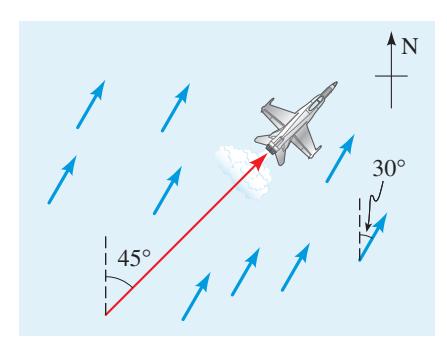
A jet is flying through a wind that is blowing with a speed of 55 mi/h in the direction N \(30^{\circ}\) E. The jet has a speed of 765 mi/h relative to the air, and the pilot heads the jet in the direction N \(45^{\circ}\) E.
question image
(a) Express the velocity of the wind as a vector in component form.
(b) Express the velocity of the jet relative to the air as a vector in component form.
(c) Find the true velocity of the jet as a vector.
(d) Find the true speed and direction of the jet.

Enter your answer directly below each part above.

61 Applications - True Velocity of a Jet · Level 3
Find the true speed and direction of the jet in Exercise 60 if the pilot heads the plane in the direction N \(30^{\circ}\) W.
62 Applications - True Velocity of a Jet · Level 3
In what direction should the pilot in Exercise 60 head the plane for the true course to be due north?
63 Applications - Velocity of a Boat · Level 3
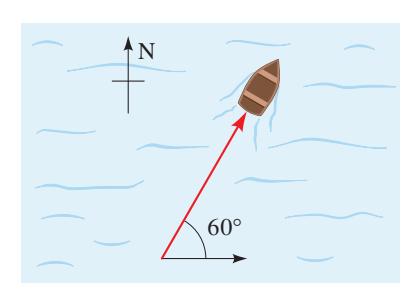
A straight river flows east at a speed of 10 mi/h. A boater starts at the south shore of the river and heads in a direction \(60^{\circ}\) from the shore. The motorboat has a speed of 20 mi/h relative to the water.
question image
(a) Express the velocity of the river as a vector in component form.
(b) Express the velocity of the motorboat relative to the water as a vector in component form.
(c) Find the true velocity of the motorboat.
(d) Find the true speed and direction of the motorboat.

Enter your answer directly below each part above.

64 Applications - Velocity of a Boat · Level 3
The boater in Exercise 63 wants to arrive at a point on the north shore of the river directly opposite the starting point. In what direction should the boat be headed?
65 Velocity Application · Level 3
Velocity: A woman walks due west on the deck of an ocean liner at \(2\) mi/h. The ocean liner is moving due north at a speed of \(25\) mi/h. Find the speed and direction of the woman relative to the surface of the water.
66 Equilibrium of Forces · Level 2
Equilibrium of Forces: The forces \(\mathbf{F}_1, \mathbf{F}_2, ..., \mathbf{F}_n\) acting at the same point \(P\) are said to be in equilibrium if the resultant force is zero, that is, if \(\mathbf{F}_1 + \mathbf{F}_2 + ... + \mathbf{F}_n = \mathbf{0}\). Find (a) the resultant force acting at \(P\), and (b) the additional force required (if any) for the forces to be in equilibrium. \(\mathbf{F}_1 = \langle 2, 5 \rangle\), \(\mathbf{F}_2 = \langle 3, -8 \rangle\)
67 Equilibrium of Forces · Level 2
Equilibrium of Forces: The forces \(\mathbf{F}_1, \mathbf{F}_2, ..., \mathbf{F}_n\) acting at the same point \(P\) are said to be in equilibrium if the resultant force is zero, that is, if \(\mathbf{F}_1 + \mathbf{F}_2 + ... + \mathbf{F}_n = \mathbf{0}\). Find (a) the resultant force acting at \(P\), and (b) the additional force required (if any) for the forces to be in equilibrium. \(\mathbf{F}_1 = \langle 3, -7 \rangle\), \(\mathbf{F}_2 = \langle 4, -2 \rangle\), \(\mathbf{F}_3 = \langle -7, 9 \rangle\)
68 Equilibrium of Forces · Level 2
Equilibrium of Forces: The forces \(\mathbf{F}_1, \mathbf{F}_2, ..., \mathbf{F}_n\) acting at the same point \(P\) are said to be in equilibrium if the resultant force is zero, that is, if \(\mathbf{F}_1 + \mathbf{F}_2 + ... + \mathbf{F}_n = \mathbf{0}\). Find (a) the resultant force acting at \(P\), and (b) the additional force required (if any) for the forces to be in equilibrium. \(\mathbf{F}_1 = 4 \mathbf{i} - \mathbf{j}\), \(\mathbf{F}_2 = 3 \mathbf{i} - 7 \mathbf{j}\), \(\mathbf{F}_3 = -8 \mathbf{i} + 3 \mathbf{j}\), \(\mathbf{F}_4 = \mathbf{i} + \mathbf{j}\)
69 Equilibrium of Forces · Level 2
Equilibrium of Forces: The forces \(\mathbf{F}_1, \mathbf{F}_2, ..., \mathbf{F}_n\) acting at the same point \(P\) are said to be in equilibrium if the resultant force is zero, that is, if \(\mathbf{F}_1 + \mathbf{F}_2 + ... + \mathbf{F}_n = \mathbf{0}\). Find (a) the resultant force acting at \(P\), and (b) the additional force required (if any) for the forces to be in equilibrium. \(\mathbf{F}_1 = \mathbf{i} - \mathbf{j}\), \(\mathbf{F}_2 = \mathbf{i} + \mathbf{j}\), \(\mathbf{F}_3 = -2 \mathbf{i} + \mathbf{j}\)
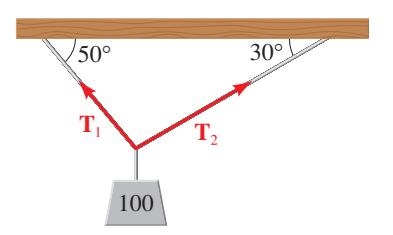
70 Equilibrium of Tensions · Level 3
Equilibrium of Tensions: A \(100\)-lb weight hangs from a string as shown in the figure. Find the tensions \(\mathbf{T}_1\) and \(\mathbf{T}_2\) in the string.
question image
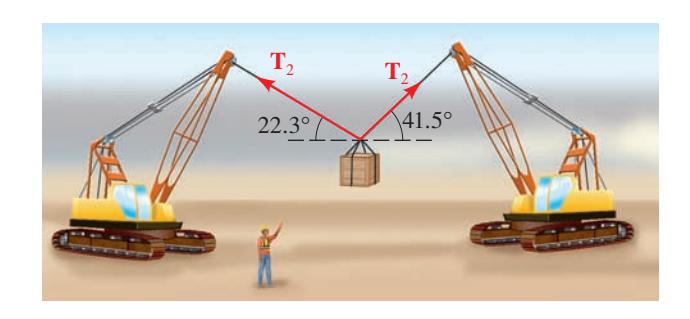
71 Equilibrium of Tensions · Level 3
Equilibrium of Tensions: The cranes in the figure are lifting an object that weighs \$18,278\( lb. Find the tensions \)bold(T)_1\( and \)bold(T)_2$.
question image
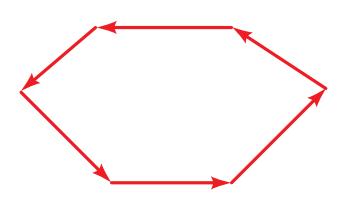
72 Discovery, Discussion, Writing · Level 2
Vectors That Form a Polygon: Suppose that \(n\) vectors can be placed head to tail in the plane so that they form a polygon. (The figure shows the case of a hexagon.) Explain why the sum of these vectors is \(\mathbf{0}\).
question image
73 Example - Describing Vectors in Component Form · Level 2
question image
(a) Find the component form of the vector \(\mathbf{u}\) with initial point \((-2, 5)\) and terminal point \((3, 7)\).
(b) If the vector \(\mathbf{v} = ⟨3, 7⟩\) is sketched with initial point \((2, 4)\), what is its terminal point?
(c) Sketch representations of the vector \(\mathbf{w} = ⟨2, 3⟩\) with initial points at \((0, 0)\), \((2, 2)\), \((-2, -1)\), and \((1, 4)\).

Enter your answer directly below each part above.

74 Example - Magnitudes of Vectors · Level 2
Find the magnitude of each vector.
(a) \(\mathbf{u} = ⟨2, -3⟩\)
(b) \(\mathbf{v} = ⟨5, 0⟩\)
(c) \(\mathbf{w} = ⟨\dfrac{3}{5}, \dfrac{4}{5}⟩\)

Enter your answer directly below each part above.

75 Example - Operations with Vectors · Level 2
If \(\mathbf{u} = ⟨2, -3⟩\) and \(\mathbf{v} = ⟨-1, 2⟩\), find \(\mathbf{u} + \mathbf{v}\), \(\mathbf{u} - \mathbf{v}\), \(2 \mathbf{u}\), \(-3 \mathbf{v}\), and \(2 \mathbf{u} + 3 \mathbf{v}\).
76 Example - Vectors in Terms of i and j · Level 2
(a) Write the vector \(\mathbf{u} = ⟨5, -8⟩\) in terms of \(\mathbf{i}\) and \(\mathbf{j}\).
(b) If \(\mathbf{u} = 3 \mathbf{i} + 2 \mathbf{j}\) and \(\mathbf{v} = - \mathbf{i} + 6 \mathbf{j}\), write \(2 \mathbf{u} + 5 \mathbf{v}\) in terms of \(\mathbf{i}\) and \(\mathbf{j}\).

Enter your answer directly below each part above.

77 Example - Components and Direction of a Vector · Level 2
question image
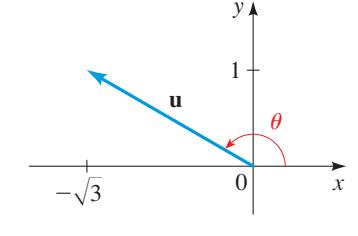
(a) A vector \(\mathbf{v}\) has length 8 and direction \(\dfrac{\pi}{3}\). Find the horizontal and vertical components, and write \(\mathbf{v}\) in terms of \(\mathbf{i}\) and \(\mathbf{j}\).
(b) Find the direction of the vector \(\mathbf{u} = -\sqrt{3} \mathbf{i} + \mathbf{j}\).

Enter your answer directly below each part above.

78 Example - True Speed and Direction of an Airplane · Level 3
An airplane heads due north at 300 mi/h. It experiences a 40 mi/h crosswind flowing in the direction N \(30^{\circ}\) E.
question image
(a) Express the velocity \(\mathbf{v}\) of the airplane relative to the air, and the velocity \(\mathbf{u}\) of the wind, in component form.
(b) Find the true velocity of the airplane as a vector.
(c) Find the true speed and direction of the airplane.

Enter your answer directly below each part above.

79 Example - Calculating a Heading · Level 3
A woman launches a boat from one shore of a straight river and wants to land at the point directly on the opposite shore. If the speed of the boat (relative to the water) is 10 mi/h and the river is flowing east at the rate of 5 mi/h, in what direction should she head the boat in order to arrive at the desired landing point?
80 Example - Resultant Force · Level 3
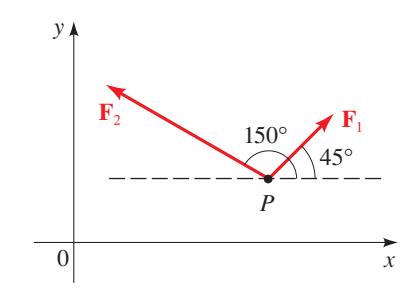
Two forces \(\mathbf{F}_1\) and \(\mathbf{F}_2\) with magnitudes 10 and 20 lb, respectively, act on an object at a point \(P\) as shown in Figure 19. Find the resultant force acting at \(P\).
question image

Answered: 0 / 80