Stewart Section 10.1: Curves Defined by Parametric Equations

52 questions

--:--
0 / 52
Stewart Section 10.1: Curves Defined by Parametric Equations 0/52
1 Parametric Equations - Curve Sketching · Level 2
Sketch the curve by using the parametric equations to plot points. Indicate with an arrow the direction in which the curve is traced as \(t\) increases. \(x = 1 - t^2\), \(y = 2t - t^2\), \(-1 \leq t \leq 2\)
2 Parametric Equations - Curve Sketching · Level 2
Sketch the curve by using the parametric equations to plot points. Indicate with an arrow the direction in which the curve is traced as \(t\) increases. \(x = t^3 + t\), \(y = t^2 + 2\), \(-2 \leq t \leq 2\)
3 Parametric Equations - Curve Sketching · Level 2
Sketch the curve by using the parametric equations to plot points. Indicate with an arrow the direction in which the curve is traced as \(t\) increases. \(x = t + \sin t\), \(y = \cos t\), \(-\pi \leq t \leq \pi\)
4 Parametric Equations - Curve Sketching · Level 2
Sketch the curve by using the parametric equations to plot points. Indicate with an arrow the direction in which the curve is traced as \(t\) increases. \(x = e^{-t} + t\), \(y = e^t - t\), \(-2 \leq t \leq 2\)
5 Parametric Equations - Eliminate Parameter · Level 2
(a) Sketch the curve by using the parametric equations to plot points. Indicate with an arrow the direction in which the curve is traced as \(t\) increases.
(b) Eliminate the parameter to find a Cartesian equation of the curve. \(x = 2t - 1\), \(y = \dfrac{1}{2} t + 1\)

Enter your answer directly below each part above.

6 Parametric Equations - Eliminate Parameter · Level 2
(a) Sketch the curve by using the parametric equations to plot points. Indicate with an arrow the direction in which the curve is traced as \(t\) increases.
(b) Eliminate the parameter to find a Cartesian equation of the curve. \(x = 3t + 2\), \(y = 2t + 3\)

Enter your answer directly below each part above.

7 Parametric Equations - Eliminate Parameter · Level 2
(a) Sketch the curve by using the parametric equations to plot points. Indicate with an arrow the direction in which the curve is traced as \(t\) increases.
(b) Eliminate the parameter to find a Cartesian equation of the curve. \(x = t^2 - 3\), \(y = t + 2\), \(-3 \leq t \leq 3\)

Enter your answer directly below each part above.

8 Parametric Equations - Eliminate Parameter · Level 2
(a) Sketch the curve by using the parametric equations to plot points. Indicate with an arrow the direction in which the curve is traced as \(t\) increases.
(b) Eliminate the parameter to find a Cartesian equation of the curve. \(x = \sin t\), \(y = 1 - \cos t\), \(0 \leq t \leq 2 \pi\)

Enter your answer directly below each part above.

9 Parametric Equations - Eliminate Parameter · Level 2
(a) Sketch the curve by using the parametric equations to plot points. Indicate with an arrow the direction in which the curve is traced as \(t\) increases.
(b) Eliminate the parameter to find a Cartesian equation of the curve. \(x = \sqrt{t}\), \(y = 1 - t\)

Enter your answer directly below each part above.

10 Parametric Equations - Eliminate Parameter · Level 2
(a) Sketch the curve by using the parametric equations to plot points. Indicate with an arrow the direction in which the curve is traced as \(t\) increases.
(b) Eliminate the parameter to find a Cartesian equation of the curve. \(x = t^2\), \(y = t^3\)

Enter your answer directly below each part above.

11 Parametric Equations - Eliminate Parameter · Level 3
(a) Eliminate the parameter to find a Cartesian equation of the curve.
(b) Sketch the curve and indicate with an arrow the direction in which the curve is traced as the parameter increases. \(x = \sin \dfrac{1}{2} \theta\), \(y = \cos \dfrac{1}{2} \theta\), \(-\pi \leq \theta \leq \pi\)

Enter your answer directly below each part above.

12 Parametric Equations - Eliminate Parameter · Level 3
(a) Eliminate the parameter to find a Cartesian equation of the curve.
(b) Sketch the curve and indicate with an arrow the direction in which the curve is traced as the parameter increases. \(x = \dfrac{1}{2} \cos \theta\), \(y = 2 \sin \theta\), \(0 \leq \theta \leq \pi\)

Enter your answer directly below each part above.

13 Parametric Equations - Eliminate Parameter · Level 3
(a) Eliminate the parameter to find a Cartesian equation of the curve.
(b) Sketch the curve and indicate with an arrow the direction in which the curve is traced as the parameter increases. \(x = \sin t\), \(y = \csc t\), \(0 < t < \dfrac{\pi}{2}\)

Enter your answer directly below each part above.

14 Parametric Equations - Eliminate Parameter · Level 3
(a) Eliminate the parameter to find a Cartesian equation of the curve.
(b) Sketch the curve and indicate with an arrow the direction in which the curve is traced as the parameter increases. \(x = e^t\), \(y = e^{-2t}\)

Enter your answer directly below each part above.

15 Parametric Equations - Eliminate Parameter · Level 3
(a) Eliminate the parameter to find a Cartesian equation of the curve.
(b) Sketch the curve and indicate with an arrow the direction in which the curve is traced as the parameter increases. \(x = t^2\), \(y = \ln t\)

Enter your answer directly below each part above.

16 Parametric Equations - Eliminate Parameter · Level 3
(a) Eliminate the parameter to find a Cartesian equation of the curve.
(b) Sketch the curve and indicate with an arrow the direction in which the curve is traced as the parameter increases. \(x = \sqrt{t + 1}\), \(y = \sqrt{t - 1}\)

Enter your answer directly below each part above.

17 Parametric Equations - Eliminate Parameter · Level 3
(a) Eliminate the parameter to find a Cartesian equation of the curve.
(b) Sketch the curve and indicate with an arrow the direction in which the curve is traced as the parameter increases. \(x = \sinh t\), \(y = \cosh t\)

Enter your answer directly below each part above.

18 Parametric Equations - Eliminate Parameter · Level 3
(a) Eliminate the parameter to find a Cartesian equation of the curve.
(b) Sketch the curve and indicate with an arrow the direction in which the curve is traced as the parameter increases. \(x = \tan^2 \theta\), \(y = \sec \theta\), \(-\dfrac{\pi}{2} < \theta < \dfrac{\pi}{2}\)

Enter your answer directly below each part above.

19 Parametric Equations - Particle Motion · Level 3
Describe the motion of a particle with position \((x, y)\) as \(t\) varies in the given interval. \(x = 5 + 2 \cos \pi t\), \(y = 3 + 2 \sin \pi t\), \(1 \leq t \leq 2\)
20 Parametric Equations - Particle Motion · Level 3
Describe the motion of a particle with position \((x, y)\) as \(t\) varies in the given interval. \(x = 2 + \sin t\), \(y = 1 + 3 \cos t\), \(\dfrac{\pi}{2} \leq t \leq 2 \pi\)
21 Parametric Equations - Particle Motion · Level 3
Describe the motion of a particle with position \((x, y)\) as \(t\) varies in the given interval. \(x = 5 \sin t\), \(y = 2 \cos t\), \(-\pi \leq t \leq 5 \pi\)
22 Parametric Equations - Particle Motion · Level 3
Describe the motion of a particle with position \((x, y)\) as \(t\) varies in the given interval. \(x = \sin t\), \(y = \cos^2 t\), \(-2 \pi \leq t \leq 2 \pi\)
23 Parametric Equations - Conceptual · Level 3
Suppose a curve is given by the parametric equations \(x = f(t)\), \(y = g(t)\), where the range of \(f\) is \([1, 4]\) and the range of \(g\) is \([2, 3]\). What can you say about the curve?
24 Parametric Equations - Graph Matching · Level 3
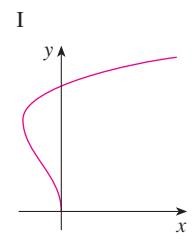
Match the graphs of the parametric equations \(x = f(t)\) and \(y = g(t)\) in (a)-(d) with the parametric curves labeled I-IV. Give reasons for your choices.
question image
25 Parametric Equations - Graph Sketching · Level 3
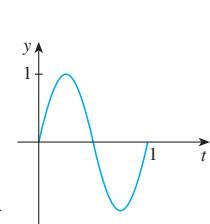
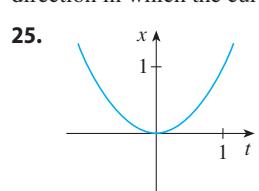
Use the graphs of \(x = f(t)\) and \(y = g(t)\) to sketch the parametric curve \(x = f(t)\), \(y = g(t)\). Indicate with arrows the direction in which the curve is traced as \(t\) increases.
question image
26 Parametric Equations - Graph Sketching · Level 3
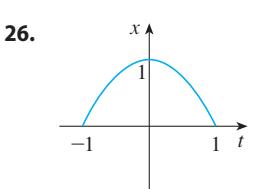
Use the graphs of \(x = f(t)\) and \(y = g(t)\) to sketch the parametric curve \(x = f(t)\), \(y = g(t)\). Indicate with arrows the direction in which the curve is traced as \(t\) increases.
question image
27 Parametric Equations - Graph Sketching · Level 3
Use the graphs of \(x = f(t)\) and \(y = g(t)\) to sketch the parametric curve \(x = f(t)\), \(y = g(t)\). Indicate with arrows the direction in which the curve is traced as \(t\) increases.
question image
28 Parametric Equations - Graph Matching · Level 3
Match the parametric equations with the graphs labeled I-VI. Give reasons for your choices. (Do not use a graphing device.)
question image
(a) \(x = t^4 - t + 1\), \(y = t^2\)
(b) \(x = t^2 - 2t\), \(y = \sqrt{t}\)
(c) \(x = \sin 2t\), \(y = \sin(t + \sin 2t)\)
(d) \(x = \cos 5t\), \(y = \sin 2t\)
(e) \(x = t + \sin 4t\), \(y = t^2 + \cos 3t\)
(f) \(x = \dfrac{\sin 2t}{4 + t^2}\), \(y = \dfrac{\cos 2t}{4 + t^2}\)

Enter your answer directly below each part above.

29 Parametric Equations - Graphing · Level 2
Graph the curve \(x = y - 2 \sin \pi y\).
30 Parametric Equations - Graphing · Level 3
Graph the curves \(y = x^3 - 4x\) and \(x = y^3 - 4y\) and find their points of intersection correct to one decimal place.
31 Parametric Equations - Line Segments · Level 3
(a) Show that the parametric equations \(x = x_1 + (x_2 - x_1) t\), \(y = y_1 + (y_2 - y_1) t\) where \(0 \leq t \leq 1\), describe the line segment that joins the points \(P_1 (x_1, y_1)\) and \(P_2 (x_2, y_2)\).
(b) Find parametric equations to represent the line segment from \((-2, 7)\) to \((3, -1)\).

Enter your answer directly below each part above.

32 Parametric Equations - Line Segments · Level 2
Use a graphing device and the result of Exercise 31(a) to draw the triangle with vertices \(A(1, 1)\), \(B(4, 2)\), and \(C(1, 5)\).
33 Parametric Equations - Circles · Level 3
Find parametric equations for the path of a particle that moves along the circle \(x^2 + (y - 1)^2 = 4\) in the manner described.
(a) Once around clockwise, starting at \((2, 1)\)
(b) Three times around counterclockwise, starting at \((2, 1)\)
(c) Halfway around counterclockwise, starting at \((0, 3)\)

Enter your answer directly below each part above.

34 Parametric Equations - Ellipses · Level 3
(a) Find parametric equations for the ellipse \(x^2 / a^2 + y^2 / b^2 = 1\). [Hint: Modify the equations of the circle in Example 2.]
(b) Use these parametric equations to graph the ellipse when \(a = 3\) and \(b = 1, 2, 4\), and \(8\).
(c) How does the shape of the ellipse change as \(b\) varies?

Enter your answer directly below each part above.

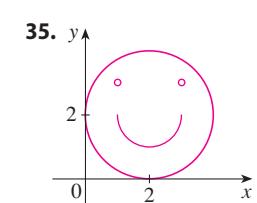
35 Parametric Equations - Graphing · Level 3
Use the parametric equations given in the figure to graph the curve. Indicate the direction.
question image
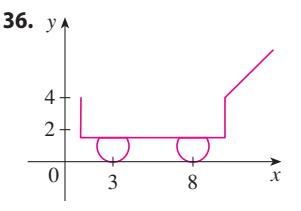
36 Parametric Equations - Graphing · Level 3
Use the parametric equations given in the figure to graph the curve. Indicate the direction.
question image
37 Parametric Equations - Comparison · Level 3
Compare the curves represented by the parametric equations. How do they differ?
(a) \(x = t^3\), \(y = t^2\)
(b) \(x = t^6\), \(y = t^4\)
(c) \(x = e^{-3t}\), \(y = e^{-2t}\)

Enter your answer directly below each part above.

38 Parametric Equations - Comparison · Level 3
Compare the curves represented by the parametric equations. How do they differ?
(a) \(x = t\), \(y = t^{-2}\)
(b) \(x = \cos t\), \(y = \sec^2 t\)
(c) \(x = e^t\), \(y = e^{-2t}\)

Enter your answer directly below each part above.

39 Parametric Equations - Cycloid · Level 4
Derive Equations 1 for the case \(\dfrac{\pi}{2} < \theta < \pi\).
40 Parametric Equations - Trochoid · Level 4
Let \(P\) be a point at a distance \(d\) from the center of a circle of radius \(r\). The curve traced out by \(P\) as the circle rolls along a straight line is called a trochoid. Using the same parameter \(\theta\) as for the cycloid, and assuming the line is the \(x\)-axis and \(\theta = 0\) when \(P\) is at one of its lowest points, show that parametric equations of the trochoid are \(x = r \theta - d \sin \theta\), \(y = r - d \cos \theta\) Sketch the trochoid for the cases \(d < r\) and \(d > r\).
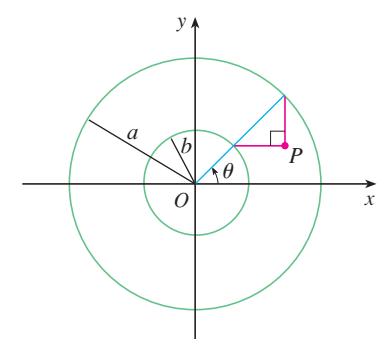
41 Parametric Equations - Derivation · Level 4
If \(a\) and \(b\) are fixed numbers, find parametric equations for the curve that consists of all possible positions of the point \(P\) in the figure, using the angle \(\theta\) as the parameter. Then eliminate the parameter and identify the curve.
question image
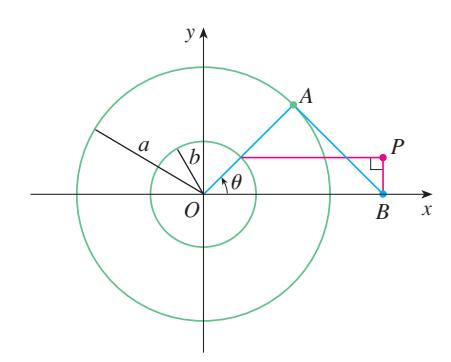
42 Parametric Equations - Derivation · Level 4
If \(a\) and \(b\) are fixed numbers, find parametric equations for the curve that consists of all possible positions of the point \(P\) in the figure, using the angle \(\theta\) as the parameter. The line segment \(A B\) is tangent to the larger circle.
question image
43 Parametric Equations - Witch of Agnesi · Level 4
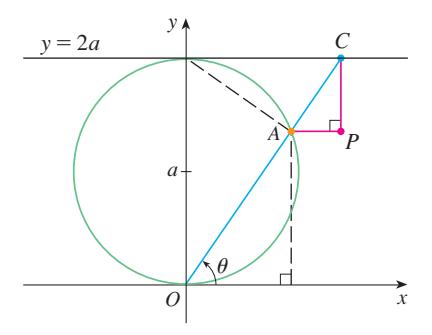
A curve, called a witch of Maria Agnesi, consists of all possible positions of the point \(P\) in the figure. Show that parametric equations for this curve can be written as \(x = 2a \cot \theta\), \(y = 2a \sin^2 \theta\) Sketch the curve.
question image
44 Parametric Equations - Cissoid · Level 4
question image
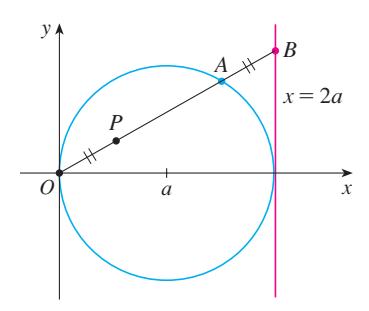
(a) Find parametric equations for the set of all points \(P\) as shown in the figure such that \(|O P| = |A B|\). (This curve is called the cissoid of Diocles.)
(b) Use the geometric description of the curve to draw a rough sketch of the curve by hand. Check your work by using the parametric equations to graph the curve.

Enter your answer directly below each part above.

45 Parametric Equations - Collision · Level 4
Suppose that the position of one particle at time \(t\) is given by \(x_1 = 3 \sin t\), \(y_1 = 2 \cos t\), \(0 \leq t \leq 2 \pi\) and the position of a second particle is given by \(x_2 = -3 + \cos t\), \(y_2 = 1 + \sin t\), \(0 \leq t \leq 2 \pi\)
(a) Graph the paths of both particles. How many points of intersection are there?
(b) Are any of these points of intersection collision points? In other words, are the particles ever at the same place at the same time? If so, find the collision points.
(c) Describe what happens if the path of the second particle is given by \(x_2 = 3 + \cos t\), \(y_2 = 1 + \sin t\), \(0 \leq t \leq 2 \pi\)

Enter your answer directly below each part above.

46 Parametric Equations - Projectile · Level 3
If a projectile is fired with an initial velocity of \(v_0\) meters per second at an angle \(\alpha\) above the horizontal and air resistance is assumed to be negligible, then its position after \(t\) seconds is given by the parametric equations \(x = (v_0 \cos \alpha) t\), \(y = (v_0 \sin \alpha) t - \dfrac{1}{2} g t^2\) where \(g\) is the acceleration due to gravity (\(9.8\) m/s\({}^2\)).
(a) If a gun is fired with \(\alpha = 30^{\circ}\) and \(v_0 = 500\) m/s, when will the bullet hit the ground? How far from the gun will it hit the ground? What is the maximum height reached by the bullet?
(b) Use a graphing device to check your answers to part (a). Then graph the path of the projectile for several other values of the angle \(\alpha\) to see where it hits the ground. Summarize your findings.
(c) Show that the path is parabolic by eliminating the parameter.

Enter your answer directly below each part above.

47 Parametric Equations - Families · Level 3
Investigate the family of curves defined by the parametric equations \(x = t^2\), \(y = t^3 - c t\). How does the shape change as \(c\) increases? Illustrate by graphing several members of the family.
48 Parametric Equations - Families · Level 3
The swallowtail catastrophe curves are defined by the parametric equations \(x = 2c t - 4t^3\), \(y = -c t^2 + 3t^4\). Graph several of these curves. What features do the curves have in common? How do they change when \(c\) increases?
49 Parametric Equations - Families · Level 3
Graph several members of the family of curves with parametric equations \(x = t + a \cos t\), \(y = t + a \sin t\), where \(a > 0\). How does the shape change as \(a\) increases? For what values of \(a\) does the curve have a loop?
50 Parametric Equations - Families · Level 3
Graph several members of the family of curves \(x = \sin t + \sin n t\), \(y = \cos t + \cos n t\), where \(n\) is a positive integer. What features do the curves have in common? What happens as \(n\) increases?
51 Parametric Equations - Lissajous · Level 3
The curves with equations \(x = a \sin n t\), \(y = b \cos t\) are called Lissajous figures. Investigate how these curves vary when \(a\), \(b\), and \(n\) vary. (Take \(n\) to be a positive integer.)
52 Parametric Equations - Families · Level 3
Investigate the family of curves defined by the parametric equations \(x = \cos t\), \(y = \sin t - \sin c t\), where \(c > 0\). Start by letting \(c\) be a positive integer and see what happens to the shape as \(c\) increases. Then explore some of the possibilities that occur when \(c\) is a fraction.

Answered: 0 / 52