Stewart Section 11.2: Series

88 questions

--:--
0 / 88
Stewart Section 11.2: Series 0/88
1 Series - Concepts · Level 1
(a) What is the difference between a sequence and a series?
(b) What is a convergent series? What is a divergent series?

Enter your answer directly below each part above.

2 Series - Concepts · Level 1
Explain what it means to say that \(\displaystyle\sum_{n=1}^{\infty} a_n = 5\).
3 Series - Partial Sums · Level 2
Calculate the sum of the series \(\displaystyle\sum_{n=1}^{\infty} a_n\) whose partial sums are given. \(s_n = 2 - 3(0.8)^n\)
4 Series - Partial Sums · Level 2
Calculate the sum of the series \(\displaystyle\sum_{n=1}^{\infty} a_n\) whose partial sums are given. \(s_n = \dfrac{n^2 - 1}{4n^2 + 1}\)
5 Series - Partial Sums · Level 3
Calculate the first eight terms of the sequence of partial sums correct to four decimal places. Does it appear that the series is convergent or divergent? \(\displaystyle\sum_{n=1}^{\infty} \dfrac{1}{n^4 + n^2}\)
6 Series - Partial Sums · Level 3
Calculate the first eight terms of the sequence of partial sums correct to four decimal places. Does it appear that the series is convergent or divergent? \(\displaystyle\sum_{n=1}^{\infty} \dfrac{1}{\sqrt[3]{n}}\)
7 Series - Partial Sums · Level 3
Calculate the first eight terms of the sequence of partial sums correct to four decimal places. Does it appear that the series is convergent or divergent? \(\displaystyle\sum_{n=1}^{\infty} \sin n\)
8 Series - Partial Sums · Level 3
Calculate the first eight terms of the sequence of partial sums correct to four decimal places. Does it appear that the series is convergent or divergent? \(\displaystyle\sum_{n=1}^{\infty} \dfrac{(-1)^{n-1}}{n!}\)
9 Series - Graphing · Level 3
Find at least 10 partial sums of the series. Graph both the sequence of terms and the sequence of partial sums on the same screen. Does it appear that the series is convergent or divergent? If it is convergent, find the sum. If it is divergent, explain why. \(\displaystyle\sum_{n=1}^{\infty} \dfrac{12}{(-5)^n}\)
10 Series - Graphing · Level 3
Find at least 10 partial sums of the series. Graph both the sequence of terms and the sequence of partial sums on the same screen. Does it appear that the series is convergent or divergent? If it is convergent, find the sum. If it is divergent, explain why. \(\displaystyle\sum_{n=1}^{\infty} \cos n\)
11 Series - Graphing · Level 3
Find at least 10 partial sums of the series. Graph both the sequence of terms and the sequence of partial sums on the same screen. Does it appear that the series is convergent or divergent? If it is convergent, find the sum. If it is divergent, explain why. \(\displaystyle\sum_{n=1}^{\infty} \dfrac{n}{\sqrt{n^2 + 4}}\)
12 Series - Graphing · Level 3
Find at least 10 partial sums of the series. Graph both the sequence of terms and the sequence of partial sums on the same screen. Does it appear that the series is convergent or divergent? If it is convergent, find the sum. If it is divergent, explain why. \(\displaystyle\sum_{n=1}^{\infty} \dfrac{7^{n+1}}{10^n}\)
13 Series - Graphing · Level 3
Find at least 10 partial sums of the series. Graph both the sequence of terms and the sequence of partial sums on the same screen. Does it appear that the series is convergent or divergent? If it is convergent, find the sum. If it is divergent, explain why. \(\displaystyle\sum_{n=1}^{\infty} \dfrac{1}{n^2 + 1}\)
14 Series - Graphing · Level 3
Find at least 10 partial sums of the series. Graph both the sequence of terms and the sequence of partial sums on the same screen. Does it appear that the series is convergent or divergent? If it is convergent, find the sum. If it is divergent, explain why. \(\displaystyle\sum_{n=1}^{\infty} \left(\sin \dfrac{1}{n} - \sin \dfrac{1}{n+1}\right)\)
15 Series - Divergence Test · Level 2
Let \(a_n = \dfrac{2n}{3n + 1}\).
(a) Determine whether \({a_n}\) is convergent.
(b) Determine whether \(\displaystyle\sum_{n=1}^{\infty} a_n\) is convergent.

Enter your answer directly below each part above.

16 Series - Concepts · Level 2
(a) Explain the difference between \(\displaystyle\sum_{i=1}^{n} a_i\) and \(\displaystyle\sum_{j=1}^{n} a_j\).
(b) Explain the difference between \(\displaystyle\sum_{i=1}^{n} a_i\) and \(\displaystyle\sum_{i=1}^{n} a_j\).

Enter your answer directly below each part above.

17 Series - Geometric · Level 2
\( 3 - 4 + \dfrac{16}{3} - \dfrac{64}{9} + \cdots \)
18 Series - Geometric · Level 2
\( 4 + 3 + \dfrac{9}{4} + \dfrac{27}{16} + \cdots \)
19 Series - Geometric · Level 2
\( 10 - 2 + 0.4 - 0.08 + \cdots \)
20 Series - Geometric · Level 2
\( 2 + 0.5 + 0.125 + 0.03125 + \cdots \)
21 Series - Geometric · Level 2
\( \displaystyle\sum_{n=1}^{\infty} 12(0.73)^{n-1} \)
22 Series - Geometric · Level 2
\( \displaystyle\sum_{n=1}^{\infty} \dfrac{5}{\pi^n} \)
23 Series - Geometric · Level 2
\( \displaystyle\sum_{n=1}^{\infty} \dfrac{(-3)^{n-1}}{4^n} \)
24 Series - Geometric · Level 2
\( \displaystyle\sum_{n=0}^{\infty} \dfrac{3^{n+1}}{(-2)^n} \)
25 Series - Geometric · Level 3
\( \displaystyle\sum_{n=1}^{\infty} \dfrac{e^{2n}}{6^{n-1}} \)
26 Series - Geometric · Level 3
\( \displaystyle\sum_{n=1}^{\infty} \dfrac{6 \cdot 2^{2n-1}}{3^n} \)
27 Series - Convergence · Level 2
\( \dfrac{1}{3} + \dfrac{1}{6} + \dfrac{1}{9} + \dfrac{1}{12} + \dfrac{1}{15} + \cdots \)
28 Series - Convergence · Level 3
\( \dfrac{1}{3} + \dfrac{2}{9} + \dfrac{1}{27} + \dfrac{2}{81} + \dfrac{1}{243} + \dfrac{2}{729} + \cdots \)
29 Series - Convergence · Level 2
\( \displaystyle\sum_{n=1}^{\infty} \dfrac{2 + n}{1 - 2n} \)
30 Series - Convergence · Level 2
\( \displaystyle\sum_{k=1}^{\infty} \dfrac{k^2}{k^2 - 2k + 5} \)
31 Series - Convergence · Level 2
\( \displaystyle\sum_{n=1}^{\infty} 3^{n+1} 4^{-n} \)
32 Series - Convergence · Level 3
\( \displaystyle\sum_{n=1}^{\infty} [(-0.2)^n + (0.6)^{n-1}] \)
33 Series - Convergence · Level 2
\( \displaystyle\sum_{n=1}^{\infty} \dfrac{1}{4 + e^{-n}} \)
34 Series - Convergence · Level 3
\( \displaystyle\sum_{n=1}^{\infty} \dfrac{2^n + 4^n}{e^n} \)
35 Series - Convergence · Level 3
\( \displaystyle\sum_{k=1}^{\infty} (\sin 100)^k \)
36 Series - Convergence · Level 2
\( \displaystyle\sum_{n=1}^{\infty} \dfrac{1}{1 + \left(\dfrac{2}{3}\right)^n} \)
37 Series - Convergence · Level 3
\( \displaystyle\sum_{n=1}^{\infty} \ln\left(\dfrac{n^2 + 1}{2n^2 + 1}\right) \)
38 Series - Convergence · Level 2
\( \displaystyle\sum_{k=0}^{\infty} (\sqrt{2})^{-k} \)
39 Series - Convergence · Level 2
\( \displaystyle\sum_{n=1}^{\infty} \arctan n \)
40 Series - Convergence · Level 3
\( \displaystyle\sum_{n=1}^{\infty} \left(\dfrac{3}{5^n} + \dfrac{2}{n}\right) \)
41 Series - Convergence · Level 3
\( \displaystyle\sum_{n=1}^{\infty} (\dfrac{1}{e^n} + \dfrac{1}{n(n+1)}) \)
42 Series - Convergence · Level 2
\( \displaystyle\sum_{n=1}^{\infty} \dfrac{e^n}{n^2} \)
43 Series - Telescoping · Level 3
Determine whether the series is convergent or divergent by expressing \(s_n\) as a telescoping sum (as in Example 8). If it is convergent, find its sum. \(\displaystyle\sum_{n=2}^{\infty} \dfrac{2}{n^2 - 1}\)
44 Series - Telescoping · Level 3
Determine whether the series is convergent or divergent by expressing \(s_n\) as a telescoping sum. If it is convergent, find its sum. \(\displaystyle\sum_{n=1}^{\infty} \ln \dfrac{n}{n+1}\)
45 Series - Telescoping · Level 3
Determine whether the series is convergent or divergent by expressing \(s_n\) as a telescoping sum. If it is convergent, find its sum. \(\displaystyle\sum_{n=1}^{\infty} \dfrac{3}{n(n+3)}\)
46 Series - Telescoping · Level 3
Determine whether the series is convergent or divergent by expressing \(s_n\) as a telescoping sum. If it is convergent, find its sum. \(\displaystyle\sum_{n=4}^{\infty} \left(\dfrac{1}{\sqrt{n}} - \dfrac{1}{\sqrt{n+1}}\right)\)
47 Series - Telescoping · Level 3
Determine whether the series is convergent or divergent by expressing \(s_n\) as a telescoping sum. If it is convergent, find its sum. \(\displaystyle\sum_{n=1}^{\infty} (e^{\dfrac{1}{n}} - e^{1/(n+1)})\)
48 Series - Telescoping · Level 3
Determine whether the series is convergent or divergent by expressing \(s_n\) as a telescoping sum. If it is convergent, find its sum. \(\displaystyle\sum_{n=2}^{\infty} \dfrac{1}{n^3 - n}\)
49 Series - Applications · Level 3
Let \(x = 0.99999 \ldots\)
(a) Do you think that \(x < 1\) or \(x = 1\)?
(b) Sum a geometric series to find the value of \(x\).
(c) How many decimal representations does the number 1 have?
(d) Which numbers have more than one decimal representation?

Enter your answer directly below each part above.

50 Series - Applications · Level 3
A sequence of terms is defined by \(a_1 = 1\), \(a_n = (5 - n) a_{n-1}\) Calculate \(\displaystyle\sum_{n=1}^{\infty} a_n\).
51 Series - Repeating Decimals · Level 2
Express the number as a ratio of integers. \(0.\overline{8} = 0.8888...\)
52 Series - Repeating Decimals · Level 2
Express the number as a ratio of integers. \(0.\overline{46} = 0.46464646...\)
53 Series - Repeating Decimals · Level 2
Express the number as a ratio of integers. \(2.\overline{516} = 2.516516516...\)
54 Series - Repeating Decimals · Level 3
Express the number as a ratio of integers. \(10.1\overline{35} = 10.135353535...\)
55 Series - Convergence Values · Level 3
Find the values of \(x\) for which the series converges. Find the sum of the series for those values of \(x\). \(\displaystyle\sum_{n=1}^{\infty} (-5)^n x^n\)
56 Series - Convergence Values · Level 3
Find the values of \(x\) for which the series converges. Find the sum of the series for those values of \(x\). \(\displaystyle\sum_{n=1}^{\infty} (x + 2)^n\)
57 Series - Convergence Values · Level 3
Find the values of \(x\) for which the series converges. Find the sum of the series for those values of \(x\). \(\displaystyle\sum_{n=0}^{\infty} \dfrac{(x - 2)^n}{3^n}\)
58 Series - Convergence Values · Level 3
Find the values of \(x\) for which the series converges. Find the sum of the series for those values of \(x\). \(\displaystyle\sum_{n=0}^{\infty} (-4)^n (x - 5)^n\)
59 Series - Convergence Values · Level 3
Find the values of \(x\) for which the series converges. Find the sum of the series for those values of \(x\). \(\displaystyle\sum_{n=0}^{\infty} \dfrac{2^n}{x^n}\)
60 Series - Convergence Values · Level 3
Find the values of \(x\) for which the series converges. Find the sum of the series for those values of \(x\). \(\displaystyle\sum_{n=0}^{\infty} \dfrac{\sin^n x}{3^n}\)
61 Series - Convergence Values · Level 3
Find the values of \(x\) for which the series converges. Find the sum of the series for those values of \(x\). \(\displaystyle\sum_{n=0}^{\infty} e^{n x}\)
62 Series - Proof · Level 4
We have seen that the harmonic series is a divergent series whose terms approach 0. Show that \(\displaystyle\sum_{n=1}^{\infty} \ln\left(1 + \dfrac{1}{n}\right)\) is another series with this property.
63 Series - CAS · Level 4
Use a CAS to find a convenient expression for the partial sum, and then use this expression to find the sum of the series. \(\displaystyle\sum_{n=1}^{\infty} \dfrac{3n^2 + 3n + 1}{(n^2 + n)^3}\)
64 Series - CAS · Level 4
Use a CAS to find a convenient expression for the partial sum, and then use this expression to find the sum of the series. \(\displaystyle\sum_{n=3}^{\infty} \dfrac{1}{n^5 - 5n^3 + 4n}\)
65 Series - Partial Sums · Level 3
If the \(n\)th partial sum of a series \(\displaystyle\sum_{n=1}^{\infty} a_n\) is \(s_n = \dfrac{n - 1}{n + 1}\) find \(a_n\) and \(\displaystyle\sum_{n=1}^{\infty} a_n\).
66 Series - Partial Sums · Level 3
If the \(n\)th partial sum of a series \(\displaystyle\sum_{n=1}^{\infty} a_n\) is \(s_n = 3n 2^{-n}\), find \(a_n\) and \(\displaystyle\sum_{n=1}^{\infty} a_n\).
67 Series - Applications · Level 3
A doctor prescribes a 100-mg antibiotic tablet to be taken every eight hours. Just before each tablet is taken, 20% of the drug remains in the body.
(a) How much of the drug is in the body just after the second tablet is taken? After the third tablet?
(b) If \(Q_n\) is the quantity of the antibiotic in the body just after the \(n\)th tablet is taken, find an equation that expresses \(Q_{n+1}\) in terms of \(Q_n\).
(c) What quantity of the antibiotic remains in the body in the long run?

Enter your answer directly below each part above.

68 Series - Applications · Level 3
A patient is injected with a drug every 12 hours. Immediately before each injection the concentration of the drug has been reduced by 90% and the new dose increases the concentration by 1.5 mg/L.
(a) What is the concentration after three doses?
(b) If \(C_n\) is the concentration after the \(n\)th dose, find a formula for \(C_n\) as a function of \(n\).
(c) What is the limiting value of the concentration?

Enter your answer directly below each part above.

69 Series - Applications · Level 3
A patient takes 150 mg of a drug at the same time every day. Just before each tablet is taken, 5% of the drug remains in the body.
(a) What quantity of the drug is in the body after the third tablet? After the \(n\)th tablet?
(b) What quantity of the drug remains in the body in the long run?

Enter your answer directly below each part above.

70 Series - Applications · Level 4
After injection of a dose \(D\) of insulin, the concentration of insulin in a patient's system decays exponentially and so it can be written as \(D e^{-a t}\), where \(t\) represents time in hours and \(a\) is a positive constant.
(a) If a dose \(D\) is injected every \(T\) hours, write an expression for the sum of the residual concentrations just before the \((n + 1)\)st injection.
(b) Determine the limiting pre-injection concentration.
(c) If the concentration of insulin must always remain at or above a critical value \(C\), determine a minimal dosage \(D\) in terms of \(C\), \(a\), and \(T\).

Enter your answer directly below each part above.

71 Series - Applications · Level 3
When money is spent on goods and services, those who receive the money also spend some of it. The people receiving some of the twice-spent money will spend some of that, and so on. Economists call this chain reaction the multiplier effect. In a hypothetical isolated community, the local government begins the process by spending \(D\) dollars. Suppose that each recipient of spent money spends \(100 c\)% and saves \(100 s\)% of the money that he or she receives. The values \(c\) and \(s\) are called the marginal propensity to consume and the marginal propensity to save and, of course, \(c + s = 1\).
(a) Let \(S_n\) be the total spending that has been generated after \(n\) transactions. Find an equation for \(S_n\).
(b) Show that \(\operatorname*{lim}\limits_{n \rightarrow \infty} S_n = k D\), where \(k = \dfrac{1}{s}\). The number \(k\) is called the multiplier. What is the multiplier if the marginal propensity to consume is 80%?

Enter your answer directly below each part above.

72 Series - Applications · Level 4
A certain ball has the property that each time it falls from a height \(h\) onto a hard, level surface, it rebounds to a height \(r h\), where \(0 < r < 1\). Suppose that the ball is dropped from an initial height of \(H\) meters.
(a) Assuming that the ball continues to bounce indefinitely, find the total distance that it travels.
(b) Calculate the total time that the ball travels. (Use the fact that the ball falls \(\dfrac{1}{2} g t^2\) meters in \(t\) seconds.)
(c) Suppose that each time the ball strikes the surface with velocity \(v\) it rebounds with velocity \(-k v\), where \(0 < k < 1\). How long will it take for the ball to come to rest?

Enter your answer directly below each part above.

73 Series - Problem Solving · Level 3
Find the value of \(c\) if \(\displaystyle\sum_{n=2}^{\infty} (1 + c)^{-n} = 2\)
74 Series - Problem Solving · Level 3
Find the value of \(c\) such that \(\displaystyle\sum_{n=0}^{\infty} e^{n c} = 10\)
75 Series - Proof · Level 5
In Example 9 we showed that the harmonic series is divergent. Here we outline another method, making use of the fact that \(e^x > 1 + x\) for any \(x > 0\). If \(s_n\) is the \(n\)th partial sum of the harmonic series, show that \(e^{s_n} > n + 1\). Why does this imply that the harmonic series is divergent?
76 Series - Proof · Level 4
Graph the curves \(y = x^n\), \(0 \leq x \leq 1\), for \(n = 0, 1, 2, 3, 4, \ldots\) on a common screen. By finding the areas between successive curves, give a geometric demonstration of the fact, shown in Example 8, that \(\displaystyle\sum_{n=1}^{\infty} \dfrac{1}{n(n+1)} = 1\)
77 Series - Geometry · Level 5
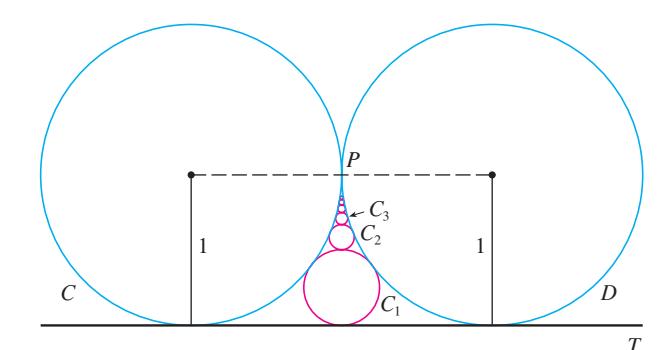
The figure shows two circles \(C\) and \(D\) of radius 1 that touch at \(P\). The line \(T\) is a common tangent line; \(C_1\) is the circle that touches \(C\), \(D\), and \(T\); \(C_2\) is the circle that touches \(C\), \(D\), and \(C_1\); \(C_3\) is the circle that touches \(C\), \(D\), and \(C_2\). This procedure can be continued indefinitely and produces an infinite sequence of circles \({C_n}\). Find an expression for the diameter of \(C_n\) and thus provide another geometric demonstration of Example 8.
question image
78 Series - Geometry · Level 4
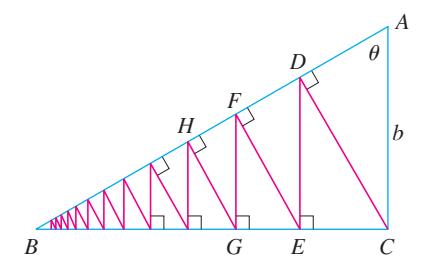
A right triangle \(A B C\) is given with \(\angle A = \theta\) and \(|A C| = b\). \(C D\) is drawn perpendicular to \(A B\), \(D E\) is drawn perpendicular to \(B C\), \(E F \perp A B\), and this process is continued indefinitely, as shown in the figure. Find the total length of all the perpendiculars \(|C D| + |D E| + |E F| + |F G| + \cdots\) in terms of \(b\) and \(\theta\).
question image
79 Series - Proof · Level 3
What is wrong with the following calculation? \(0 = 0 + 0 + 0 + \cdots\) \(= (1 - 1) + (1 - 1) + (1 - 1) + \cdots\) \(= 1 - 1 + 1 - 1 + 1 - 1 + \cdots\) \(= 1 + (-1 + 1) + (-1 + 1) + (-1 + 1) + \cdots\) \(= 1 + 0 + 0 + 0 + \cdots = 1\)
80 Series - Proof · Level 4
Suppose that \(\displaystyle\sum_{n=1}^{\infty} a_n\) \((a_n \neq 0)\) is known to be a convergent series. Prove that \(\displaystyle\sum_{n=1}^{\infty} \dfrac{1}{a_n}\) is a divergent series.
81 Series - Proof · Level 4
Prove part (i) of Theorem 8.
82 Series - Proof · Level 4
If \(\sum a_n\) is divergent and \(c \neq 0\), show that \(\sum c a_n\) is divergent.
83 Series - Proof · Level 4
If \(\sum a_n\) is convergent and \(\sum b_n\) is divergent, show that the series \(\sum (a_n + b_n)\) is divergent. [Hint: Argue by contradiction.]
84 Series - Proof · Level 4
If \(\sum a_n\) and \(\sum b_n\) are both divergent, is \(\sum (a_n + b_n)\) necessarily divergent?
85 Series - Proof · Level 3
Suppose that a series \(\sum a_n\) has positive terms and its partial sums \(s_n\) satisfy the inequality \(s_n \leq 1000\) for all \(n\). Explain why \(\sum a_n\) must be convergent.
86 Series - Fibonacci · Level 4
The Fibonacci sequence was defined in Section 11.1 by the equations \(f_1 = 1\), \(f_2 = 1\), \(f_n = f_{n-1} + f_{n-2}\) for \(n \geq 3\). Show that each of the following statements is true.
(a) \(\dfrac{1}{f_{n-1} f_{n+1}} = \dfrac{1}{f_{n-1} f_n} - \dfrac{1}{f_n f_{n+1}}\)
(b) \(\displaystyle\sum_{n=2}^{\infty} \dfrac{1}{f_{n-1} f_{n+1}} = 1\)
(c) \(\displaystyle\sum_{n=2}^{\infty} \dfrac{f_n}{f_{n-1} f_{n+1}} = 2\)

Enter your answer directly below each part above.

87 Series - Applications · Level 4
The Cantor set, named after the German mathematician Georg Cantor (1845-1918), is constructed as follows. We start with the closed interval \([0, 1]\) and remove the open interval \(\left(\dfrac{1}{3}, \dfrac{2}{3}\right)\). That leaves the two intervals \([0, \dfrac{1}{3}]\) and \([\dfrac{2}{3}, 1]\) and we remove the open middle third of each. Four intervals remain and again we remove the open middle third of each of them. We continue this procedure indefinitely.
question image
(a) Show that the total length of all the intervals that are removed is 1. Despite that, the Cantor set contains infinitely many numbers. Give examples of some numbers in the Cantor set.
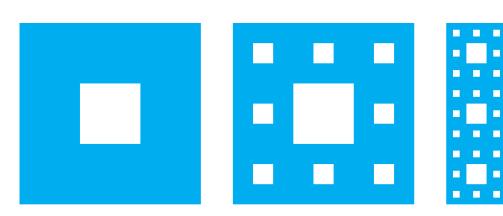
(b) The Sierpinski carpet is a two-dimensional counterpart of the Cantor set. It is constructed by removing the center one-ninth of a square of side 1, then removing the centers of the eight smaller remaining squares, and so on. Show that the sum of the areas of the removed squares is 1.

Enter your answer directly below each part above.

88 Series - Sequences · Level 4
(a) A sequence \({a_n}\) is defined recursively by the equation \(a_n = \dfrac{1}{2}(a_{n-1} + a_{n-2})\) for \(n \geq 3\), where \(a_1\) and \(a_2\) can be any real numbers. Experiment with various values of \(a_1\) and \(a_2\) and use your calculator to guess the limit of the sequence.

Answered: 0 / 88