Stewart 9e Section 1.7: The Precise Definition of a Limit

49 questions

--:--
0 / 49
Stewart 9e Section 1.7: The Precise Definition of a Limit 0/49
1 Find delta from a graph · Level 1
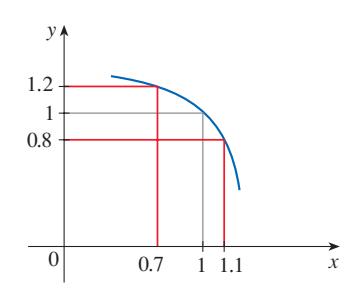
Use the given graph of \(f\) to find a number \(\delta\) such that if \(|x - 1| < \delta\) then \(|f(x) - 1| < 0.2\).
question image
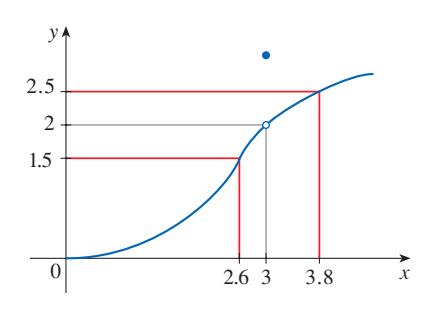
2 Find delta from a graph · Level 1
Use the given graph of \(f\) to find a number \(\delta\) such that if \(0 < |x - 3| < \delta\) then \(|f(x) - 2| < 0.5\).
question image
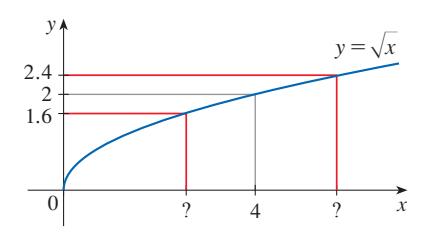
3 Find delta from a graph · Level 2
Use the given graph of \(f(x) = \sqrt{x}\) to find a number \(\delta\) such that if \(|x - 4| < \delta\) then \(|\sqrt{x} - 2| < 0.4\).
question image
4 Find delta from a graph · Level 2
Use the given graph of \(f(x) = x^2\) to find a number \(\delta\) such that if \(|x - 1| < \delta\) then \(|x^2 - 1| < \dfrac{1}{2}\).
question image
5 Find delta from a graph · Level 2
Use a graph to find a number \(\delta\) such that if \(|x - 2| < \delta\) then \(|\sqrt{x^2 + 5} - 3| < 0.3\).
6 Find delta from a graph · Level 2
Use a graph to find a number \(\delta\) such that if \(|x - \dfrac{\pi}{6}| < \delta\) then \(|\cos^2(x) - \dfrac{3}{4}| < 0.1\).
7 Numerical delta calculation · Level 2
For the limit \(\operatorname*{lim}\limits_{x\rightarrow 2} (x^3 - 3 x + 4) = 6\), illustrate Definition 2 by finding values of \(\delta\) that correspond to \(\epsilon = 0.2\) and \(\epsilon = 0.1\).
8 Numerical delta calculation · Level 2
For the limit \(\operatorname*{lim}\limits_{x\rightarrow 2} \dfrac{4 x + 1}{3 x - 4} = 4.5\), illustrate Definition 2 by finding values of \(\delta\) that correspond to \(\epsilon = 0.5\) and \(\epsilon = 0.1\).
9 Infinite limit estimation · Level 2
(a) Use a graph to find a number \(\delta\) such that if \(4 < x < 4 + \delta\) then \(\dfrac{x^2 + 4}{\sqrt{x - 4}} > 100\). (b) What limit does part (a) suggest is true?
10 Infinite limit estimation · Level 2
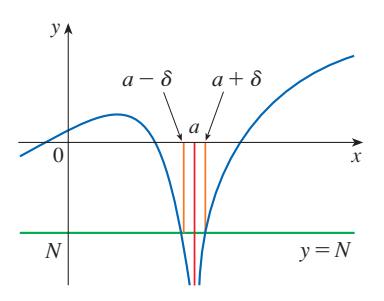
Given that \(\operatorname*{lim}\limits_{x\rightarrow \pi} \csc^2(x) = \infty\), illustrate Definition 6 by finding values of \(\delta\) that correspond to (a) \(M = 500\) and (b) \(M = 1000\).
11 Application - tolerance · Level 2
A machinist is required to manufacture a circular metal disk with area \(1000\) cm\(^2\). (a) What radius produces such a disk? (b) If the machinist is allowed an error tolerance of \(\pm 5\) cm\(^2\) in the area of the disk, how close to the ideal radius in part (a) must the machinist control the radius? (c) In terms of the \(\epsilon, \delta\) definition of \(\operatorname*{lim}\limits_{x\rightarrow a} f(x) = L\), what is \(x\)? What is \(f(x)\)? What is \(a\)? What is \(L\)? What value of \(\epsilon\) is given? What is the corresponding value of \(\delta\)?
12 Application - tolerance · Level 2
Crystal growth furnaces are used in research to determine how best to manufacture crystals used in electronic components. For proper growth of a crystal, the temperature must be controlled accurately by adjusting the input power. Suppose the relationship is given by \(T(w) = 0.1 w^2 + 2.155 w + 20\), where \(T\) is the temperature in degrees Celsius and \(w\) is the power input in watts. (a) How much power is needed to maintain the temperature at \(200^{\circ}\)C? (b) If the temperature is allowed to vary from \(200^{\circ}\)C by up to \(\pm 1^{\circ}\)C, what range of wattage is allowed for the input power? (c) In terms of the \(\epsilon, \delta\) definition of \(\operatorname*{lim}\limits_{x\rightarrow a} f(x) = L\), what is \(x\)? What is \(f(x)\)? What is \(a\)? What is \(L\)? What value of \(\epsilon\) is given? What is the corresponding value of \(\delta\)?
13 Numerical delta calculation · Level 1
(a) Find a number \(\delta\) such that if \(|x - 2| < \delta\), then \(|4 x - 8| < \epsilon\), where \(\epsilon = 0.1\). (b) Repeat part (a) with \(\epsilon = 0.01\).
14 Numerical delta calculation · Level 1
Given that \(\operatorname*{lim}\limits_{x\rightarrow 2} (5 x - 7) = 3\), illustrate Definition 2 by finding values of \(\delta\) that correspond to \(\epsilon = 0.1\), \(\epsilon = 0.05\), and \(\epsilon = 0.01\).
15 Epsilon-delta proof - linear · Level 2
Prove the statement using the \(\epsilon, \delta\) definition of a limit and illustrate with a diagram like Figure 9: \(\operatorname*{lim}\limits_{x\rightarrow 4} (\left(\dfrac{1}{2}\right) x - 1) = 1\).
16 Epsilon-delta proof - linear · Level 2
Prove the statement using the \(\epsilon, \delta\) definition of a limit and illustrate with a diagram like Figure 9: \(\operatorname*{lim}\limits_{x\rightarrow 2} (2 - 3 x) = -4\).
17 Epsilon-delta proof - linear · Level 2
Prove the statement using the \(\epsilon, \delta\) definition of a limit and illustrate with a diagram like Figure 9: \(\operatorname*{lim}\limits_{x\rightarrow -2} (-2 x + 1) = 5\).
18 Epsilon-delta proof - linear · Level 2
Prove the statement using the \(\epsilon, \delta\) definition of a limit and illustrate with a diagram like Figure 9: \(\operatorname*{lim}\limits_{x\rightarrow 1} (2 x - 5) = -3\).
19 Epsilon-delta proof - linear · Level 2
Prove the statement using the \(\epsilon, \delta\) definition of a limit: \(\operatorname*{lim}\limits_{x\rightarrow 9} (1 - \left(\dfrac{1}{3}\right) x) = -2\).
20 Epsilon-delta proof - linear · Level 2
Prove the statement using the \(\epsilon, \delta\) definition of a limit: \(\operatorname*{lim}\limits_{x\rightarrow 5} (\left(\dfrac{3}{2}\right) x - \dfrac{1}{2}) = 7\).
21 Epsilon-delta proof - removable discontinuity · Level 2
Prove the statement using the \(\epsilon, \delta\) definition of a limit: \(\operatorname*{lim}\limits_{x\rightarrow 4} \dfrac{x^2 - 2 x - 8}{x - 4} = 6\).
22 Epsilon-delta proof - removable discontinuity · Level 2
Prove the statement using the \(\epsilon, \delta\) definition of a limit: \(\operatorname*{lim}\limits_{x\rightarrow -1.5} \dfrac{9 - 4 x^2}{3 + 2 x} = 6\).
23 Epsilon-delta proof - basic · Level 1
Prove the statement using the \(\epsilon, \delta\) definition of a limit: \(\operatorname*{lim}\limits_{x\rightarrow a} x = a\).
24 Epsilon-delta proof - basic · Level 1
Prove the statement using the \(\epsilon, \delta\) definition of a limit: \(\operatorname*{lim}\limits_{x\rightarrow a} c = c\).
25 Epsilon-delta proof - basic · Level 1
Prove the statement using the \(\epsilon, \delta\) definition of a limit: \(\operatorname*{lim}\limits_{x\rightarrow 0} x^2 = 0\).
26 Epsilon-delta proof - basic · Level 1
Prove the statement using the \(\epsilon, \delta\) definition of a limit: \(\operatorname*{lim}\limits_{x\rightarrow 0} x^3 = 0\).
27 Epsilon-delta proof - basic · Level 1
Prove the statement using the \(\epsilon, \delta\) definition of a limit: \(\operatorname*{lim}\limits_{x\rightarrow 0} |x| = 0\).
28 Epsilon-delta proof - right-hand limit with root · Level 2
Prove the statement using the \(\epsilon, \delta\) definition of a limit: \(\operatorname*{lim}\limits_{x\rightarrow -6^+} \sqrt[8]{6 + x} = 0\).
29 Epsilon-delta proof - quadratic · Level 2
Prove the statement using the \(\epsilon, \delta\) definition of a limit: \(\operatorname*{lim}\limits_{x\rightarrow 2} (x^2 - 4 x + 5) = 1\).
30 Epsilon-delta proof - quadratic · Level 3
Prove the statement using the \(\epsilon, \delta\) definition of a limit: \(\operatorname*{lim}\limits_{x\rightarrow 2} (x^2 + 2 x - 7) = 1\).
31 Epsilon-delta proof - quadratic · Level 3
Prove the statement using the \(\epsilon, \delta\) definition of a limit: \(\operatorname*{lim}\limits_{x\rightarrow 2} (x^2 - 1) = 3\).
32 Epsilon-delta proof - cubic · Level 3
Prove the statement using the \(\epsilon, \delta\) definition of a limit: \(\operatorname*{lim}\limits_{x\rightarrow 2} x^3 = 8\).
33 Alternative delta verification · Level 2
Verify that another possible choice of \(\delta\) for showing that \(\operatorname*{lim}\limits_{x\rightarrow 3} x^2 = 9\) in Example 3 is \(\delta = \min\left(2, \dfrac{\epsilon}{8}\right)\).
34 Optimal delta - geometric argument · Level 3
Verify, by a geometric argument, that the largest possible choice of \(\delta\) for showing that \(\operatorname*{lim}\limits_{x\rightarrow 3} x^2 = 9\) is \(\delta = \sqrt{9 + \epsilon} - 3\).
35 Cubic limit - graphical and analytic delta · Level 3
(a) For the limit \(\operatorname*{lim}\limits_{x\rightarrow 1} (x^3 + x + 1) = 3\), use a graph to find a value of \(\delta\) that corresponds to \(\epsilon = 0.4\). (b) By solving the cubic equation \(x^3 + x + 1 = 3 + \epsilon\), find the largest possible value of \(\delta\) that works for any given \(\epsilon > 0\). (c) Put \(\epsilon = 0.4\) in your answer to part (b) and compare with your answer to part (a).
36 Epsilon-delta proof - reciprocal · Level 3
Prove that \(\operatorname*{lim}\limits_{x\rightarrow 2} \dfrac{1}{x} = \dfrac{1}{2}\).
37 Epsilon-delta proof - square root · Level 3
Prove that \(\operatorname*{lim}\limits_{x\rightarrow a} \sqrt{x} = \sqrt{a}\) if \(a > 0\). Hint: Use \(|\sqrt{x} - \sqrt{a}| = |x - a|/(\sqrt{x} + \sqrt{a})\).
38 Limit existence - Heaviside · Level 3
If \(H\) is the Heaviside function defined in Section 1.5, prove, using Definition 2, that \(\operatorname*{lim}\limits_{t\rightarrow 0} H(t)\) does not exist. Hint: Use an indirect proof as follows. Suppose that the limit is \(L\). Take \(\epsilon = \dfrac{1}{2}\) in the definition of a limit and try to arrive at a contradiction.
39 Limit existence - Dirichlet-type · Level 3
If the function \(f\) is defined by \(f(x) = \begin{cases} 0 & \quad \text{if } x \text{is rational} \\ 1 & \quad \text{if } x \text{is irrational} \end{cases}\), prove that \(\operatorname*{lim}\limits_{x\rightarrow 0} f(x)\) does not exist.
40 Two-sided versus one-sided limits · Level 3
By comparing Definitions 2, 3, and 4, prove Theorem 1.6.1: \(\operatorname*{lim}\limits_{x\rightarrow a} f(x) = L\) if and only if \(\operatorname*{lim}\limits_{x\rightarrow a^-} f(x) = L = \operatorname*{lim}\limits_{x\rightarrow a^+} f(x)\).
41 Infinite limit estimation · Level 2
How close to \(-3\) do we have to take \(x\) so that \(1/(x + 3)^4 > 10000\)?
42 Infinite limit proof · Level 2
Prove, using Definition 6, that \(\operatorname*{lim}\limits_{x\rightarrow -3} 1/(x + 3)^4 = \infty\).
43 Infinite limit proof - negative · Level 3
Prove that \(\operatorname*{lim}\limits_{x\rightarrow -1^-} 5/(x + 1)^3 = -\infty\).
44 Properties of infinite limits · Level 3
Suppose that \(\operatorname*{lim}\limits_{x\rightarrow a} f(x) = \infty\) and \(\operatorname*{lim}\limits_{x\rightarrow a} g(x) = c\), where \(c\) is a real number. Prove each statement. (a) \(\operatorname*{lim}\limits_{x\rightarrow a} [f(x) + g(x)] = \infty\). (b) \(\operatorname*{lim}\limits_{x\rightarrow a} [f(x) g(x)] = \infty\) if \(c > 0\). (c) \(\operatorname*{lim}\limits_{x\rightarrow a} [f(x) g(x)] = -\infty\) if \(c < 0\).
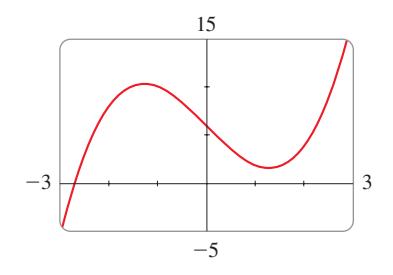
45 Example - Find delta from a graph · Level 2
Since \(f(x) = x^3 - 5 x + 6\) is a polynomial, we know from the Direct Substitution Property that \(\operatorname*{lim}\limits_{x\rightarrow 1} f(x) = f(1) = 1^3 - 5(1) + 6 = 2\). Use a graph to find a number \(\delta\) such that if \(x\) is within \(\delta\) of 1, then \(y\) is within 0.2 of 2, that is, if \(|x - 1| < \delta\) then \(|(x^3 - 5 x + 6) - 2| < 0.2\). In other words, find a number \(\delta\) that corresponds to \(\epsilon = 0.2\) in the definition of a limit for the function \(f(x) = x^3 - 5 x + 6\) with \(a = 1\) and \(L = 2\).
question image
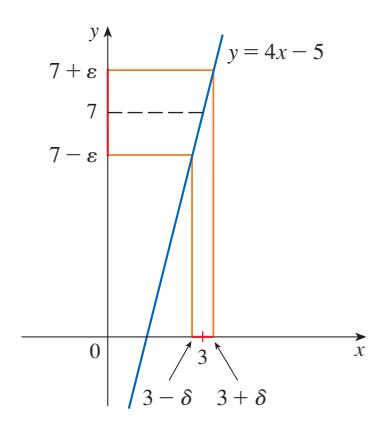
46 Example - Epsilon-delta proof of a linear limit · Level 2
Prove that \(\operatorname*{lim}\limits_{x\rightarrow 3} (4 x - 5) = 7\).
question image
47 Example - Epsilon-delta proof of a quadratic limit · Level 3
Prove that \(\operatorname*{lim}\limits_{x\rightarrow 3} x^2 = 9\).
48 Example - Epsilon-delta proof of a right-hand limit · Level 2
Use Definition 4 to prove that \(\operatorname*{lim}\limits_{x\rightarrow 0^+} \sqrt{x} = 0\).
49 Example - Precise definition of an infinite limit · Level 2
Prove that \(\operatorname*{lim}\limits_{x\rightarrow 0} 1/x^2 = \infty\).
question image

Answered: 0 / 49