Stewart Precalc 6e Chapter 5 Focus on Modeling: Fitting Sinusoidal Curves to Data

11 questions

--:--
0 / 11
Stewart Precalc 6e Chapter 5 Focus on Modeling: Fitting Sinusoidal Curves to Data 0/11
1 Modeling Periodic Data · Level 3
A set of data is given. (a) Make a scatter plot of the data. (b) Find a cosine function of the form \(y = a \cos(\omega (t - c)) + b\) that models the data, as in Example 1. (c) Graph the function you found in part (b) together with the scatter plot. How well does the curve fit the data? (d) Use a graphing calculator to find the sine function that best fits the data, as in Example 2. (e) Compare the functions you found in parts (b) and (d). [Use the reduction formula \(\sin u = \cos\left(u - \dfrac{\pi}{2}\right)\).] Data: \(t\) = 0, 2, 4, 6, 8, 10, 12, 14; \(y\) = 2.1, 1.1, -0.8, -2.1, -1.3, 0.6, 1.9, 1.5.
2 Modeling Periodic Data · Level 3
A set of data is given. (a) Make a scatter plot of the data. (b) Find a cosine function of the form \(y = a \cos(\omega (t - c)) + b\) that models the data, as in Example 1. (c) Graph the function you found in part (b) together with the scatter plot. How well does the curve fit the data? (d) Use a graphing calculator to find the sine function that best fits the data, as in Example 2. (e) Compare the functions you found in parts (b) and (d). [Use the reduction formula \(\sin u = \cos\left(u - \dfrac{\pi}{2}\right)\).] Data: \(t\) = 0, 25, 50, 75, 100, 125, 150, 175, 200, 225, 250, 275, 300, 325, 350; \(y\) = 190, 175, 155, 125, 110, 95, 105, 120, 140, 165, 185, 200, 195, 185, 165.
3 Modeling Periodic Data · Level 3
A set of data is given. (a) Make a scatter plot of the data. (b) Find a cosine function of the form \(y = a \cos(\omega (t - c)) + b\) that models the data, as in Example 1. (c) Graph the function you found in part (b) together with the scatter plot. How well does the curve fit the data? (d) Use a graphing calculator to find the sine function that best fits the data, as in Example 2. (e) Compare the functions you found in parts (b) and (d). [Use the reduction formula \(\sin u = \cos\left(u - \dfrac{\pi}{2}\right)\).] Data: \(t\) = 0.1, 0.2, 0.3, 0.4, 0.5, 0.6, 0.7, 0.8, 0.9, 1.0, 1.1, 1.2, 1.3, 1.4, 1.5; \(y\) = 21.1, 23.6, 24.5, 21.7, 17.5, 12.0, 5.6, 2.2, 1.0, 3.5, 7.6, 13.2, 18.4, 23.0, 25.1.
4 Modeling Periodic Data · Level 3
A set of data is given. (a) Make a scatter plot of the data. (b) Find a cosine function of the form \(y = a \cos(\omega (t - c)) + b\) that models the data, as in Example 1. (c) Graph the function you found in part (b) together with the scatter plot. How well does the curve fit the data? (d) Use a graphing calculator to find the sine function that best fits the data, as in Example 2. (e) Compare the functions you found in parts (b) and (d). [Use the reduction formula \(\sin u = \cos\left(u - \dfrac{\pi}{2}\right)\).] Data: \(t\) = 0.0, 0.5, 1.0, 1.5, 2.0, 2.5, 3.0, 3.5, 4.0, 4.5, 5.0, 5.5, 6.0; \(y\) = 0.56, 0.45, 0.29, 0.13, 0.05, -0.10, 0.02, 0.12, 0.26, 0.43, 0.54, 0.63, 0.59.
5 Modeling Periodic Data - Annual Temperature · Level 3
Annual Temperature Change. The table gives the average monthly temperature (°F) in Montgomery County, Maryland. (a) Make a scatter plot of the data. (b) Find a cosine curve that models the data (as in Example 1). (c) Graph the function you found in part (b) together with the scatter plot. (d) Use a graphing calculator to find the sine curve that best fits the data (as in Example 2). Data (month, average temperature): January 40.0, February 43.1, March 54.6, April 64.2, May 73.8, June 81.8, July 85.8, August 83.9, September 76.9, October 66.8, November 55.5, December 44.5.
6 Modeling Periodic Data - Circadian Rhythms · Level 3
Circadian Rhythms. Circadian rhythm (from the Latin circa—about, and diem—day) is the daily biological pattern by which body temperature, blood pressure, and other physiological variables change. The data show typical changes in human body temperature (°C) over a 24-hour period (\(t = 0\) corresponds to midnight). (a) Make a scatter plot of the data. (b) Find a cosine curve that models the data (as in Example 1). (c) Graph the function you found in part (b) together with the scatter plot. (d) Use a graphing calculator to find the sine curve that best fits the data (as in Example 2). Data (time \(t\) in hours, body temperature): (0, 36.8), (2, 36.7), (4, 36.6), (6, 36.7), (8, 36.8), (10, 37.0), (12, 37.2), (14, 37.3), (16, 37.4), (18, 37.3), (20, 37.2), (22, 37.0), (24, 36.8).
7 Modeling Periodic Data - Predator Population · Level 3
Predator Population. When two species interact in a predator/prey relationship, the populations of both species tend to vary in a sinusoidal fashion. In a certain midwestern county, the main food source for barn owls consists of field mice and other small mammals. The table gives the population of barn owls in this county every July 1 over a 12-year period. (a) Make a scatter plot of the data. (b) Find a sine curve that models the data (as in Example 1). (c) Graph the function you found in part (b) together with the scatter plot. (d) Use a graphing calculator to find the sine curve that best fits the data (as in Example 2). Compare to your answer from part (b). Data (year, owl population): (0, 50), (1, 62), (2, 73), (3, 80), (4, 71), (5, 60), (6, 51), (7, 43), (8, 29), (9, 20), (10, 28), (11, 41), (12, 49).
8 Modeling Periodic Data - Salmon Survival · Level 3
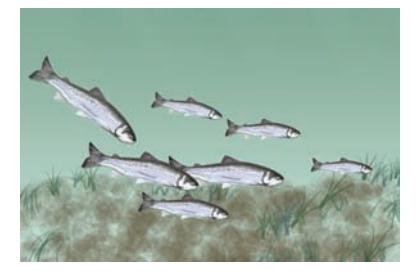
Salmon Survival. For reasons not yet fully understood, the number of fingerling salmon that survive the trip from their riverbed spawning grounds to the open ocean varies approximately sinusoidally from year to year. The table shows the number of salmon (in thousands of fingerlings) that hatch in a certain British Columbia creek and then make their way to the Strait of Georgia, over a period of 16 years. (a) Make a scatter plot of the data. (b) Find a sine curve that models the data (as in Example 1). (c) Graph the function you found in part (b) together with the scatter plot. (d) Use a graphing calculator to find the sine curve that best fits the data (as in Example 2). Compare to your answer from part (b). Data (year, salmon in thousands): (1985, 43), (1986, 36), (1987, 27), (1988, 23), (1989, 26), (1990, 33), (1991, 43), (1992, 50), (1993, 56), (1994, 63), (1995, 57), (1996, 50), (1997, 44), (1998, 38), (1999, 30), (2000, 22).
question image
9 Modeling Periodic Data - Sunspot Activity · Level 3
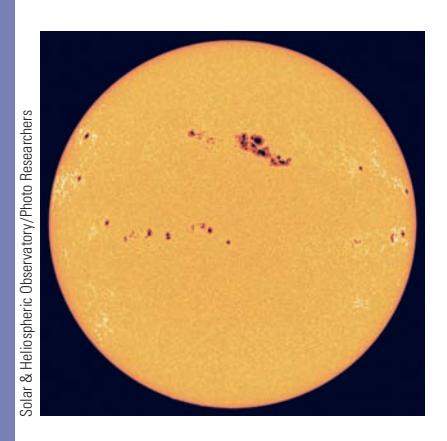
Sunspot Activity. Sunspots are relatively cool regions on the sun that appear as dark spots when observed through special solar filters. The number of sunspots varies in an 11-year cycle. The table gives the average daily sunspot count for the years 1975–2004. (a) Make a scatter plot of the data. (b) Find a cosine curve that models the data (as in Example 1). (c) Graph the function you found in part (b) together with the scatter plot. (d) Use a graphing calculator to find the sine curve that best fits the data (as in Example 2). Compare to your answer in part (b). Data (year, sunspots): (1975, 16), (1976, 13), (1977, 28), (1978, 93), (1979, 155), (1980, 155), (1981, 140), (1982, 116), (1983, 67), (1984, 46), (1985, 18), (1986, 13), (1987, 29), (1988, 100), (1989, 158), (1990, 143), (1991, 146), (1992, 94), (1993, 55), (1994, 30), (1995, 18), (1996, 9), (1997, 21), (1998, 64), (1999, 93), (2000, 119), (2001, 111), (2002, 104), (2003, 64), (2004, 40).
question image
10 Example - Modeling Tide Height with Sinusoidal Curves · Level 3
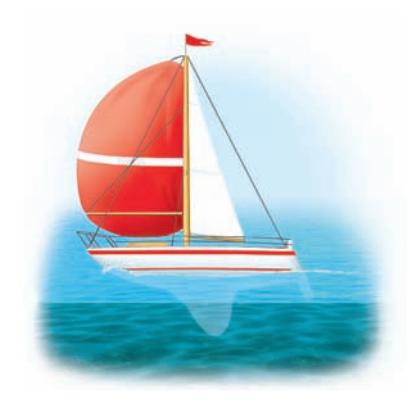
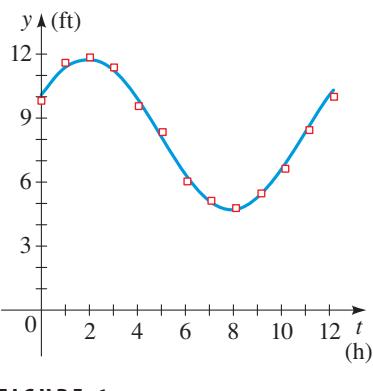
The water depth in a narrow channel varies with the tides. The table shows the water depth over a 12-hour period.
Time Depth (ft)
12:00 A.M. 9.8
1:00 A.M. 11.4
2:00 A.M. 11.6
3:00 A.M. 11.2
4:00 A.M. 9.6
5:00 A.M. 8.5
6:00 A.M. 6.5
7:00 A.M. 5.7
8:00 A.M. 5.4
9:00 A.M. 6.0
10:00 A.M. 7.0
11:00 A.M. 8.6
12:00 P.M. 10.0
question image
(a) Make a scatter plot of the water depth data.
(b) Find a function that models the water depth with respect to time.
(c) If a boat needs at least 11 ft of water to cross the channel, during which times can it safely do so?

Enter your answer directly below each part above.

11 Example - Fitting a Sine Curve to Data · Level 3
(a) Use a graphing device to find the sine curve that best fits the depth of water data in Table 1 (page 427). (b) Compare your result to the model found in Example 1.
question image

Answered: 0 / 11