Stewart 9th Section 3.8: Newton's Method

43 questions

--:--
0 / 43
Stewart 9th Section 3.8: Newton's Method 0/43
1 Newton's Method - Graphical · Level 2
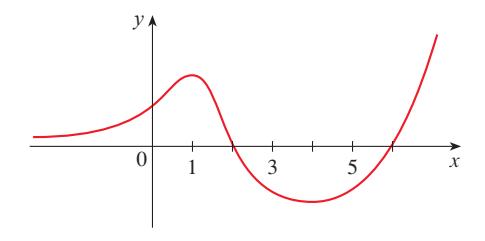
The figure shows the graph of a function \(f\). Suppose that Newton's method is used to approximate the solution \(s\) of the equation \(f(x) = 0\) with initial approximation \(x_1 = 6\).
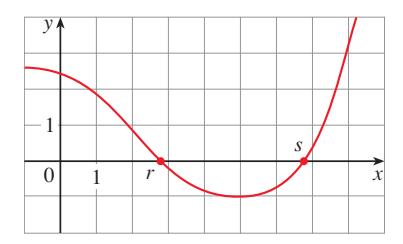
question image
(a) Draw the tangent lines that are used to find \(x_2\) and \(x_3\), and estimate the numerical values of \(x_2\) and \(x_3\).
(b) Would \(x_1 = 8\) be a better first approximation? Explain.

Enter your answer directly below each part above.

2 Newton's Method - Graphical · Level 2
Follow the instructions for Exercise 1(a) but use \(x_1 = 1\) as the starting approximation for finding the solution \(r\).
3 Newton's Method - Tangent Line · Level 2
Suppose the tangent line to the curve \(y = f(x)\) at the point \((2, 5)\) has the equation \(y = 9 - 2x\). If Newton's method is used to locate a solution of the equation \(f(x) = 0\) and the initial approximation is \(x_1 = 2\), find the second approximation \(x_2\).
4 Newton's Method - Convergence · Level 3
For each initial approximation, determine graphically what happens if Newton's method is used for the function whose graph is shown.
question image
(a) \(x_1 = 0\)
(b) \(x_1 = 1\)
(c) \(x_1 = 3\)
(d) \(x_1 = 4\)
(e) \(x_1 = 5\)

Enter your answer directly below each part above.

5 Newton's Method - Convergence · Level 2
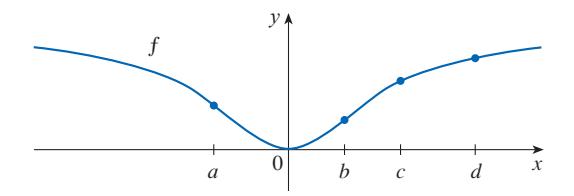
For which of the initial approximations \(x_1 = a, b, c\), and \(d\) do you think Newton's method will work and lead to the solution of the equation \(f(x) = 0\)?
question image
6 Newton's Method - Computation · Level 2
Use Newton's method with the specified initial approximation \(x_1\) to find \(x_3\), the third approximation to the solution of the given equation. (Give your answer to four decimal places.) \(2x^3 - 3x^2 + 2 = 0\), \(x_1 = -1\)
7 Newton's Method - Computation · Level 2
Use Newton's method with the specified initial approximation \(x_1\) to find \(x_3\), the third approximation to the solution of the given equation. \(\dfrac{2}{x} - x^2 + 1 = 0\), \(x_1 = 2\)
8 Newton's Method - Computation · Level 2
Use Newton's method with the specified initial approximation \(x_1\) to find \(x_3\), the third approximation to the solution of the given equation. \(x^5 = x^2 + 1\), \(x_1 = 1\)
9 Newton's Method - Computation · Level 2
Use Newton's method with initial approximation \(x_1 = -1\) to find \(x_2\), the second approximation to the solution of the equation \(x^3 + x + 3 = 0\). Explain how the method works by first graphing the function and its tangent line at \((-1, 1)\).
10 Newton's Method - Computation · Level 2
Use Newton's method with initial approximation \(x_1 = 1\) to find \(x_2\), the second approximation to the solution of the equation \(x^4 - x - 1 = 0\). Explain how the method works by first graphing the function and its tangent line at \((1, -1)\).
11 Newton's Method - Roots · Level 2
Use Newton's method to approximate the given number correct to eight decimal places. \(\sqrt[4]{75}\)
12 Newton's Method - Roots · Level 2
Use Newton's method to approximate the given number correct to eight decimal places. \(\sqrt[8]{500}\)
13 Newton's Method - IVT · Level 3
(a) Explain how we know that the given equation must have a solution in the given interval. (b) Use Newton's method to approximate the solution correct to six decimal places. \(3x^4 - 8x^3 + 2 = 0\), \([2, 3]\)
14 Newton's Method - IVT · Level 3
(a) Explain how we know that the given equation must have a solution in the given interval. (b) Use Newton's method to approximate the solution correct to six decimal places. \(-2x^5 + 9x^4 - 7x^3 - 11x = 0\), \([3, 4]\)
15 Newton's Method - Trig · Level 2
Use Newton's method to approximate the indicated solution of the equation correct to six decimal places. The negative solution of \(\cos x = x^2 - 4\)
16 Newton's Method - Trig · Level 2
Use Newton's method to approximate the indicated solution of the equation correct to six decimal places. The positive solution of \(3 \sin x = x\)
17 Newton's Method - All Solutions · Level 2
Use Newton's method to find all solutions of the equation correct to six decimal places. \(\sin x = x - 1\)
18 Newton's Method - All Solutions · Level 2
Use Newton's method to find all solutions of the equation correct to six decimal places. \(\cos 2x = x^3\)
19 Newton's Method - All Solutions · Level 2
Use Newton's method to find all solutions of the equation correct to six decimal places. \(\dfrac{1}{x} = \sqrt[3]{x} - 1\)
20 Newton's Method - All Solutions · Level 2
Use Newton's method to find all solutions of the equation correct to six decimal places. \((x - 1)^2 = \sqrt{x}\)
21 Newton's Method - All Solutions · Level 2
Use Newton's method to find all solutions of the equation correct to six decimal places. \(x^3 = \cos x\)
22 Newton's Method - All Solutions · Level 2
Use Newton's method to find all solutions of the equation correct to six decimal places. \(x^3 = 5x - 3\)
23 Newton's Method - High Precision · Level 3
Use Newton's method to find all the solutions of the equation correct to eight decimal places. Start by looking at a graph to find initial approximations. \(-2x^7 - 5x^4 + 9x^3 + 5 = 0\)
24 Newton's Method - High Precision · Level 3
Use Newton's method to find all the solutions of the equation correct to eight decimal places. \(x^5 - 3x^4 + x^3 - x^2 - x + 6 = 0\)
25 Newton's Method - High Precision · Level 3
Use Newton's method to find all the solutions of the equation correct to eight decimal places. \(\dfrac{x}{x^2 + 1} = \sqrt{1 - x}\)
26 Newton's Method - High Precision · Level 3
Use Newton's method to find all the solutions of the equation correct to eight decimal places. \(\cos(x^2 - x) = x^4\)
27 Newton's Method - Babylonian Algorithm · Level 3
(a) Apply Newton's method to the equation \(x^2 - a = 0\) to derive the following square-root algorithm (used by the ancient Babylonians to compute \(\sqrt{a}\)): \(x_{n+1} = \dfrac{1}{2}\left(x_n + \dfrac{a}{x_n}\right)\)
(b) Use part (a) to compute \(\sqrt{1000}\) correct to six decimal places.

Enter your answer directly below each part above.

28 Newton's Method - Reciprocal · Level 3
(a) Apply Newton's method to the equation \(\dfrac{1}{x} - a = 0\) to derive the following reciprocal algorithm: \(x_{n+1} = 2x_n - a x_n^2\) (This algorithm enables a computer to find reciprocals without actually dividing.)
(b) Use part (a) to compute \(\dfrac{1}{1}.6984\) correct to six decimal places.

Enter your answer directly below each part above.

29 Newton's Method - Failure · Level 3
Explain why Newton's method doesn't work for finding the solution of the equation \(x^3 - 3x + 6 = 0\) if the initial approximation is chosen to be \(x_1 = 1\).
30 Newton's Method - Sensitivity · Level 3
(a) Use Newton's method with \(x_1 = 1\) to find the solution of the equation \(x^3 - x = 1\) correct to six decimal places.
(b) Solve the equation in part (a) using \(x_1 = 0.6\) as the initial approximation.
(c) Solve the equation in part (a) using \(x_1 = 0.57\). (You definitely need a programmable calculator for this part.)
(d) Graph \(f(x) = x^3 - x - 1\) and its tangent lines at \(x_1 = 1, 0.6\), and \(0.57\) to explain why Newton's method is so sensitive to the value of the initial approximation.

Enter your answer directly below each part above.

31 Newton's Method - Failure · Level 3
Explain why Newton's method fails when applied to the equation \(\sqrt[3]{x} = 0\) with any initial approximation \(x_1 \neq 0\). Illustrate your explanation with a sketch.
32 Newton's Method - Failure · Level 3
If \(f(x) = \begin{cases} \sqrt{x} & \quad \text{if } x \geq 0 \\ -\sqrt{-x} & \quad \text{if } x < 0 \end{cases}\) then the solution of the equation \(f(x) = 0\) is \(x = 0\). Explain why Newton's method fails to find the solution no matter which initial approximation \(x_1 \neq 0\) is used. Illustrate your explanation with a sketch.
33 Newton's Method - Critical Numbers · Level 3
(a) Use Newton's method to find the critical numbers of the function \(f(x) = x^6 - x^4 + 3x^3 - 2x\) correct to six decimal places.
(b) Find the absolute minimum value of \(f\) correct to four decimal places.

Enter your answer directly below each part above.

34 Newton's Method - Optimization · Level 3
Use Newton's method to find the absolute maximum value of the function \(f(x) = x \cos x\), \(0 \leq x \leq \pi\), correct to six decimal places.
35 Newton's Method - Inflection Point · Level 3
Use Newton's method to find the coordinates of the inflection point of the curve \(y = x^2 \sin x\), \(0 \leq x \leq \pi\), correct to six decimal places.
36 Newton's Method - Tangent Lines · Level 3
Of the infinitely many lines that are tangent to the curve \(y = -\sin x\) and pass through the origin, there is one that has the largest slope. Use Newton's method to find the slope of that line correct to six decimal places.
37 Newton's Method - Optimization · Level 3
Use Newton's method to find the coordinates, correct to six decimal places, of the point on the parabola \(y = (x - 1)^2\) that is closest to the origin.
38 Newton's Method - Geometry · Level 3
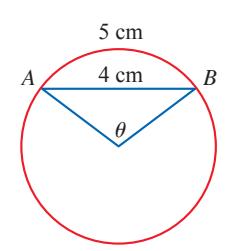
In the figure, the length of the chord \(AB\) is 4 cm and the length of the arc \(AB\) is 5 cm. Find the central angle \(\theta\), in radians, correct to four decimal places. Then give the answer to the nearest degree.
question image
39 Newton's Method - Finance · Level 4
A car dealer sells a new car for \$18,000. He also offers to sell the same car for payments of \$375 per month for five years. What monthly interest rate is this dealer charging? To solve this problem you will need to use the formula for the present value \(A\) of an annuity consisting of \(n\) equal payments of size \(R\) with interest rate \(i\) per time period: \(A = \dfrac{R}{i} [1 - (1 + i)^{-n}]\) Replacing \(i\) by \(x\), show that \(48 x (1 + x)^{60} - (1 + x)^{60} + 1 = 0\) Use Newton's method to solve this equation.
40 Newton's Method - Astronomy · Level 4
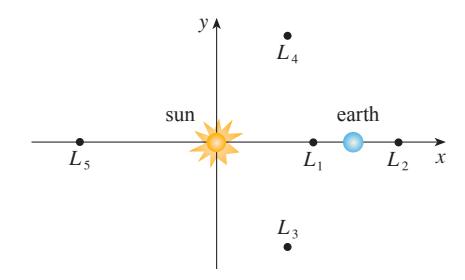
The figure shows the sun located at the origin and the earth at the point \((1, 0)\). (The unit here is the distance between the centers of the earth and the sun, called an astronomical unit: \(1\) AU \(\approx 1.496 \times 10^8\) km.) There are five locations \(L_1, L_2, L_3, L_4\), and \(L_5\) in this plane of rotation of the earth about the sun where a satellite remains motionless with respect to the earth because the forces acting on the satellite (including the gravitational attractions of the earth and the sun) balance each other. These locations are called libration points. (A solar research satellite has been placed at one of these libration points.) If \(m_1\) is the mass of the sun, \(m_2\) is the mass of the earth, and \(r = m_2 / (m_1 + m_2)\), it turns out that the \(x\)-coordinate of \(L_1\) is the unique solution of the fifth-degree equation \(p(x) = x^5 - (2 + r) x^4 + (1 + 2r) x^3 - (1 - r) x^2 + 2(1 - r) x + r - 1 = 0\) and the \(x\)-coordinate of \(L_2\) is the solution of the equation \(p(x) - 2 r x^2 = 0\) Using the value \(r \approx 3.04042 \times 10^{-6}\), find the locations of the libration points (a) \(L_1\) and (b) \(L_2\).
question image
41 Example - Newton's method third iteration · Level 2
Starting with \(x_1 = 2\), find the third approximation \(x_3\) to the solution of the equation \(x^3 - 2 x - 5 = 0\).
42 Example - Newton's method sixth root of 2 · Level 2
Use Newton's method to find \(\sqrt[6]{2}\) correct to eight decimal places.
43 Example - Newton's method cosine equation · Level 2
Find, correct to six decimal places, the solution of the equation \(\cos x = x\).

Answered: 0 / 43