Stewart Section 12.6: Cylinders and Quadric Surfaces

46 questions

--:--
0 / 46
Stewart Section 12.6: Cylinders and Quadric Surfaces 0/46
1 Cylinders and Quadric Surfaces - Curves and Surfaces · Level 2
(a) What does the equation \(y = x^2\) represent as a curve in \(RR^2\)?
(b) What does it represent as a surface in \(RR^3\)?
(c) What does the equation \(z = y^2\) represent?

Enter your answer directly below each part above.

2 Cylinders and Quadric Surfaces - Curves and Surfaces · Level 2
(a) Sketch the graph of \(y = e^x\) as a curve in \(RR^2\).
(b) Sketch the graph of \(y = e^x\) as a surface in \(RR^3\).
(c) Describe and sketch the surface \(z = e^y\).

Enter your answer directly below each part above.

3 Cylinders and Quadric Surfaces - Describe and Sketch · Level 2
Describe and sketch the surface. \( x^2 + z^2 = 1 \)
4 Cylinders and Quadric Surfaces - Describe and Sketch · Level 2
Describe and sketch the surface. \( 4x^2 + y^2 = 4 \)
5 Cylinders and Quadric Surfaces - Describe and Sketch · Level 2
Describe and sketch the surface. \( z = 1 - y^2 \)
6 Cylinders and Quadric Surfaces - Describe and Sketch · Level 2
Describe and sketch the surface. \( y = z^2 \)
7 Cylinders and Quadric Surfaces - Describe and Sketch · Level 2
Describe and sketch the surface. \( x y = 1 \)
8 Cylinders and Quadric Surfaces - Describe and Sketch · Level 2
Describe and sketch the surface. \( z = \sin y \)
9 Cylinders and Quadric Surfaces - Traces · Level 3
(a) Find and identify the traces of the quadric surface \(x^2 + y^2 - z^2 = 1\) and explain why the graph looks like the graph of the hyperboloid of one sheet in Table 1.
(b) If we change the equation in part (a) to \(x^2 - y^2 + z^2 = 1\), how is the graph affected?
(c) What if we change the equation in part (a) to \(x^2 + y^2 + 2y - z^2 = 0\)?

Enter your answer directly below each part above.

10 Cylinders and Quadric Surfaces - Traces · Level 3
(a) Find and identify the traces of the quadric surface \(-x^2 + y^2 - z^2 = 1\) and explain why the graph looks like the graph of the hyperboloid of two sheets in Table 1.
(b) If the equation in part (a) is changed to \(x^2 - y^2 - z^2 = 1\), what happens to the graph? Sketch the new graph.

Enter your answer directly below each part above.

11 Cylinders and Quadric Surfaces - Trace and Identify · Level 3
\( x = y^2 + 4z^2 \)
12 Cylinders and Quadric Surfaces - Trace and Identify · Level 3
\( 4x^2 + 9y^2 + 9z^2 = 36 \)
13 Cylinders and Quadric Surfaces - Trace and Identify · Level 3
\( x^2 = 4y^2 + z^2 \)
14 Cylinders and Quadric Surfaces - Trace and Identify · Level 3
\( z^2 - 4x^2 - y^2 = 4 \)
15 Cylinders and Quadric Surfaces - Trace and Identify · Level 3
\( 9y^2 + 4z^2 = x^2 + 36 \)
16 Cylinders and Quadric Surfaces - Trace and Identify · Level 3
\( 3x^2 + y + 3z^2 = 0 \)
17 Cylinders and Quadric Surfaces - Trace and Identify · Level 3
\( \dfrac{x^2}{9} + \dfrac{y^2}{25} + \dfrac{z^2}{4} = 1 \)
18 Cylinders and Quadric Surfaces - Trace and Identify · Level 3
\( 3x^2 - y^2 + 3z^2 = 0 \)
19 Cylinders and Quadric Surfaces - Trace and Identify · Level 3
\( y = z^2 - x^2 \)
20 Cylinders and Quadric Surfaces - Trace and Identify · Level 3
\( x = y^2 - z^2 \)
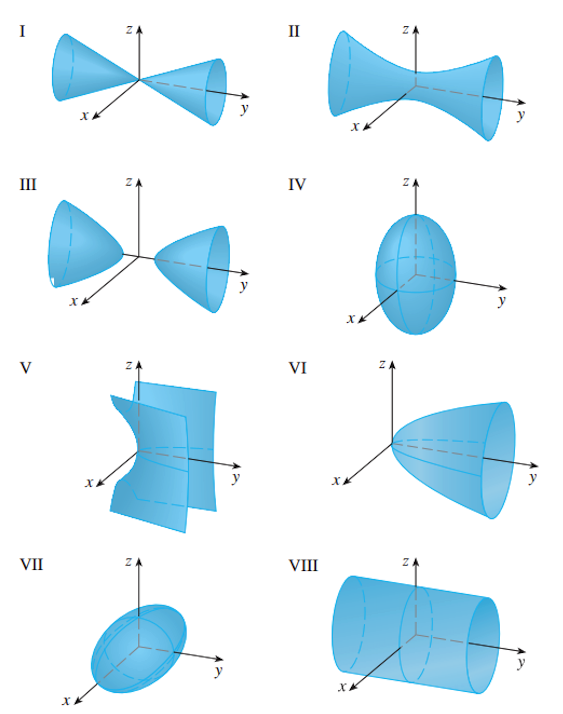
21 Cylinders and Quadric Surfaces - Graph Matching · Level 3
Match the equation with its graph (labeled I--VIII). Give reasons for your choice. 21. \(x^2 + 4y^2 + 9z^2 = 1\) 22. \(9x^2 + 4y^2 + z^2 = 1\) 23. \(x^2 - y^2 + z^2 = 1\) 24. \(-x^2 + y^2 - z^2 = 1\) 25. \(y = 2x^2 + z^2\) 26. \(y^2 = x^2 + 2z^2\) 27. \(x^2 + 2z^2 = 1\) 28. \(y = x^2 - z^2\)
question image
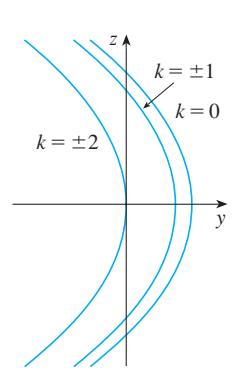
29 Cylinders and Quadric Surfaces - Trace Sketching · Level 3
Sketch and identify a quadric surface that could have the traces shown. Traces in \(x = k\) and traces in \(y = k\) are provided.
question image
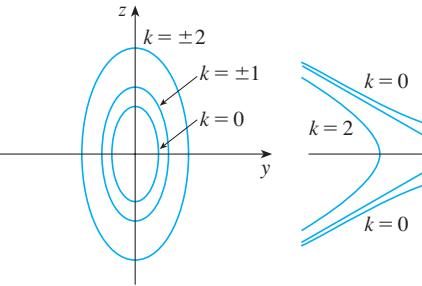
30 Cylinders and Quadric Surfaces - Trace Sketching · Level 3
Sketch and identify a quadric surface that could have the traces shown. Traces in \(x = k\) and traces in \(z = k\) are provided.
question image
31 Cylinders and Quadric Surfaces - Reduce and Classify · Level 4
Reduce the equation to one of the standard forms, classify the surface, and sketch it. \( y^2 = x^2 + \dfrac{1}{9} z^2 \)
32 Cylinders and Quadric Surfaces - Reduce and Classify · Level 4
Reduce the equation to one of the standard forms, classify the surface, and sketch it. \( 4x^2 - y + 2z^2 = 0 \)
33 Cylinders and Quadric Surfaces - Reduce and Classify · Level 4
Reduce the equation to one of the standard forms, classify the surface, and sketch it. \( x^2 + 2y - 2z^2 = 0 \)
34 Cylinders and Quadric Surfaces - Reduce and Classify · Level 4
Reduce the equation to one of the standard forms, classify the surface, and sketch it. \( y^2 = x^2 + 4z^2 + 4 \)
35 Cylinders and Quadric Surfaces - Reduce and Classify · Level 4
Reduce the equation to one of the standard forms, classify the surface, and sketch it. \( x^2 + y^2 - 2x - 6y - z + 10 = 0 \)
36 Cylinders and Quadric Surfaces - Reduce and Classify · Level 4
Reduce the equation to one of the standard forms, classify the surface, and sketch it. \( x^2 - y^2 - z^2 - 4x - 2z + 3 = 0 \)
37 Cylinders and Quadric Surfaces - Reduce and Classify · Level 4
Reduce the equation to one of the standard forms, classify the surface, and sketch it. \( x^2 - y^2 + z^2 - 4x - 2z = 0 \)
38 Cylinders and Quadric Surfaces - Reduce and Classify · Level 4
Reduce the equation to one of the standard forms, classify the surface, and sketch it. \( 4x^2 + y^2 + z^2 - 24x - 8y + 4z + 55 = 0 \)
39 Cylinders and Quadric Surfaces - Computer Graphing · Level 3
Use a computer with three-dimensional graphing software to graph the surface. Experiment with viewpoints and with domains for the variables until you get a good view of the surface. \( -4x^2 - y^2 + z^2 = 1 \)
40 Cylinders and Quadric Surfaces - Computer Graphing · Level 3
Use a computer with three-dimensional graphing software to graph the surface. Experiment with viewpoints and with domains for the variables until you get a good view of the surface. \( x^2 - y^2 - z = 0 \)
41 Cylinders and Quadric Surfaces - Computer Graphing · Level 3
Use a computer with three-dimensional graphing software to graph the surface. Experiment with viewpoints and with domains for the variables until you get a good view of the surface. \( -4x^2 - y^2 + z^2 = 0 \)
42 Cylinders and Quadric Surfaces - Computer Graphing · Level 3
Use a computer with three-dimensional graphing software to graph the surface. Experiment with viewpoints and with domains for the variables until you get a good view of the surface. \( x^2 - 6x + 4y^2 - z = 0 \)
43 Cylinders and Quadric Surfaces - Bounded Regions · Level 4
Sketch the region bounded by the surfaces \(z = \sqrt{x^2 + y^2}\) and \(x^2 + y^2 = 1\) for \(1 \leq z \leq 2\).
44 Cylinders and Quadric Surfaces - Bounded Regions · Level 4
Sketch the region bounded by the paraboloids \(z = x^2 + y^2\) and \(z = 2 - x^2 - y^2\).
45 Cylinders and Quadric Surfaces - Surfaces of Revolution · Level 3
Find an equation for the surface obtained by rotating the curve \(y = \sqrt{x}\) about the \(x\)-axis.
46 Cylinders and Quadric Surfaces - Surfaces of Revolution · Level 3
Find an equation for the surface obtained by rotating the line \(z = 2y\) about the \(z\)-axis.
47 Cylinders and Quadric Surfaces - Equidistant Surfaces · Level 4
Find an equation for the surface consisting of all points that are equidistant from the point \((-1, 0, 0)\) and the plane \(x = 1\). Identify the surface.
48 Cylinders and Quadric Surfaces - Equidistant Surfaces · Level 4
Find an equation for the surface consisting of all points \(P\) for which the distance from \(P\) to the \(x\)-axis is twice the distance from \(P\) to the \(y z\)-plane. Identify the surface.
49 Cylinders and Quadric Surfaces - Applications · Level 4
Traditionally, the earth's surface has been modeled as a sphere, but the World Geodetic System of 1984 (WGS-84) uses an ellipsoid as a more accurate model. It places the center of the earth at the origin and the north pole on the positive \(z\)-axis. The distance from the center to the poles is 6356.523 km and the distance to a point on the equator is 6378.137 km.
(a) Find an equation of the earth's surface as used by WGS-84.
(b) Curves of equal latitude are traces in the planes \(z = k\). What is the shape of these curves?
(c) Meridians (curves of equal longitude) are traces in planes of the form \(y = m x\). What is the shape of these meridians?

Enter your answer directly below each part above.

50 Cylinders and Quadric Surfaces - Applications · Level 4
A cooling tower for a nuclear reactor is to be constructed in the shape of a hyperboloid of one sheet (see the photo on page 839). The diameter at the base is 280 m and the minimum diameter, 500 m above the base, is 200 m. Find an equation for the tower.
51 Cylinders and Quadric Surfaces - Proofs · Level 5
Show that if the point \((a, b, c)\) lies on the hyperbolic paraboloid \(z = y^2 - x^2\), then the lines with parametric equations \(x = a + t\), \(y = b + t\), \(z = c + 2(b - a)t\) and \(x = a + t\), \(y = b - t\), \(z = c - 2(b + a)t\) both lie entirely on this paraboloid. (This shows that the hyperbolic paraboloid is what is called a ruled surface; that is, it can be generated by the motion of a straight line. In fact, this exercise shows that through each point on the hyperbolic paraboloid there are two generating lines. The only other quadric surfaces that are ruled surfaces are cylinders, cones, and hyperboloids of one sheet.)
52 Cylinders and Quadric Surfaces - Proofs · Level 5
Show that the curve of intersection of the surfaces \(x^2 + 2y^2 - z^2 + 3x = 1\) and \(2x^2 + 4y^2 - 2z^2 - 5y = 0\) lies in a plane.
53 Cylinders and Quadric Surfaces - Intersection Curves · Level 4
Graph the surfaces \(z = x^2 + y^2\) and \(z = 1 - y^2\) on a common screen using the domain \(|x| \leq 1.2\), \(|y| \leq 1.2\) and observe the curve of intersection of these surfaces. Show that the projection of this curve onto the \(x y\)-plane is an ellipse.

Answered: 0 / 46