Stewart Precalc 6e Section 4.1: Exponential Functions

66 questions

--:--
0 / 66
Stewart Precalc 6e Section 4.1: Exponential Functions 0/66
1 Concepts · Level 1
The function \(f(x) = 5^x\) is an exponential function with base ____, so \(f(2) = \) ____, \(f(-2) = \) ____, \(f(0) = \) ____, and \(f(6) = \) ____.
2 Concepts · Level 2
Match the exponential function with its graph.
(a) \(f(x) = 2^x\)
(b) \(f(x) = 2^{-x}\)
(c) \(f(x) = -2^x\)
(d) \(f(x) = -2^{-x}\)

Enter your answer directly below each part above.

3 Concepts · Level 1
(a) To obtain the graph of \(g(x) = 2^x - 1\), we start with the graph of \(f(x) = 2^x\) and shift it ____ (upward/downward) 1 unit.
(b) To obtain the graph of \(h(x) = 2^{x - 1}\), we start with the graph of \(f(x) = 2^x\) and shift it to the ____ (left/right) 1 unit.

Enter your answer directly below each part above.

4 Concepts · Level 2
In the formula \(A(t) = P\left(1 + \dfrac{r}{n}\right)^{n t}\) for compound interest the letters \(P\), \(r\), \(n\), and \(t\) stand for ____, ____, ____, and ____, respectively, and \(A(t)\) stands for ____. So if \$100 is invested at an interest rate of 6% compounded quarterly, then the amount after 2 years is ____.
5 Skills - Function Evaluation · Level 2
Use a calculator to evaluate the function at the indicated values. Round your answers to three decimals. \(f(x) = 4^x\); \(f(0.5)\), \(f(\sqrt{2})\), \(f(-\pi)\), \(f\left(\dfrac{1}{3}\right)\)
6 Skills - Function Evaluation · Level 2
Use a calculator to evaluate the function at the indicated values. Round your answers to three decimals. \(f(x) = 3^{x + 1}\); \(f(-1.5)\), \(f(\sqrt{3})\), \(f(e)\), \(f\left(-\dfrac{5}{4}\right)\)
7 Skills - Function Evaluation · Level 2
Use a calculator to evaluate the function at the indicated values. Round your answers to three decimals. \(g(x) = \left(\dfrac{2}{3}\right)^{x - 1}\); \(g(1.3)\), \(g(\sqrt{5})\), \(g(2 \pi)\), \(g\left(-\dfrac{1}{2}\right)\)
8 Skills - Function Evaluation · Level 2
Use a calculator to evaluate the function at the indicated values. Round your answers to three decimals. \(g(x) = \left(\dfrac{3}{4}\right)^{2 x}\); \(g(0.7)\), \(g\left(\dfrac{\sqrt{7}}{2}\right)\), \(g\left(\dfrac{1}{\pi}\right)\), \(g\left(\dfrac{2}{3}\right)\)
9 Skills - Graphing · Level 1
Sketch the graph of the function by making a table of values. Use a calculator if necessary. \(f(x) = 2^x\)
10 Skills - Graphing · Level 1
Sketch the graph of the function by making a table of values. Use a calculator if necessary. \(g(x) = 8^x\)
11 Skills - Graphing · Level 1
Sketch the graph of the function by making a table of values. Use a calculator if necessary. \(f(x) = \left(\dfrac{1}{3}\right)^x\)
12 Skills - Graphing · Level 1
Sketch the graph of the function by making a table of values. Use a calculator if necessary. \(h(x) = (1.1)^x\)
13 Skills - Graphing · Level 2
Sketch the graph of the function by making a table of values. Use a calculator if necessary. \(g(x) = 3 (1.3)^x\)
14 Skills - Graphing · Level 2
Sketch the graph of the function by making a table of values. Use a calculator if necessary. \(h(x) = 2 \left(\dfrac{1}{4}\right)^x\)
15 Skills - Comparing Graphs · Level 2
Graph both functions on one set of axes. \(f(x) = 2^x\) and \(g(x) = 2^{-x}\)
16 Skills - Comparing Graphs · Level 2
Graph both functions on one set of axes. \(f(x) = 3^{-x}\) and \(g(x) = \left(\dfrac{1}{3}\right)^x\)
17 Skills - Comparing Graphs · Level 2
Graph both functions on one set of axes. \(f(x) = 4^x\) and \(g(x) = 7^x\)
18 Skills - Comparing Graphs · Level 2
Graph both functions on one set of axes. \(f(x) = \left(\dfrac{2}{3}\right)^x\) and \(g(x) = \left(\dfrac{4}{3}\right)^x\)
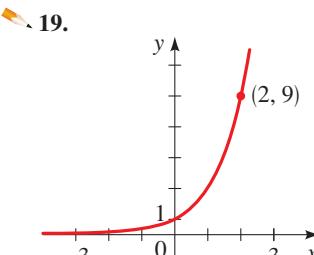
19 Skills - Finding the Function · Level 2
Find the exponential function \(f(x) = a^x\) whose graph is given.
question image
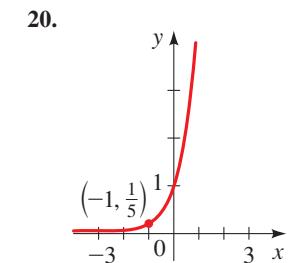
20 Skills - Finding the Function · Level 2
Find the exponential function \(f(x) = a^x\) whose graph is given.
question image
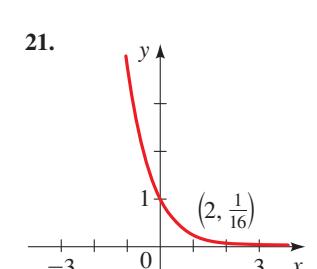
21 Skills - Finding the Function · Level 2
Find the exponential function \(f(x) = a^x\) whose graph is given.
question image
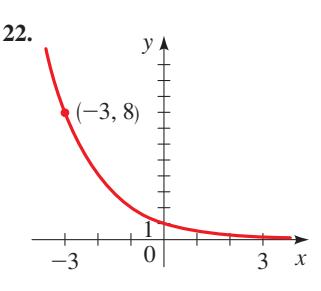
22 Skills - Finding the Function · Level 2
Find the exponential function \(f(x) = a^x\) whose graph is given.
question image
23 Skills - Matching · Level 2
Match the exponential function with one of the graphs labeled I or
II. \(f(x) = 5^{x + 1}\)
24 Skills - Matching · Level 2
Match the exponential function with one of the graphs labeled I or
II. \(f(x) = 5^x + 1\)
25 Skills - Transformations · Level 2
\( f(x) = -3^x \)
26 Skills - Transformations · Level 2
\( f(x) = 10^{-x} \)
27 Skills - Transformations · Level 2
\( g(x) = 2^x - 3 \)
28 Skills - Transformations · Level 2
\( g(x) = 2^{x - 3} \)
29 Skills - Transformations · Level 2
\( h(x) = 4 + \left(\dfrac{1}{2}\right)^x \)
30 Skills - Transformations · Level 2
\( h(x) = 6 - 3^x \)
31 Skills - Transformations · Level 2
\( f(x) = 10^{x + 3} \)
32 Skills - Transformations · Level 2
\( f(x) = -\left(\dfrac{1}{5}\right)^x \)
33 Skills - Transformations · Level 2
\( y = 5^{-x} + 1 \)
34 Skills - Transformations · Level 2
\( y = 1 - 3^{-x} \)
35 Skills - Transformations · Level 2
\( y = 3 - 10^{x - 1} \)
36 Skills - Transformations · Level 2
\( h(x) = 2^{x - 4} + 1 \)
37 Skills - Various · Level 3
(a) Sketch the graphs of \(f(x) = 2^x\) and \(g(x) = 3 (2^x)\).
(b) How are the graphs related?

Enter your answer directly below each part above.

38 Skills - Various · Level 3
(a) Sketch the graphs of \(f(x) = 9^{\dfrac{x}{2}}\) and \(g(x) = 3^x\).
(b) Use the Laws of Exponents to explain the relationship between these graphs.

Enter your answer directly below each part above.

39 Skills - Various · Level 3
Compare the functions \(f(x) = x^3\) and \(g(x) = 3^x\) by evaluating both of them for \(x = 0, 1, 2, 3, 4, 5, 6, 7, 8, 9, 10, 15\), and \(20\). Then draw the graphs of \(f\) and \(g\) on the same set of axes.
40 Skills - Various · Level 3
If \(f(x) = 10^x\), show that \((f(x + h) - f(x))/h = 10^x ((10^h - 1)/h)\).
41 Skills - Various · Level 3
(a) Compare the rates of growth of the functions \(f(x) = 2^x\) and \(g(x) = x^5\) by drawing the graphs of both functions in the following viewing rectangles. (i) \([0, 5]\) by \([0, 20]\) (ii) \([0, 25]\) by \([0, 10^7]\) (iii) \([0, 50]\) by \([0, 10^8]\)
(b) Find the solutions of the equation \(2^x = x^5\), rounded to one decimal place.

Enter your answer directly below each part above.

42 Skills - Various · Level 3
(a) Compare the rates of growth of the functions \(f(x) = 3^x\) and \(g(x) = x^4\) by drawing the graphs of both functions in the following viewing rectangles: (i) \([-4, 4]\) by \([0, 20]\) (ii) \([0, 10]\) by \([0, 5000]\) (iii) \([0, 20]\) by \([0, 10^5]\)
(b) Find the solutions of the equation \(3^x = x^4\), rounded to two decimal places.

Enter your answer directly below each part above.

43 Skills - Various · Level 2
Draw graphs of the given family of functions for \(c = 0.25, 0.5, 1, 2, 4\). How are the graphs related? \(f(x) = c \cdot 2^x\)
44 Skills - Various · Level 2
Draw graphs of the given family of functions for \(c = 0.25, 0.5, 1, 2, 4\). How are the graphs related? \(f(x) = 2^{c x}\)
45 Skills - Various · Level 3
Find, rounded to two decimal places, (a) the intervals on which the function is increasing or decreasing and (b) the range of the function. \(y = 10^{x - x^2}\)
46 Skills - Various · Level 3
Find, rounded to two decimal places, (a) the intervals on which the function is increasing or decreasing and (b) the range of the function. \(y = x \cdot 2^x\)
47 Applications - Population · Level 2
A bacteria culture contains 1500 bacteria initially and doubles every hour.
(a) Find a function that models the number of bacteria after \(t\) hours.
(b) Find the number of bacteria after 24 hours.

Enter your answer directly below each part above.

48 Applications - Population · Level 2
A certain breed of mouse was introduced onto a small island with an initial population of 320 mice, and scientists estimate that the mouse population is doubling every year.
(a) Find a function that models the number of mice after \(t\) years.
(b) Estimate the mouse population after 8 years.

Enter your answer directly below each part above.

49 Applications - Compound Interest · Level 2
An investment of \$5000 is deposited into an account in which interest is compounded monthly. Complete the table by filling in the amounts to which the investment grows at the indicated times. Fixed rate: \(r = 4%\). Times (years): 1, 2, 3, 4, 5, 6.
50 Applications - Compound Interest · Level 2
An investment of \$5000 is deposited into an account in which interest is compounded monthly. Complete the table by filling in the amounts to which the investment grows at the indicated interest rates. Fixed time: \(t = 5\) years. Rates per year: 1%, 2%, 3%, 4%, 5%, 6%.
51 Applications - Compound Interest · Level 2
If \$10,000 is invested at an interest rate of 3% per year, compounded semiannually, find the value of the investment after the given number of years. (a) 5 years (b) 10 years (c) 15 years
52 Applications - Compound Interest · Level 2
If \$2500 is invested at an interest rate of 2.5% per year, compounded daily, find the value of the investment after the given number of years. (a) 2 years (b) 3 years (c) 6 years
53 Applications - Compound Interest · Level 2
If \$500 is invested at an interest rate of 3.75% per year, compounded quarterly, find the value of the investment after the given number of years. (a) 1 year (b) 2 years (c) 10 years
54 Applications - Compound Interest · Level 2
If \$4000 is borrowed at a rate of 5.75% interest per year, compounded quarterly, find the amount due at the end of the given number of years. (a) 4 years (b) 6 years (c) 8 years
55 Applications - Compound Interest · Level 3
Find the present value of \$10,000 if interest is paid at a rate of 9% per year, compounded semiannually, for 3 years.
56 Applications - Compound Interest · Level 3
Find the present value of \$100,000 if interest is paid at a rate of 8% per year, compounded monthly, for 5 years.
57 Applications - Compound Interest · Level 3
Find the annual percentage yield for an investment that earns 8% per year, compounded monthly.
58 Applications - Compound Interest · Level 3
Find the annual percentage yield for an investment that earns \(5 \dfrac{1}{2}\)% per year, compounded quarterly.
59 Discovery - Discussion - Writing · Level 3
Suppose you are offered a job that lasts one month, and you are to be very well paid. Which of the following methods of payment is more profitable for you?
(a) One million dollars at the end of the month
(b) Two cents on the first day of the month, 4 cents on the second day, 8 cents on the third day, and, in general, \(2^n\) cents on the \(n\)th day

Enter your answer directly below each part above.

60 Discovery - Discussion - Writing · Level 3
Your mathematics instructor asks you to sketch a graph of the exponential function \(f(x) = 2^x\) for \(x\) between 0 and 40, using a scale of 10 units to one inch. What are the dimensions of the sheet of paper you will need to sketch this graph?
question image
61 Example - Evaluating an Exponential Function · Level 1
Let \(f(x) = 3^x\), and evaluate the following:
(a) \(f(2)\)
(b) \(f\left(-\dfrac{2}{3}\right)\)
(c) \(f(\pi)\)
(d) \(f(\sqrt{2})\)

Enter your answer directly below each part above.

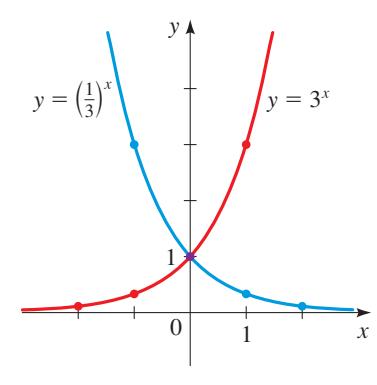
62 Example - Graphing Exponential Functions by Plotting Points · Level 2
Draw the graph of each function.
question image
(a) \(f(x) = 3^x\)
(b) \(g(x) = \left(\dfrac{1}{3}\right)^x\)

Enter your answer directly below each part above.

63 Example - Identifying Graphs of Exponential Functions · Level 2
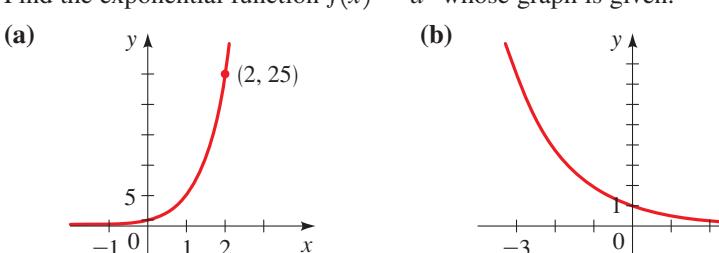
Find the exponential function \(f(x) = a^x\) whose graph is given.
question image
(a) The graph passes through the point \((2, 25)\).
(b) The graph passes through the point \(\left(3, \dfrac{1}{8}\right)\).

Enter your answer directly below each part above.

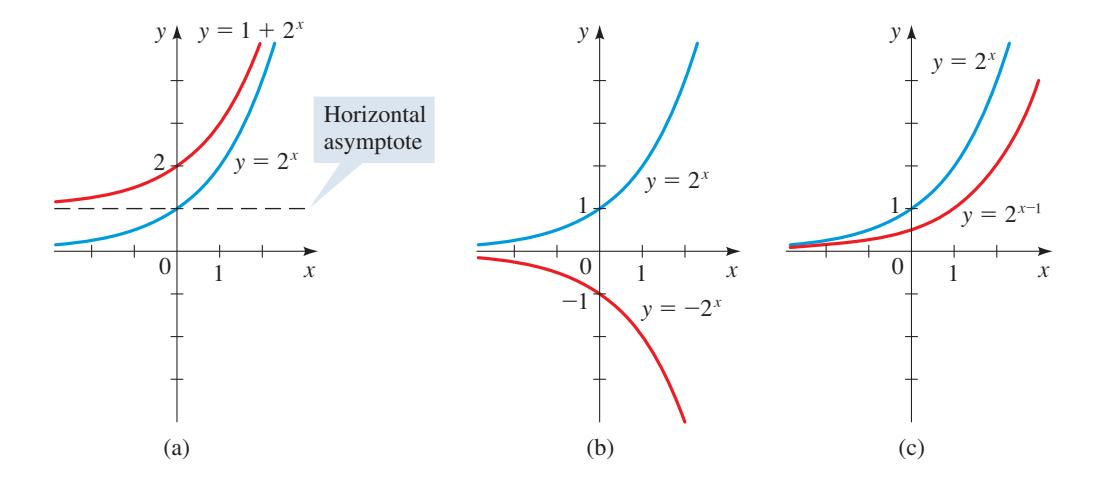
64 Example - Transformations of Exponential Functions · Level 2
Use the graph of \(f(x) = 2^x\) to sketch the graph of each function.
question image
(a) \(g(x) = 1 + 2^x\)
(b) \(h(x) = -2^x\)
(c) \(k(x) = 2^{x-1}\)

Enter your answer directly below each part above.

65 Example - Compound Interest · Level 2
A sum of \$1000 is invested at an interest rate of 12% per year. Find the amounts in the account after 3 years if interest is compounded annually, semiannually, quarterly, monthly, and daily.
66 Example - Annual Percentage Yield · Level 2
Find the annual percentage yield for an investment that earns interest at a rate of 6% per year, compounded daily.

Answered: 0 / 66