Stewart Precalc 6e Chapter 8 Review

57 questions

--:--
0 / 57
Stewart Precalc 6e Chapter 8 Review 0/57
1 Exercise - Polar to rectangular · Level 2
A point \(P(r, \theta)\) is given in polar coordinates: \(\left(12, \dfrac{\pi}{6}\right)\). *(a)* Plot the point \(P\). *(b)* Find rectangular coordinates for \(P\).
2 Exercise - Polar to rectangular · Level 2
A point \(P(r, \theta)\) is given in polar coordinates: \(\left(8, -\dfrac{3 \pi}{4}\right)\). *(a)* Plot the point \(P\). *(b)* Find rectangular coordinates for \(P\).
3 Exercise - Polar to rectangular · Level 2
A point \(P(r, \theta)\) is given in polar coordinates: \(\left(- 3, \dfrac{7 \pi}{4}\right)\). *(a)* Plot the point \(P\). *(b)* Find rectangular coordinates for \(P\).
4 Exercise - Polar to rectangular · Level 2
A point \(P(r, \theta)\) is given in polar coordinates: \(\left(- \sqrt{3}, \dfrac{2 \pi}{3}\right)\). *(a)* Plot the point \(P\). *(b)* Find rectangular coordinates for \(P\).
5 Exercise - Polar to rectangular · Level 2
A point \(P(r, \theta)\) is given in polar coordinates: \(\left(4 \sqrt{3}, - \dfrac{5 \pi}{3}\right)\). *(a)* Plot the point \(P\). *(b)* Find rectangular coordinates for \(P\).
6 Exercise - Polar to rectangular · Level 2
A point \(P(r, \theta)\) is given in polar coordinates: \(\left(- 6 \sqrt{2}, - \dfrac{\pi}{4}\right)\). *(a)* Plot the point \(P\). *(b)* Find rectangular coordinates for \(P\).
7 Exercise - Rectangular to polar · Level 2
A point \(P(x, y)\) is given in rectangular coordinates: \((8, 8)\). *(a)* Plot the point \(P\). *(b)* Find polar coordinates for \(P\) with \(r \geq 0\). *(c)* Find polar coordinates for \(P\) with \(r \leq 0\).
8 Exercise - Rectangular to polar · Level 2
A point \(P(x, y)\) is given in rectangular coordinates: \((- \sqrt{2}, \sqrt{6})\). *(a)* Plot the point \(P\). *(b)* Find polar coordinates for \(P\) with \(r \geq 0\). *(c)* Find polar coordinates for \(P\) with \(r \leq 0\).
9 Exercise - Rectangular to polar · Level 2
A point \(P(x, y)\) is given in rectangular coordinates: \((- 6 \sqrt{2}, - 6 \sqrt{2})\). *(a)* Plot the point \(P\). *(b)* Find polar coordinates for \(P\) with \(r \geq 0\). *(c)* Find polar coordinates for \(P\) with \(r \leq 0\).
10 Exercise - Rectangular to polar · Level 2
A point \(P(x, y)\) is given in rectangular coordinates: \((3 \sqrt{3}, 3)\). *(a)* Plot the point \(P\). *(b)* Find polar coordinates for \(P\) with \(r \geq 0\). *(c)* Find polar coordinates for \(P\) with \(r \leq 0\).
11 Exercise - Rectangular to polar · Level 2
A point \(P(x, y)\) is given in rectangular coordinates: \((- 3, \sqrt{3})\). *(a)* Plot the point \(P\). *(b)* Find polar coordinates for \(P\) with \(r \geq 0\). *(c)* Find polar coordinates for \(P\) with \(r \leq 0\).
12 Exercise - Rectangular to polar · Level 2
A point \(P(x, y)\) is given in rectangular coordinates: \((4, - 4)\). *(a)* Plot the point \(P\). *(b)* Find polar coordinates for \(P\) with \(r \geq 0\). *(c)* Find polar coordinates for \(P\) with \(r \leq 0\).
13 Exercise - Rectangular to polar equation · Level 2
*(a)* Convert the equation \(x + y = 4\) to polar coordinates and simplify. *(b)* Graph the equation.
14 Exercise - Rectangular to polar equation · Level 2
*(a)* Convert the equation \(x y = 1\) to polar coordinates and simplify. *(b)* Graph the equation.
15 Exercise - Rectangular to polar equation · Level 2
*(a)* Convert the equation \(x^2 + y^2 = 4 x + 4 y\) to polar coordinates and simplify. *(b)* Graph the equation.
16 Exercise - Rectangular to polar equation · Level 3
*(a)* Convert the equation \((x^2 + y^2)^2 = 2 x y\) to polar coordinates and simplify. *(b)* Graph the equation.
17 Exercise - Polar equation, rectangular form · Level 3
*(a)* Sketch the graph of the polar equation \(r = 3 + 3 \cos \theta\). *(b)* Express the equation in rectangular coordinates.
18 Exercise - Polar equation, rectangular form · Level 2
*(a)* Sketch the graph of the polar equation \(r = 3 \sin \theta\). *(b)* Express the equation in rectangular coordinates.
19 Exercise - Polar equation, rectangular form · Level 3
*(a)* Sketch the graph of the polar equation \(r = 2 \sin 2 \theta\). *(b)* Express the equation in rectangular coordinates.
20 Exercise - Polar equation, rectangular form · Level 3
*(a)* Sketch the graph of the polar equation \(r = 4 \cos 3 \theta\). *(b)* Express the equation in rectangular coordinates.
21 Exercise - Polar equation, rectangular form · Level 3
*(a)* Sketch the graph of the polar equation \(r^2 = \sec 2 \theta\). *(b)* Express the equation in rectangular coordinates.
22 Exercise - Polar equation, rectangular form · Level 3
*(a)* Sketch the graph of the polar equation \(r^2 = 4 \sin 2 \theta\). *(b)* Express the equation in rectangular coordinates.
23 Exercise - Polar equation, rectangular form · Level 2
*(a)* Sketch the graph of the polar equation \(r = \sin \theta + \cos \theta\). *(b)* Express the equation in rectangular coordinates.
24 Exercise - Polar equation, rectangular form · Level 3
*(a)* Sketch the graph of the polar equation \(r = \dfrac{4}{2 + \cos \theta}\). *(b)* Express the equation in rectangular coordinates.
25 Exercise - Graphing polar equation · Level 3
Use a graphing device to graph the polar equation \(r = \cos\left(\dfrac{\theta}{3}\right)\). Choose the domain of \(\theta\) to make sure you produce the entire graph.
26 Exercise - Graphing polar equation · Level 3
Use a graphing device to graph the polar equation \(r = \sin\left(9 \dfrac{\theta}{4}\right)\). Choose the domain of \(\theta\) to make sure you produce the entire graph.
27 Exercise - Graphing polar equation · Level 3
Use a graphing device to graph the polar equation \(r = 1 + 4 \cos\left(\dfrac{\theta}{3}\right)\). Choose the domain of \(\theta\) to make sure you produce the entire graph.
28 Exercise - Graphing polar equation · Level 3
Use a graphing device to graph the polar equation \(r = \theta \sin \theta\) for \(- 6 \pi \leq \theta \leq 6 \pi\).
29 Exercise - Complex number in polar form · Level 2
A complex number \(4 + 4 i\) is given. *(a)* Graph the complex number in the complex plane. *(b)* Find the modulus and argument. *(c)* Write the number in polar form.
30 Exercise - Complex number in polar form · Level 2
A complex number \(- 10 i\) is given. *(a)* Graph the complex number in the complex plane. *(b)* Find the modulus and argument. *(c)* Write the number in polar form.
31 Exercise - Complex number in polar form · Level 2
A complex number \(5 + 3 i\) is given. *(a)* Graph the complex number in the complex plane. *(b)* Find the modulus and argument. *(c)* Write the number in polar form.
32 Exercise - Complex number in polar form · Level 2
A complex number \(1 + \sqrt{3} i\) is given. *(a)* Graph the complex number in the complex plane. *(b)* Find the modulus and argument. *(c)* Write the number in polar form.
33 Exercise - Complex number in polar form · Level 2
A complex number \(- 1 + i\) is given. *(a)* Graph the complex number in the complex plane. *(b)* Find the modulus and argument. *(c)* Write the number in polar form.
34 Exercise - Complex number in polar form · Level 2
A complex number \(2 - 2 i\) is given. *(a)* Graph the complex number in the complex plane. *(b)* Find the modulus and argument. *(c)* Write the number in polar form.
35 Exercise - De Moivre's Theorem · Level 3
Use De Moivre's Theorem to find the indicated power: \((1 - \sqrt{3} i)^4\).
36 Exercise - De Moivre's Theorem · Level 3
Use De Moivre's Theorem to find the indicated power: \((1 + i)^8\).
37 Exercise - De Moivre's Theorem · Level 3
Use De Moivre's Theorem to find the indicated power: \((\sqrt{3} + i)^{- 4}\).
38 Exercise - De Moivre's Theorem · Level 3
Use De Moivre's Theorem to find the indicated power: \(\left(\dfrac{1}{2} + \dfrac{\sqrt{3}}{2} i\right)^{20}\).
39 Exercise - Roots of complex numbers · Level 3
Find the indicated roots: the square roots of \(- 16 i\).
40 Exercise - Roots of complex numbers · Level 3
Find the indicated roots: the cube roots of \(4 + 4 \sqrt{3} i\).
41 Exercise - Roots of complex numbers · Level 3
Find the indicated roots: the sixth roots of \(1\).
42 Exercise - Roots of complex numbers · Level 3
Find the indicated roots: the eighth roots of \(i\).
43 Exercise - Parametric to rectangular · Level 2
A pair of parametric equations is given: \(x = 1 - t^2\), \(y = 1 + t\). *(a)* Sketch the curve represented by the parametric equations. *(b)* Find a rectangular-coordinate equation for the curve by eliminating the parameter.
44 Exercise - Parametric to rectangular · Level 2
A pair of parametric equations is given: \(x = t^2 - 1\), \(y = t^2 + 1\). *(a)* Sketch the curve represented by the parametric equations. *(b)* Find a rectangular-coordinate equation for the curve by eliminating the parameter.
45 Exercise - Parametric to rectangular · Level 2
A pair of parametric equations is given: \(x = 1 + \cos t\), \(y = 1 - \sin t\), \(0 \leq t \leq \dfrac{\pi}{2}\). *(a)* Sketch the curve represented by the parametric equations. *(b)* Find a rectangular-coordinate equation for the curve by eliminating the parameter.
46 Exercise - Parametric to rectangular · Level 3
A pair of parametric equations is given: \(x = \dfrac{1}{t} + 2\), \(y = \dfrac{2}{t^2}\), \(0 < t \leq 2\). *(a)* Sketch the curve represented by the parametric equations. *(b)* Find a rectangular-coordinate equation for the curve by eliminating the parameter.
47 Exercise - Parametric curve graphing · Level 3
Use a graphing device to draw the parametric curve \(x = \cos 2 t\), \(y = \sin 3 t\).
48 Exercise - Parametric curve graphing · Level 3
Use a graphing device to draw the parametric curve \(x = \sin(t + \cos 2 t)\), \(y = \cos(t + \sin 3 t)\).
49 Exercise - Parametric representation of midpoint · Level 3
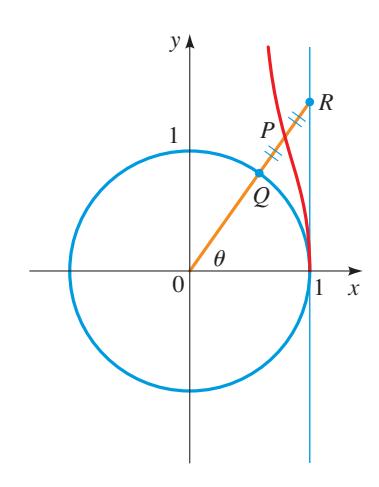
In the figure, the point \(P\) is the midpoint of the segment \(\text{QR}\) and \(0 \leq \theta < \dfrac{\pi}{2}\). Using \(\theta\) as the parameter, find a parametric representation for the curve traced out by \(P\).
question image
50 Concept Check - Polar coordinates · Level 1
Describe how polar coordinates represent the position of a point in the plane.
51 Concept Check - Polar/rectangular conversion · Level 1
*(a)* What equations do you use to change from polar to rectangular coordinates? *(b)* What equations do you use to change from rectangular to polar coordinates?
52 Concept Check - Sketching polar equations · Level 1
How do you sketch the graph of a polar equation \(r = f(\theta)\)?
53 Concept Check - Curve types in polar form · Level 1
What type of curve has a polar equation of the given form? *(a)* \(r = a \cos \theta\) or \(r = a \sin \theta\) *(b)* \(r = a(1 \pm \cos \theta)\) or \(r = a(1 \pm \sin \theta)\) *(c)* \(r = a \pm b \cos \theta\) or \(r = a \pm b \sin \theta\) *(d)* \(r = a \cos n \theta\) or \(r = a \sin n \theta\)
54 Concept Check - Complex numbers in polar form · Level 1
How do you graph a complex number \(z\)? What is the polar form of a complex number \(z\)? What is the modulus of \(z\)? What is the argument of \(z\)?
55 Concept Check - Multiplying/dividing in polar form · Level 1
*(a)* How do you multiply two complex numbers if they are given in polar form? *(b)* How do you divide two such numbers?
56 Concept Check - De Moivre's Theorem and roots · Level 1
*(a)* State De Moivre's Theorem. *(b)* How do you find the \(n\)th roots of a complex number?
57 Concept Check - Parametric curves · Level 1
A curve is given by the parametric equations \(x = f(t)\), \(y = g(t)\). *(a)* How do you sketch the curve? *(b)* How do you eliminate the parameter?

Answered: 0 / 57