Stewart Precalc 6e Section 3.4: Real Zeros of Polynomials

109 questions

--:--
0 / 109
Stewart Precalc 6e Section 3.4: Real Zeros of Polynomials 0/109
1 Concepts · Level 1
If the polynomial function \(P(x) = a_n x^n + a_{n-1} x^{n-1} + \ldots + a_1 x + a_0\) has integer coefficients, then the only numbers that could possibly be rational zeros of \(P\) are all of the form \(\dfrac{p}{q}\), where \(p\) is a factor of ____ and \(q\) is a factor of ____. The possible rational zeros of \(P(x) = 6x^3 + 5x^2 - 19x - 10\) are ____.
2 Concepts · Level 1
Using Descartes' Rule of Signs, we can tell that the polynomial \(P(x) = x^5 - 3x^4 + 2x^3 - x^2 + 8x - 8\) has ____, or ____ positive real zeros and ____ negative real zeros.
3 Concepts · Level 1
True or false? If \(c\) is a real zero of the polynomial \(P\), then all the other zeros of \(P\) are zeros of \(P\dfrac{x}{x-c}\).
4 Concepts · Level 1
True or false? If \(a\) is an upper bound for the real zeros of the polynomial \(P\), then \(-a\) is necessarily a lower bound for the real zeros of \(P\).
5 Skills - Rational Zeros Theorem · Level 2
List all possible rational zeros given by the Rational Zeros Theorem (but don't check to see which actually are zeros). \(P(x) = x^3 - 4x^2 + 3\)
6 Skills - Rational Zeros Theorem · Level 2
List all possible rational zeros given by the Rational Zeros Theorem (but don't check to see which actually are zeros). \(Q(x) = x^4 - 3x^3 - 6x + 8\)
7 Skills - Rational Zeros Theorem · Level 2
List all possible rational zeros given by the Rational Zeros Theorem (but don't check to see which actually are zeros). \(R(x) = 2x^5 + 3x^3 + 4x^2 - 8\)
8 Skills - Rational Zeros Theorem · Level 2
List all possible rational zeros given by the Rational Zeros Theorem (but don't check to see which actually are zeros). \(S(x) = 6x^4 - x^2 + 2x + 12\)
9 Skills - Rational Zeros Theorem · Level 2
List all possible rational zeros given by the Rational Zeros Theorem (but don't check to see which actually are zeros). \(T(x) = 4x^4 - 2x^2 - 7\)
10 Skills - Rational Zeros Theorem · Level 2
List all possible rational zeros given by the Rational Zeros Theorem (but don't check to see which actually are zeros). \(U(x) = 12x^5 + 6x^3 - 2x - 8\)
11 Skills - Polynomial Graphs · Level 2
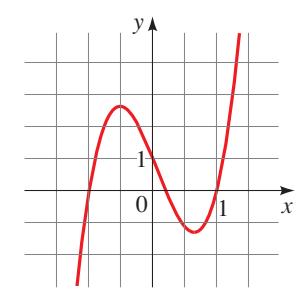
A polynomial function \(P\) and its graph are given. (a) List all possible rational zeros of \(P\) given by the Rational Zeros Theorem. (b) From the graph, determine which of the possible rational zeros actually turn out to be zeros. \(P(x) = 5x^3 - x^2 - 5x + 1\)
question image
12 Skills - Polynomial Graphs · Level 2
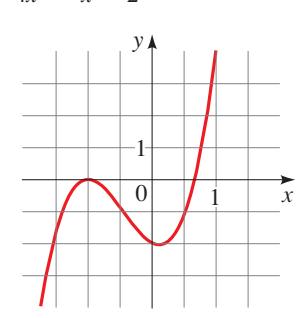
A polynomial function \(P\) and its graph are given. (a) List all possible rational zeros of \(P\) given by the Rational Zeros Theorem. (b) From the graph, determine which of the possible rational zeros actually turn out to be zeros. \(P(x) = 3x^3 + 4x^2 - x - 2\)
question image
13 Skills - Polynomial Graphs · Level 2
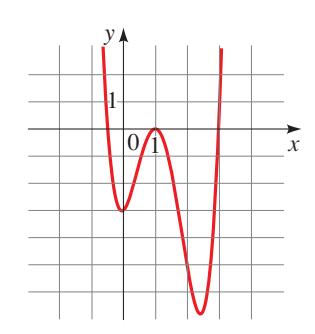
A polynomial function \(P\) and its graph are given. (a) List all possible rational zeros of \(P\) given by the Rational Zeros Theorem. (b) From the graph, determine which of the possible rational zeros actually turn out to be zeros. \(P(x) = 2x^4 - 9x^3 + 9x^2 + x - 3\)
question image
14 Skills - Polynomial Graphs · Level 2
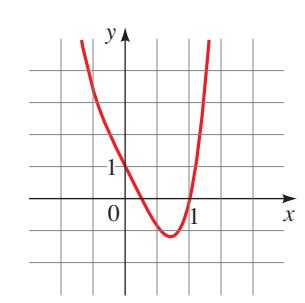
A polynomial function \(P\) and its graph are given. (a) List all possible rational zeros of \(P\) given by the Rational Zeros Theorem. (b) From the graph, determine which of the possible rational zeros actually turn out to be zeros. \(P(x) = 4x^4 - x^3 - 4x + 1\)
question image
15 Skills - Rational Zeros · Level 2
\( P(x) = x^3 + 3x^2 - 4 \)
16 Skills - Rational Zeros · Level 2
\( P(x) = x^3 - 7x^2 + 14x - 8 \)
17 Skills - Rational Zeros · Level 2
\( P(x) = x^3 - 3x - 2 \)
18 Skills - Rational Zeros · Level 2
\( P(x) = x^3 + 4x^2 - 3x - 18 \)
19 Skills - Rational Zeros · Level 2
\( P(x) = x^3 - 6x^2 + 12x - 8 \)
20 Skills - Rational Zeros · Level 2
\( P(x) = x^3 - x^2 - 8x + 12 \)
21 Skills - Rational Zeros · Level 2
\( P(x) = x^3 - 4x^2 + x + 6 \)
22 Skills - Rational Zeros · Level 2
\( P(x) = x^3 - 4x^2 - 7x + 10 \)
23 Skills - Rational Zeros · Level 2
\( P(x) = x^3 + 3x^2 - x - 3 \)
24 Skills - Rational Zeros · Level 2
\( P(x) = x^3 - 4x^2 - 11x + 30 \)
25 Skills - Rational Zeros · Level 2
\( P(x) = x^4 - 5x^2 + 4 \)
26 Skills - Rational Zeros · Level 2
\( P(x) = x^4 - 2x^3 - 3x^2 + 8x - 4 \)
27 Skills - Rational Zeros · Level 2
\( P(x) = x^4 + 6x^3 + 7x^2 - 6x - 8 \)
28 Skills - Rational Zeros · Level 2
\( P(x) = x^4 - x^3 - 23x^2 - 3x + 90 \)
29 Skills - Rational Zeros · Level 2
\( P(x) = 4x^4 - 25x^2 + 36 \)
30 Skills - Rational Zeros · Level 2
\( P(x) = 2x^4 - x^3 - 19x^2 + 9x + 9 \)
31 Skills - Rational Zeros · Level 2
\( P(x) = 3x^4 - 10x^3 - 9x^2 + 40x - 12 \)
32 Skills - Rational Zeros · Level 2
\( P(x) = 2x^3 + 7x^2 + 4x - 4 \)
33 Skills - Rational Zeros · Level 2
\( P(x) = 4x^3 + 4x^2 - x - 1 \)
34 Skills - Rational Zeros · Level 2
\( P(x) = 2x^3 - 3x^2 - 2x + 3 \)
35 Skills - Rational Zeros · Level 2
\( P(x) = 4x^3 - 7x + 3 \)
36 Skills - Rational Zeros · Level 2
\( P(x) = 8x^3 + 10x^2 - x - 3 \)
37 Skills - Rational Zeros · Level 2
\( P(x) = 4x^3 + 8x^2 - 11x - 15 \)
38 Skills - Rational Zeros · Level 2
\( P(x) = 6x^3 + 11x^2 - 3x - 2 \)
39 Skills - Rational Zeros · Level 2
\( P(x) = 20x^3 - 8x^2 - 5x + 2 \)
40 Skills - Rational Zeros · Level 2
\( P(x) = 12x^3 - 20x^2 + x + 3 \)
41 Skills - Rational Zeros · Level 2
\( P(x) = 2x^4 - 7x^3 + 3x^2 + 8x - 4 \)
42 Skills - Rational Zeros · Level 2
\( P(x) = 6x^4 - 7x^3 - 12x^2 + 3x + 2 \)
43 Skills - Rational Zeros · Level 3
\( P(x) = x^5 + 3x^4 - 9x^3 - 31x^2 + 36 \)
44 Skills - Rational Zeros · Level 3
\( P(x) = x^5 - 4x^4 - 3x^3 + 22x^2 - 4x - 24 \)
45 Skills - Rational Zeros · Level 3
\( P(x) = 3x^5 - 14x^4 - 14x^3 + 36x^2 + 43x + 10 \)
46 Skills - Rational Zeros · Level 3
\( P(x) = 2x^6 - 3x^5 - 13x^4 + 29x^3 - 27x^2 + 32x - 12 \)
47 Skills - Real Zeros · Level 3
\( P(x) = x^3 + 4x^2 + 3x - 2 \)
48 Skills - Real Zeros · Level 3
\( P(x) = x^3 - 5x^2 + 2x + 12 \)
49 Skills - Real Zeros · Level 3
\( P(x) = x^4 - 6x^3 + 4x^2 + 15x + 4 \)
50 Skills - Real Zeros · Level 3
\( P(x) = x^4 + 2x^3 - 2x^2 - 3x + 2 \)
51 Skills - Real Zeros · Level 3
\( P(x) = x^4 - 7x^3 + 14x^2 - 3x - 9 \)
52 Skills - Real Zeros · Level 3
\( P(x) = x^5 - 4x^4 - x^3 + 10x^2 + 2x - 4 \)
53 Skills - Real Zeros · Level 3
\( P(x) = 4x^3 - 6x^2 + 1 \)
54 Skills - Real Zeros · Level 3
\( P(x) = 3x^3 - 5x^2 - 8x - 2 \)
55 Skills - Real Zeros · Level 3
\( P(x) = 2x^4 + 15x^3 + 17x^2 + 3x - 1 \)
56 Skills - Real Zeros · Level 3
\( P(x) = 4x^5 - 18x^4 - 6x^3 + 91x^2 - 60x + 9 \)
57 Skills - Real Zeros and Graphs · Level 3
A polynomial \(P\) is given. (a) Find all the real zeros of \(P\). (b) Sketch the graph of \(P\). \(P(x) = x^3 - 3x^2 - 4x + 12\)
58 Skills - Real Zeros and Graphs · Level 3
A polynomial \(P\) is given. (a) Find all the real zeros of \(P\). (b) Sketch the graph of \(P\). \(P(x) = -x^3 - 2x^2 + 5x + 6\)
59 Skills - Real Zeros and Graphs · Level 3
A polynomial \(P\) is given. (a) Find all the real zeros of \(P\). (b) Sketch the graph of \(P\). \(P(x) = 2x^3 - 7x^2 + 4x + 4\)
60 Skills - Real Zeros and Graphs · Level 3
A polynomial \(P\) is given. (a) Find all the real zeros of \(P\). (b) Sketch the graph of \(P\). \(P(x) = 3x^3 + 17x^2 + 21x - 9\)
61 Skills - Real Zeros and Graphs · Level 3
A polynomial \(P\) is given. (a) Find all the real zeros of \(P\). (b) Sketch the graph of \(P\). \(P(x) = x^4 - 5x^3 + 6x^2 + 4x - 8\)
62 Skills - Real Zeros and Graphs · Level 3
A polynomial \(P\) is given. (a) Find all the real zeros of \(P\). (b) Sketch the graph of \(P\). \(P(x) = -x^4 + 10x^2 + 8x - 8\)
63 Skills - Real Zeros and Graphs · Level 3
A polynomial \(P\) is given. (a) Find all the real zeros of \(P\). (b) Sketch the graph of \(P\). \(P(x) = x^5 - x^4 - 5x^3 + x^2 + 8x + 4\)
64 Skills - Real Zeros and Graphs · Level 3
A polynomial \(P\) is given. (a) Find all the real zeros of \(P\). (b) Sketch the graph of \(P\). \(P(x) = x^5 - x^4 - 6x^3 + 14x^2 - 11x + 3\)
65 Skills - Descartes' Rule · Level 2
Use Descartes' Rule of Signs to determine how many positive and how many negative real zeros the polynomial can have. Then determine the possible total number of real zeros. \(P(x) = x^3 - x^2 - x - 3\)
66 Skills - Descartes' Rule · Level 2
Use Descartes' Rule of Signs to determine how many positive and how many negative real zeros the polynomial can have. Then determine the possible total number of real zeros. \(P(x) = 2x^3 - x^2 + 4x - 7\)
67 Skills - Descartes' Rule · Level 2
Use Descartes' Rule of Signs to determine how many positive and how many negative real zeros the polynomial can have. Then determine the possible total number of real zeros. \(P(x) = 2x^6 + 5x^4 - x^3 - 5x - 1\)
68 Skills - Descartes' Rule · Level 2
Use Descartes' Rule of Signs to determine how many positive and how many negative real zeros the polynomial can have. Then determine the possible total number of real zeros. \(P(x) = x^4 + x^3 + x^2 + x + 12\)
69 Skills - Descartes' Rule · Level 2
Use Descartes' Rule of Signs to determine how many positive and how many negative real zeros the polynomial can have. Then determine the possible total number of real zeros. \(P(x) = x^5 + 4x^3 - x^2 + 6x\)
70 Skills - Descartes' Rule · Level 2
Use Descartes' Rule of Signs to determine how many positive and how many negative real zeros the polynomial can have. Then determine the possible total number of real zeros. \(P(x) = x^8 - x^5 + x^4 - x^3 + x^2 - x + 1\)
71 Skills - Upper and Lower Bounds · Level 3
Show that the given values for \(a\) and \(b\) are lower and upper bounds for the real zeros of the polynomial. \(P(x) = 2x^3 + 5x^2 + x - 2\); \(a = -3\), \(b = 1\)
72 Skills - Upper and Lower Bounds · Level 3
Show that the given values for \(a\) and \(b\) are lower and upper bounds for the real zeros of the polynomial. \(P(x) = x^4 - 2x^3 - 9x^2 + 2x + 8\); \(a = -3\), \(b = 5\)
73 Skills - Upper and Lower Bounds · Level 3
Show that the given values for \(a\) and \(b\) are lower and upper bounds for the real zeros of the polynomial. \(P(x) = 8x^3 + 10x^2 - 39x + 9\); \(a = -3\), \(b = 2\)
74 Skills - Upper and Lower Bounds · Level 3
Show that the given values for \(a\) and \(b\) are lower and upper bounds for the real zeros of the polynomial. \(P(x) = 3x^4 - 17x^3 + 24x^2 - 9x + 1\); \(a = 0\), \(b = 6\)
75 Skills - Integer Bounds · Level 3
Find integers that are upper and lower bounds for the real zeros of the polynomial. \(P(x) = x^3 - 3x^2 + 4\)
76 Skills - Integer Bounds · Level 3
Find integers that are upper and lower bounds for the real zeros of the polynomial. \(P(x) = 2x^3 - 3x^2 - 8x + 12\)
77 Skills - Integer Bounds · Level 3
Find integers that are upper and lower bounds for the real zeros of the polynomial. \(P(x) = x^4 - 2x^3 + x^2 - 9x + 2\)
78 Skills - Integer Bounds · Level 3
Find integers that are upper and lower bounds for the real zeros of the polynomial. \(P(x) = x^5 - x^4 + 1\)
79 Skills - Rational and Irrational Zeros · Level 3
Find all rational zeros of the polynomial, and then find the irrational zeros, if any. Whenever appropriate, use the Rational Zeros Theorem, the Upper and Lower Bounds Theorem, Descartes' Rule of Signs, the quadratic formula, or other factoring techniques. \(P(x) = 2x^4 + 3x^3 - 4x^2 - 3x + 2\)
80 Skills - Rational and Irrational Zeros · Level 3
Find all rational zeros of the polynomial, and then find the irrational zeros, if any. Whenever appropriate, use the Rational Zeros Theorem, the Upper and Lower Bounds Theorem, Descartes' Rule of Signs, the quadratic formula, or other factoring techniques. \(P(x) = 2x^4 + 15x^3 + 31x^2 + 20x + 4\)
81 Skills - Rational and Irrational Zeros · Level 3
Find all rational zeros of the polynomial, and then find the irrational zeros, if any. Whenever appropriate, use the Rational Zeros Theorem, the Upper and Lower Bounds Theorem, Descartes' Rule of Signs, the quadratic formula, or other factoring techniques. \(P(x) = 4x^4 - 21x^2 + 5\)
82 Skills - Rational and Irrational Zeros · Level 3
Find all rational zeros of the polynomial, and then find the irrational zeros, if any. Whenever appropriate, use the Rational Zeros Theorem, the Upper and Lower Bounds Theorem, Descartes' Rule of Signs, the quadratic formula, or other factoring techniques. \(P(x) = 6x^4 - 7x^3 - 8x^2 + 5x\)
83 Skills - Rational and Irrational Zeros · Level 3
Find all rational zeros of the polynomial, and then find the irrational zeros, if any. Whenever appropriate, use the Rational Zeros Theorem, the Upper and Lower Bounds Theorem, Descartes' Rule of Signs, the quadratic formula, or other factoring techniques. \(P(x) = x^5 - 7x^4 + 9x^3 + 23x^2 - 50x + 24\)
84 Skills - Rational and Irrational Zeros · Level 3
Find all rational zeros of the polynomial, and then find the irrational zeros, if any. Whenever appropriate, use the Rational Zeros Theorem, the Upper and Lower Bounds Theorem, Descartes' Rule of Signs, the quadratic formula, or other factoring techniques. \(P(x) = 8x^5 - 14x^4 - 22x^3 + 57x^2 - 35x + 6\)
85 Skills - No Rational Zeros · Level 3
Show that the polynomial does not have any rational zeros. \(P(x) = x^3 - x - 2\)
86 Skills - No Rational Zeros · Level 3
Show that the polynomial does not have any rational zeros. \(P(x) = 2x^4 - x^3 + x + 2\)
87 Skills - No Rational Zeros · Level 3
Show that the polynomial does not have any rational zeros. \(P(x) = 3x^3 - x^2 - 6x + 12\)
88 Skills - No Rational Zeros · Level 3
Show that the polynomial does not have any rational zeros. \(P(x) = x^{50} - 5x^{25} + x^2 - 1\)
89 Skills - Graphical Solutions · Level 3
The real solutions of the given equation are rational. List all possible rational roots using the Rational Zeros Theorem, and then graph the polynomial in the given viewing rectangle to determine which values are actually solutions. (All solutions can be seen in the given viewing rectangle.) \(x^3 - 3x^2 - 4x + 12 = 0\); \([-4, 4]\) by \([-15, 15]\)
90 Skills - Graphical Solutions · Level 3
The real solutions of the given equation are rational. List all possible rational roots using the Rational Zeros Theorem, and then graph the polynomial in the given viewing rectangle to determine which values are actually solutions. (All solutions can be seen in the given viewing rectangle.) \(x^4 - 5x^2 + 4 = 0\); \([-4, 4]\) by \([-30, 30]\)
91 Skills - Graphical Solutions · Level 3
The real solutions of the given equation are rational. List all possible rational roots using the Rational Zeros Theorem, and then graph the polynomial in the given viewing rectangle to determine which values are actually solutions. (All solutions can be seen in the given viewing rectangle.) \(3x^3 + 8x^2 + 5x + 2 = 0\); \([-3, 3]\) by \([-10, 10]\)
92 Skills - Graphing Calculator · Level 3
Use a graphing device to find all real solutions of the equation, rounded to two decimal places. \(x^4 - x - 4 = 0\)
93 Skills - Graphing Calculator · Level 3
Use a graphing device to find all real solutions of the equation, rounded to two decimal places. \(2x^3 - 8x^2 + 9x - 9 = 0\)
94 Skills - Graphing Calculator · Level 3
Use a graphing device to find all real solutions of the equation, rounded to two decimal places. \(4.00 x^4 + 4.00 x^3 - 10.96 x^2 - 5.88 x + 9.09 = 0\)
95 Skills - Graphing Calculator · Level 3
Use a graphing device to find all real solutions of the equation, rounded to two decimal places. \(x^5 + 2.00 x^4 + 0.96 x^3 + 5.00 x^2 + 10.00 x + 4.80 = 0\)
96 Discovery / Discussion - Proof · Level 4
Let \(P(x)\) be a polynomial with real coefficients and let \(b > 0\). Use the Division Algorithm to write \(P(x) = (x - b) \cdot Q(x) + r\) Suppose that \(r \geq 0\) and that all the coefficients in \(Q(x)\) are nonnegative. Let \(z > b\).
(a) Show that \(P(z) > 0\).
(b) Prove the first part of the Upper and Lower Bounds Theorem.
(c) Use the first part of the Upper and Lower Bounds Theorem to prove the second part. [Hint: Show that if \(P(x)\) satisfies the second part of the theorem, then \(P(-x)\) satisfies the first part.]

Enter your answer directly below each part above.

97 Discovery / Discussion - Proof · Level 4
Show that the equation \(x^5 - x^4 - x^3 - 5x^2 - 12x - 6 = 0\) has exactly one rational root, and then prove that it must have either two or four irrational roots.
98 Applications - Volume of a Silo · Level 3
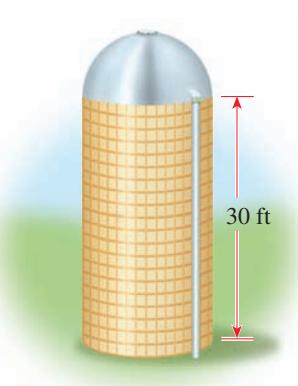
Volume of a Silo. A grain silo consists of a cylindrical main section and a hemispherical roof. If the total volume of the silo (including the part inside the roof section) is 15,000 \(\text{ft}^3\) and the cylindrical part is 30 ft tall, what is the radius of the silo, rounded to the nearest tenth of a foot?
question image
99 Applications - Dimensions of a Lot · Level 3
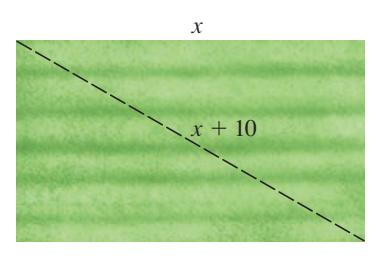
Dimensions of a Lot. A rectangular parcel of land has an area of 5000 \(\text{ft}^2\). A diagonal between opposite corners is measured to be 10 ft longer than one side of the parcel. What are the dimensions of the land, rounded to the nearest foot?
question image
100 Applications - Depth of Snowfall · Level 3
Depth of Snowfall. Snow began falling at noon on Sunday. The amount of snow on the ground at a certain location at time \(t\) was given by the function \(h(t) = 11.60 t - 12.41 t^2 + 6.20 t^3 - 1.58 t^4 + 0.20 t^5 - 0.01 t^6\) where \(t\) is measured in days from the start of the snowfall and \(h(t)\) is the depth of snow in inches. Draw a graph of this function, and use your graph to answer the following questions.
(a) What happened shortly after noon on Tuesday?
(b) Was there ever more than 5 in. of snow on the ground? If so, on what day(s)?
(c) On what day and at what time (to the nearest hour) did the snow disappear completely?

Enter your answer directly below each part above.

101 Applications - Volume of a Box · Level 4
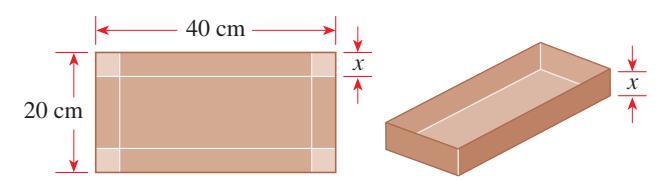
Volume of a Box. An open box with a volume of 1500 \(\text{cm}^3\) is to be constructed by taking a piece of cardboard 20 cm by 40 cm, cutting squares of side length \(x\) cm from each corner, and folding up the sides. Show that this can be done in two different ways, and find the exact dimensions of the box in each case.
question image
102 Applications - Volume of a Rocket · Level 4
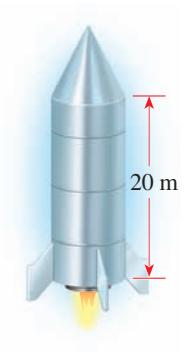
Volume of a Rocket. A rocket consists of a right circular cylinder of height 20 m surmounted by a cone whose height and diameter are equal and whose radius is the same as that of the cylindrical section. What should this radius be (rounded to two decimal places) if the total volume is to be \(\dfrac{500 \pi}{3}\) \(\text{m}^3\)?
question image
103 Application - Volume of a Box · Level 4
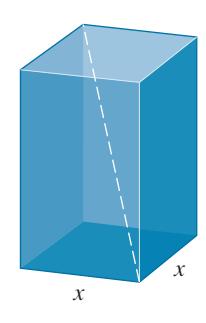
Volume of a Box. A rectangular box with a volume of \(2 \sqrt{2}\) ft³ has a square base as shown. The diagonal of the box (between a pair of opposite corners) is 1 ft longer than each side of the base.
question image
(a) If the base has sides of length \(x\) feet, show that \(x^6 - 2 x^5 - x^4 + 8 = 0\).
(b) Show that two different boxes satisfy the given conditions. Find the dimensions in each case, rounded to the nearest hundredth of a foot.

Enter your answer directly below each part above.

104 Application - Girth of a Box · Level 3
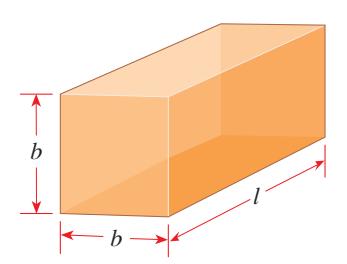
Girth of a Box. A box with a square base has length plus girth of 108 in. (Girth is the distance "around" the box.) What is the length of the box if its volume is 2200 in³?
question image
105 Discovery - Real Zeros of a Polynomial · Level 3
How Many Real Zeros Can a Polynomial Have? Give examples of polynomials that have the following properties, or explain why it is impossible to find such a polynomial.
(a) A polynomial of degree 3 that has no real zeros
(b) A polynomial of degree 4 that has no real zeros
(c) A polynomial of degree 3 that has three real zeros, only one of which is rational
(d) A polynomial of degree 4 that has four real zeros, none of which is rational What must be true about the degree of a polynomial with integer coefficients if it has no real zeros?

Enter your answer directly below each part above.

106 Discovery - The Depressed Cubic · Level 4
The Depressed Cubic. The most general cubic (third-degree) equation with rational coefficients can be written as \(x^3 + a x^2 + b x + c = 0\)
(a) Show that if we replace \(x\) by \(X - \dfrac{a}{3}\) and simplify, we end up with an equation that doesn't have an \(X^2\) term, that is, an equation of the form \(X^3 + p X + q = 0\). This is called a depressed cubic, because we have "depressed" the quadratic term.
(b) Use the procedure described in part (a) to depress the equation \(x^3 + 6 x^2 + 9 x + 4 = 0\).

Enter your answer directly below each part above.

107 Discovery - The Cubic Formula · Level 4
The Cubic Formula. The quadratic formula can be used to solve any quadratic (or second-degree) equation. You might have wondered whether similar formulas exist for cubic (third-degree), quartic (fourth-degree), and higher-degree equations. For the depressed cubic \(x^3 + p x + q = 0\), Cardano found the following formula for one solution: \(x = \sqrt[3]{-\dfrac{q}{2} + \sqrt{q^2/4 + p^3/27}} + \sqrt[3]{-\dfrac{q}{2} - \sqrt{q^2/4 + p^3/27}}\) A formula for quartic equations was discovered by the Italian mathematician Ferrari in 1540. In 1824 the Norwegian mathematician Niels Henrik Abel proved that it is impossible to write a quintic formula, that is, a formula for fifth-degree equations. Finally, Galois gave a criterion for determining which equations can be solved by a formula involving radicals. Use the cubic formula to find a solution for the following equations. Then solve the equations using the methods you learned in this section. Which method is easier?
question image
(a) \(x^3 - 3 x + 2 = 0\)
(b) \(x^3 - 27 x - 54 = 0\)
(c) \(x^3 + 3 x + 4 = 0\)

Enter your answer directly below each part above.

108 Example - Solving a Fourth-Degree Equation Graphically · Level 3
Find all real solutions of the following equation, rounded to the nearest tenth. \(3x^4 + 4x^3 - 7x^2 - 2x - 3 = 0\)
109 Example - Determining the Size of a Fuel Tank · Level 3
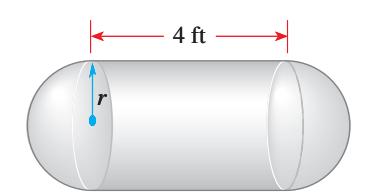
A fuel tank consists of a cylindrical center section that is 4 ft long and two hemispherical end sections, as shown in the figure. If the tank has a volume of 100 \(\text{ft}^3\), what is the radius \(r\) shown in the figure, rounded to the nearest hundredth of a foot?
question image

Answered: 0 / 109