Stewart Section 10.6: Conic Sections in Polar Coordinates

31 questions

--:--
0 / 31
Stewart Section 10.6: Conic Sections in Polar Coordinates 0/31
1 Polar Conics - Equation Writing · Level 2
Write a polar equation of a conic with the focus at the origin and the given data. Ellipse, eccentricity \(\dfrac{1}{2}\), directrix \(x = 4\)
2 Polar Conics - Equation Writing · Level 2
Write a polar equation of a conic with the focus at the origin and the given data. Parabola, directrix \(x = -3\)
3 Polar Conics - Equation Writing · Level 2
Write a polar equation of a conic with the focus at the origin and the given data. Hyperbola, eccentricity \(1.5\), directrix \(y = 2\)
4 Polar Conics - Equation Writing · Level 2
Write a polar equation of a conic with the focus at the origin and the given data. Hyperbola, eccentricity \(3\), directrix \(x = 3\)
5 Polar Conics - Equation Writing · Level 3
Write a polar equation of a conic with the focus at the origin and the given data. Ellipse, eccentricity \(\dfrac{2}{3}\), vertex \((2, \pi)\)
6 Polar Conics - Equation Writing · Level 3
Write a polar equation of a conic with the focus at the origin and the given data. Ellipse, eccentricity \(0.6\), directrix \(r = 4 \csc \theta\)
7 Polar Conics - Equation Writing · Level 3
Write a polar equation of a conic with the focus at the origin and the given data. Parabola, vertex \(\left(3, \dfrac{\pi}{2}\right)\)
8 Polar Conics - Equation Writing · Level 3
Write a polar equation of a conic with the focus at the origin and the given data. Hyperbola, eccentricity \(2\), directrix \(r = -2 \sec \theta\)
9 Polar Conics - Analysis · Level 3
(a) Find the eccentricity, (b) identify the conic, (c) give an equation of the directrix, and (d) sketch the conic. \(r = \dfrac{4}{5 - 4 \sin \theta}\)
10 Polar Conics - Analysis · Level 3
(a) Find the eccentricity, (b) identify the conic, (c) give an equation of the directrix, and (d) sketch the conic. \(r = \dfrac{1}{2 + \sin \theta}\)
11 Polar Conics - Analysis · Level 3
(a) Find the eccentricity, (b) identify the conic, (c) give an equation of the directrix, and (d) sketch the conic. \(r = \dfrac{2}{3 + 3 \sin \theta}\)
12 Polar Conics - Analysis · Level 3
(a) Find the eccentricity, (b) identify the conic, (c) give an equation of the directrix, and (d) sketch the conic. \(r = \dfrac{5}{2 - 4 \cos \theta}\)
13 Polar Conics - Analysis · Level 3
(a) Find the eccentricity, (b) identify the conic, (c) give an equation of the directrix, and (d) sketch the conic. \(r = \dfrac{9}{6 + 2 \cos \theta}\)
14 Polar Conics - Analysis · Level 3
(a) Find the eccentricity, (b) identify the conic, (c) give an equation of the directrix, and (d) sketch the conic. \(r = \dfrac{1}{3 - 3 \sin \theta}\)
15 Polar Conics - Analysis · Level 3
(a) Find the eccentricity, (b) identify the conic, (c) give an equation of the directrix, and (d) sketch the conic. \(r = \dfrac{3}{4 - 8 \cos \theta}\)
16 Polar Conics - Analysis · Level 3
(a) Find the eccentricity, (b) identify the conic, (c) give an equation of the directrix, and (d) sketch the conic. \(r = \dfrac{4}{2 + 3 \cos \theta}\)
17 Polar Conics - Graphing · Level 3
(a) Find the eccentricity and directrix of the conic \(r = \dfrac{1}{1 - 2 \sin \theta}\) and graph the conic and its directrix.
(b) If this conic is rotated counterclockwise about the origin through an angle \(3 \dfrac{\pi}{4}\), write the resulting equation and graph its curve.

Enter your answer directly below each part above.

18 Polar Conics - Graphing · Level 3
Graph the conic \(r = \dfrac{4}{5 + 6 \cos \theta}\) and its directrix. Also graph the conic obtained by rotating this curve about the origin through an angle \(\dfrac{\pi}{3}\).
19 Polar Conics - Graphing · Level 3
Graph the conics \(r = \dfrac{e}{1 - e \cos \theta}\) with \(e = 0.4\), \(0.6\), \(0.8\), and \(1.0\) on a common screen. How does the value of \(e\) affect the shape of the curve?
20 Polar Conics - Graphing · Level 3
(a) Graph the conics \(r = \dfrac{e d}{1 + e \sin \theta}\) for \(e = 1\) and various values of \(d\). How does the value of \(d\) affect the shape of the conic?
(b) Graph these conics for \(d = 1\) and various values of \(e\). How does the value of \(e\) affect the shape of the conic?

Enter your answer directly below each part above.

21 Polar Conics - Proof · Level 4
Show that a conic with focus at the origin, eccentricity \(e\), and directrix \(x = -d\) has polar equation \(r = \dfrac{e d}{1 - e \cos \theta}\)
22 Polar Conics - Proof · Level 4
Show that a conic with focus at the origin, eccentricity \(e\), and directrix \(y = d\) has polar equation \(r = \dfrac{e d}{1 + e \sin \theta}\)
23 Polar Conics - Proof · Level 4
Show that a conic with focus at the origin, eccentricity \(e\), and directrix \(y = -d\) has polar equation \(r = \dfrac{e d}{1 - e \sin \theta}\)
24 Polar Conics - Proof · Level 4
Show that the parabolas \(r = \dfrac{c}{1 + \cos \theta}\) and \(r = \dfrac{d}{1 - \cos \theta}\) intersect at right angles.
25 Polar Conics - Planetary Orbits · Level 3
The orbit of Mars around the sun is an ellipse with eccentricity \(0.093\) and semimajor axis \(2.28 \times 10^8\) km. Find a polar equation for the orbit.
26 Polar Conics - Planetary Orbits · Level 3
Jupiter's orbit has eccentricity \(0.048\) and the length of the major axis is \(1.56 \times 10^9\) km. Find a polar equation for the orbit.
27 Polar Conics - Comets · Level 3
The orbit of Halley's comet, last seen in 1986 and due to return in 2061, is an ellipse with eccentricity \(0.97\) and one focus at the sun. The length of its major axis is \(36.18\) AU. [An astronomical unit (AU) is the mean distance between the earth and the sun, about 93 million miles.] Find a polar equation for the orbit of Halley's comet. What is the maximum distance from the comet to the sun?
28 Polar Conics - Comets · Level 3
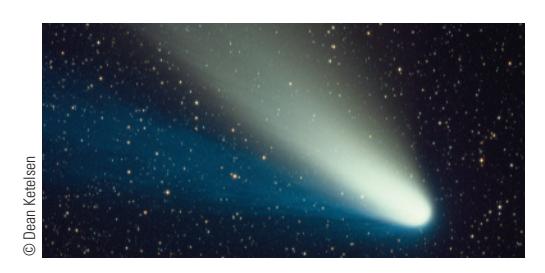
Comet Hale-Bopp, discovered in 1995, has an elliptical orbit with eccentricity \(0.9951\). The length of the orbit's major axis is \(356.5\) AU. Find a polar equation for the orbit of this comet. How close to the sun does it come?
question image
29 Polar Conics - Planetary Orbits · Level 3
The planet Mercury travels in an elliptical orbit with eccentricity \(0.206\). Its minimum distance from the sun is \(4.6 \times 10^7\) km. Find its maximum distance from the sun.
30 Polar Conics - Planetary Orbits · Level 3
The distance from the dwarf planet Pluto to the sun is \(4.43 \times 10^9\) km at perihelion and \(7.37 \times 10^9\) km at aphelion. Find the eccentricity of Pluto's orbit.
31 Polar Conics - Arc Length · Level 4
Using the data from Exercise 29, find the distance traveled by the planet Mercury during one complete orbit around the sun. (If your calculator or computer algebra system evaluates definite integrals, use it. Otherwise, use Simpson's Rule.)

Answered: 0 / 31