Stewart Precalc 6e Section 4.3: Logarithmic Functions

105 questions

--:--
0 / 105
Stewart Precalc 6e Section 4.3: Logarithmic Functions 0/105
1 Concepts - Definition of Logarithm · Level 1
\(\log x\) is the exponent to which the base \(10\) must be raised to get _____. So we can complete the following table for \(\log x\): for \(x = 10^3, 10^2, 10^1, 10^0, 10^{-1}, 10^{-2}, 10^{-3}, 10^{\dfrac{1}{2}}\), find \(\log x\).
2 Concepts - Logarithm Function Values · Level 1
The function \(f(x) = \log_9 x\) is the logarithm function with base _____, \(f(1) = ?\), \(f\left(\dfrac{1}{9}\right) = ?\), \(f(81) = ?\), and \(f(3) = ?\).
3 Concepts - Exponential and Logarithmic Forms · Level 1
(a) \(5^3 = 125\), so \(\log_? ? = ?\). (b) \(\log_5 25 = 2\), so \(? = ?\).
4 Concepts - Matching Graphs · Level 1
Match the logarithmic function with its graph. (a) \(f(x) = \log_2 x\) (b) \(f(x) = \log_2(-x)\) (c) \(f(x) = -\log_2 x\) (d) \(f(x) = -\log_2(-x)\)
question image
5 Skills - Logarithmic and Exponential Form Table · Level 2
Complete the table by finding the appropriate logarithmic or exponential form of each equation (base 8). Given: Exponential \(8^{\dfrac{1}{3}} = 2\), \(8^{\dfrac{2}{3}} = 4\), \(8^3 = 512\), \(8^{-2} = \dfrac{1}{64}\), and Logarithmic \(\log_8\left(\dfrac{1}{8}\right) = -1\), \(\log_8\left(\dfrac{1}{32}\right) = -\dfrac{5}{3}\).
6 Skills - Logarithmic and Exponential Form Table · Level 2
Complete the table by finding the appropriate logarithmic or exponential form (base 4). Given: \(4^3 = 64\), \(\log_4 2 = \dfrac{1}{2}\), \(4^{\dfrac{3}{2}} = 8\), \(\log_4\left(\dfrac{1}{16}\right) = -2\), \(\log_4\left(\dfrac{1}{2}\right) = -\dfrac{1}{2}\), \(4^{-\dfrac{5}{2}} = \dfrac{1}{32}\).
7 Skills - Express in Exponential Form · Level 2
Express the equation in exponential form. (a) \(\log_5 25 = 2\) (b) \(\log_5 1 = 0\)
8 Skills - Express in Exponential Form · Level 2
Express the equation in exponential form. (a) \(\log_{10} 0.1 = -1\) (b) \(\log_8 512 = 3\)
9 Skills - Express in Exponential Form · Level 2
Express the equation in exponential form. (a) \(\log_8 2 = \dfrac{1}{3}\) (b) \(\log_2\left(\dfrac{1}{8}\right) = -3\)
10 Skills - Express in Exponential Form · Level 2
Express the equation in exponential form. (a) \(\log_3 81 = 4\) (b) \(\log_8 4 = \dfrac{2}{3}\)
11 Skills - Express in Exponential Form · Level 2
Express the equation in exponential form. (a) \(\ln 5 = x\) (b) \(\ln y = 5\)
12 Skills - Express in Exponential Form · Level 2
Express the equation in exponential form. (a) \(\ln(x + 1) = 2\) (b) \(\ln(x - 1) = 4\)
13 Skills - Express in Logarithmic Form · Level 2
Express the equation in logarithmic form. (a) \(5^3 = 125\) (b) \(10^{-4} = 0.0001\)
14 Skills - Express in Logarithmic Form · Level 2
Express the equation in logarithmic form. (a) \(10^3 = 1000\) (b) \(81^{\dfrac{1}{2}} = 9\)
15 Skills - Express in Logarithmic Form · Level 2
Express the equation in logarithmic form. (a) \(8^{-1} = \dfrac{1}{8}\) (b) \(2^{-3} = \dfrac{1}{8}\)
16 Skills - Express in Logarithmic Form · Level 2
Express the equation in logarithmic form. (a) \(4^{-\dfrac{3}{2}} = 0.125\) (b) \(7^3 = 343\)
17 Skills - Express in Logarithmic Form · Level 2
Express the equation in logarithmic form. (a) \(e^x = 2\) (b) \(e^3 = y\)
18 Skills - Express in Logarithmic Form · Level 2
Express the equation in logarithmic form. (a) \(e^{x+1} = 0.5\) (b) \(e^{0.5 x} = t\)
19 Skills - Evaluate Logarithms · Level 2
Evaluate the expression. (a) \(\log_3 3\) (b) \(\log_3 1\) (c) \(\log_3 3^2\)
20 Skills - Evaluate Logarithms · Level 2
Evaluate the expression. (a) \(\log_5 5^4\) (b) \(\log_4 64\) (c) \(\log_3 9\)
21 Skills - Evaluate Logarithms · Level 2
Evaluate the expression. (a) \(\log_6 36\) (b) \(\log_9 81\) (c) \(\log_7 7^{10}\)
22 Skills - Evaluate Logarithms · Level 2
Evaluate the expression. (a) \(\log_2 32\) (b) \(\log_8 8^{17}\) (c) \(\log_6 1\)
23 Skills - Evaluate Logarithms · Level 2
Evaluate the expression. (a) \(\log_3\left(\dfrac{1}{27}\right)\) (b) \(\log_{10} \sqrt{10}\) (c) \(\log_5 0.2\)
24 Skills - Evaluate Logarithms · Level 2
Evaluate the expression. (a) \(\log_5 125\) (b) \(\log_{49} 7\) (c) \(\log_9 \sqrt{3}\)
25 Skills - Evaluate Logarithms · Level 2
Evaluate the expression. (a) \(2^{\log_2 37}\) (b) \(3^{\log_3 8}\) (c) \(e^{\ln \sqrt{5}}\)
26 Skills - Evaluate Logarithms · Level 2
Evaluate the expression. (a) \(e^{\ln \pi}\) (b) \(10^{\log 5}\) (c) \(10^{\log 87}\)
27 Skills - Evaluate Logarithms · Level 2
Evaluate the expression. (a) \(\log_8 0.25\) (b) \(\ln e^4\) (c) \(\ln\left(\dfrac{1}{e}\right)\)
28 Skills - Evaluate Logarithms · Level 2
Evaluate the expression. (a) \(\log_4 \sqrt{2}\) (b) \(\log_4\left(\dfrac{1}{2}\right)\) (c) \(\log_4 8\)
29 Skills - Solve for x · Level 2
Use the definition of the logarithmic function to find \(x\). (a) \(\log_2 x = 5\) (b) \(\log_2 16 = x\)
30 Skills - Solve for x · Level 2
Find \(x\). (a) \(\log_5 x = 4\) (b) \(\log_{10} 0.1 = x\)
31 Skills - Solve for x · Level 2
Find \(x\). (a) \(\log_3 243 = x\) (b) \(\log_3 x = 3\)
32 Skills - Solve for x · Level 2
Find \(x\). (a) \(\log_4 2 = x\) (b) \(\log_4 x = 2\)
33 Skills - Solve for x · Level 2
Find \(x\). (a) \(\log_{10} x = 2\) (b) \(\log_5 x = 2\)
34 Skills - Solve for Base · Level 2
Find \(x\). (a) \(\log_x 1000 = 3\) (b) \(\log_x 25 = 2\)
35 Skills - Solve for Base · Level 2
Find \(x\). (a) \(\log_x 16 = 4\) (b) \(\log_x 8 = \dfrac{3}{2}\)
36 Skills - Solve for Base · Level 2
Find \(x\). (a) \(\log_x 6 = \dfrac{1}{2}\) (b) \(\log_x 3 = \dfrac{1}{3}\)
37 Skills - Calculator Evaluation · Level 2
Use a calculator to evaluate the expression, correct to four decimal places. (a) \(\log 2\) (b) \(\log 35.2\) (c) \(\log\left(\dfrac{2}{3}\right)\)
38 Skills - Calculator Evaluation · Level 2
Evaluate to four decimal places. (a) \(\log 50\) (b) \(\log \sqrt{2}\) (c) \(\log(3 \sqrt{2})\)
39 Skills - Calculator Evaluation · Level 2
Evaluate to four decimal places. (a) \(\ln 5\) (b) \(\ln 25.3\) (c) \(\ln(1 + \sqrt{3})\)
40 Skills - Calculator Evaluation · Level 2
Evaluate to four decimal places. (a) \(\ln 27\) (b) \(\ln 7.39\) (c) \(\ln 54.6\)
41 Skills - Sketch Graph · Level 2
Sketch the graph of \(f(x) = \log_3 x\) by plotting points.
42 Skills - Sketch Graph · Level 2
Sketch the graph of \(g(x) = \log_4 x\) by plotting points.
43 Skills - Sketch Graph · Level 2
Sketch the graph of \(f(x) = 2 \log x\) by plotting points.
44 Skills - Sketch Graph · Level 2
Sketch the graph of \(g(x) = 1 + \log x\) by plotting points.
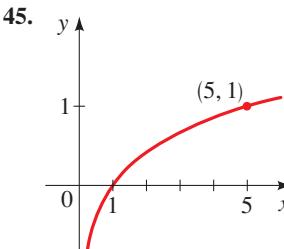
45 Skills - Identify Function from Graph · Level 3
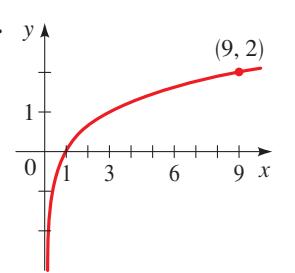
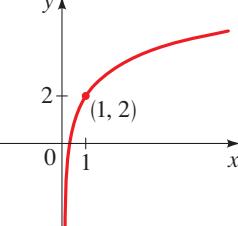
Find the function of the form \(y = \log_a x\) whose graph is given.
question image
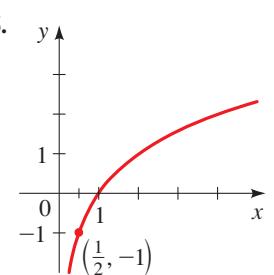
46 Skills - Identify Function from Graph · Level 3
Find the function of the form \(y = \log_a x\) whose graph is given.
question image
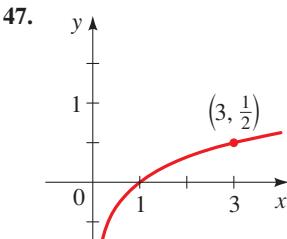
47 Skills - Identify Function from Graph · Level 3
Find the function of the form \(y = \log_a x\) whose graph is given.
question image
48 Skills - Identify Function from Graph · Level 3
Find the function of the form \(y = \log_a x\) whose graph is given.
question image
49 Skills - Match Graph · Level 3
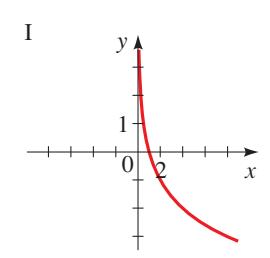
Match the logarithmic function \(f(x) = 2 + \ln x\) with one of the graphs labeled I or II.
question image
50 Skills - Match Graph · Level 3
Match the logarithmic function \(f(x) = \ln(x - 2)\) with one of the graphs labeled I or II.
question image
51 Skills - Inverse Graphs · Level 2
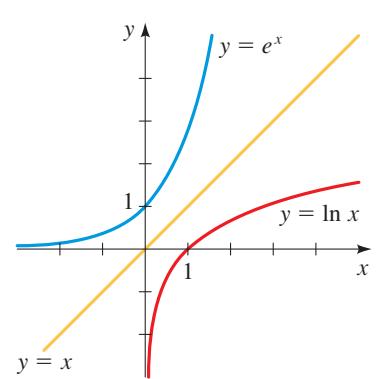
Draw the graph of \(y = 4^x\), then use it to draw the graph of \(y = \log_4 x\).
52 Skills - Inverse Graphs · Level 2
Draw the graph of \(y = 3^x\), then use it to draw the graph of \(y = \log_3 x\).
53 Skills - Transform Graph · Level 3
Graph the function \(f(x) = \log_2(x - 4)\), not by plotting points, but by starting from the graphs in Figures 4 and 9. State the domain, range, and asymptote.
54 Skills - Transform Graph · Level 3
Graph \(f(x) = -\log_{10} x\). State the domain, range, and asymptote.
55 Skills - Transform Graph · Level 3
Graph \(g(x) = \log_5(-x)\). State the domain, range, and asymptote.
56 Skills - Transform Graph · Level 3
Graph \(g(x) = \ln(x + 2)\). State the domain, range, and asymptote.
57 Skills - Transform Graph · Level 3
Graph \(y = 2 + \log_3 x\). State the domain, range, and asymptote.
58 Skills - Transform Graph · Level 3
Graph \(y = \log_3(x - 1) - 2\). State the domain, range, and asymptote.
59 Skills - Transform Graph · Level 3
Graph \(y = 1 - \log_{10} x\). State the domain, range, and asymptote.
60 Skills - Transform Graph · Level 3
Graph \(y = 1 + \ln(-x)\). State the domain, range, and asymptote.
61 Skills - Transform Graph · Level 3
Graph \(y = |\ln x|\). State the domain, range, and asymptote.
62 Skills - Transform Graph · Level 3
Graph \(y = \ln |x|\). State the domain, range, and asymptote.
63 Skills - Find Domain · Level 2
Find the domain of the function \(f(x) = \log_{10}(x + 3)\).
64 Skills - Find Domain · Level 2
Find the domain of \(f(x) = \log_5(8 - 2x)\).
65 Skills - Find Domain · Level 3
Find the domain of \(g(x) = \log_3(x^2 - 1)\).
66 Skills - Find Domain · Level 3
Find the domain of \(g(x) = \ln(x - x^2)\).
67 Skills - Find Domain · Level 3
Find the domain of \(h(x) = \ln x + \ln(2 - x)\).
68 Skills - Find Domain · Level 3
Find the domain of \(h(x) = \sqrt{x - 2} - \log_5(10 - x)\).
69 Skills - Graph with Calculator · Level 3
Draw the graph of \(y = \log_{10}(1 - x^2)\) in a suitable viewing rectangle, and use it to find the domain, the asymptotes, and the local maximum and minimum values.
70 Skills - Graph with Calculator · Level 3
Draw the graph of \(y = \ln(x^2 - x)\) and find domain, asymptotes, and local extrema.
71 Skills - Graph with Calculator · Level 3
Draw the graph of \(y = x + \ln x\) and find domain, asymptotes, and local extrema.
72 Skills - Graph with Calculator · Level 3
Draw the graph of \(y = x(\ln x)^2\) and find domain, asymptotes, and local extrema.
73 Skills - Graph with Calculator · Level 3
Draw the graph of \(y = \dfrac{\ln x}{x}\) and find domain, asymptotes, and local extrema.
74 Skills - Graph with Calculator · Level 3
Draw the graph of \(y = x \log_{10}(x + 10)\) and find domain, asymptotes, and local extrema.
75 Skills - Composition of Functions · Level 3
Find the functions \(f \circ g\) and \(g \circ f\) and their domains, where \(f(x) = 2^x\) and \(g(x) = x + 1\).
76 Skills - Composition of Functions · Level 3
Find \(f \circ g\) and \(g \circ f\) and their domains: \(f(x) = 3^x\), \(g(x) = x^2 + 1\).
77 Skills - Composition of Functions · Level 3
Find \(f \circ g\) and \(g \circ f\) and their domains: \(f(x) = \log_2 x\), \(g(x) = x - 2\).
78 Skills - Composition of Functions · Level 3
Find \(f \circ g\) and \(g \circ f\) and their domains: \(f(x) = \log x\), \(g(x) = x^2\).
79 Skills - Compare Growth Rates · Level 3
Compare the rates of growth of the functions \(f(x) = \ln x\) and \(g(x) = \sqrt{x}\) by drawing their graphs on a common screen using the viewing rectangle \([-1, 30]\) by \([-1, 6]\).
80 Skills - Logarithm vs Root Function · Level 4
(a) By drawing the graphs of the functions \(f(x) = 1 + \ln(1 + x)\) and \(g(x) = \sqrt{x}\) in a suitable viewing rectangle, show that even when a logarithmic function starts out higher than a root function, it is ultimately overtaken by the root function. (b) Find, correct to two decimal places, the solutions of the equation \(\sqrt{x} = 1 + \ln(1 + x)\).
81 Skills - Family of Functions · Level 3
A family of functions \(f(x) = \log(c x)\) is given. (a) Draw graphs of the family for \(c = 1, 2, 3, 4\). (b) How are the graphs in part (a) related?
82 Skills - Family of Functions · Level 3
Family: \(f(x) = c \log x\). (a) Draw graphs for \(c = 1, 2, 3, 4\). (b) How are the graphs related?
83 Skills - Composition Domain and Inverse · Level 4
A function \(f(x) = \log_2(\log_{10} x)\) is given. (a) Find the domain of the function \(f\). (b) Find the inverse function of \(f\).
84 Skills - Composition Domain and Inverse · Level 4
Given \(f(x) = \ln(\ln(\ln x))\). (a) Find the domain of \(f\). (b) Find the inverse function of \(f\).
85 Skills - Inverse Function · Level 4
(a) Find the inverse of the function \(f(x) = \dfrac{2^x}{1 + 2^x}\). (b) What is the domain of the inverse function?
86 Applications - Absorption of Light · Level 3
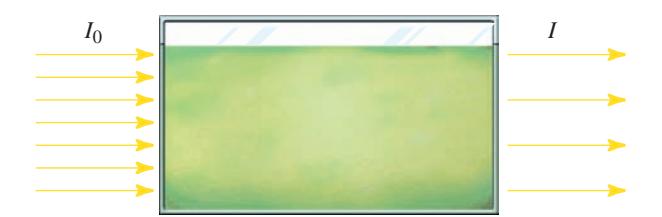
A spectrophotometer measures the concentration of a sample dissolved in water by shining a light through it and recording the amount of light that emerges. For a certain substance the concentration (in moles per liter) is found by using the formula \(C = -2500 \ln\left(\dfrac{I}{I_0}\right)\) where \(I_0\) is the intensity of the incident light and \(I\) is the intensity of light that emerges. Find the concentration of the substance if the intensity \(I\) is \(70%\) of \(I_0\).
question image
87 Applications - Carbon Dating · Level 3
The age of an ancient artifact can be determined by the amount of radioactive carbon-14 remaining in it. If \(D_0\) is the original amount of carbon-14 and \(D\) is the amount remaining, then the artifact's age \(A\) (in years) is given by \(A = -8267 \ln\left(\dfrac{D}{D_0}\right)\). Find the age of an object if the amount \(D\) of carbon-14 that remains in the object is \(73%\) of the original amount \(D_0\).
88 Applications - Bacteria Colony · Level 3
A certain strain of bacteria divides every three hours. If a colony is started with 50 bacteria, then the time \(t\) (in hours) required for the colony to grow to \(N\) bacteria is given by \(t = 3 \dfrac{\log\left(\dfrac{N}{50}\right)}{\log 2}\). Find the time required for the colony to grow to a million bacteria.
89 Applications - Investment · Level 3
The time required to double the amount of an investment at an interest rate \(r\) compounded continuously is given by \(t = \dfrac{\ln 2}{r}\). Find the time required to double an investment at \(6%\), \(7%\), and \(8%\).
90 Applications - Charging a Battery · Level 3
The rate at which a battery charges is slower the closer the battery is to its maximum charge \(C_0\). The time (in hours) required to charge a fully discharged battery to a charge \(C\) is given by \(t = -k \ln\left(1 - \dfrac{C}{C_0}\right)\) where \(k\) is a positive constant. For a certain battery, \(k = 0.25\). If this battery is fully discharged, how long will it take to charge to \(90%\) of its maximum charge \(C_0\)?
91 Applications - Fitts's Law · Level 3
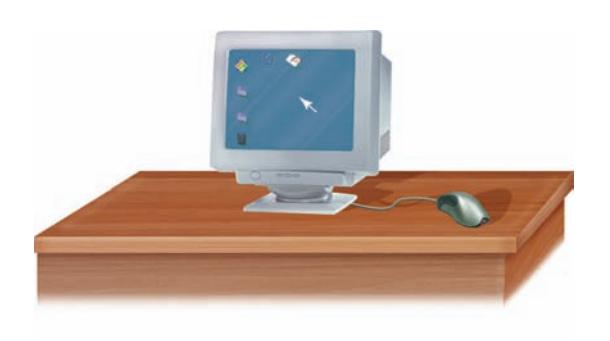
The difficulty in acquiring a target (such as using your mouse to click on an icon on your computer screen) depends on the distance to the target and the size of the target. According to Fitts's Law, the index of difficulty (ID) is given by \(\text{ID} = \dfrac{\log(2 A slash W)}{\log 2}\) where \(W\) is the width of the target and \(A\) is the distance to the center of the target. Compare the difficulty of clicking on an icon that is 5 mm wide to clicking on one that is 10 mm wide. In each case, assume that the mouse is 100 mm from the icon.
question image
92 Discovery - The Height of the Graph · Level 4
Suppose that the graph of \(y = 2^x\) is drawn on a coordinate plane where the unit of measurement is an inch. (a) Show that at a distance 2 ft to the right of the origin the height of the graph is about 265 mi. (b) If the graph of \(y = \log_2 x\) is drawn on the same set of axes, how far to the right of the origin do we have to go before the height of the curve reaches 2 ft?
93 Discovery - Googolplex · Level 4
A googol is \(10^{100}\), and a googolplex is \(10^{\text{googol}}\). Find \(\log(\log(\text{googol}))\) and \(\log(\log(\log(\text{googolplex})))\).
94 Discovery - Comparing Logarithms · Level 4
Which is larger, \(\log_4 17\) or \(\log_5 24\)? Explain your reasoning.
95 Discovery - Number of Digits · Level 4
Compare \(\log 1000\) to the number of digits in 1000. Do the same for 10,000. How many digits does any number between 1000 and 10,000 have? Between what two values must the common logarithm of such a number lie? Use your observations to explain why the number of digits in any positive integer \(x\) is \(\lfloor \log x \rfloor + 1\) (where \(\lfloor n \rfloor\) is the greatest integer function). How many digits does the number \(2^{100}\) have?
96 Example - Evaluating Logarithms · Level 1
Evaluate each logarithm.
(a) \(\log_{10} 1000\)
(b) \(\log_2 32\)
(c) \(\log_{10} 0.1\)
(d) \(\log_{16} 4\)

Enter your answer directly below each part above.

97 Example - Properties of Logarithms · Level 1
Illustrate the four properties of logarithms when the base is 5.
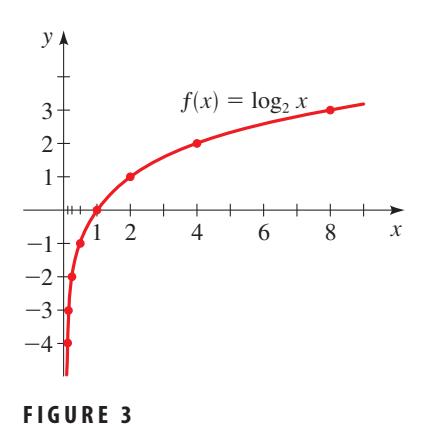
98 Example - Graphing Logarithmic Functions by Plotting Points · Level 2
Sketch the graph of \(f(x) = \log_2 x\) by plotting points.
question image
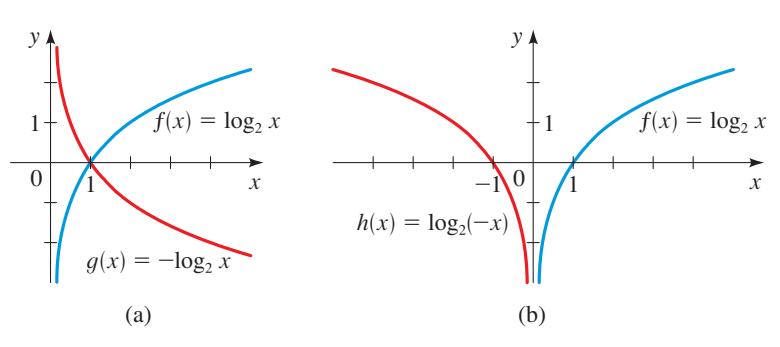
99 Example - Reflecting Graphs of Logarithmic Functions · Level 2
Sketch the graph of each function.
question image
(a) \(g(x) = -\log_2 x\)
(b) \(h(x) = \log_2(-x)\)

Enter your answer directly below each part above.

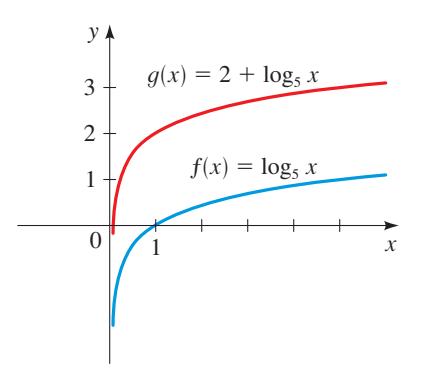
100 Example - Shifting Graphs of Logarithmic Functions · Level 2
Find the domain of each function, and sketch the graph.
question image
(a) \(g(x) = 2 + \log_5 x\)
(b) \(h(x) = \log_{10}(x - 3)\)

Enter your answer directly below each part above.

101 Example - Evaluating Common Logarithms · Level 1
Use a calculator to find appropriate values of \(f(x) = \log x\) and use the values to sketch the graph.
question image
102 Example - Common Logarithms and Sound · Level 2
The perception of the loudness \(B\) (in decibels, dB) of a sound with physical intensity \(I\) (in W/m²) is given by \(B = 10 \log\left(\dfrac{I}{I_0}\right)\) where \(I_0\) is the physical intensity of a barely audible sound. Find the decibel level (loudness) of a sound whose physical intensity \(I\) is 100 times that of \(I_0\).
103 Example - Evaluating the Natural Logarithm Function · Level 2
Evaluate each expression. (a) \(\ln e^8\) (b) \(\ln\left(\dfrac{1}{e^2}\right)\) (c) \(\ln 5\)
104 Example - Finding the Domain of a Logarithmic Function · Level 2
Find the domain of the function \(f(x) = \ln(4 - x^2)\).
105 Example - Drawing the Graph of a Logarithmic Function · Level 3
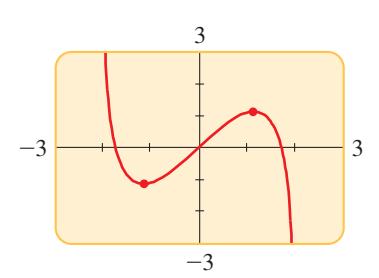
Draw the graph of the function \(y = x \ln(4 - x^2)\), and use it to find the asymptotes and local maximum and minimum values.
question image

Answered: 0 / 105