Stewart Precalc 6e Section 1.5: Equations

136 questions

--:--
0 / 136
Stewart Precalc 6e Section 1.5: Equations 0/136
1 Concept Check · Level 1
True or false? (a) Adding the same number to each side of an equation always gives an equivalent equation. (b) Multiplying each side of an equation by the same number always gives an equivalent equation. (c) Squaring each side of an equation always gives an equivalent equation.
2 Concept Check · Level 1
Explain how you would use each method to solve the equation \(x^2 - 4x - 5 = 0\). (a) By factoring. (b) By completing the square. (c) By using the Quadratic Formula.
3 Concept Check · Level 1
(a) The solutions of the equation \(x^2 (x - 4) = 0\) are ___. (b) To solve the equation \(x^3 - 4x^2 = 0\), we ___ the left-hand side.
4 Concept Check · Level 1
Solve the equation \(\sqrt{2x} + x = 0\) by doing the following. (a) Isolate the radical. (b) Square both sides. (c) The solutions of the resulting quadratic equation are ___. (d) The solution(s) that satisfy the original equation are ___.
5 Concept Check · Level 1
The equation \((x + 1)^2 - 5(x + 1) + 6 = 0\) is of ___ type. To solve the equation, we set \(W = \) ___. The resulting quadratic equation is ___.
6 Concept Check · Level 1
The equation \(x^6 + 7x^3 - 8 = 0\) is of ___ type. To solve the equation, we set \(W = \) ___. The resulting quadratic equation is ___.
7 Verify Solution · Level 1
Determine whether the given value is a solution of the equation \(4x + 7 = 9x - 3\). (a) \(x = -2\) (b) \(x = 2\)
8 Verify Solution · Level 1
Determine whether the given value is a solution of the equation \(1 - [2 - (3 - x)] = 4x - (6 + x)\). (a) \(x = 2\) (b) \(x = 4\)
9 Verify Solution · Level 2
Determine whether the given value is a solution of the equation \(\dfrac{1}{x} - \dfrac{1}{x - 4} = 1\).
10 Verify Solution · Level 2
Determine whether the given value is a solution of the equation \(\dfrac{x^{\dfrac{3}{2}}}{x - 6} = x - 8\). (a) \(x = 4\) (b) \(x = 8\)
11 Linear Equation · Level 1
Solve the equation \(2x + 7 = 31\).
12 Linear Equation · Level 1
Solve the equation \(5x - 3 = 4\).
13 Linear Equation · Level 1
Solve the equation \(\dfrac{1}{2} x - 8 = 1\).
14 Linear Equation · Level 1
Solve the equation \(3 + \dfrac{1}{3} x = 5\).
15 Linear Equation · Level 1
Solve the equation \(-7w = 15 - 2w\).
16 Linear Equation · Level 1
Solve the equation \(5t - 13 = 12 - 5t\).
17 Linear Equation · Level 2
Solve the equation \(\dfrac{1}{2} y - 2 = \dfrac{1}{3} y\).
18 Linear Equation · Level 2
Solve the equation \(\dfrac{z}{5} = \dfrac{3}{10} z + 7\).
19 Linear Equation · Level 2
Solve the equation \(2(1 - x) = 3(1 + 2x) + 5\).
20 Linear Equation · Level 2
Solve the equation \(\dfrac{2}{3} y + \dfrac{1}{2}(y - 3) = \dfrac{y + 1}{4}\).
21 Linear Equation · Level 2
Solve the equation \(x - \dfrac{1}{3} x - \dfrac{1}{2} x - 5 = 0\).
22 Linear Equation · Level 2
Solve the equation \(2x - \dfrac{x}{2} + \dfrac{x + 1}{4} = 6x\).
23 Fractional Equation · Level 2
Solve the equation \(\dfrac{1}{x} = \dfrac{4}{3x} + 1\).
24 Fractional Equation · Level 2
Solve the equation \(\dfrac{2x - 1}{x + 2} = \dfrac{4}{5}\).
25 Fractional Equation · Level 2
Solve the equation \(\dfrac{3}{x + 1} - \dfrac{1}{2} = \dfrac{1}{3x + 3}\).
26 Fractional Equation · Level 3
Solve the equation \(\dfrac{4}{x - 1} + \dfrac{2}{x + 1} = \dfrac{35}{x^2 - 1}\).
27 Linear Equation · Level 2
Solve the equation \((t - 4)^2 = (t + 4)^2 + 32\).
28 Linear Equation · Level 2
Solve the equation \(\sqrt{3} x + \sqrt{12} = \dfrac{x + 5}{\sqrt{2}}\).
29 Solve for Variable · Level 2
Solve the equation \(P V = n R T\) for \(R\).
30 Solve for Variable · Level 2
Solve the equation \(F = G \dfrac{m M}{r^2}\) for \(m\).
31 Solve for Variable · Level 3
Solve the equation \(\dfrac{1}{R} = \dfrac{1}{R_1} + \dfrac{1}{R_2}\) for \(R_1\).
32 Solve for Variable · Level 2
Solve the equation \(\dfrac{a x + b}{c x + d} = 2\) for \(x\).
33 Solve for Variable · Level 2
Solve the equation \(a - 2[b - 3(c - x)] = 6\) for \(x\).
34 Solve for Variable · Level 3
Solve the equation \(a^2 x + (a - 1) = (a + 1) x\) for \(x\).
35 Solve for Variable · Level 3
Solve the equation \(\dfrac{a + 1}{b} = \dfrac{a - 1}{b} + \dfrac{b + 1}{a}\) for \(a\).
36 Solve for Variable · Level 2
Solve the equation \(V = \dfrac{1}{3} \pi r^2 h\) for \(r\).
37 Solve for Variable · Level 2
Solve the equation \(F = G \dfrac{m M}{r^2}\) for \(r\).
38 Solve for Variable · Level 2
Solve the equation \(a^2 + b^2 = c^2\) for \(b\).
39 Solve for Variable · Level 3
Solve the equation \(A = P \left(1 + \dfrac{i}{100}\right)^2\) for \(i\).
40 Solve for Variable · Level 3
Solve the equation \(h = \dfrac{1}{2} g t^2 + v_0 t\) for \(t\).
41 Solve for Variable · Level 3
Solve the equation \(S = \dfrac{n (n + 1)}{2}\) for \(n\).
42 Quadratic - Factoring · Level 2
Solve the equation by factoring: \(x^2 + x - 12 = 0\).
43 Quadratic - Factoring · Level 2
Solve the equation by factoring: \(x^2 + 3x - 4 = 0\).
44 Quadratic - Factoring · Level 2
Solve the equation by factoring: \(x^2 - 7x + 12 = 0\).
45 Quadratic - Factoring · Level 2
Solve the equation by factoring: \(x^2 + 8x + 12 = 0\).
46 Quadratic - Factoring · Level 2
Solve the equation by factoring: \(4x^2 - 4x - 15 = 0\).
47 Quadratic - Factoring · Level 2
Solve the equation by factoring: \(2y^2 + 7y + 3 = 0\).
48 Quadratic - Factoring · Level 2
Solve the equation by factoring: \(3x^2 + 5x = 2\).
49 Quadratic - Factoring · Level 2
Solve the equation by factoring: \(6x (x - 1) = 21 - x\).
50 Quadratic - Factoring · Level 1
Solve the equation by factoring: \(2x^2 = 8\).
51 Quadratic - Factoring · Level 1
Solve the equation by factoring: \(3x^2 - 27 = 0\).
52 Quadratic - Factoring · Level 2
Solve the equation by factoring: \((3x + 2)^2 = 10\).
53 Quadratic - Factoring · Level 2
Solve the equation by factoring: \((2x - 1)^2 = 8\).
54 Quadratic - Completing the Square · Level 3
Solve the equation by completing the square: \(x^2 + 2x - 5 = 0\).
55 Quadratic - Completing the Square · Level 3
Solve the equation by completing the square: \(x^2 - 4x + 2 = 0\).
56 Quadratic - Completing the Square · Level 3
Solve the equation by completing the square: \(x^2 - 6x - 11 = 0\).
57 Quadratic - Completing the Square · Level 3
Solve the equation by completing the square: \(x^2 + 3x - \dfrac{7}{4} = 0\).
58 Quadratic - Completing the Square · Level 3
Solve the equation by completing the square: \(2x^2 + 8x + 1 = 0\).
59 Quadratic - Completing the Square · Level 3
Solve the equation by completing the square: \(3x^2 - 6x - 1 = 0\).
60 Quadratic - Completing the Square · Level 3
Solve the equation by completing the square: \(4x^2 - x = 0\).
61 Quadratic - Completing the Square · Level 3
Solve the equation by completing the square: \(x^2 = \dfrac{3}{4} x - \dfrac{1}{8}\).
62 Quadratic Equation · Level 2
Find all real solutions of the quadratic equation: \(x^2 - 2x - 15 = 0\).
63 Quadratic Equation · Level 2
Find all real solutions of the quadratic equation: \(x^2 + 5x - 6 = 0\).
64 Quadratic Equation · Level 2
Find all real solutions of the quadratic equation: \(x^2 - 7x + 10 = 0\).
65 Quadratic Equation · Level 2
Find all real solutions of the quadratic equation: \(x^2 + 30x + 200 = 0\).
66 Quadratic Equation · Level 2
Find all real solutions of the quadratic equation: \(2x^2 + x - 3 = 0\).
67 Quadratic Equation · Level 2
Find all real solutions of the quadratic equation: \(3x^2 + 7x + 4 = 0\).
68 Quadratic Equation · Level 3
Find all real solutions of the quadratic equation: \(3x^2 + 6x - 5 = 0\).
69 Quadratic Equation · Level 3
Find all real solutions of the quadratic equation: \(x^2 - 6x + 1 = 0\).
70 Quadratic Equation · Level 3
Find all real solutions of the quadratic equation: \(z^2 - \dfrac{3}{2} z + \dfrac{9}{16} = 0\).
71 Quadratic Equation · Level 3
Find all real solutions of the quadratic equation: \(2y^2 - y - \dfrac{1}{2} = 0\).
72 Quadratic Equation · Level 3
Find all real solutions of the quadratic equation: \(4x^2 + 16x - 9 = 0\).
73 Quadratic Equation · Level 3
Find all real solutions of the quadratic equation: \(0 = x^2 - 4x + 1\).
74 Quadratic Equation · Level 3
Find all real solutions of the quadratic equation: \(w^2 = 3 (w - 1)\).
75 Quadratic Equation · Level 3
Find all real solutions of the quadratic equation: \(3 + 5z + z^2 = 0\).
76 Quadratic Equation · Level 3
Find all real solutions of the quadratic equation: \(10y^2 - 16y + 5 = 0\).
77 Quadratic Equation · Level 3
Find all real solutions of the quadratic equation: \(25x^2 + 70x + 49 = 0\).
78 Discriminant · Level 2
Use the discriminant to determine the number of real solutions of the equation. Do not solve the equation: \(x^2 - 6x + 1 = 0\).
79 Discriminant · Level 2
Use the discriminant to determine the number of real solutions of the equation. Do not solve the equation: \(3x^2 = 6x - 9\).
80 Discriminant · Level 2
Use the discriminant to determine the number of real solutions of the equation. Do not solve the equation: \(x^2 + 2.20 x + 1.21 = 0\).
81 Discriminant · Level 2
Use the discriminant to determine the number of real solutions of the equation. Do not solve the equation: \(x^2 + 2.21 x + 1.21 = 0\).
82 Discriminant · Level 3
Use the discriminant to determine the number of real solutions of the equation. Do not solve the equation: \(4x^2 + 5x + \dfrac{13}{8} = 0\).
83 Discriminant · Level 3
Use the discriminant to determine the number of real solutions of the equation. Do not solve the equation: \(x^2 + r x - s = 0\) where \(s > 0\).
84 Fractional Equation · Level 3
Find all real solutions of the equation \(\dfrac{1}{x - 1} + \dfrac{1}{x + 2} = \dfrac{5}{4}\).
85 Fractional Equation · Level 3
Find all real solutions of the equation \(\dfrac{10}{x} - \dfrac{12}{x - 3} + 4 = 0\).
86 Fractional Equation · Level 3
Find all real solutions of the equation \(\dfrac{x^2}{x + 100} = 50\).
87 Fractional Equation · Level 3
Find all real solutions of the equation \(\dfrac{1}{x - 1} - \dfrac{2}{x^2} = 0\).
88 Fractional Equation · Level 3
Find all real solutions of the equation \(\dfrac{x + 5}{x - 2} = \dfrac{5}{x + 2} + \dfrac{28}{x^2 - 4}\).
89 Fractional Equation · Level 3
Find all real solutions of the equation \(\dfrac{x}{2x + 7} - \dfrac{x + 1}{x + 3} = 1\).
90 Radical Equation · Level 3
Find all real solutions of the equation \(\sqrt{2x + 1} + 1 = x\).
91 Radical Equation · Level 3
Find all real solutions of the equation \(\sqrt{5 - x} + 1 = x - 2\).
92 Radical Equation · Level 3
Find all real solutions of the equation \(2x + \sqrt{x + 1} = 8\).
93 Radical Equation · Level 4
Find all real solutions of the equation \(\sqrt{\sqrt{x - 5} + x} = 5\).
94 Quadratic Type Equation · Level 3
Find all real solutions of the equation \(x^4 - 13x^2 + 40 = 0\).
95 Quadratic Type Equation · Level 3
Find all real solutions of the equation \(x^4 - 5x^2 + 4 = 0\).
96 Quadratic Type Equation · Level 3
Find all real solutions of the equation \(2x^4 + 4x^2 + 1 = 0\).
97 Quadratic Type Equation · Level 3
Find all real solutions of the equation \(x^6 - 2x^3 - 3 = 0\).
98 Quadratic Type Equation · Level 4
Find all real solutions of the equation \(x^{\dfrac{4}{3}} - 5x^{\dfrac{2}{3}} + 6 = 0\).
99 Quadratic Type Equation · Level 4
Find all real solutions of the equation \(\sqrt{x} - 3 \sqrt[4]{x} - 4 = 0\).
100 Fractional Power Equation · Level 4
Find all real solutions of the equation \(4 (x + 1)^{\dfrac{1}{2}} - 5 (x + 1)^{\dfrac{3}{2}} + (x + 1)^{\dfrac{5}{2}} = 0\).
101 Fractional Power Equation · Level 4
Find all real solutions of the equation \(x^{\dfrac{1}{2}} + 3 x^{-\dfrac{1}{2}} = 10 x^{-\dfrac{3}{2}}\).
102 Fractional Power Equation · Level 4
Find all real solutions of the equation \(x^{\dfrac{1}{2}} - 3 x^{\dfrac{1}{3}} = 3 x^{\dfrac{1}{6}} - 9\).
103 Quadratic Type Equation · Level 3
Find all real solutions of the equation \(x - 5 \sqrt{x} + 6 = 0\).
104 Absolute Value Equation · Level 2
Find all real solutions of the equation \(|3x + 5| = 1\).
105 Absolute Value Equation · Level 2
Find all real solutions of the equation \(|2x| = 3\).
106 Absolute Value Equation · Level 2
Find all real solutions of the equation \(|x - 4| = 0.01\).
107 Absolute Value Equation · Level 2
Find all real solutions of the equation \(|x - 6| = -1\).
108 Application - Falling Body · Level 3
Falling-Body Problems. Suppose an object is dropped from a height \(h_0\) above the ground. Then its height after \(t\) seconds is given by \(h = -16 t^2 + h_0\), where \(h\) is measured in feet. If a ball is dropped from 288 ft above the ground, how long does it take to reach ground level?
109 Application - Falling Body · Level 3
Falling-Body Problems. Suppose an object is dropped from a height \(h_0\) above the ground. Then its height after \(t\) seconds is given by \(h = -16 t^2 + h_0\), where \(h\) is measured in feet. A ball is dropped from the top of a building 96 ft tall. (a) How long will it take to fall half the distance to ground level? (b) How long will it take to fall to ground level?
110 Application - Falling Body · Level 4
Falling-Body Problems. Use the formula \(h = -16 t^2 + v_0 t\) discussed in Example 9. A ball is thrown straight upward at an initial speed of \(v_0 = 40\) ft/s. (a) When does the ball reach a height of 24 ft? (b) When does it reach a height of 48 ft? (c) What is the greatest height reached by the ball? (d) When does the ball reach the highest point of its path? (e) When does the ball hit the ground?
111 Application - Falling Body · Level 4
Falling-Body Problems. Use the formula \(h = -16 t^2 + v_0 t\) discussed in Example 9. How fast would a ball have to be thrown upward to reach a maximum height of 100 ft? [Hint: Use the discriminant of the equation \(16 t^2 - v_0 t + h = 0\).]
112 Application - Concrete Shrinkage · Level 4
Shrinkage in Concrete Beams. As concrete dries, it shrinks—the higher the water content, the greater the shrinkage. If a concrete beam has a water content of \(w\) kg/m^3, then it will shrink by a factor \(S = \dfrac{0.032 w - 2.5}{10000}\) where \(S\) is the fraction of the original beam length that disappears due to shrinkage. (a) A beam 12.025 m long is cast in concrete that contains 250 kg/m^3 water. What is the shrinkage factor \(S\)? How long will the beam be when it has dried?
113 Application - Optics · Level 3
*The Lens Equation* If \(F\) is the focal length of a convex lens and an object is placed at a distance \(x\) from the lens, then its image will be at a distance \(y\) from the lens, where \(F\), \(x\), and \(y\) are related by the lens equation \( \dfrac{1}{F} = \dfrac{1}{x} + \dfrac{1}{y} \) Suppose that a lens has a focal length of 4.8 cm and that the image of an object is 4 cm closer to the lens than the object itself. How far from the lens is the object?
question image
114 Application - Population · Level 3
*Fish Population* The fish population in a certain lake rises and falls according to the formula \( F = 1000(30 + 17 t - t^2) \) Here \(F\) is the number of fish at time \(t\), where \(t\) is measured in years since January 1, 2002, when the fish population was first estimated.
(a) On what date will the fish population again be the same as it was on January 1, 2002?
(b) By what date will all the fish in the lake have died?

Enter your answer directly below each part above.

115 Application - Population · Level 3
*Fish Population* A large pond is stocked with fish. The fish population \(P\) is modeled by the formula \(P = 3 t + 10 \sqrt{t} + 140\), where \(t\) is the number of days since the fish were first introduced into the pond. How many days will it take for the fish population to reach 500?
116 Application - Business · Level 3
*Profit* A small-appliance manufacturer finds that the profit \(P\) (in dollars) generated by producing \(x\) microwave ovens per week is given by the formula \(P = \dfrac{1}{10} x (300 - x)\) provided that \(0 \leq x \leq 200\). How many ovens must be manufactured in a given week to generate a profit of \$1250?
117 Application - Physics · Level 4
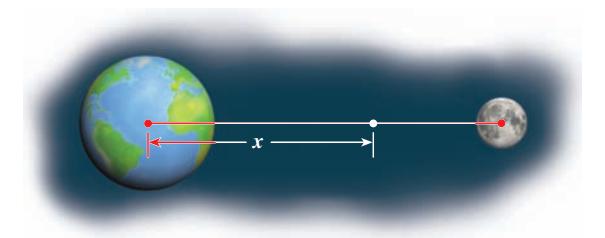
*Gravity* If an imaginary line segment is drawn between the centers of the earth and the moon, then the net gravitational force \(F\) acting on an object situated on this line segment is \( F = \dfrac{-K}{x^2} + \dfrac{0.012 K}{(239 - x)^2} \) where \(K > 0\) is a constant and \(x\) is the distance of the object from the center of the earth, measured in thousands of miles. How far from the center of the earth is the "dead spot" where no net gravitational force acts upon the object? (Express your answer to the nearest thousand miles.)
118 Application - Physics · Level 4
*Depth of a Well* One method for determining the depth of a well is to drop a stone into it and then measure the time it takes until the splash is heard. If \(d\) is the depth of the well (in feet) and \(t_1\) the time (in seconds) it takes for the stone to fall, then \(d = 16 t_1^2\), so \(t_1 = \dfrac{\sqrt{d}}{4}\). Now if \(t_2\) is the time it takes for the sound to travel back up, then \(d = 1090 t_2\) because the speed of sound is 1090 ft/s. So \(t_2 = \dfrac{d}{1090}\). Thus, the total time elapsed between dropping the stone and hearing the splash is \( t_1 + t_2 = \dfrac{\sqrt{d}}{4} + \dfrac{d}{1090} \) How deep is the well if this total time is 3 s?
question image
119 Discovery - Family of Equations · Level 4
*A Family of Equations* The equation \( 3 x + k - 5 = k x - k + 1 \) is really a *family of equations*, because for each value of \(k\), we get a different equation with the unknown \(x\). The letter \(k\) is called a parameter for this family. What value should we pick for \(k\) to make the given value of \(x\) a solution of the resulting equation?
(a) \(x = 0\)
(b) \(x = 1\)
(c) \(x = 2\)

Enter your answer directly below each part above.

120 Discovery - Error Analysis · Level 3
*Proof That \(0 = 1\)?* The following steps appear to give equivalent equations, which seem to prove that \(1 = 0\). Find the error. \(x = 1\) — Given \(x^2 = x\) — Multiply by \(x\) \(x^2 - x = 0\) — Subtract \(x\) \(x(x - 1) = 0\) — Factor \( \dfrac{x(x - 1)}{x - 1} = \dfrac{0}{x - 1} \) — Divide by \(x - 1\) \(x = 0\) — Simplify \(1 = 0\) — Given \(x = 1\)
121 Discovery - Geometry · Level 3
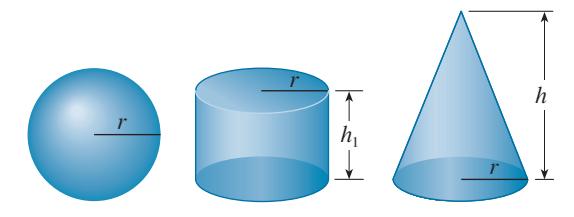
*Volumes of Solids* The sphere, cylinder, and cone shown here all have the same radius \(r\) and the same volume \(V\).
question image
(a) Use the volume formulas given on the inside front cover of this book, to show that \( \dfrac{4}{3} \pi r^3 = \pi r^2 h_1 \) and \( \dfrac{4}{3} \pi r^3 = \dfrac{1}{3} \pi r^2 h_2 \)
(b) Solve these equations for \(h_1\) and \(h_2\).

Enter your answer directly below each part above.

122 Discovery - Algebra · Level 4
*Relationship Between Roots and Coefficients* The Quadratic Formula gives us the roots of a quadratic equation from its coefficients. We can also obtain the coefficients from the roots. For example, find the roots of the equation \(x^2 - 9 x + 20 = 0\) and show that the product of the roots is the constant term 20 and the sum of the roots is 9, the negative of the coefficient of \(x\). Show that the same relationship between roots and coefficients holds for the following equations: \( x^2 - 2 x - 8 = 0 \) \( x^2 + 4 x + 2 = 0 \) Use the Quadratic Formula to prove that in general, if the equation \(x^2 + b x + c = 0\) has roots \(r_1\) and \(r_2\), then \(c = r_1 r_2\) and \(b = -(r_1 + r_2)\).
123 Discovery - Equation Solving · Level 4
*Solving an Equation in Different Ways* We have learned several different ways to solve an equation in this section. Some equations can be tackled by more than one method. For example, the equation \(x - \sqrt{x} - 2 = 0\) is of quadratic type. We can solve it by letting \(\sqrt{x} = u\) and \(x = u^2\), and factoring. Or we could solve for \(\sqrt{x}\), square each side, and then solve the resulting quadratic equation. Solve the following equations using both methods indicated, and show that you get the same final answers.
(a) \(x - \sqrt{x} - 2 = 0\) — quadratic type; solve for the radical, and square
(b) \( \dfrac{12}{(x - 3)^2} + \dfrac{10}{x - 3} + 1 = 0 \) — quadratic type; multiply by LCD

Enter your answer directly below each part above.

124 Example - Solving for One Variable in Terms of Others · Level 2
Solve for the variable \(M\) in the equation \(F = G \dfrac{m M}{r^2}\).
125 Example - Solving for One Variable in Terms of Others · Level 2
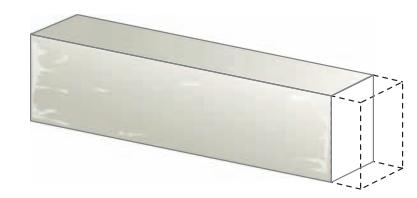
The surface area \(A\) of the closed rectangular box shown in Figure 1 can be calculated from the length \(l\), the width \(w\), and the height \(h\) according to the formula \(A = 2 l w + 2 w h + 2 l h\). Solve for \(w\) in terms of the other variables in this equation.
question image
126 Example - Solving a Quadratic Equation by Factoring · Level 2
Solve the equation \(x^2 + 5 x = 24\).
127 Example - Solving Simple Quadratics · Level 2
Solve each equation. (a) \(x^2 = 5\) (b) \((x - 4)^2 = 5\)
128 Example - Solving Quadratic Equations by Completing the Square · Level 3
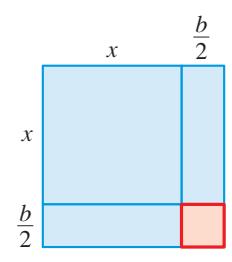
Solve each equation by completing the square. (a) \(x^2 - 8 x + 13 = 0\) (b) \(3 x^2 - 12 x + 6 = 0\)
question image
129 Example - Using the Quadratic Formula · Level 3
Find all solutions of each equation. (a) \(3 x^2 - 5 x - 1 = 0\) (b) \(4 x^2 + 12 x + 9 = 0\) (c) \(x^2 + 2 x + 2 = 0\)
130 Example - Using the Discriminant · Level 3
Use the discriminant \(D = b^2 - 4 a c\) to determine how many real solutions each equation has. (a) \(x^2 + 4 x - 1 = 0\) (b) \(4 x^2 - 12 x + 9 = 0\) (c) \(\dfrac{1}{3} x^2 - 2 x + 4 = 0\)
131 Example - The Path of a Projectile · Level 4
An object thrown or fired straight upward at an initial speed of \(v_0\) ft/s will reach a height of \(h\) feet after \(t\) seconds, where \(h\) and \(t\) are related by the formula \(h = -16 t^2 + v_0 t\). Suppose that a bullet is shot straight upward with an initial speed of 800 ft/s. (a) When does the bullet fall back to ground level? (b) When does it reach a height of 6400 ft?
132 Example - Equation Involving Fractional Expressions · Level 3
Solve the equation \(\dfrac{3}{x} + \dfrac{5}{x + 2} = 2\).
133 Example - Equation Involving a Radical · Level 3
Solve the equation \(2x = 1 - \sqrt{2 - x}\).
134 Example - Fourth-Degree Equation of Quadratic Type · Level 4
Find all solutions of the equation \(x^4 - 8x^2 + 8 = 0\).
135 Example - Equation Involving Fractional Powers · Level 4
Find all solutions of the equation \(x^{\dfrac{1}{3}} + x^{\dfrac{1}{6}} - 2 = 0\).
136 Example - Absolute Value Equation · Level 2
Solve the equation \(|2x - 5| = 3\).

Answered: 0 / 136