Stewart Precalc 6e Section 11.3: Hyperbolas

56 questions

--:--
0 / 56
Stewart Precalc 6e Section 11.3: Hyperbolas 0/56
1 Concepts - Definition of Hyperbola · Level 1
A hyperbola is the set of all points in the plane for which the _____ of the distances from two fixed points \(F_1\) and \(F_2\) is constant. The points \(F_1\) and \(F_2\) are called the _____ of the hyperbola.
2 Concepts - Standard Hyperbola with Horizontal Transverse Axis · Level 1
The graph of the equation \(\dfrac{x^2}{a^2} - \dfrac{y^2}{b^2} = 1\) with \(a > 0\), \(b > 0\) is a hyperbola with vertices (___, ___) and (___, ___) and foci \((\pm c, 0)\), where \(c = \) _____. So the graph of \(\dfrac{x^2}{4^2} - \dfrac{y^2}{3^2} = 1\) is a hyperbola with vertices (___, ___) and (___, ___) and foci (___, ___) and (___, ___).
3 Concepts - Standard Hyperbola with Vertical Transverse Axis · Level 1
The graph of the equation \(\dfrac{y^2}{a^2} - \dfrac{x^2}{b^2} = 1\) with \(a > 0\), \(b > 0\) is a hyperbola with vertices (___, ___) and (___, ___) and foci \((0, \pm c)\), where \(c = \) _____. So the graph of \(\dfrac{y^2}{4^2} - \dfrac{x^2}{2^2} = 1\) is a hyperbola with vertices (___, ___) and (___, ___) and foci (___, ___) and (___, ___).
4 Concepts - Labeling Vertices, Foci, and Asymptotes · Level 1
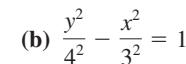
Label the vertices, foci, and asymptotes on the graphs given for the hyperbolas in Exercises 2 and 3. (a) \(\dfrac{x^2}{4^2} - \dfrac{y^2}{3^2} = 1\) (b) \(\dfrac{y^2}{4^2} - \dfrac{x^2}{2^2} = 1\)
question image
5 Skill - Matching graphs · Level 2
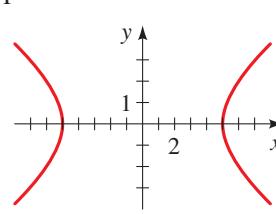
Match the equation \(\dfrac{x^2}{4} - y^2 = 1\) with the graphs labeled I–IV. Give reasons for your answer.
question image
6 Skill - Matching graphs · Level 2
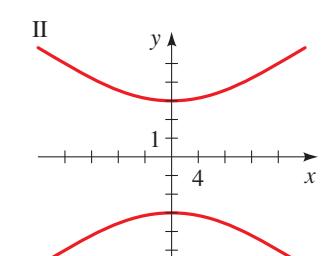
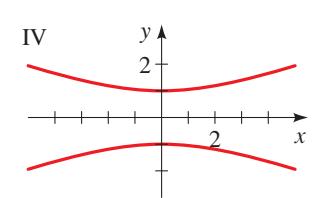
Match the equation \(y^2 - \dfrac{x^2}{9} = 1\) with the graphs labeled I–IV. Give reasons for your answer.
question image
7 Skill - Matching graphs · Level 2
Match the equation \(16 y^2 - x^2 = 144\) with the graphs labeled I–IV. Give reasons for your answer.
question image
8 Skill - Matching graphs · Level 2
Match the equation \(9 x^2 - 25 y^2 = 225\) with the graphs labeled I–IV. Give reasons for your answer.
9 Skill - Finding hyperbola parts · Level 2
Find the vertices, foci, and asymptotes of the hyperbola \(\dfrac{x^2}{4} - \dfrac{y^2}{16} = 1\), and sketch its graph.
10 Skill - Finding hyperbola parts · Level 2
Find the vertices, foci, and asymptotes of the hyperbola \(\dfrac{y^2}{9} - \dfrac{x^2}{16} = 1\), and sketch its graph.
11 Skill - Finding hyperbola parts · Level 2
Find the vertices, foci, and asymptotes of the hyperbola \(y^2 - \dfrac{x^2}{25} = 1\), and sketch its graph.
12 Skill - Finding hyperbola parts · Level 2
Find the vertices, foci, and asymptotes of the hyperbola \(\dfrac{x^2}{2} - y^2 = 1\), and sketch its graph.
13 Skill - Finding hyperbola parts · Level 2
Find the vertices, foci, and asymptotes of the hyperbola \(x^2 - y^2 = 1\), and sketch its graph.
14 Skill - Finding hyperbola parts · Level 2
Find the vertices, foci, and asymptotes of the hyperbola \(9 x^2 - 4 y^2 = 36\), and sketch its graph.
15 Skill - Finding hyperbola parts · Level 2
Find the vertices, foci, and asymptotes of the hyperbola \(25 y^2 - 9 x^2 = 225\), and sketch its graph.
16 Skill - Finding hyperbola parts · Level 2
Find the vertices, foci, and asymptotes of the hyperbola \(x^2 - y^2 + 4 = 0\), and sketch its graph.
17 Skill - Finding hyperbola parts · Level 2
Find the vertices, foci, and asymptotes of the hyperbola \(x^2 - 4 y^2 - 8 = 0\), and sketch its graph.
18 Skill - Finding hyperbola parts · Level 2
Find the vertices, foci, and asymptotes of the hyperbola \(x^2 - 2 y^2 = 3\), and sketch its graph.
19 Skill - Finding hyperbola parts · Level 2
Find the vertices, foci, and asymptotes of the hyperbola \(4 y^2 - x^2 = 1\), and sketch its graph.
20 Skill - Finding hyperbola parts · Level 2
Find the vertices, foci, and asymptotes of the hyperbola \(9 x^2 - 16 y^2 = 1\), and sketch its graph.
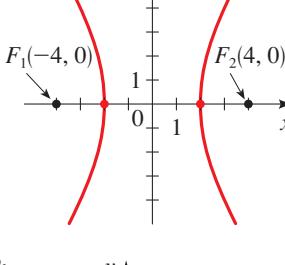
21 Skill - Equation from graph · Level 2
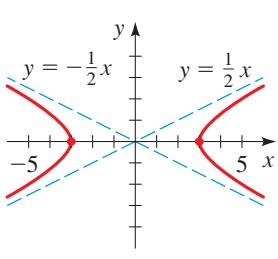
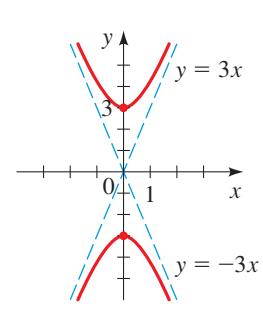
Find the equation for the hyperbola whose graph is shown.
question image
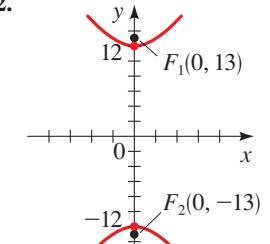
22 Skill - Equation from graph · Level 2
Find the equation for the hyperbola whose graph is shown.
question image
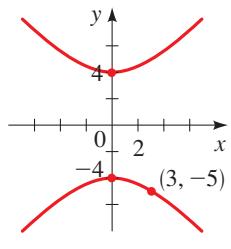
23 Skill - Equation from graph · Level 2
Find the equation for the hyperbola whose graph is shown.
question image
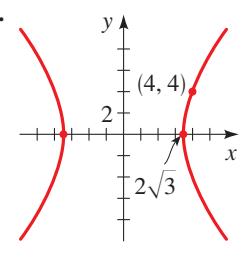
24 Skill - Equation from graph · Level 2
Find the equation for the hyperbola whose graph is shown.
question image
25 Skill - Equation from graph · Level 2
Find the equation for the hyperbola whose graph is shown.
question image
26 Skill - Equation from graph · Level 2
Find the equation for the hyperbola whose graph is shown.
question image
27 Skill - Graphing device · Level 2
Use a graphing device to graph the hyperbola \(x^2 - 2 y^2 = 8\).
28 Skill - Graphing device · Level 2
Use a graphing device to graph the hyperbola \(3 y^2 - 4 x^2 = 24\).
29 Skill - Graphing device · Level 2
Use a graphing device to graph the hyperbola \(\dfrac{y^2}{2} - \dfrac{x^2}{6} = 1\).
30 Skill - Graphing device · Level 2
Use a graphing device to graph the hyperbola \(\dfrac{x^2}{100} - \dfrac{y^2}{64} = 1\).
31 Skill - Equation from conditions · Level 2
Find an equation for the hyperbola that satisfies the given conditions. Foci: \((\pm 5, 0)\), vertices: \((\pm 3, 0)\).
32 Skill - Equation from conditions · Level 2
Find an equation for the hyperbola that satisfies the given conditions. Foci: \((0, \pm 10)\), vertices: \((0, \pm 8)\).
33 Skill - Equation from conditions · Level 2
Find an equation for the hyperbola that satisfies the given conditions. Foci: \((0, \pm 2)\), vertices: \((0, \pm 1)\).
34 Skill - Equation from conditions · Level 2
Find an equation for the hyperbola that satisfies the given conditions. Foci: \((\pm 6, 0)\), vertices: \((\pm 2, 0)\).
35 Skill - Equation from conditions · Level 2
Find an equation for the hyperbola that satisfies the given conditions. Vertices: \((\pm 1, 0)\), asymptotes: \(y = \pm 5 x\).
36 Skill - Equation from conditions · Level 2
Find an equation for the hyperbola that satisfies the given conditions. Vertices: \((0, \pm 6)\), asymptotes: \(y = \pm \dfrac{1}{3} x\).
37 Skill - Equation from conditions · Level 3
Find an equation for the hyperbola that satisfies the given conditions. Foci: \((0, \pm 8)\), asymptotes: \(y = \pm \dfrac{1}{2} x\).
38 Skill - Equation from conditions · Level 3
Find an equation for the hyperbola that satisfies the given conditions. Vertices: \((0, \pm 6)\), hyperbola passes through \((-5, 9)\).
39 Skill - Equation from conditions · Level 3
Find an equation for the hyperbola that satisfies the given conditions. Asymptotes: \(y = \pm x\), hyperbola passes through \((5, 3)\).
40 Skill - Equation from conditions · Level 3
Find an equation for the hyperbola that satisfies the given conditions. Foci: \((\pm 3, 0)\), hyperbola passes through \((4, 1)\).
41 Skill - Equation from conditions · Level 2
Find an equation for the hyperbola that satisfies the given conditions. Foci: \((\pm 5, 0)\), length of transverse axis: 6.
42 Skill - Equation from conditions · Level 2
Find an equation for the hyperbola that satisfies the given conditions. Foci: \((0, \pm 1)\), length of transverse axis: 1.
43 Proof - Hyperbola properties · Level 3
(a) Show that the asymptotes of the hyperbola \(x^2 - y^2 = 5\) are perpendicular to each other. (b) Find an equation for the hyperbola with foci \((\pm c, 0)\) and with asymptotes perpendicular to each other.
44 Proof - Conjugate hyperbolas · Level 4
The hyperbolas \(\dfrac{x^2}{a^2} - \dfrac{y^2}{b^2} = 1\) and \(\dfrac{x^2}{a^2} - \dfrac{y^2}{b^2} = -1\) are said to be conjugate to each other. (a) Show that the hyperbolas \(x^2 - 4 y^2 + 16 = 0\) and \(4 y^2 - x^2 + 16 = 0\) are conjugate to each other, and sketch their graphs on the same coordinate axes. (b) What do the hyperbolas of part (a) have in common? (c) Show that any pair of conjugate hyperbolas have the relationship you discovered in part (b).
45 Proof - Hyperbola derivation · Level 4
In the derivation of the equation of the hyperbola at the beginning of this section, we said that the equation \(\sqrt{(x + c)^2 + y^2} - \sqrt{(x - c)^2 + y^2} = \pm 2 a\) simplifies to \((c^2 - a^2) x^2 - a^2 y^2 = a^2 (c^2 - a^2)\). Supply the steps needed to show this.
46 Skill - Hyperbola verification · Level 3
(a) For the hyperbola \(\dfrac{x^2}{9} - \dfrac{y^2}{16} = 1\) determine the values of \(a\), \(b\), and \(c\), and find the coordinates of the foci \(F_1\) and \(F_2\). (b) Show that the point \(P\left(5, \dfrac{16}{3}\right)\) lies on this hyperbola. (c) Find \(d(P, F_1)\) and \(d(P, F_2)\). (d) Verify that the difference between \(d(P, F_1)\) and \(d(P, F_2)\) is \(2 a\).
47 Skill - Confocal hyperbolas · Level 3
Hyperbolas are called confocal if they have the same foci. (a) Show that the hyperbolas \(\dfrac{y^2}{k} - \dfrac{x^2}{16 - k} = 1\) with \(0 < k < 16\) are confocal. (b) Use a graphing device to draw the top branches of the family of hyperbolas in part (a) for \(k = 1\), \(4\), \(8\), and \(12\). How does the shape of the graph change as \(k\) increases?
48 Application - Navigation · Level 3
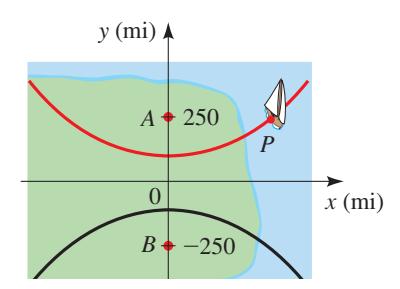
Navigation. In the figure, the LORAN stations at \(A\) and \(B\) are 500 mi apart, and the ship at \(P\) receives station \(A\)'s signal 2640 microseconds (μs) before it receives the signal from station \(B\). (a) Assuming that radio signals travel at 980 ft/μs, find \(d(P, A) - d(P, B)\). (b) Find an equation for the branch of the hyperbola indicated in red in the figure. (Use miles as the unit of distance.) (c) If \(A\) is due north of \(B\) and if \(P\) is due east of \(A\), how far is \(P\) from \(A\)?
question image
49 Application - Astronomy · Level 3
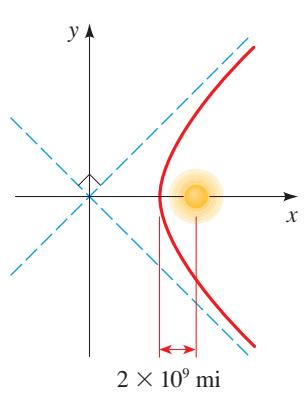
Comet Trajectories. Some comets, such as Halley's comet, are a permanent part of the solar system, traveling in elliptical orbits around the sun. Other comets pass through the solar system only once, following a hyperbolic path with the sun at a focus. The figure shows the path of such a comet. Find an equation for the path, assuming that the closest the comet comes to the sun is \(2 \times 10^9\) mi and that the path the comet was taking before it neared the solar system is at a right angle to the path it continues on after leaving the solar system.
question image
50 Application - Wave interference · Level 3
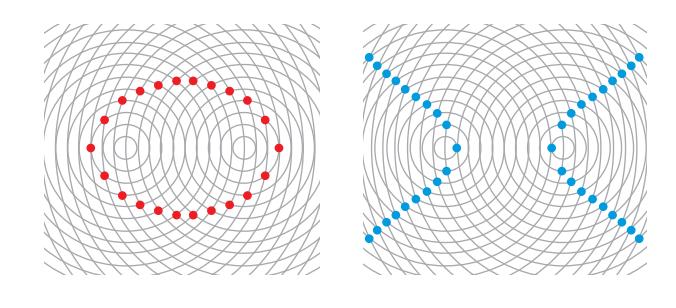
Ripples in Pool. Two stones are dropped simultaneously into a calm pool of water. The crests of the resulting waves form equally spaced concentric circles, as shown in the figures. The waves interact with each other to create certain interference patterns. (a) Explain why the red dots lie on an ellipse. (b) Explain why the blue dots lie on a hyperbola.
question image
51 Discussion - Real-world hyperbolas · Level 2
Hyperbolas in the Real World. Several examples of the uses of hyperbolas are given in the text. Find other situations in real life in which hyperbolas occur. Consult a scientific encyclopedia in the reference section of your library, or search the Internet.
52 Discussion - Light boundary · Level 3
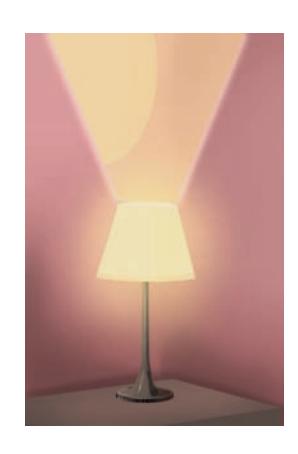
Light from a Lamp. The light from a lamp forms a lighted area on a wall, as shown in the figure. Why is the boundary of this lighted area a hyperbola? How can one hold a flashlight so that its beam forms a hyperbola on the ground?
question image
53 Example - Hyperbola with Horizontal Transverse Axis · Level 2
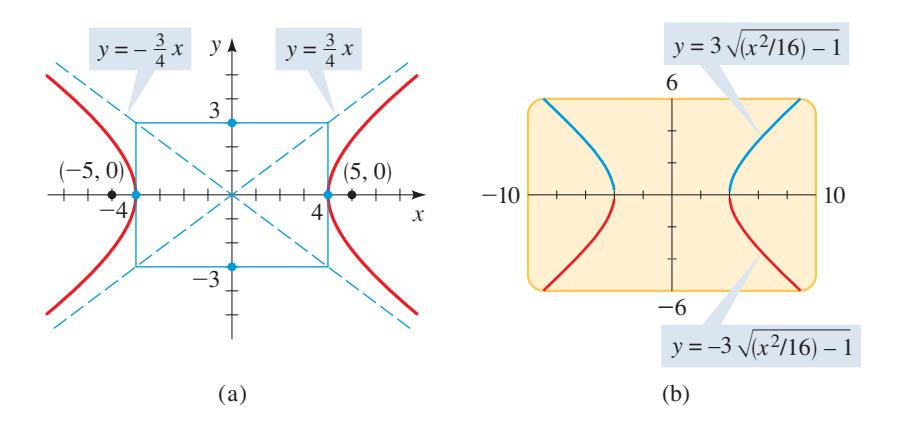
A hyperbola has the equation \(9 x^2 - 16 y^2 = 144\). (a) Find the vertices, foci, and asymptotes, and sketch the graph. (b) Draw the graph using a graphing calculator.
question image
54 Example - Hyperbola with Vertical Transverse Axis · Level 2
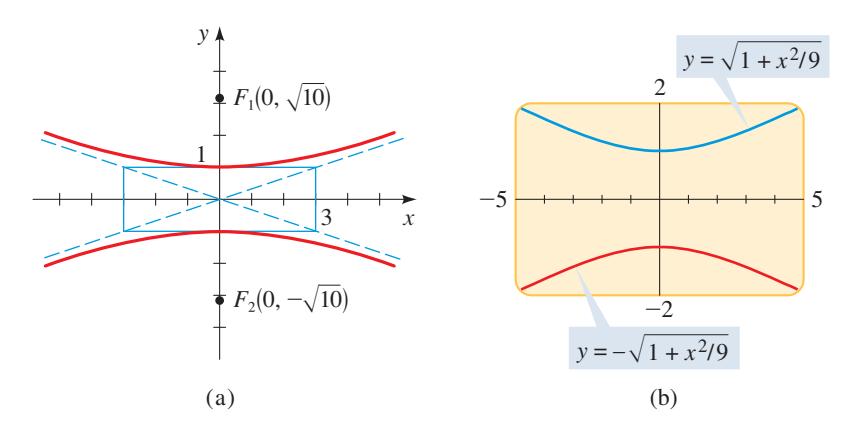
Find the vertices, foci, and asymptotes of the hyperbola \(x^2 - 9 y^2 + 9 = 0\), and sketch its graph.
question image
55 Example - Finding the Equation from Vertices and Foci · Level 2
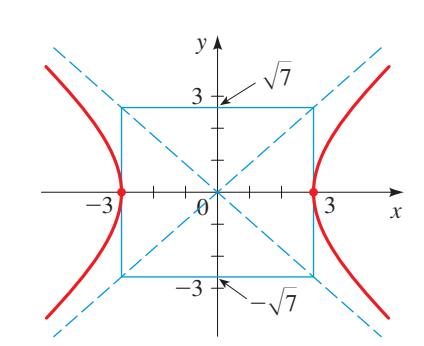
Find the equation of the hyperbola with vertices \((\pm 3, 0)\) and foci \((\pm 4, 0)\). Sketch the graph.
question image
56 Example - Finding the Equation from Vertices and Asymptotes · Level 2
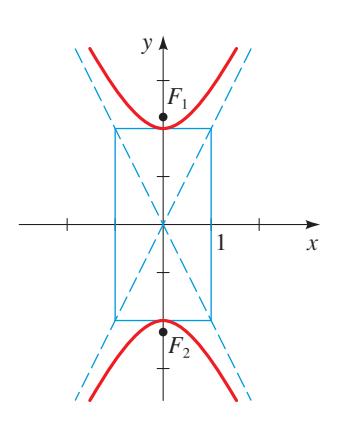
Find the equation and the foci of the hyperbola with vertices \((0, \pm 2)\) and asymptotes \(y = \pm 2 x\). Sketch the graph.
question image

Answered: 0 / 56