Stewart Precalc 6e Section 11.5: Rotation of Axes

44 questions

--:--
0 / 44
Stewart Precalc 6e Section 11.5: Rotation of Axes 0/44
1 Concepts - Rotation Formulas · Level 1
Suppose the \(x\)- and \(y\)-axes are rotated through an acute angle \(\phi\) to produce the new \(X\)- and \(Y\)-axes. A point \(P\) in the plane can be described by its \(x y\)-coordinates \((x, y)\) or its \(X Y\)-coordinates \((X, Y)\). These coordinates are related by which formulas? Fill in the blanks: \(x = \) ___, \(y = \) ___.
2 Concepts - Discriminant of a Conic · Level 1
Consider the equation \(A x^2 + B x y + C y^2 + D x + E y + F = 0\). (a) In general, the graph of this equation is a ___. (b) To eliminate the \(x y\)-term from this equation, we rotate the axes through an angle \(\phi\) that satisfies \(\cot(2 \phi) = \) ___. (c) The discriminant of this equation is ___. If the discriminant is 0, the graph is a ___; if it is negative, the graph is ___; and if it is positive, the graph is ___.
3 Skills - Rotation of Coordinates · Level 1
Determine the \(X Y\)-coordinates of the point \((1, 1)\) if the coordinate axes are rotated through the angle \(\phi = 45^{\circ}\).
4 Skills - Rotation of Coordinates · Level 2
Determine the \(X Y\)-coordinates of the point \((-2, 1)\) if the coordinate axes are rotated through the angle \(\phi = 30^{\circ}\).
5 Skills - Rotation of Coordinates · Level 2
Determine the \(X Y\)-coordinates of the point \((3, -\sqrt{3})\) if the coordinate axes are rotated through the angle \(\phi = 60^{\circ}\).
6 Skills - Rotation of Coordinates · Level 2
Determine the \(X Y\)-coordinates of the point \((2, 0)\) if the coordinate axes are rotated through the angle \(\phi = 15^{\circ}\).
7 Skills - Rotation of Coordinates · Level 2
Determine the \(X Y\)-coordinates of the point \((0, 2)\) if the coordinate axes are rotated through the angle \(\phi = 55^{\circ}\).
8 Skills - Rotation of Coordinates · Level 2
Determine the \(X Y\)-coordinates of the point \((\sqrt{2}, 4 \sqrt{2})\) if the coordinate axes are rotated through the angle \(\phi = 45^{\circ}\).
9 Skills - Rotation of Equation · Level 3
Determine the equation of the conic \(x^2 - 3 y^2 = 4\) in \(X Y\)-coordinates when the coordinate axes are rotated through the angle \(\phi = 60^{\circ}\).
10 Skills - Rotation of Equation · Level 3
Determine the equation of the conic \(y = (x - 1)^2\) in \(X Y\)-coordinates when the coordinate axes are rotated through the angle \(\phi = 45^{\circ}\).
11 Skills - Rotation of Equation · Level 4
Determine the equation of the conic \(x^2 - y^2 = 2 y\) in \(X Y\)-coordinates when the coordinate axes are rotated through the angle \(\phi = \arccos\left(\dfrac{3}{5}\right)\).
12 Skills - Rotation of Equation · Level 4
Determine the equation of the conic \(x^2 + 2 y^2 = 16\) in \(X Y\)-coordinates when the coordinate axes are rotated through the angle \(\phi = \arcsin\left(\dfrac{3}{5}\right)\).
13 Skills - Rotation of Equation · Level 4
Determine the equation of the conic \(x^2 + 2 \sqrt{3} x y - y^2 = 4\) in \(X Y\)-coordinates when the coordinate axes are rotated through the angle \(\phi = 30^{\circ}\).
14 Skills - Rotation of Equation · Level 4
Determine the equation of the conic \(x y = x + y\) in \(X Y\)-coordinates when the coordinate axes are rotated through the angle \(\phi = \dfrac{\pi}{4}\).
15 Skills - Discriminant Analysis · Level 2
Consider the equation \(x y = 8\). (a) Use the discriminant to determine whether the graph is a parabola, an ellipse, or a hyperbola. (b) Use a rotation of axes to eliminate the \(x y\)-term. (c) Sketch the graph.
16 Skills - Discriminant Analysis · Level 2
Consider the equation \(x y + 4 = 0\). (a) Use the discriminant to determine whether the graph is a parabola, an ellipse, or a hyperbola. (b) Use a rotation of axes to eliminate the \(x y\)-term. (c) Sketch the graph.
17 Skills - Discriminant Analysis · Level 3
Consider the equation \(x^2 + 2 \sqrt{3} x y - y^2 + 2 = 0\). (a) Use the discriminant to determine whether the graph is a parabola, an ellipse, or a hyperbola. (b) Use a rotation of axes to eliminate the \(x y\)-term. (c) Sketch the graph.
18 Skills - Discriminant Analysis · Level 3
Consider the equation \(13 x^2 + 6 \sqrt{3} x y + 7 y^2 = 16\). (a) Use the discriminant to determine whether the graph is a parabola, an ellipse, or a hyperbola. (b) Use a rotation of axes to eliminate the \(x y\)-term. (c) Sketch the graph.
19 Skills - Discriminant Analysis · Level 3
Consider the equation \(11 x^2 - 24 x y + 4 y^2 + 20 = 0\). (a) Use the discriminant to determine whether the graph is a parabola, an ellipse, or a hyperbola. (b) Use a rotation of axes to eliminate the \(x y\)-term. (c) Sketch the graph.
20 Skills - Discriminant Analysis · Level 3
Consider the equation \(21 x^2 + 10 \sqrt{3} x y + 31 y^2 = 144\). (a) Use the discriminant to determine whether the graph is a parabola, an ellipse, or a hyperbola. (b) Use a rotation of axes to eliminate the \(x y\)-term. (c) Sketch the graph.
21 Skills - Discriminant Analysis · Level 3
Consider the equation \(\sqrt{3} x^2 + 3 x y = 3\). (a) Use the discriminant to determine whether the graph is a parabola, an ellipse, or a hyperbola. (b) Use a rotation of axes to eliminate the \(x y\)-term. (c) Sketch the graph.
22 Skills - Discriminant Analysis · Level 3
Consider the equation \(153 x^2 + 192 x y + 97 y^2 = 225\). (a) Use the discriminant to determine whether the graph is a parabola, an ellipse, or a hyperbola. (b) Use a rotation of axes to eliminate the \(x y\)-term. (c) Sketch the graph.
23 Skills - Discriminant Analysis · Level 3
Consider the equation \(x^2 + 2 x y + y^2 + x - y = 0\). (a) Use the discriminant to determine whether the graph is a parabola, an ellipse, or a hyperbola. (b) Use a rotation of axes to eliminate the \(x y\)-term. (c) Sketch the graph.
24 Skills - Discriminant Analysis · Level 3
Consider the equation \(25 x^2 - 120 x y + 144 y^2 - 156 x - 65 y = 0\). (a) Use the discriminant to determine whether the graph is a parabola, an ellipse, or a hyperbola. (b) Use a rotation of axes to eliminate the \(x y\)-term. (c) Sketch the graph.
25 Skills - Discriminant Analysis · Level 3
Consider the equation \(2 \sqrt{3} x^2 - 6 x y + \sqrt{3} x + 3 y = 0\). (a) Use the discriminant to determine whether the graph is a parabola, an ellipse, or a hyperbola. (b) Use a rotation of axes to eliminate the \(x y\)-term. (c) Sketch the graph.
26 Skills - Discriminant Analysis · Level 3
Consider the equation \(9 x^2 - 24 x y + 16 y^2 = 100(x - y - 1)\). (a) Use the discriminant to determine whether the graph is a parabola, an ellipse, or a hyperbola. (b) Use a rotation of axes to eliminate the \(x y\)-term. (c) Sketch the graph.
27 Skills - Discriminant Analysis · Level 3
Consider the equation \(52 x^2 + 72 x y + 73 y^2 = 40 x - 30 y + 75\). (a) Use the discriminant to determine whether the graph is a parabola, an ellipse, or a hyperbola. (b) Use a rotation of axes to eliminate the \(x y\)-term. (c) Sketch the graph.
28 Skills - Discriminant Analysis · Level 3
Consider the equation \((7 x + 24 y)^2 = 600 x - 175 y + 25\). (a) Use the discriminant to determine whether the graph is a parabola, an ellipse, or a hyperbola. (b) Use a rotation of axes to eliminate the \(x y\)-term. (c) Sketch the graph.
29 Skills - Identify Conic by Discriminant · Level 2
Consider the equation \(2 x^2 - 4 x y + 2 y^2 - 5 x - 5 = 0\). (a) Use the discriminant to identify the conic. (b) Confirm your answer by graphing the conic using a graphing device.
30 Skills - Identify Conic by Discriminant · Level 2
Consider the equation \(x^2 - 2 x y + 3 y^2 = 8\). (a) Use the discriminant to identify the conic. (b) Confirm your answer by graphing the conic using a graphing device.
31 Skills - Identify Conic by Discriminant · Level 2
Consider the equation \(6 x^2 + 10 x y + 3 y^2 - 6 y = 36\). (a) Use the discriminant to identify the conic. (b) Confirm your answer by graphing the conic using a graphing device.
32 Skills - Identify Conic by Discriminant · Level 2
Consider the equation \(9 x^2 - 6 x y + y^2 + 6 x - 2 y = 0\). (a) Use the discriminant to identify the conic. (b) Confirm your answer by graphing the conic using a graphing device.
33 Skills - Rotation, Center, Foci, Asymptotes · Level 4
Consider the equation \(7 x^2 + 48 x y - 7 y^2 - 200 x - 150 y + 600 = 0\). (a) Use rotation of axes to show that the equation represents a hyperbola. (b) Find the \(X Y\)- and \(x y\)-coordinates of the center, vertices, and foci. (c) Find the equations of the asymptotes in \(X Y\)- and \(x y\)-coordinates.
34 Skills - Rotation, Vertex, Focus, Directrix · Level 4
Consider the equation \(2 \sqrt{2}(x + y)^2 = 7 x + 9 y\). (a) Use rotation of axes to show that the equation represents a parabola. (b) Find the \(X Y\)- and \(x y\)-coordinates of the vertex and focus. (c) Find the equation of the directrix in \(X Y\)- and \(x y\)-coordinates.
35 Skills - Inverse Rotation Formulas · Level 3
Solve the equations \(x = X \cos \phi - Y \sin \phi\) and \(y = X \sin \phi + Y \cos \phi\) for \(X\) and \(Y\) in terms of \(x\) and \(y\). (Hint: To begin, multiply the first equation by \(\cos \phi\) and the second by \(\sin \phi\), and then add the two equations to solve for \(X\).)
36 Skills - Conic Identification by Rotation · Level 4
Show that the graph of the equation \(\sqrt{x} + \sqrt{y} = 1\) is part of a parabola by rotating the axes through an angle of \(45^{\circ}\). (Hint: First convert the equation to one that does not involve radicals.)
37 Discovery - Matrix Form of Rotation Formulas · Level 3
Let \(Z\), \(Z'\), and \(R\) be the matrices \(Z = \begin{pmatrix} x \\ y \end{pmatrix}\), \(Z' = \begin{pmatrix} X \\ Y \end{pmatrix}\), and \(R = \begin{pmatrix} \cos \phi & -\sin \phi \\ \sin \phi & \cos \phi \end{pmatrix}\). Show that the Rotation of Axes Formulas can be written as \(Z = R Z'\) and \(Z' = R^{-1} Z\).
38 Discovery - Algebraic Invariants · Level 4
A quantity is invariant under rotation if it does not change when the axes are rotated. It was stated in the text that for the general equation of a conic the quantity \(B^2 - 4 A C\) is invariant under rotation. (a) Use the formulas for \(A'\), \(B'\), and \(C'\) on page 760 to prove that the quantity \(B^2 - 4 A C\) is invariant under rotation; that is, show that \(B^2 - 4 A C = (B')^2 - 4 A' C'\). (b) Prove that \(A + C\) is invariant under rotation. (c) Is the quantity \(F\) invariant under rotation?
39 Discovery - Geometric Invariants · Level 3
Do you expect that the distance between two points is invariant under rotation? Prove your answer by comparing the distance \(d(P, Q)\) and \(d(P', Q')\) where \(P'\) and \(Q'\) are the images of \(P\) and \(Q\) under a rotation of axes.
question image
40 Example - Rotation of Axes · Level 2
If the coordinate axes are rotated through \(30^{\circ}\), find the XY-coordinates of the point with xy-coordinates \((2, -4)\).
41 Example - Rotating a Hyperbola · Level 3
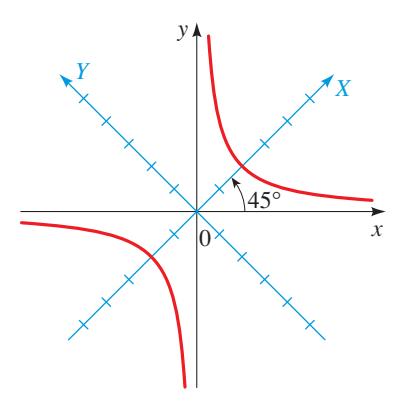
Rotate the coordinate axes through \(45^{\circ}\) to show that the graph of the equation \(x y = 2\) is a hyperbola.
question image
42 Example - Eliminating the xy-Term · Level 3
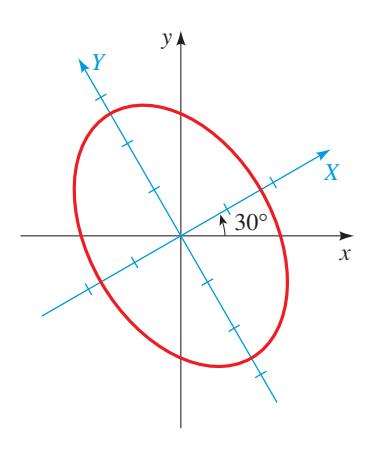
Use a rotation of axes to eliminate the \(x y\)-term in the equation \(6 \sqrt{3} x^2 + 6 x y + 4 \sqrt{3} y^2 = 21 \sqrt{3}\). Identify and sketch the curve.
question image
43 Example - Graphing a Rotated Conic · Level 4
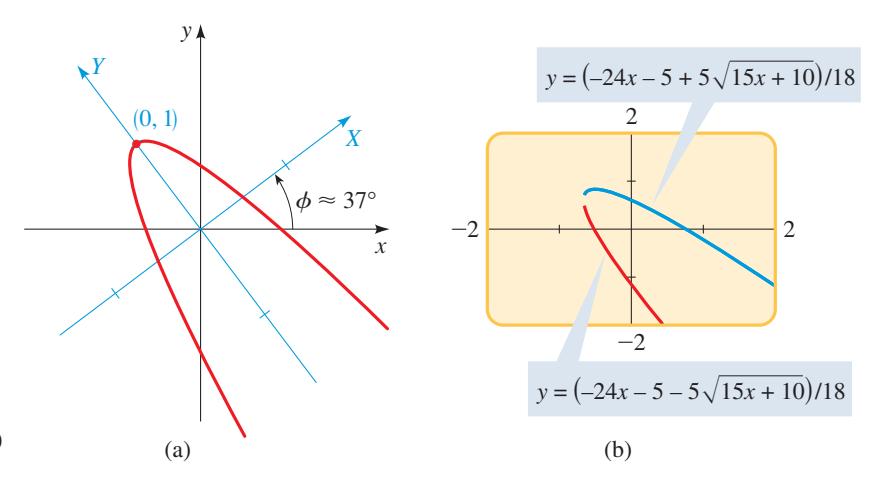
A conic has the equation \(64 x^2 + 96 x y + 36 y^2 - 15 x + 20 y - 25 = 0\). (a) Use a rotation of axes to eliminate the \(x y\)-term. (b) Identify and sketch the graph. (c) Draw the graph using a graphing calculator.
question image
44 Example - Identifying a Conic by the Discriminant · Level 3
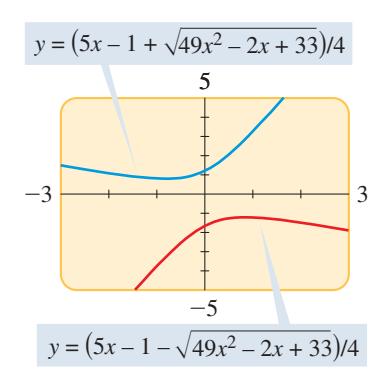
A conic has the equation \(3 x^2 + 5 x y - 2 y^2 + x - y + 4 = 0\). (a) Use the discriminant to identify the conic. (b) Confirm your answer to part (a) by graphing the conic with a graphing calculator.
question image

Answered: 0 / 44