Stewart Section 2.7: Derivatives and Rates of Change

61 questions

--:--
0 / 61
Stewart Section 2.7: Derivatives and Rates of Change 0/61
1 Derivatives - Tangent Lines · Level 2
A curve has equation \(y = f(x)\).
(a) Write an expression for the slope of the secant line through the points \(P(3, f(3))\) and \(Q(x, f(x))\).
(b) Write an expression for the slope of the tangent line at \(P\).

Enter your answer directly below each part above.

2 Derivatives - Tangent Lines · Level 2
Graph the curve \(y = e^x\) in the viewing rectangles \([-1, 1]\) by \([0, 2]\), \([-0.5, 0.5]\) by \([0.5, 1.5]\), and \([-0.1, 0.1]\) by \([0.9, 1.1]\). What do you notice about the curve as you zoom in toward the point \((0, 1)\)?
3 Derivatives - Tangent Lines · Level 3
(a) Find the slope of the tangent line to the parabola \(y = 4x - x^2\) at the point \((1, 3)\) (i) using Definition 1 (ii) using Equation 2
(b) Find an equation of the tangent line in part (a).
(c) Graph the parabola and the tangent line. As a check on your work, zoom in toward the point \((1, 3)\) until the parabola and the tangent line are indistinguishable.

Enter your answer directly below each part above.

4 Derivatives - Tangent Lines · Level 3
(a) Find the slope of the tangent line to the curve \(y = x - x^3\) at the point \((1, 0)\) (i) using Definition 1 (ii) using Equation 2
(b) Find an equation of the tangent line in part (a).
(c) Graph the curve and the tangent line in successively smaller viewing rectangles centered at \((1, 0)\) until the curve and the line appear to coincide.

Enter your answer directly below each part above.

5 Derivatives - Tangent Lines · Level 3
Find an equation of the tangent line to the curve at the given point. \(y = 4x - 3x^2\), \((2, -4)\)
6 Derivatives - Tangent Lines · Level 3
Find an equation of the tangent line to the curve at the given point. \(y = x^3 - 3x + 1\), \((2, 3)\)
7 Derivatives - Tangent Lines · Level 3
Find an equation of the tangent line to the curve at the given point. \(y = \sqrt{x}\), \((1, 1)\)
8 Derivatives - Tangent Lines · Level 3
Find an equation of the tangent line to the curve at the given point. \(y = \dfrac{2x + 1}{x + 2}\), \((1, 1)\)
9 Derivatives - Tangent Lines · Level 3
(a) Find the slope of the tangent to the curve \(y = 3 + 4x^2 - 2x^3\) at the point where \(x = a\).
(b) Find equations of the tangent lines at the points \((1, 5)\) and \((2, 3)\).
(c) Graph the curve and both tangents on a common screen.

Enter your answer directly below each part above.

10 Derivatives - Tangent Lines · Level 3
(a) Find the slope of the tangent to the curve \(y = \dfrac{1}{\sqrt{x}}\) at the point where \(x = a\).
(b) Find equations of the tangent lines at the points \((1, 1)\) and \(\left(4, \dfrac{1}{2}\right)\).
(c) Graph the curve and both tangents on a common screen.

Enter your answer directly below each part above.

11 Derivatives - Velocity · Level 3
question image
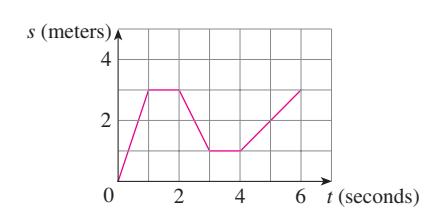
(a) A particle starts by moving to the right along a horizontal line; the graph of its position function is shown in the figure. When is the particle moving to the right? Moving to the left? Standing still?
(b) Draw a graph of the velocity function.

Enter your answer directly below each part above.

12 Derivatives - Velocity · Level 3
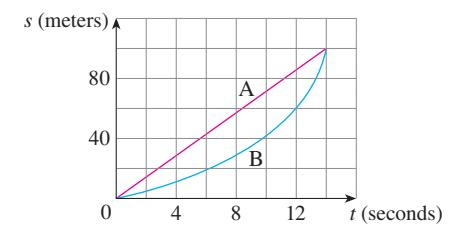
Shown are graphs of the position functions of two runners, A and B, who run a 100-meter race and finish in a tie.
question image
(a) Describe and compare how the runners run the race.
(b) At what time is the distance between the runners the greatest?
(c) At what time do they have the same velocity?

Enter your answer directly below each part above.

13 Derivatives - Velocity · Level 3
If a ball is thrown into the air with a velocity of 40 ft/s, its height (in feet) after \(t\) seconds is given by \(y = 40t - 16t^2\). Find the velocity when \(t = 2\).
14 Derivatives - Velocity · Level 3
If a rock is thrown upward on the planet Mars with a velocity of 10 m/s, its height (in meters) after \(t\) seconds is given by \(H = 10t - 1.86t^2\).
(a) Find the velocity of the rock after one second.
(b) Find the velocity of the rock when \(t = a\).
(c) When will the rock hit the surface?
(d) With what velocity will the rock hit the surface?

Enter your answer directly below each part above.

15 Derivatives - Velocity · Level 3
The displacement (in meters) of a particle moving in a straight line is given by the equation of motion \(s = 1 / t^2\), where \(t\) is measured in seconds. Find the velocity of the particle at times \(t = a\), \(t = 1\), \(t = 2\), and \(t = 3\).
16 Derivatives - Velocity · Level 3
The displacement (in feet) of a particle moving in a straight line is given by \(s = \dfrac{1}{2} t^2 - 6t + 23\), where \(t\) is measured in seconds.
(a) Find the average velocity over each time interval: (i) \([4, 8]\) (ii) \([6, 8]\) (iii) \([8, 10]\) (iv) \([8, 12]\)
(b) Find the instantaneous velocity when \(t = 8\).
(c) Draw the graph of \(s\) as a function of \(t\) and draw the secant lines whose slopes are the average velocities in part (a). Then draw the tangent line whose slope is the instantaneous velocity in part (b).

Enter your answer directly below each part above.

17 Derivatives - Graph Analysis · Level 3
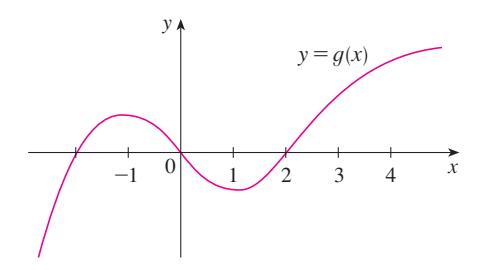
For the function \(g\) whose graph is given, arrange the following numbers in increasing order and explain your reasoning: \(0 \quad g'(-2) \quad g'(0) \quad g'(2) \quad g'(4)\)
question image
18 Derivatives - Rates of Change · Level 3
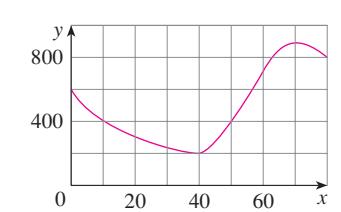
The graph of a function \(f\) is shown.
question image
(a) Find the average rate of change of \(f\) on the interval \([20, 60]\).
(b) Identify an interval on which the average rate of change of \(f\) is 0.
(c) Which interval gives a larger average rate of change, \([40, 60]\) or \([40, 70]\)?
(d) Compute \(\dfrac{f(40) - f(10)}{40 - 10}\); what does this value represent geometrically?

Enter your answer directly below each part above.

19 Derivatives - Rates of Change · Level 3
For the function \(f\) graphed in Exercise 18:
(a) Estimate the value of \(f'(50)\).
(b) Is \(f'(10) > f'(30)\)?
(c) Is \(f'(60) > \dfrac{f(80) - f(40)}{80 - 40}\)? Explain.

Enter your answer directly below each part above.

20 Derivatives - Tangent Lines · Level 2
Find an equation of the tangent line to the graph of \(y = g(x)\) at \(x = 5\) if \(g(5) = -3\) and \(g'(5) = 4\).
21 Derivatives - Tangent Lines · Level 2
If an equation of the tangent line to the curve \(y = f(x)\) at the point where \(a = 2\) is \(y = 4x - 5\), find \(f(2)\) and \(f'(2)\).
22 Derivatives - Tangent Lines · Level 2
If the tangent line to \(y = f(x)\) at \((4, 3)\) passes through the point \((0, 2)\), find \(f(4)\) and \(f'(4)\).
23 Derivatives - Graph Sketching · Level 3
Sketch the graph of a function \(f\) for which \(f(0) = 0\), \(f'(0) = 3\), \(f'(1) = 0\), and \(f'(2) = -1\).
24 Derivatives - Graph Sketching · Level 3
Sketch the graph of a function \(g\) for which \(g(0) = g(2) = g(4) = 0\), \(g'(1) = g'(3) = 0\), \(g'(0) = g'(4) = 1\), \(g'(2) = -1\), \(\operatorname*{lim}\limits_{x \rightarrow \infty} g(x) = \infty\), and \(\operatorname*{lim}\limits_{x \rightarrow -\infty} g(x) = -\infty\).
25 Derivatives - Graph Sketching · Level 3
Sketch the graph of a function \(g\) that is continuous on its domain \((-5, 5)\) and where \(g(0) = 1\), \(g'(0) = 1\), \(g'(-2) = 0\), \(\operatorname*{lim}\limits_{x \rightarrow -5^+} g(x) = \infty\), and \(\operatorname*{lim}\limits_{x \rightarrow 5^-} g(x) = 3\).
26 Derivatives - Graph Sketching · Level 3
Sketch the graph of a function \(f\) where the domain is \((-2, 2)\), \(f'(0) = -2\), \(\operatorname*{lim}\limits_{x \rightarrow 2^-} f(x) = \infty\), \(f\) is continuous at all numbers in its domain except \(\pm 1\), and \(f\) is odd.
27 Derivatives - Computing · Level 3
If \(f(x) = 3x^2 - x^3\), find \(f'(1)\) and use it to find an equation of the tangent line to the curve \(y = 3x^2 - x^3\) at the point \((1, 2)\).
28 Derivatives - Computing · Level 3
If \(g(x) = x^4 - 2\), find \(g'(1)\) and use it to find an equation of the tangent line to the curve \(y = x^4 - 2\) at the point \((1, -1)\).
29 Derivatives - Computing · Level 3
(a) If \(F(x) = 5x / (1 + x^2)\), find \(F'(2)\) and use it to find an equation of the tangent line to the curve \(y = 5x / (1 + x^2)\) at the point \((2, 2)\).
(b) Illustrate part (a) by graphing the curve and the tangent line on the same screen.

Enter your answer directly below each part above.

30 Derivatives - Computing · Level 3
(a) If \(G(x) = 4x^2 - x^3\), find \(G'(a)\) and use it to find equations of the tangent lines to the curve \(y = 4x^2 - x^3\) at the points \((2, 8)\) and \((3, 9)\).
(b) Illustrate part (a) by graphing the curve and the tangent lines on the same screen.

Enter your answer directly below each part above.

31 Derivatives - Computing · Level 3
Find \(f'(a)\). \(f(x) = 3x^2 - 4x + 1\)
32 Derivatives - Computing · Level 3
Find \(f'(a)\). \(f(t) = 2t^3 + t\)
33 Derivatives - Computing · Level 3
Find \(f'(a)\). \(f(t) = \dfrac{2t + 1}{t + 3}\)
34 Derivatives - Computing · Level 3
Find \(f'(a)\). \(f(x) = x^{-2}\)
35 Derivatives - Computing · Level 3
Find \(f'(a)\). \(f(x) = \sqrt{1 - 2x}\)
36 Derivatives - Computing · Level 3
Find \(f'(a)\). \(f(x) = \dfrac{4}{\sqrt{1 - x}}\)
37 Derivatives - Limit Interpretation · Level 3
Each limit represents the derivative of some function \(f\) at some number \(a\). State such an \(f\) and \(a\) in each case. \(\operatorname*{lim}\limits_{h \rightarrow 0} \dfrac{\sqrt{9 + h} - 3}{h}\)
38 Derivatives - Limit Interpretation · Level 3
Each limit represents the derivative of some function \(f\) at some number \(a\). State such an \(f\) and \(a\) in each case. \(\operatorname*{lim}\limits_{h \rightarrow 0} \dfrac{e^{-2 + h} - e^{-2}}{h}\)
39 Derivatives - Limit Interpretation · Level 3
Each limit represents the derivative of some function \(f\) at some number \(a\). State such an \(f\) and \(a\) in each case. \(\operatorname*{lim}\limits_{x \rightarrow 2} \dfrac{x^6 - 64}{x - 2}\)
40 Derivatives - Limit Interpretation · Level 3
Each limit represents the derivative of some function \(f\) at some number \(a\). State such an \(f\) and \(a\) in each case. \(\operatorname*{lim}\limits_{x \rightarrow \dfrac{1}{4}} \dfrac{\dfrac{1}{x} - 4}{x - \dfrac{1}{4}}\)
41 Derivatives - Limit Interpretation · Level 3
Each limit represents the derivative of some function \(f\) at some number \(a\). State such an \(f\) and \(a\) in each case. \(\operatorname*{lim}\limits_{h \rightarrow 0} \dfrac{\cos(\pi + h) + 1}{h}\)
42 Derivatives - Limit Interpretation · Level 3
Each limit represents the derivative of some function \(f\) at some number \(a\). State such an \(f\) and \(a\) in each case. \(\operatorname*{lim}\limits_{\theta \rightarrow \dfrac{\pi}{6}} \dfrac{\sin \theta - \dfrac{1}{2}}{\theta - \dfrac{\pi}{6}}\)
43 Derivatives - Velocity · Level 3
A particle moves along a straight line with equation of motion \(s = f(t)\), where \(s\) is measured in meters and \(t\) in seconds. Find the velocity and the speed when \(t = 4\). \(f(t) = 80t - 6t^2\)
44 Derivatives - Velocity · Level 3
A particle moves along a straight line with equation of motion \(s = f(t)\), where \(s\) is measured in meters and \(t\) in seconds. Find the velocity and the speed when \(t = 4\). \(f(t) = 10 + \dfrac{45}{t + 1}\)
45 Derivatives - Rates of Change · Level 2
A warm can of soda is placed in a cold refrigerator. Sketch the graph of the temperature of the soda as a function of time. Is the initial rate of change of temperature greater or less than the rate of change after an hour?
46 Derivatives - Rates of Change · Level 3
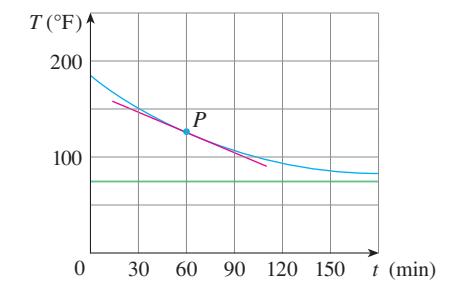
A roast turkey is taken from an oven when its temperature has reached 185 degrees F and is placed on a table in a room where the temperature is 75 degrees F. The graph shows how the temperature of the turkey decreases and eventually approaches room temperature. By measuring the slope of the tangent, estimate the rate of change of the temperature after an hour.
question image
47 Derivatives - Rates of Change · Level 3
Researchers measured the average blood alcohol concentration \(C(t)\) of eight men starting one hour after consumption of 30 mL of ethanol (corresponding to two alcoholic drinks).
\(t\) (hours) 1.0 1.5 2.0 2.5 3.0
\(C(t)\) (mg/mL) 0.33 0.24 0.18 0.12 0.07
(a) Find the average rate of change of \(C\) with respect to \(t\) over each time interval: (i) \([1.0, 2.0]\) (ii) \([1.5, 2.0]\) (iii) \([2.0, 2.5]\) (iv) \([2.0, 3.0]\) In each case, include the units.
(b) Estimate the instantaneous rate of change at \(t = 2\) and interpret your result. What are the units?

Enter your answer directly below each part above.

48 Derivatives - Rates of Change · Level 3
The number \(N\) of locations of a popular coffeehouse chain is given in the table. (The numbers of locations as of October 1 are given.)
Year 2004 2006 2008 2010 2012
\(N\) 8569 12,440 16,680 16,858 18,066
(a) Find the average rate of growth (i) from 2006 to 2008 (ii) from 2008 to 2010 In each case, include the units. What can you conclude?
(b) Estimate the instantaneous rate of growth in 2010 by taking the average of two average rates of change. What are its units?
(c) Estimate the instantaneous rate of growth in 2010 by measuring the slope of a tangent.

Enter your answer directly below each part above.

49 Derivatives - Rates of Change · Level 3
The table shows world average daily oil consumption from 1985 to 2010 measured in thousands of barrels per day.
Years since 1985 0 5 10 15 20 25
Thousands of barrels of oil per day 60,083 66,533 70,099 76,784 84,077 87,302
(a) Compute and interpret the average rate of change from 1990 to 2005. What are the units?
(b) Estimate the instantaneous rate of change in 2000 by taking the average of two average rates of change. What are its units?

Enter your answer directly below each part above.

50 Derivatives - Rates of Change · Level 3
The table shows values of the viral load \(V(t)\) in HIV patient 303, measured in RNA copies/mL, \(t\) days after ABT-538 treatment was begun.
\(t\) 4 8 11 15 22
\(V(t)\) 53 18 9.4 5.2 3.6
(a) Find the average rate of change of \(V\) with respect to \(t\) over each time interval: (i) \([4, 11]\) (ii) \([8, 11]\) (iii) \([11, 15]\) (iv) \([11, 22]\) What are the units?
(b) Estimate and interpret the value of the derivative \(V'(11)\).

Enter your answer directly below each part above.

51 Derivatives - Rates of Change · Level 3
The cost (in dollars) of producing \(x\) units of a certain commodity is \(C(x) = 5000 + 10x + 0.05x^2\).
(a) Find the average rate of change of \(C\) with respect to \(x\) when the production level is changed (i) from \(x = 100\) to \(x = 105\) (ii) from \(x = 100\) to \(x = 101\)
(b) Find the instantaneous rate of change of \(C\) with respect to \(x\) when \(x = 100\). (This is called the marginal cost.)

Enter your answer directly below each part above.

52 Derivatives - Rates of Change · Level 4
If a cylindrical tank holds 100,000 gallons of water, which can be drained from the bottom of the tank in an hour, then Torricelli's Law gives the volume \(V\) of water remaining in the tank after \(t\) minutes as \(V(t) = 100000 \left(1 - \dfrac{1}{60} t\right)^2\), \(\quad 0 \leq t \leq 60\) Find the rate at which the water is flowing out of the tank (the instantaneous rate of change of \(V\) with respect to \(t\)) as a function of \(t\). What are its units? For times \(t = 0, 10, 20, 30, 40, 50\), and \(60\) min, find the flow rate and the amount of water remaining in the tank. Summarize your findings in a sentence or two. At what time is the flow rate the greatest? The least?
53 Derivatives - Interpretation · Level 2
The cost of producing \(x\) ounces of gold from a new gold mine is \(C = f(x)\) dollars.
(a) What is the meaning of the derivative \(f'(x)\)? What are its units?
(b) What does the statement \(f'(800) = 17\) mean?
(c) Do you think the values of \(f'(x)\) will increase or decrease in the short term? What about the long term? Explain.

Enter your answer directly below each part above.

54 Derivatives - Interpretation · Level 2
The number of bacteria after \(t\) hours in a controlled laboratory experiment is \(n = f(t)\).
(a) What is the meaning of the derivative \(f'(5)\)? What are its units?
(b) Suppose there is an unlimited amount of space and nutrients for the bacteria. Which do you think is larger, \(f'(5)\) or \(f'(10)\)? If the supply of nutrients is limited, would that affect your conclusion? Explain.

Enter your answer directly below each part above.

55 Derivatives - Interpretation · Level 2
Let \(H(t)\) be the daily cost (in dollars) to heat an office building when the outside temperature is \(t\) degrees Fahrenheit.
(a) What is the meaning of \(H'(58)\)? What are its units?
(b) Would you expect \(H'(58)\) to be positive or negative? Explain.

Enter your answer directly below each part above.

56 Derivatives - Interpretation · Level 2
The quantity (in pounds) of a gourmet ground coffee that is sold by a coffee company at a price of \(p\) dollars per pound is \(Q = f(p)\).
(a) What is the meaning of the derivative \(f'(8)\)? What are its units?
(b) Is \(f'(8)\) positive or negative? Explain.

Enter your answer directly below each part above.

57 Derivatives - Interpretation · Level 3
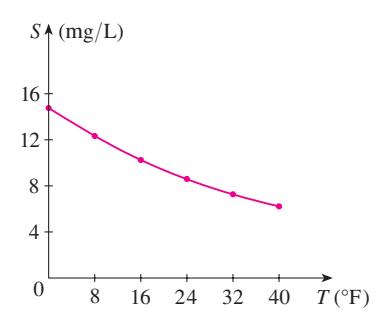
The quantity of oxygen that can dissolve in water depends on the temperature of the water. (So thermal pollution influences the oxygen content of water.) The graph shows how oxygen solubility \(S\) varies as a function of the water temperature \(T\).
question image
(a) What is the meaning of the derivative \(S'(T)\)? What are its units?
(b) Estimate the value of \(S'(16)\) and interpret it.

Enter your answer directly below each part above.

58 Derivatives - Interpretation · Level 3
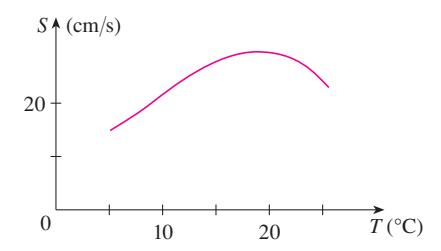
The graph shows the influence of the temperature \(T\) on the maximum sustainable swimming speed \(S\) of Coho salmon.
question image
(a) What is the meaning of the derivative \(S'(T)\)? What are its units?
(b) Estimate the values of \(S'(15)\) and \(S'(25)\) and interpret them.

Enter your answer directly below each part above.

59 Derivatives - Existence · Level 4
Determine whether \(f'(0)\) exists. \(f(x) = \begin{cases} x \sin\left(\dfrac{1}{x}\right) & \quad \text{if} x \neq 0 \\ 0 & \quad \text{if} x = 0 \end{cases}\)
60 Derivatives - Existence · Level 4
Determine whether \(f'(0)\) exists. \(f(x) = \begin{cases} x^2 \sin\left(\dfrac{1}{x}\right) & \quad \text{if} x \neq 0 \\ 0 & \quad \text{if} x = 0 \end{cases}\)
61 Derivatives - Graph Analysis · Level 4
(a) Graph the function \(f(x) = \sin x - \dfrac{1}{1000} \sin(1000x)\) in the viewing rectangle \([-2 \pi, 2 \pi]\) by \([-4, 4]\). What slope does the graph appear to have at the origin?
(b) Zoom in to the viewing window \([-0.4, 0.4]\) by \([-0.25, 0.25]\) and estimate the value of \(f'(0)\). Does this agree with your answer from part (a)?
(c) Now zoom in to the viewing window \([-0.008, 0.008]\) by \([-0.005, 0.005]\). Do you wish to revise your estimate for \(f'(0)\)?

Enter your answer directly below each part above.

Answered: 0 / 61