Stewart Precalc 6e Section 5.1: The Unit Circle

51 questions

--:--
0 / 51
Stewart Precalc 6e Section 5.1: The Unit Circle 0/51
1 Find missing coordinate on unit circle · Level 2
The point \(P\left(\dfrac{2}{5}, y\right)\) is on the unit circle and lies in Quadrant
I. Find the missing \(y\)-coordinate.
2 Find missing coordinate on unit circle · Level 2
The point \(P\left(x, -\dfrac{2}{7}\right)\) is on the unit circle and lies in Quadrant
IV. Find the missing \(x\)-coordinate.
3 Find missing coordinate on unit circle · Level 2
The point \(P\left(-\dfrac{2}{3}, y\right)\) is on the unit circle and lies in Quadrant
II. Find the missing \(y\)-coordinate.
4 Find P(x,y) on unit circle from given info · Level 2
The point \(P\) is on the unit circle. Find \(P(x, y)\) from the given information: the \(x\)-coordinate of \(P\) is \(\dfrac{4}{5}\), and the \(y\)-coordinate is positive.
5 Find P(x,y) on unit circle from given info · Level 2
The point \(P\) is on the unit circle. Find \(P(x, y)\) from the given information: the \(y\)-coordinate of \(P\) is \(-\dfrac{1}{3}\), and the \(x\)-coordinate is positive.
6 Find P(x,y) on unit circle from given info · Level 2
The point \(P\) is on the unit circle. Find \(P(x, y)\) from the given information: the \(y\)-coordinate of \(P\) is \(\dfrac{2}{3}\), and the \(x\)-coordinate is negative.
7 Find P(x,y) on unit circle from given info · Level 2
The point \(P\) is on the unit circle. Find \(P(x, y)\) from the given information: the \(x\)-coordinate of \(P\) is positive, and the \(y\)-coordinate of \(P\) is \(-\dfrac{\sqrt{5}}{5}\).
8 Find P(x,y) on unit circle from given info · Level 2
The point \(P\) is on the unit circle. Find \(P(x, y)\) from the given information: the \(x\)-coordinate of \(P\) is \(-\dfrac{\sqrt{2}}{3}\), and \(P\) lies below the \(x\)-axis.
9 Find P(x,y) on unit circle from given info · Level 2
The point \(P\) is on the unit circle. Find \(P(x, y)\) from the given information: the \(x\)-coordinate of \(P\) is \(-\dfrac{2}{5}\), and \(P\) lies above the \(x\)-axis.
10 Terminal points from figure · Level 2
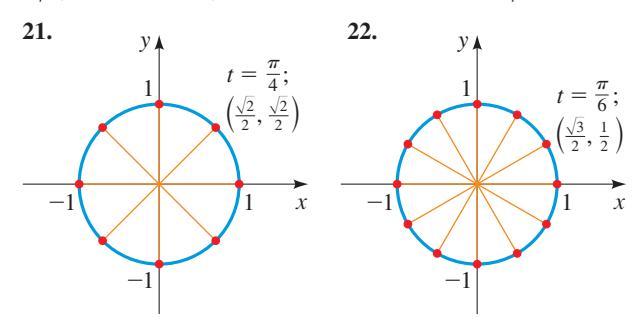
Find \(t\) and the terminal point determined by \(t\) for each point in the figure. In this exercise, \(t\) increases in increments of \(\dfrac{\pi}{4}\).
question image
11 Terminal points from figure · Level 2
Find \(t\) and the terminal point determined by \(t\) for each point in the figure. In this exercise, \(t\) increases in increments of \(\dfrac{\pi}{6}\).
12 Terminal point P(x,y) from t · Level 2
Find the terminal point \(P(x, y)\) on the unit circle determined by \(t = \dfrac{\pi}{2}\).
13 Terminal point P(x,y) from t · Level 2
Find the terminal point \(P(x, y)\) on the unit circle determined by \(t = \dfrac{3 \pi}{2}\).
14 Terminal point P(x,y) from t · Level 2
Find the terminal point \(P(x, y)\) on the unit circle determined by \(t = \dfrac{5 \pi}{6}\).
15 Terminal point P(x,y) from t · Level 2
Find the terminal point \(P(x, y)\) on the unit circle determined by \(t = \dfrac{7 \pi}{6}\).
16 Terminal point P(x,y) from t · Level 2
Find the terminal point \(P(x, y)\) on the unit circle determined by \(t = -\dfrac{\pi}{3}\).
17 Terminal point P(x,y) from t · Level 2
Find the terminal point \(P(x, y)\) on the unit circle determined by \(t = \dfrac{5 \pi}{3}\).
18 Terminal point P(x,y) from t · Level 2
Find the terminal point \(P(x, y)\) on the unit circle determined by \(t = \dfrac{2 \pi}{3}\).
19 Terminal point P(x,y) from t · Level 2
Find the terminal point \(P(x, y)\) on the unit circle determined by \(t = -\dfrac{\pi}{2}\).
20 Terminal point P(x,y) from t · Level 2
Find the terminal point \(P(x, y)\) on the unit circle determined by \(t = -\dfrac{3 \pi}{4}\).
21 Terminal point P(x,y) from t · Level 2
Find the terminal point \(P(x, y)\) on the unit circle determined by \(t = \dfrac{11 \pi}{6}\).
22 Symmetry of terminal points · Level 3
Suppose that the terminal point determined by \(t\) is the point \(\left(\dfrac{3}{5}, \dfrac{4}{5}\right)\) on the unit circle. Find the terminal point determined by each of the following.
(a) \(\pi - t\)
(b) \(-t\)
(c) \(\pi + t\)
(d) \(2 \pi + t\)

Enter your answer directly below each part above.

23 Symmetry of terminal points · Level 3
Suppose that the terminal point determined by \(t\) is the point \(\left(\dfrac{3}{4}, \dfrac{\sqrt{7}}{4}\right)\) on the unit circle. Find the terminal point determined by each of the following.
(a) \(-t\)
(b) \(4 \pi + t\)
(c) \(\pi - t\)
(d) \(t - \pi\)

Enter your answer directly below each part above.

24 Reference numbers · Level 2
Find the reference number for each value of \(t\).
(a) \(t = \dfrac{5 \pi}{4}\)
(b) \(t = \dfrac{7 \pi}{3}\)
(c) \(t = -\dfrac{4 \pi}{3}\)
(d) \(t = \dfrac{\pi}{6}\)

Enter your answer directly below each part above.

25 Reference numbers · Level 2
Find the reference number for each value of \(t\).
(a) \(t = \dfrac{5 \pi}{6}\)
(b) \(t = \dfrac{7 \pi}{6}\)
(c) \(t = \dfrac{11 \pi}{3}\)
(d) \(t = -\dfrac{7 \pi}{4}\)

Enter your answer directly below each part above.

26 Reference numbers · Level 3
Find the reference number for each value of \(t\).
(a) \(t = \dfrac{5 \pi}{7}\)
(b) \(t = -\dfrac{7 \pi}{9}\)
(c) \(t = -3\)
(d) \(t = 5\)

Enter your answer directly below each part above.

27 Reference numbers · Level 3
Find the reference number for each value of \(t\).
(a) \(t = \dfrac{11 \pi}{5}\)
(b) \(t = -\dfrac{9 \pi}{7}\)
(c) \(t = 6\)
(d) \(t = -7\)

Enter your answer directly below each part above.

28 Reference number and terminal point · Level 3
Find (a) the reference number for \(t = \dfrac{2 \pi}{3}\) and (b) the terminal point determined by \(t\).
29 Reference number and terminal point · Level 3
Find (a) the reference number for \(t = \dfrac{4 \pi}{3}\) and (b) the terminal point determined by \(t\).
30 Exercise - Reference Number and Terminal Point · Level 2
Find (a) the reference number for \(t = \dfrac{3 \pi}{4}\) and (b) the terminal point determined by \(t\).
31 Exercise - Reference Number and Terminal Point · Level 2
Find (a) the reference number for \(t = \dfrac{7 \pi}{3}\) and (b) the terminal point determined by \(t\).
32 Exercise - Reference Number and Terminal Point · Level 2
Find (a) the reference number for \(t = -\dfrac{2 \pi}{3}\) and (b) the terminal point determined by \(t\).
33 Exercise - Reference Number and Terminal Point · Level 2
Find (a) the reference number for \(t = -\dfrac{7 \pi}{6}\) and (b) the terminal point determined by \(t\).
34 Exercise - Reference Number and Terminal Point · Level 2
Find (a) the reference number for \(t = \dfrac{13 \pi}{4}\) and (b) the terminal point determined by \(t\).
35 Exercise - Reference Number and Terminal Point · Level 2
Find (a) the reference number for \(t = \dfrac{13 \pi}{6}\) and (b) the terminal point determined by \(t\).
36 Exercise - Reference Number and Terminal Point · Level 2
Find (a) the reference number for \(t = \dfrac{7 \pi}{6}\) and (b) the terminal point determined by \(t\).
37 Exercise - Reference Number and Terminal Point · Level 2
Find (a) the reference number for \(t = \dfrac{17 \pi}{4}\) and (b) the terminal point determined by \(t\).
38 Exercise - Reference Number and Terminal Point · Level 2
Find (a) the reference number for \(t = -\dfrac{11 \pi}{3}\) and (b) the terminal point determined by \(t\).
39 Exercise - Reference Number and Terminal Point · Level 2
Find (a) the reference number for \(t = \dfrac{31 \pi}{6}\) and (b) the terminal point determined by \(t\).
40 Exercise - Reference Number and Terminal Point · Level 2
Find (a) the reference number for \(t = \dfrac{16 \pi}{3}\) and (b) the terminal point determined by \(t\).
41 Exercise - Reference Number and Terminal Point · Level 2
Find (a) the reference number for \(t = -\dfrac{41 \pi}{4}\) and (b) the terminal point determined by \(t\).
42 Exercise - Terminal Point from Figure (Approximate) · Level 2
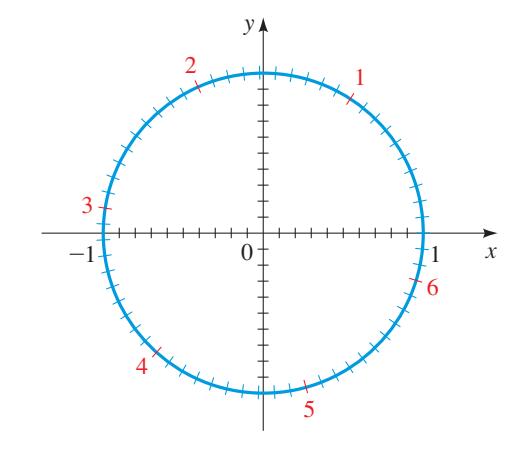
Use the figure to find the terminal point determined by the real number \(t = 1\), with coordinates rounded to one decimal place.
question image
43 Exercise - Terminal Point from Figure (Approximate) · Level 2
Use the figure to find the terminal point determined by the real number \(t = 2.5\), with coordinates rounded to one decimal place.
44 Exercise - Terminal Point from Figure (Approximate) · Level 2
Use the figure to find the terminal point determined by the real number \(t = -1.1\), with coordinates rounded to one decimal place.
45 Exercise - Terminal Point from Figure (Approximate) · Level 2
Use the figure to find the terminal point determined by the real number \(t = 4.2\), with coordinates rounded to one decimal place.
46 Discovery - Finding terminal points · Level 4
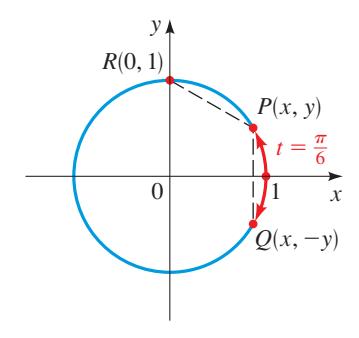
Finding the Terminal Point for \(\dfrac{\pi}{6}\). Suppose the terminal point determined by \(t = \dfrac{\pi}{6}\) is \(P(x, y)\) and the points \(Q\) and \(R\) are as shown in the figure. Why are the distances PQ and PR the same? Use this fact, together with the Distance Formula, to show that the coordinates of \(P\) satisfy the equation \(2 y = \sqrt{x^2 + (y - 1)^2}\). Simplify this equation using the fact that \(x^2 + y^2 = 1\). Solve the simplified equation to find \(P(x, y)\).
question image
47 Discovery - Finding terminal points · Level 4
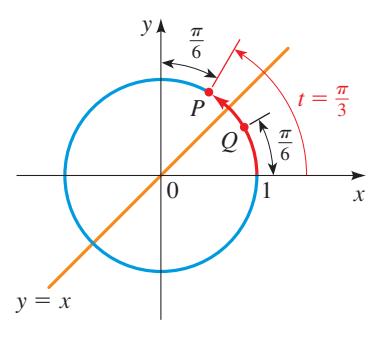
Finding the Terminal Point for \(\dfrac{\pi}{3}\). Now that you know the terminal point determined by \(t = \dfrac{\pi}{6}\), use symmetry to find the terminal point determined by \(t = \dfrac{\pi}{3}\) (see the figure). Explain your reasoning.
question image
48 Example - A Point on the Unit Circle · Level 1
Show that the point \(P\left(\dfrac{\sqrt{3}}{3}, \dfrac{\sqrt{6}}{3}\right)\) is on the unit circle.
49 Example - Locating a Point on the Unit Circle · Level 2
The point \(P\left(\dfrac{\sqrt{3}}{2}, y\right)\) is on the unit circle in Quadrant
IV. Find its \(y\)-coordinate.
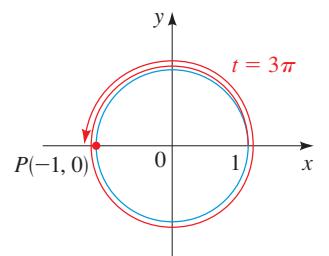
50 Example - Finding Terminal Points · Level 2
Find the terminal point on the unit circle determined by each real number \(t\).
question image
(a) \(t = 3 \pi\)
(b) \(t = -\pi\)
(c) \(t = -\dfrac{\pi}{2}\)

Enter your answer directly below each part above.

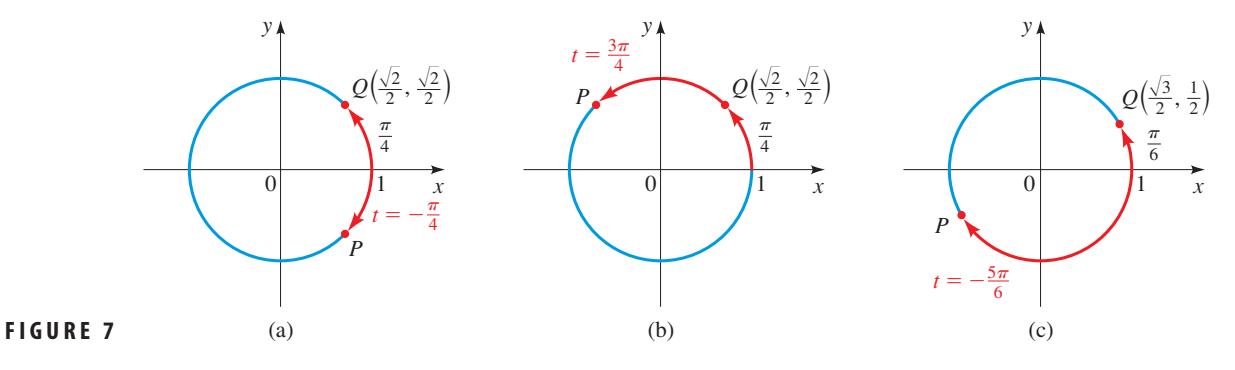
51 Example - Finding Terminal Points · Level 3
Find the terminal point determined by each given real number \(t\).
question image
(a) \(t = -\dfrac{\pi}{4}\)
(b) \(t = \dfrac{3 \pi}{4}\)
(c) \(t = -\dfrac{5 \pi}{6}\)

Enter your answer directly below each part above.

Answered: 0 / 51