Stewart Precalc 6e Section 10.3: Matrices and Systems of Linear Equations

67 questions

--:--
0 / 67
Stewart Precalc 6e Section 10.3: Matrices and Systems of Linear Equations 0/67
1 Concepts · Level 1
If a system of linear equations has infinitely many solutions, then the system is called ______. If a system of linear equations has no solution, then the system is called ______.
2 Concepts · Level 2
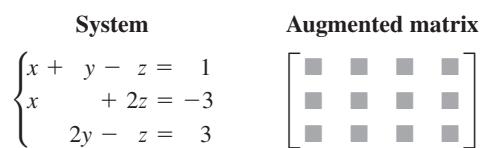
Write the augmented matrix of the following system of equations.
question image
3 Concepts · Level 2
The following matrix is the augmented matrix of a system of linear equations in the variables \(x\), \(y\), and \(z\). (It is given in reduced row-echelon form.) \( \begin{pmatrix} 1 & 0 & -1 & 3 \\ 0 & 1 & 2 & 5 \\ 0 & 0 & 0 & 0 \end{pmatrix} \)
(a) The leading variables are ______.
(b) Is the system inconsistent or dependent? ______.
(c) The solution of the system is: \(x = \) ______, \(y = \) ______, \(z = \) ______.

Enter your answer directly below each part above.

4 Concepts · Level 2
The augmented matrix of a system of linear equations is given in reduced row-echelon form. Find the solution of the system.
(a) \(\begin{pmatrix} 1 & 0 & 0 & 2 \\ 0 & 1 & 0 & 1 \\ 0 & 0 & 1 & 3 \end{pmatrix}\)
(b) \(\begin{pmatrix} 1 & 0 & 1 & 2 \\ 0 & 1 & 1 & 1 \\ 0 & 0 & 0 & 0 \end{pmatrix}\)
(c) \(\begin{pmatrix} 1 & 0 & 0 & 2 \\ 0 & 1 & 0 & 1 \\ 0 & 0 & 0 & 3 \end{pmatrix}\)

Enter your answer directly below each part above.

5 Skills - Matrix Dimensions · Level 1
State the dimension of the matrix. \( \begin{pmatrix} 2 & 7 \\ 0 & -1 \\ 5 & -3 \end{pmatrix} \)
6 Skills - Matrix Dimensions · Level 1
State the dimension of the matrix. \( \begin{pmatrix} -1 & 5 & 4 & 0 \\ 0 & 2 & 11 & 3 \end{pmatrix} \)
7 Skills - Matrix Dimensions · Level 1
State the dimension of the matrix. \( \begin{pmatrix} 12 \\ 35 \end{pmatrix} \)
8 Skills - Matrix Dimensions · Level 1
State the dimension of the matrix. \( \begin{pmatrix} -3 \\ 0 \\ 1 \end{pmatrix} \)
9 Skills - Matrix Dimensions · Level 1
State the dimension of the matrix. \( \begin{pmatrix} 1 & 4 & 7 \end{pmatrix} \)
10 Skills - Matrix Dimensions · Level 1
State the dimension of the matrix. \( \begin{pmatrix} 1 & 0 \\ 0 & 1 \end{pmatrix} \)
11 Skills - Row-Echelon Form · Level 2
A matrix is given. (a) Determine whether the matrix is in row-echelon form. (b) Determine whether the matrix is in reduced row-echelon form. (c) Write the system of equations for which the given matrix is the augmented matrix. \( \begin{pmatrix} 1 & 0 & -3 \\ 0 & 1 & 5 \end{pmatrix} \)
12 Skills - Row-Echelon Form · Level 2
A matrix is given. (a) Determine whether the matrix is in row-echelon form. (b) Determine whether the matrix is in reduced row-echelon form. (c) Write the system of equations for which the given matrix is the augmented matrix. \( \begin{pmatrix} 1 & 3 & -3 \\ 0 & 1 & 5 \end{pmatrix} \)
13 Skills - Row-Echelon Form · Level 2
A matrix is given. (a) Determine whether the matrix is in row-echelon form. (b) Determine whether the matrix is in reduced row-echelon form. (c) Write the system of equations for which the given matrix is the augmented matrix. \( \begin{pmatrix} 1 & 2 & 8 & 0 \\ 0 & 1 & 3 & 2 \\ 0 & 0 & 0 & 0 \end{pmatrix} \)
14 Skills - Row-Echelon Form · Level 2
A matrix is given. (a) Determine whether the matrix is in row-echelon form. (b) Determine whether the matrix is in reduced row-echelon form. (c) Write the system of equations for which the given matrix is the augmented matrix. \( \begin{pmatrix} 1 & 0 & -7 & 0 \\ 0 & 1 & 3 & 0 \\ 0 & 0 & 0 & 1 \end{pmatrix} \)
15 Skills - Row-Echelon Form · Level 2
A matrix is given. (a) Determine whether the matrix is in row-echelon form. (b) Determine whether the matrix is in reduced row-echelon form. (c) Write the system of equations for which the given matrix is the augmented matrix. \( \begin{pmatrix} 1 & 0 & 0 & 0 \\ 0 & 0 & 0 & 0 \\ 0 & 1 & 5 & 1 \end{pmatrix} \)
16 Skills - Row-Echelon Form · Level 2
A matrix is given. (a) Determine whether the matrix is in row-echelon form. (b) Determine whether the matrix is in reduced row-echelon form. (c) Write the system of equations for which the given matrix is the augmented matrix. \( \begin{pmatrix} 1 & 0 & 0 & 1 \\ 0 & 1 & 0 & 2 \\ 0 & 0 & 1 & 3 \end{pmatrix} \)
17 Skills - Row-Echelon Form · Level 3
A matrix is given. (a) Determine whether the matrix is in row-echelon form. (b) Determine whether the matrix is in reduced row-echelon form. (c) Write the system of equations for which the given matrix is the augmented matrix. \( \begin{pmatrix} 1 & 3 & 0 & -1 & 0 \\ 0 & 0 & 1 & 2 & 0 \\ 0 & 0 & 0 & 0 & 1 \\ 0 & 0 & 0 & 0 & 0 \end{pmatrix} \)
18 Skills - Row-Echelon Form · Level 3
A matrix is given. (a) Determine whether the matrix is in row-echelon form. (b) Determine whether the matrix is in reduced row-echelon form. (c) Write the system of equations for which the given matrix is the augmented matrix. \( \begin{pmatrix} 1 & 3 & 0 & 1 & 0 & 0 \\ 0 & 1 & 0 & 4 & 0 & 0 \\ 0 & 0 & 0 & 1 & 1 & 2 \\ 0 & 0 & 0 & 1 & 0 & 0 \end{pmatrix} \)
19 Skills - Unique Solutions · Level 3
The system of linear equations has a unique solution. Find the solution using Gaussian elimination or Gauss-Jordan elimination. \( \begin{cases} x + y + z = 2 \\ 2x - 3y + 2z = 4 \\ 4x + y - 3z = 1 \end{cases} \)
20 Skills - Unique Solutions · Level 3
The system of linear equations has a unique solution. Find the solution using Gaussian elimination or Gauss-Jordan elimination. \( \begin{cases} x + y + z = 4 \\ -x + 2y + 3z = 17 \\ 2x - y = -7 \end{cases} \)
21 Skills - Unique Solutions · Level 3
The system of linear equations has a unique solution. Find the solution using Gaussian elimination or Gauss-Jordan elimination. \( \begin{cases} x + 2y - z = -2 \\ x + z = 0 \\ 2x - y - z = -3 \end{cases} \)
22 Skills - Unique Solutions · Level 3
The system of linear equations has a unique solution. Find the solution using Gaussian elimination or Gauss-Jordan elimination. \( \begin{cases} 2y + z = 4 \\ x + y = 4 \\ 3x + 3y - z = 10 \end{cases} \)
23 Skills - Unique Solutions · Level 3
The system of linear equations has a unique solution. Find the solution using Gaussian elimination or Gauss-Jordan elimination. \( \begin{cases} x_1 + 2 x_2 - x_3 = 9 \\ 2 x_1 - x_3 = -2 \\ 3 x_1 + 5 x_2 + 2 x_3 = 22 \end{cases} \)
24 Skills - Unique Solutions · Level 3
The system of linear equations has a unique solution. Find the solution using Gaussian elimination or Gauss-Jordan elimination. \( \begin{cases} 2 x_1 + x_2 = 7 \\ 2 x_1 - x_2 + x_3 = 6 \\ 3 x_1 - 2 x_2 + 4 x_3 = 11 \end{cases} \)
25 Skills - Unique Solutions · Level 3
The system of linear equations has a unique solution. Find the solution using Gaussian elimination or Gauss-Jordan elimination. \( \begin{cases} 2x - 3y - z = 13 \\ -x + 2y - 5z = 6 \\ 5x - y - z = 49 \end{cases} \)
26 Skills - Unique Solutions · Level 3
The system of linear equations has a unique solution. Find the solution using Gaussian elimination or Gauss-Jordan elimination. \( \begin{cases} 10x + 10y - 20z = 60 \\ 15x + 20y + 30z = -25 \\ -5x + 30y - 10z = 45 \end{cases} \)
27 Skills - Inconsistent or Dependent · Level 3
\( \begin{cases} x + y + z = 2 \\ y - 3z = 1 \\ 2x + y + 5z = 0 \end{cases} \)
28 Skills - Inconsistent or Dependent · Level 3
\( \begin{cases} x + 3z = 3 \\ 2x + y - 2z = 5 \\ -y + 8z = 8 \end{cases} \)
29 Skills - Inconsistent or Dependent · Level 3
\( \begin{cases} 2x - 3y - 9z = -5 \\ x + 3z = 2 \\ -3x + y - 4z = -3 \end{cases} \)
30 Skills - Inconsistent or Dependent · Level 3
\( \begin{cases} x - 2y + 5z = 3 \\ -2x + 6y - 11z = 1 \\ 3x - 16y - 20z = -26 \end{cases} \)
31 Skills - Inconsistent or Dependent · Level 3
\( \begin{cases} x - y + 3z = 3 \\ 4x - 8y + 32z = 24 \\ 2x - 3y + 11z = 4 \end{cases} \)
32 Skills - Inconsistent or Dependent · Level 3
\( \begin{cases} -2x + 6y - 2z = -12 \\ x - 3y + 2z = 10 \\ -x + 3y + 2z = 6 \end{cases} \)
33 Skills - Inconsistent or Dependent · Level 3
\( \begin{cases} x + 4y - 2z = -3 \\ 2x - y + 5z = 12 \\ 8x + 5y + 11z = 30 \end{cases} \)
34 Skills - Inconsistent or Dependent · Level 3
\( \begin{cases} 3r + 2s - 3t = 10 \\ r - s - t = -5 \\ r + 4s - t = 20 \end{cases} \)
35 Skills - Inconsistent or Dependent · Level 3
\( \begin{cases} 2x + y - 2z = 12 \\ -x - \dfrac{1}{2} y + z = -6 \\ 3x + \dfrac{3}{2} y - 3z = 18 \end{cases} \)
36 Skills - Inconsistent or Dependent · Level 3
\( \begin{cases} y - 5z = 7 \\ 3x + 2y = 12 \\ 3x + 10z = 80 \end{cases} \)
37 Skills - Solving Linear Systems · Level 3
\( \begin{cases} 4x - 3y + z = -8 \\ -2x + y - 3z = -4 \\ x - y + 2z = 3 \end{cases} \)
38 Skills - Solving Linear Systems · Level 3
\( \begin{cases} 2x - 3y + 5z = 14 \\ 4x - y - 2z = -17 \\ -x - y + z = 3 \end{cases} \)
39 Skills - Solving Linear Systems · Level 3
\( \begin{cases} 2x + y + 3z = 9 \\ -x - 7z = 10 \\ 3x + 2y - z = 4 \end{cases} \)
40 Skills - Solving Linear Systems · Level 3
\( \begin{cases} -4x - y + 36z = 24 \\ x - 2y + 9z = 3 \\ -2x + y + 6z = 6 \end{cases} \)
41 Skills - Solving Linear Systems · Level 3
\( \begin{cases} x + 2y - 3z = -5 \\ -2x - 4y - 6z = 10 \\ 3x + 7y - 2z = -13 \end{cases} \)
42 Skills - Solving Linear Systems · Level 3
\( \begin{cases} 3x + y = 2 \\ -4x + 3y + z = 4 \\ 2x + 5y + z = 0 \end{cases} \)
43 Skills - Solving Linear Systems · Level 3
\( \begin{cases} x - y + 6z = 8 \\ x + z = 5 \\ x + 3y - 14z = -4 \end{cases} \)
44 Skills - Solving Linear Systems · Level 3
\( \begin{cases} 3x - y + 2z = -1 \\ 4x - 2y + z = -7 \\ -x + 3y - 2z = -1 \end{cases} \)
45 Skills - Solving Linear Systems · Level 4
\( \begin{cases} -x + 2y + z - 3w = 3 \\ 3x - 4y + z + w = 9 \\ -x - y + z + w = 0 \\ 2x + y + 4z - 2w = 3 \end{cases} \)
46 Skills - Solving Linear Systems · Level 4
\( \begin{cases} x + y - z - w = 6 \\ 2x + z - 3w = 8 \\ x - y + 4w = -10 \\ 3x + 5y - z - w = 20 \end{cases} \)
47 Skills - Solving Linear Systems · Level 4
\( \begin{cases} x + y + 2z - w = -2 \\ 3y + z + 2w = 2 \\ x + y + 3w = 2 \\ -3x + z + 2w = 5 \end{cases} \)
48 Skills - Solving Linear Systems · Level 4
\( \begin{cases} x - 3y + 2z + w = -2 \\ x - 2y - 2w = -10 \\ z + 5w = 15 \\ 3x + 2z + w = -3 \end{cases} \)
49 Skills - Solving Linear Systems · Level 4
\( \begin{cases} x - y + w = 0 \\ 3x - z + 2w = 0 \\ x - 4y + z + 2w = 0 \end{cases} \)
50 Skills - Solving Linear Systems · Level 4
\( \begin{cases} 2x - y + 2z + w = 5 \\ -x + y + 4z - w = 3 \\ 3x - 2y - z = 0 \end{cases} \)
51 Skills - Solving Linear Systems · Level 4
\( \begin{cases} x + z + w = 4 \\ y - z = -4 \\ x - 2y + 3z + w = 12 \\ 2x - 2z + 5w = -1 \end{cases} \)
52 Skills - Solving Linear Systems · Level 4
\( \begin{cases} y - z + 2w = 0 \\ 3x + 2y + w = 0 \\ 2x + 4w = 12 \\ -2x - 2z + 5w = 6 \end{cases} \)
53 Applications - Nutrition · Level 4
Nutrition. A doctor recommends that a patient take 50 mg each of niacin, riboflavin, and thiamin daily to alleviate a vitamin deficiency. In his medicine chest at home the patient finds three brands of vitamin pills. The amounts of the relevant vitamins per pill are given in the table. How many pills of each type should he take every day to get 50 mg of each vitamin?
VitaMax Vitron VitaPlus
Niacin (mg) 5 10 15
Riboflavin (mg) 15 20 0
Thiamin (mg) 10 10 10
54 Applications - Mixtures · Level 4
Mixtures. A chemist has three acid solutions at various concentrations. The first is 10% acid, the second is 20%, and the third is 40%. How many milliliters of each should she use to make 100 mL of 18% solution, if she has to use four times as much of the 10% solution as the 40% solution?
55 Applications - Distance, Speed, Time · Level 4
Distance, Speed, and Time. Amanda, Bryce, and Corey enter a race in which they have to run, swim, and cycle over a marked course. Their average speeds are given in the table. Corey finishes first with a total time of 1 h 45 min. Amanda comes in second with a time of 2 h 30 min. Bryce finishes last with a time of 3 h. Find the distance (in miles) for each part of the race.
Running (mi/h) Swimming (mi/h) Cycling (mi/h)
Amanda 10 4 20
Bryce \(7 \dfrac{1}{2}\) 6 15
Corey 15 3 40
56 Applications - Classroom Use · Level 4
Classroom Use. A small school has 100 students who occupy three classrooms: A, B, and C. After the first period of the school day, half the students in room A move to room B, one-fifth of the students in room B move to room C, and one-third of the students in room C move to room A. Nevertheless, the total number of students in each room is the same for both periods. How many students occupy each room?
57 Applications - Manufacturing · Level 4
Manufacturing Furniture. A furniture factory makes wooden tables, chairs, and armoires. Each piece of furniture requires three operations: cutting the wood, assembling, and finishing. Each operation requires the number of hours (h) given in the table. The workers in the factory can provide 300 hours of cutting, 400 hours of assembling, and 590 hours of finishing each work week. How many tables, chairs, and armoires should be produced so that all available labor-hours are used? Or is this impossible?
Table Chair Armoire
Cutting (h) \(\dfrac{1}{2}\) 1 1
Assembling (h) \(\dfrac{1}{2}\) \(1 \dfrac{1}{2}\) 1
Finishing (h) 1 \(1 \dfrac{1}{2}\) 2
58 Applications - Traffic Flow · Level 4
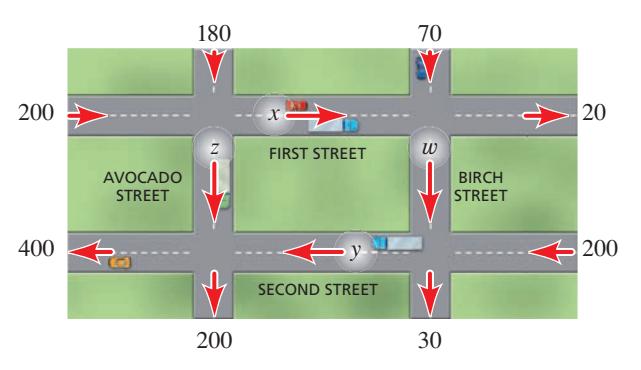
Traffic Flow. A section of a city's street network is shown in the figure. The arrows indicate one-way streets, and the numbers show how many cars enter or leave this section of the city via the indicated street in a certain one-hour period. The variables \(x\), \(y\), \(z\), and \(w\) represent the number of cars that travel along the portions of First, Second, Avocado, and Birch Streets during this period. Find \(x\), \(y\), \(z\), and \(w\), assuming that none of the cars stop or park on any of the streets shown.
question image
59 Discovery, Discussion, Writing · Level 4
Polynomials Determined by a Set of Points. We all know that two points uniquely determine a line \(y = a x + b\) in the coordinate plane. Similarly, three points uniquely determine a quadratic (second-degree) polynomial \( y = a x^2 + b x + c \) four points uniquely determine a cubic (third-degree) polynomial \( y = a x^3 + b x^2 + c x + d \) and so on. (Some exceptions to this rule are if the three points actually lie on a line, or the four points lie on a quadratic or line, and so on.) For the following set of five points, find the line that contains the first two points, the quadratic that contains the first three points, the cubic that contains the first four points, and the fourth-degree polynomial that contains all five points. \((0, 0), (1, 12), (2, 40), (3, 6), (-1, -14)\) Graph the points and functions in the same viewing rectangle using a graphing device.
60 Example - Finding the Augmented Matrix of a Linear System · Level 1
Write the augmented matrix of the system of equations. \(\begin{cases} 6x - 2y - z = 4 \\ x + 3z = 1 \\ 7y + z = 5 \end{cases}\)
61 Example - Using Elementary Row Operations to Solve a Linear System · Level 2
Solve the system of linear equations using elementary row operations on the augmented matrix. \(\begin{cases} x - y + 3z = 4 \\ x + 2y - 2z = 10 \\ 3x - y + 5z = 14 \end{cases}\)
62 Example - Solving a System Using Row-Echelon Form (Gaussian Elimination) · Level 3
Solve the system of linear equations using Gaussian elimination. \(\begin{cases} 4x + 8y - 4z = 4 \\ 3x + 8y + 5z = -11 \\ -2x + y + 12z = -17 \end{cases}\)
63 Example - Solving a System Using Reduced Row-Echelon Form · Level 2
Solve the system of linear equations using Gauss-Jordan elimination. \(\begin{cases} 4 x + 8 y - 4 z = 4 \\ 3 x + 8 y + 5 z = -11 \\ -2 x + y + 12 z = -17 \end{cases}\)
64 Example - A System with No Solution (Inconsistent) · Level 2
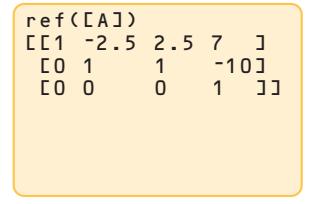
Solve the system. \(\begin{cases} x - 3 y + 2 z = 12 \\ 2 x - 5 y + 5 z = 14 \\ x - 2 y + 3 z = 20 \end{cases}\)
question image
65 Example - A System with Infinitely Many Solutions · Level 3
Find the complete solution of the system. \(\begin{cases} -3 x - 5 y + 36 z = 10 \\ -x + 7 z = 5 \\ x + y - 10 z = -4 \end{cases}\)
66 Example - A System with Infinitely Many Solutions (Four Variables) · Level 3
Find the complete solution of the system. \(\begin{cases} x + 2 y - 3 z - 4 w = 10 \\ x + 3 y - 3 z - 4 w = 15 \\ 2 x + 2 y - 6 z - 8 w = 10 \end{cases}\)
67 Example - Nutritional Analysis Using a System of Linear Equations · Level 3
A nutritionist is performing an experiment on student volunteers. He wishes to feed one of his subjects a daily diet that consists of a combination of three commercial diet foods: MiniCal, LiquiFast, and SlimQuick. For the experiment, the subject must consume exactly \(500\) mg of potassium, \(75\) g of protein, and \(1150\) units of vitamin D every day. The amounts of these nutrients in one ounce of each food are: - MiniCal: \(50\) mg potassium, \(5\) g protein, \(90\) units vitamin D per ounce. - LiquiFast: \(75\) mg potassium, \(10\) g protein, \(100\) units vitamin D per ounce. - SlimQuick: \(10\) mg potassium, \(3\) g protein, \(50\) units vitamin D per ounce. How many ounces of each food should the subject eat every day to satisfy the nutrient requirements exactly?

Answered: 0 / 67