Stewart Precalc 6e Section 5.6: Modeling Harmonic Motion

57 questions

--:--
0 / 57
Stewart Precalc 6e Section 5.6: Modeling Harmonic Motion 0/57
1 Concept - Simple Harmonic Motion · Level 1
For an object in simple harmonic motion with amplitude \(a\) and period \(2 \dfrac{\pi}{\omega}\), find an equation that models the displacement \(y\) at time \(t\) if (a) \(y = 0\) at time \(t = 0\); (b) \(y = a\) at time \(t = 0\).
2 Concept - Damped Harmonic Motion · Level 1
For an object in damped harmonic motion with initial amplitude \(k\), period \(2 \dfrac{\pi}{\omega}\), and damping constant \(c\), find an equation that models the displacement \(y\) at time \(t\) if (a) \(y = 0\) at time \(t = 0\); (b) \(y = a\) at time \(t = 0\).
3 Skills - Simple Harmonic Motion · Level 2
The given function models the displacement of an object moving in simple harmonic motion: \(y = 2 \sin(3 t)\). (a) Find the amplitude, period, and frequency of the motion. (b) Sketch a graph of the displacement of the object over one complete period.
4 Skills - Simple Harmonic Motion · Level 2
The given function models the displacement of an object moving in simple harmonic motion: \(y = 3 \cos(\left(\dfrac{1}{2}\right) t)\). (a) Find the amplitude, period, and frequency. (b) Sketch a graph of the displacement over one complete period.
5 Skills - Simple Harmonic Motion · Level 2
The given function models simple harmonic motion: \(y = -\cos(0.3 t)\). (a) Find the amplitude, period, and frequency. (b) Sketch a graph of the displacement over one complete period.
6 Skills - Simple Harmonic Motion · Level 2
The given function models simple harmonic motion: \(y = 2.4 \sin(3.6 t)\). (a) Find the amplitude, period, and frequency. (b) Sketch a graph over one complete period.
7 Skills - Simple Harmonic Motion · Level 2
The given function models simple harmonic motion: \(y = -0.25 \cos\left(1.5 t - \dfrac{\pi}{3}\right)\). (a) Find the amplitude, period, and frequency. (b) Sketch a graph over one complete period.
8 Skills - Simple Harmonic Motion · Level 2
The given function models simple harmonic motion: \(y = -\left(\dfrac{3}{2}\right) \sin(0.2 t + 1.4)\). (a) Find the amplitude, period, and frequency. (b) Sketch a graph over one complete period.
9 Skills - Simple Harmonic Motion · Level 2
The given function models simple harmonic motion: \(y = 5 \cos(\left(\dfrac{2}{3}\right) t + \dfrac{3}{4})\). (a) Find the amplitude, period, and frequency. (b) Sketch a graph over one complete period.
10 Skills - Simple Harmonic Motion · Level 2
The given function models simple harmonic motion: \(y = 1.6 \sin(t - 1.8)\). (a) Find the amplitude, period, and frequency. (b) Sketch a graph over one complete period.
11 Skills - Finding SHM Function (zero at t=0) · Level 2
Find a function that models the simple harmonic motion having the given properties. Assume that the displacement is zero at time \(t = 0\). Amplitude 10 cm, period 3 s.
12 Skills - Finding SHM Function (zero at t=0) · Level 2
Find a function that models simple harmonic motion with displacement zero at \(t = 0\). Amplitude 24 ft, period 2 min.
13 Skills - Finding SHM Function (zero at t=0) · Level 2
Find a function that models simple harmonic motion with displacement zero at \(t = 0\). Amplitude 6 in., frequency \(\dfrac{5}{\pi}\) Hz.
14 Skills - Finding SHM Function (zero at t=0) · Level 2
Find a function that models simple harmonic motion with displacement zero at \(t = 0\). Amplitude 1.2 m, frequency 0.5 Hz.
15 Skills - Finding SHM Function (max at t=0) · Level 2
Find a function that models the simple harmonic motion having the given properties. Assume that the displacement is at its maximum at time \(t = 0\). Amplitude 60 ft, period 0.5 min.
16 Skills - Finding SHM Function (max at t=0) · Level 2
Find a function that models simple harmonic motion with maximum displacement at \(t = 0\). Amplitude 35 cm, period 8 s.
17 Skills - Finding SHM Function (max at t=0) · Level 2
Find a function that models simple harmonic motion with maximum displacement at \(t = 0\). Amplitude 2.4 m, frequency 750 Hz.
18 Skills - Finding SHM Function (max at t=0) · Level 2
Find a function that models simple harmonic motion with maximum displacement at \(t = 0\). Amplitude 6.25 in., frequency 60 Hz.
19 Skills - Damped Harmonic Motion (cosine) · Level 3
An initial amplitude \(k\), damping constant \(c\), and frequency \(f\) or period \(p\) are given. (a) Find a function of the form \(y = k e^{-c t} \cos(\omega t)\) that models the damped harmonic motion. (b) Graph the function. Given: \(k = 2\), \(c = 1.5\), \(f = 3\).
20 Skills - Damped Harmonic Motion (cosine) · Level 3
Find a damped harmonic motion function of the form \(y = k e^{-c t} \cos(\omega t)\) and graph it. Given: \(k = 15\), \(c = 0.25\), \(f = 0.6\).
21 Skills - Damped Harmonic Motion (cosine) · Level 3
Find a damped harmonic motion function of the form \(y = k e^{-c t} \cos(\omega t)\) and graph it. Given: \(k = 100\), \(c = 0.05\), \(p = 4\).
22 Skills - Damped Harmonic Motion (cosine) · Level 3
Find a damped harmonic motion function of the form \(y = k e^{-c t} \cos(\omega t)\) and graph it. Given: \(k = 0.75\), \(c = 3\), \(p = 3 \pi\).
23 Skills - Damped Harmonic Motion (sine) · Level 3
Find a damped harmonic motion function of the form \(y = k e^{-c t} \sin(\omega t)\) and graph it. Given: \(k = 7\), \(c = 10\), \(p = \dfrac{\pi}{6}\).
24 Skills - Damped Harmonic Motion (sine) · Level 3
Find a damped harmonic motion function of the form \(y = k e^{-c t} \sin(\omega t)\) and graph it. Given: \(k = 1\), \(c = 1\), \(p = 1\).
25 Skills - Damped Harmonic Motion (sine) · Level 3
Find a damped harmonic motion function of the form \(y = k e^{-c t} \sin(\omega t)\) and graph it. Given: \(k = 0.3\), \(c = 0.2\), \(f = 20\).
26 Skills - Damped Harmonic Motion (sine) · Level 3
Find a damped harmonic motion function of the form \(y = k e^{-c t} \sin(\omega t)\) and graph it. Given: \(k = 12\), \(c = 0.01\), \(f = 8\).
27 Applications - A Bobbing Cork · Level 3
A cork floating in a lake is bobbing in simple harmonic motion. Its displacement above the bottom of the lake is modeled by \(y = 0.2 \cos(20 \pi t) + 8\), where \(y\) is measured in meters and \(t\) is measured in minutes. (a) Find the frequency of the motion of the cork. (b) Sketch a graph of \(y\). (c) Find the maximum displacement of the cork above the lake bottom.
28 Applications - FM Radio Signals · Level 3
The carrier wave for an FM radio signal is modeled by the function \(y = a \sin(2 \pi (9.15 \times 10^7) t)\), where \(t\) is measured in seconds. Find the period and frequency of the carrier wave.
29 Applications - Blood Pressure · Level 3
Each time your heart beats, your blood pressure increases, then decreases as the heart rests between beats. A certain person's blood pressure is modeled by \(p(t) = 115 + 25 \sin(160 \pi t)\), where \(p(t)\) is the pressure in mmHg at time \(t\), measured in minutes. (a) Find the amplitude, period, and frequency of \(p\). (b) Sketch a graph of \(p\). (c) If a person is exercising, his or her heart beats faster. How does this affect the period and frequency of \(p\)?
30 Applications - Predator Population Model · Level 3
In a predator/prey model the predator population is modeled by \(y = 900 \cos(2 t) + 8000\), where \(t\) is measured in years. (a) What is the maximum population? (b) Find the length of time between successive periods of maximum population.
31 Applications - Spring-Mass System · Level 3
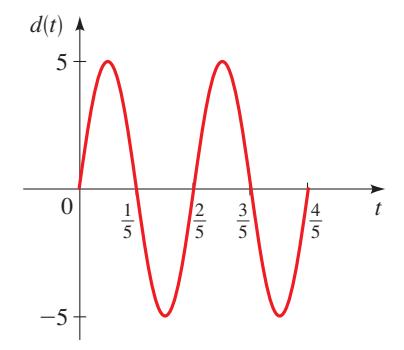
A mass attached to a spring is moving up and down in simple harmonic motion. The graph gives its displacement \(d(t)\) from equilibrium at time \(t\). Express the function \(d\) in the form \(d(t) = a \sin(\omega t)\).
question image
32 Applications - Tides · Level 3
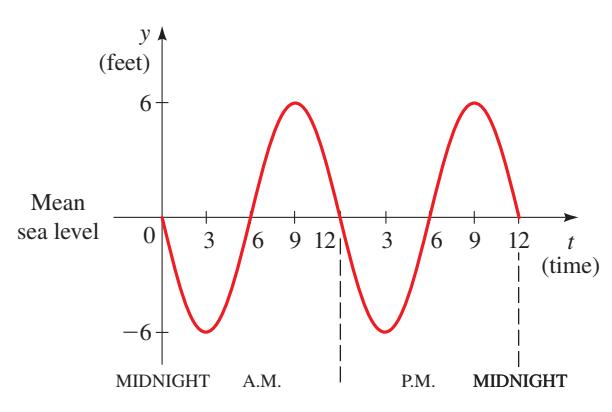
The graph shows the variation of the water level relative to mean sea level in Commencement Bay at Tacoma, Washington, for a particular 24-hour period. Assuming that this variation is modeled by simple harmonic motion, find an equation of the form \(y = a \sin(\omega t)\) that describes the variation in water level as a function of the number of hours after midnight.
question image
33 Applications - Tides (Bay of Fundy) · Level 3
The Bay of Fundy in Nova Scotia has the highest tides in the world. In one 12-hour period the water starts at mean sea level, rises to 21 ft above, drops to 21 ft below, then returns to mean sea level. Assuming that the motion of the tides is simple harmonic, find an equation that describes the height of the tide in the Bay of Fundy above mean sea level. Sketch a graph that shows the level of the tides over a 12-hour period.
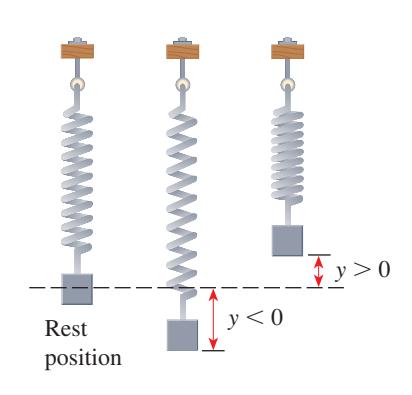
34 Applications - Spring-Mass System · Level 3
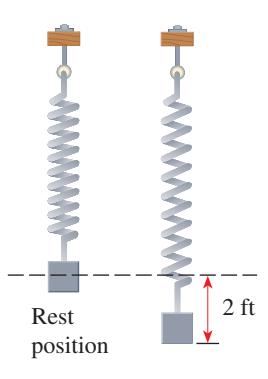
A mass suspended from a spring is pulled down a distance of 2 ft from its rest position, as shown in the figure. The mass is released at time \(t = 0\) and allowed to oscillate. If the mass returns to this position after 1 s, find an equation that describes its motion.
question image
35 Applications - Spring-Mass System · Level 3
A mass is suspended on a spring. The spring is compressed so that the mass is located 5 cm above its rest position. The mass is released at time \(t = 0\) and allowed to oscillate. It is observed that the mass reaches its lowest point \(\dfrac{1}{2}\) s after it is released. Find an equation that describes the motion of the mass.
36 Applications - Spring-Mass System (Spring Constant) · Level 4
The frequency of oscillation of an object suspended on a spring depends on the stiffness \(k\) of the spring (called the spring constant) and the mass \(m\) of the object. If the spring is compressed a distance \(a\) and then allowed to oscillate, its displacement is given by \(f(t) = a \cos\left(\sqrt{\dfrac{k}{m}} t\right)\). (a) A 10-g mass is suspended from a spring with stiffness \(k = 3\). If the spring is compressed a distance 5 cm and then released, find the equation that describes the oscillation of the spring. (b) Find a general formula for the frequency (in terms of \(k\) and \(m\)). (c) How is the frequency affected if the mass is increased? Is the oscillation faster or slower? (d) How is the frequency affected if a stiffer spring is used (larger \(k\))? Is the oscillation faster or slower?
37 Applications - Ferris Wheel · Level 3
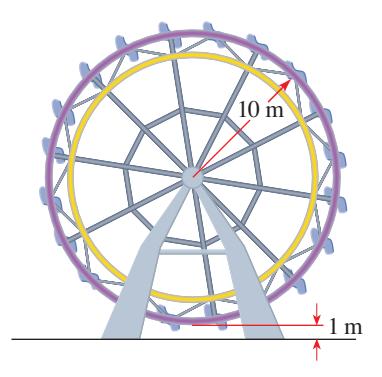
A ferris wheel has a radius of 10 m, and the bottom of the wheel passes 1 m above the ground. If the ferris wheel makes one complete revolution every 20 s, find an equation that gives the height above the ground of a person on the ferris wheel as a function of time.
question image
38 Applications - Clock Pendulum · Level 3
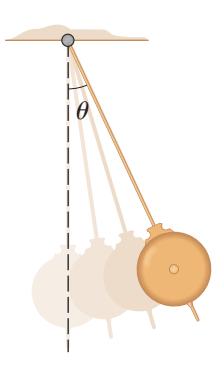
The pendulum in a grandfather clock makes one complete swing every 2 s. The maximum angle that the pendulum makes with respect to its rest position is \(10^{\circ}\). We know from physical principles that the angle \(u\) between the pendulum and its rest position changes in simple harmonic fashion. Find an equation that describes the size of the angle \(u\) as a function of time. (Take \(t = 0\) to be a time when the pendulum is vertical.)
question image
39 Applications - Variable Stars · Level 3
The variable star Zeta Gemini has a period of 10 days. The average brightness of the star is 3.8 magnitudes, and the maximum variation from the average is 0.2 magnitude. Assuming that the variation in brightness is simple harmonic, find an equation that gives the brightness of the star as a function of time.
40 Applications - Variable Stars (Delta Cephei) · Level 3
Astronomers believe that the radius of a variable star increases and decreases with the brightness of the star. The variable star Delta Cephei (Example
4) has an average radius of 20 million miles and changes by a maximum of 1.5 million miles from this average during a single pulsation. Find an equation that describes the radius of this star as a function of time.
41 Applications - Biological Clocks · Level 3
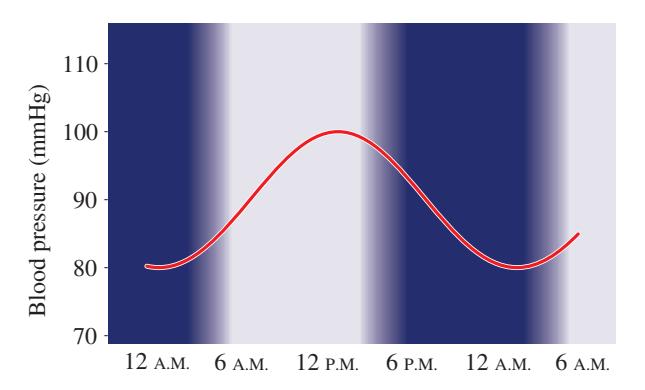
Circadian rhythms are biological processes that oscillate with a period of approximately 24 hours. That is, a circadian rhythm is an internal daily biological clock. Blood pressure appears to follow such a rhythm. For a certain individual the average resting blood pressure varies from a maximum of 100 mmHg at 2:00 P.M. to a minimum of 80 mmHg at 2:00 A.M. Find a sine function of the form \(f(t) = a \sin(\omega(t - c)) + b\) that models the blood pressure at time \(t\), measured in hours from midnight.
question image
42 Applications - Electric Generator · Level 3
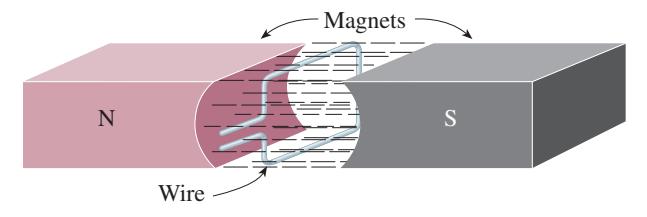
The armature in an electric generator is rotating at the rate of 100 revolutions per second (rps). If the maximum voltage produced is 310 V, find an equation that describes this variation in voltage. What is the rms voltage?
43 Applications - Electric Generator (Graph) · Level 3
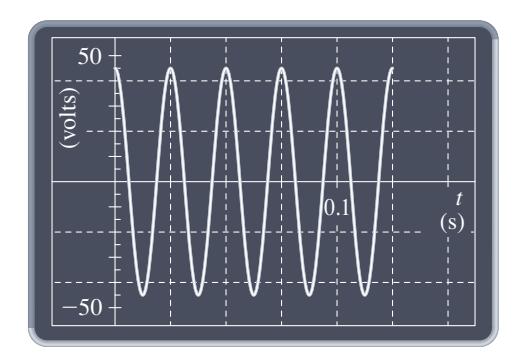
The graph shows an oscilloscope reading of the variation in voltage of an AC current produced by a simple generator. (a) Find the maximum voltage produced. (b) Find the frequency (cycles per second) of the generator. (c) How many revolutions per second does the armature in the generator make? (d) Find a formula that describes the variation in voltage as a function of time.
question image
44 Applications - Doppler Effect · Level 4
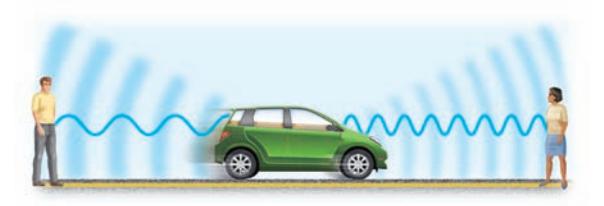
When a car with its horn blowing drives by an observer, the pitch of the horn seems higher as it approaches and lower as it recedes. This phenomenon is called the Doppler effect. If the sound source is moving at speed \(v\) relative to the observer and if the speed of sound is \(v_0\), then the perceived frequency \(f\) is related to the actual frequency \(f_0\) as follows: \(f = f_0 (v_0 / (v_0 \pm v))\). We choose the minus sign if the source is moving toward the observer and the plus sign if it is moving away. Suppose that a car drives at 110 ft/s past a woman standing on the shoulder of a highway, blowing its horn, which has a frequency of 500 Hz. Assume that the speed of sound is 1130 ft/s. (a) What are the frequencies of the sounds that the woman hears as the car approaches her and as it moves away from her? (b) Let \(A\) be the amplitude of the sound. Find functions of the form \(y = A \sin(\omega t)\) that model the perceived sound as the car approaches the woman and as it recedes.
question image
45 Applications - Motion of a Building · Level 3
A strong gust of wind strikes a tall building, causing it to sway back and forth in damped harmonic motion. The frequency of the oscillation is 0.5 cycle per second, and the damping constant is \(c = 0.9\). Find an equation that describes the motion of the building. (Assume that \(k = 1\), and take \(t = 0\) to be the instant when the gust of wind strikes the building.)
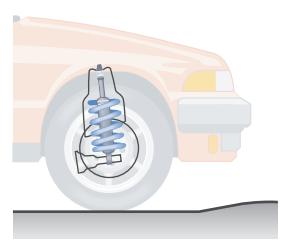
46 Applications - Shock Absorber · Level 4
When a car hits a certain bump on the road, a shock absorber on the car is compressed a distance of 6 in., then released. The shock absorber vibrates in damped harmonic motion with a frequency of 2 cycles per second. The damping constant for this particular shock absorber is 2.8. (a) Find an equation that describes the displacement of the shock absorber from its rest position as a function of time. Take \(t = 0\) to be the instant that the shock absorber is released. (b) How long does it take for the amplitude of the vibration to decrease to 0.5 in?
question image
47 Applications - Tuning Fork · Level 3
A tuning fork is struck and oscillates in damped harmonic motion. The amplitude of the motion is measured, and 3 s later it is found that the amplitude has dropped to \(\dfrac{1}{4}\) of this value. Find the damping constant \(c\) for this tuning fork.
48 Applications - Guitar String · Level 4
A guitar string is pulled at point \(P\) a distance of 3 cm above its rest position. It is then released and vibrates in damped harmonic motion with a frequency of 165 cycles per second. After 2 s, it is observed that the amplitude of the vibration at point \(P\) is 0.6 cm. (a) Find the damping constant \(c\). (b) Find an equation that describes the position of point \(P\) above its rest position as a function of time. Take \(t = 0\) to be the instant that the string is released.
49 Example - A Vibrating Spring · Level 2
The displacement of a mass suspended by a spring is modeled by the function \(y = 10 \sin(4 \pi t)\), where \(y\) is measured in inches and \(t\) in seconds.
question image
(a) Find the amplitude, period, and frequency of the motion of the mass.
(b) Sketch a graph of the displacement of the mass.

Enter your answer directly below each part above.

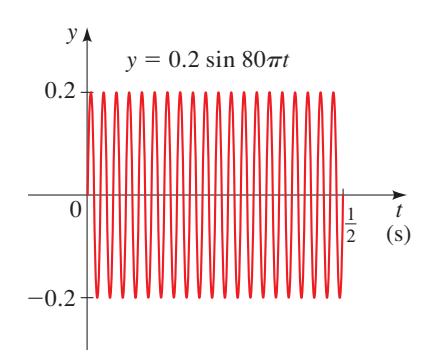
50 Example - Vibrations of a Musical Note · Level 2
A tuba player plays the note E and sustains the sound for some time. For a pure E the variation in pressure from normal air pressure is given by \( V(t) = 0.2 \sin(80 \pi t) \) where \(V\) is measured in pounds per square inch and \(t\) is measured in seconds.
question image
(a) Find the amplitude, period, and frequency of \(V\).
(b) Sketch a graph of \(V\).
(c) If the tuba player increases the loudness of the note, how does the equation for \(V\) change?
(d) If the player is playing the note incorrectly and it is a little flat, how does the equation for \(V\) change?

Enter your answer directly below each part above.

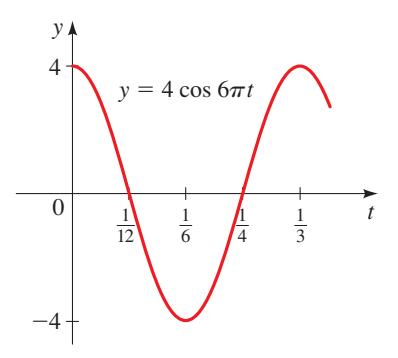
51 Example - Modeling a Vibrating Spring · Level 2
A mass is suspended from a spring. The spring is compressed a distance of \(4\) cm and then released. It is observed that the mass returns to the compressed position after \(\dfrac{1}{3}\) s.
question image
(a) Find a function that models the displacement of the mass.
(b) Sketch the graph of the displacement of the mass.

Enter your answer directly below each part above.

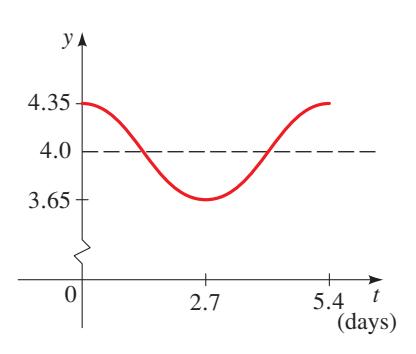
52 Example - Modeling the Brightness of a Variable Star · Level 3
A variable star is one whose brightness alternately increases and decreases. For the variable star Delta Cephei, the time between periods of maximum brightness is \(5.4\) days. The average brightness (or magnitude) of the star is \(4.0\), and its brightness varies by \(\pm 0.35\) magnitude.
question image
(a) Find a function that models the brightness of Delta Cephei as a function of time.
(b) Sketch a graph of the brightness of Delta Cephei as a function of time.

Enter your answer directly below each part above.

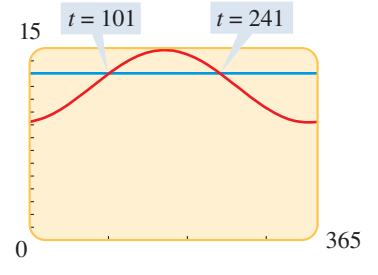
53 Example - Modeling the Number of Hours of Daylight · Level 3
In Philadelphia (\(40^{\circ}\) N latitude) the longest day of the year has \(14\) h \(50\) min of daylight, and the shortest day has \(9\) h \(10\) min of daylight.
question image
(a) Find a function \(L\) that models the length of daylight as a function of \(t\), the number of days from January 1.
(b) An astronomer needs at least \(11\) hours of darkness for a long exposure astronomical photograph. On what days of the year are such long exposures possible?

Enter your answer directly below each part above.

54 Example - Modeling Alternating Current · Level 2
Ordinary \(110\)-V household alternating current varies from \(+155\) V to \(-155\) V with a frequency of \(60\) Hz (cycles per second). Find an equation that describes this variation in voltage.
question image
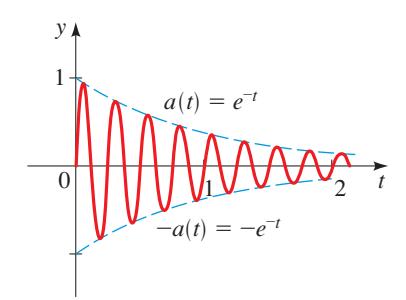
55 Example - Modeling Damped Harmonic Motion · Level 3
Two mass-spring systems are experiencing damped harmonic motion, both at \(0.5\) cycles per second and both with an initial maximum displacement of \(10\) cm. The first has a damping constant of \(0.5\), and the second has a damping constant of \(0.1\).
question image
(a) Find functions of the form \(g(t) = k e^{-c t} \cos(\omega t)\) to model the motion in each case.
(b) Graph the two functions you found in part (a). How do they differ?

Enter your answer directly below each part above.

56 Example - Damped Harmonic Motion (Vibrating Violin String) · Level 3
The G-string on a violin is pulled a distance of 0.5 cm above its rest position, then released and allowed to vibrate. The damping constant \(c\) for this string is determined to be 1.4. Suppose that the note produced is a pure G (frequency \(= 200\) Hz). Find an equation that describes the motion of the point at which the string was plucked.
57 Example - Damped Harmonic Motion (Ripples on a Pond) · Level 3
A stone is dropped in a calm lake, causing waves to form. The up-and-down motion of a point on the surface of the water is modeled by damped harmonic motion. At some time the amplitude of the wave is measured, and 20 s later it is found that the amplitude has dropped to \(\dfrac{1}{10}\) of this value. Find the damping constant \(c\).

Answered: 0 / 57