Stewart Precalc 6e Section 3.7: Rational Functions

93 questions

--:--
0 / 93
Stewart Precalc 6e Section 3.7: Rational Functions 0/93
1 Concept - Asymptote Behavior · Level 1
If the rational function \(y = r(x)\) has the vertical asymptote \(x = 2\), then as \(x \rightarrow 2^+\), what are the two possible behaviors of \(y\)?
2 Concept - Asymptote Behavior · Level 1
If the rational function \(y = r(x)\) has the horizontal asymptote \(y = 2\), what value does \(y\) approach as \(x \rightarrow \pm \infty\)?
3 Concept - Rational Function Properties · Level 1
For the rational function \(r(x) = \dfrac{(x+1)(x-2)}{(x+2)(x-3)}\), find the \(x\)-intercepts.
4 Concept - Rational Function Properties · Level 1
For the rational function \(r(x) = \dfrac{(x+1)(x-2)}{(x+2)(x-3)}\), find the \(y\)-intercept.
5 Concept - Rational Function Properties · Level 1
For the rational function \(r(x) = \dfrac{(x+1)(x-2)}{(x+2)(x-3)}\), find the vertical asymptotes.
6 Concept - Rational Function Properties · Level 1
For the rational function \(r(x) = \dfrac{(x+1)(x-2)}{(x+2)(x-3)}\), find the horizontal asymptote.
7 Skill - Table Analysis · Level 2
Given \(r(x) = \dfrac{x}{x - 2}\): (a) Complete each table for the function. (b) Describe the behavior of the function near its vertical asymptote, based on Tables 1 and 2. (c) Determine the horizontal asymptote, based on Tables 3 and 4. Table 1: \(x = 1.5, 1.9, 1.99, 1.999\). Table 2: \(x = 2.5, 2.1, 2.01, 2.001\). Table 3: \(x = 10, 50, 100, 1000\). Table 4: \(x = -10, -50, -100, -1000\).
8 Skill - Table Analysis · Level 2
Given \(r(x) = \dfrac{4 x + 1}{x - 2}\): (a) Complete each table for the function. (b) Describe the behavior of the function near its vertical asymptote, based on Tables 1 and 2. (c) Determine the horizontal asymptote, based on Tables 3 and 4. Table 1: \(x = 1.5, 1.9, 1.99, 1.999\). Table 2: \(x = 2.5, 2.1, 2.01, 2.001\). Table 3: \(x = 10, 50, 100, 1000\). Table 4: \(x = -10, -50, -100, -1000\).
9 Skill - Table Analysis · Level 2
Given \(r(x) = \dfrac{3 x - 10}{(x - 2)^2}\): (a) Complete each table for the function. (b) Describe the behavior of the function near its vertical asymptote, based on Tables 1 and 2. (c) Determine the horizontal asymptote, based on Tables 3 and 4. Table 1: \(x = 1.5, 1.9, 1.99, 1.999\). Table 2: \(x = 2.5, 2.1, 2.01, 2.001\). Table 3: \(x = 10, 50, 100, 1000\). Table 4: \(x = -10, -50, -100, -1000\).
10 Skill - Table Analysis · Level 2
Given \(r(x) = \dfrac{3 x^2 + 1}{(x - 2)^2}\): (a) Complete each table for the function. (b) Describe the behavior of the function near its vertical asymptote, based on Tables 1 and 2. (c) Determine the horizontal asymptote, based on Tables 3 and 4. Table 1: \(x = 1.5, 1.9, 1.99, 1.999\). Table 2: \(x = 2.5, 2.1, 2.01, 2.001\). Table 3: \(x = 10, 50, 100, 1000\). Table 4: \(x = -10, -50, -100, -1000\).
11 Skill - Find Intercepts · Level 2
Find the \(x\)- and \(y\)-intercepts of the rational function \(r(x) = \dfrac{x - 1}{x + 4}\).
12 Skill - Find Intercepts · Level 2
Find the \(x\)- and \(y\)-intercepts of the rational function \(s(x) = \dfrac{3 x}{x - 5}\).
13 Skill - Find Intercepts · Level 2
Find the \(x\)- and \(y\)-intercepts of the rational function \(t(x) = \dfrac{x^2 - x - 2}{x - 6}\).
14 Skill - Find Intercepts · Level 2
Find the \(x\)- and \(y\)-intercepts of the rational function \(r(x) = \dfrac{2}{x^2 + 3 x - 4}\).
15 Skill - Find Intercepts · Level 2
Find the \(x\)- and \(y\)-intercepts of the rational function \(r(x) = \dfrac{x^2 - 9}{x^2}\).
16 Skill - Find Intercepts · Level 2
Find the \(x\)- and \(y\)-intercepts of the rational function \(r(x) = \dfrac{x^3 + 8}{x^2 + 4}\).
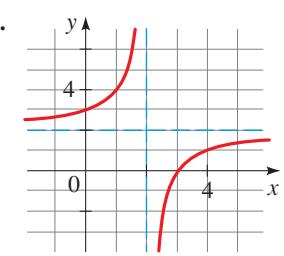
17 Skill - Read From Graph · Level 2
From the graph, determine the \(x\)- and \(y\)-intercepts and the vertical and horizontal asymptotes.
question image
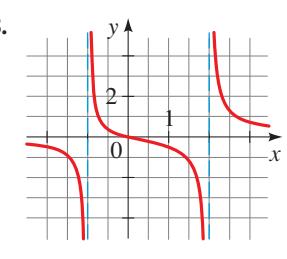
18 Skill - Read From Graph · Level 2
From the graph, determine the \(x\)- and \(y\)-intercepts and the vertical and horizontal asymptotes.
question image
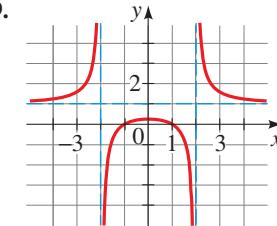
19 Skill - Read From Graph · Level 2
From the graph, determine the \(x\)- and \(y\)-intercepts and the vertical and horizontal asymptotes.
question image
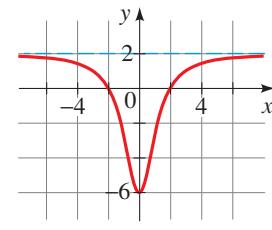
20 Skill - Read From Graph · Level 2
From the graph, determine the \(x\)- and \(y\)-intercepts and the vertical and horizontal asymptotes.
question image
21 Skill - Find Asymptotes · Level 2
Find all horizontal and vertical asymptotes (if any) of \(r(x) = \dfrac{5}{x - 2}\).
22 Skill - Find Asymptotes · Level 2
Find all horizontal and vertical asymptotes (if any) of \(r(x) = \dfrac{2 x - 3}{x^2 - 1}\).
23 Skill - Find Asymptotes · Level 2
Find all horizontal and vertical asymptotes (if any) of \(r(x) = \dfrac{6 x}{x^2 + 2}\).
24 Skill - Find Asymptotes · Level 2
Find all horizontal and vertical asymptotes (if any) of \(r(x) = \dfrac{2 x - 4}{x^2 + x + 1}\).
25 Skill - Find Asymptotes · Level 2
Find all horizontal and vertical asymptotes (if any) of \(s(x) = \dfrac{6 x^2 + 1}{2 x^2 + x - 1}\).
26 Skill - Find Asymptotes · Level 2
Find all horizontal and vertical asymptotes (if any) of \(s(x) = \dfrac{8 x^2 + 1}{4 x^2 + 2 x - 6}\).
27 Skill - Find Asymptotes · Level 2
Find all horizontal and vertical asymptotes (if any) of \(s(x) = \dfrac{(5 x - 1)(x + 1)}{(3 x - 1)(x + 2)}\).
28 Skill - Find Asymptotes · Level 2
Find all horizontal and vertical asymptotes (if any) of \(s(x) = \dfrac{(2 x - 1)(x + 3)}{(3 x - 1)(x - 4)}\).
29 Skill - Find Asymptotes · Level 2
Find all horizontal and vertical asymptotes (if any) of \(r(x) = \dfrac{6 x^3 - 2}{2 x^3 + 5 x^2 + 6 x}\).
30 Skill - Find Asymptotes · Level 2
Find all horizontal and vertical asymptotes (if any) of \(r(x) = \dfrac{5 x^3}{x^3 + 2 x^2 + 5 x}\).
31 Skill - Find Asymptotes · Level 2
Find all horizontal and vertical asymptotes (if any) of \(t(x) = \dfrac{x^2 + 2}{x - 1}\).
32 Skill - Find Asymptotes · Level 2
Find all horizontal and vertical asymptotes (if any) of \(r(x) = \dfrac{x^3 + 3 x^2}{x^2 - 4}\).
33 Skill - Transformations · Level 3
Use transformations of the graph of \(y = \dfrac{1}{x}\) to graph the rational function \(r(x) = \dfrac{1}{x - 1}\), as in Example 2.
34 Skill - Transformations · Level 3
Use transformations of the graph of \(y = \dfrac{1}{x}\) to graph the rational function \(r(x) = \dfrac{1}{x + 4}\), as in Example 2.
35 Skill - Transformations · Level 3
Use transformations of the graph of \(y = \dfrac{1}{x}\) to graph the rational function \(s(x) = \dfrac{3}{x + 1}\), as in Example 2.
36 Skill - Transformations · Level 3
Use transformations of the graph of \(y = \dfrac{1}{x}\) to graph the rational function \(s(x) = \dfrac{-2}{x - 2}\), as in Example 2.
37 Skill - Transformations · Level 3
Use transformations of the graph of \(y = \dfrac{1}{x}\) to graph the rational function \(t(x) = \dfrac{2 x - 3}{x - 2}\), as in Example 2.
38 Skill - Transformations · Level 3
Use transformations of the graph of \(y = \dfrac{1}{x}\) to graph the rational function \(t(x) = \dfrac{3 x - 3}{x + 2}\), as in Example 2.
39 Skill - Transformations · Level 3
Use transformations of the graph of \(y = \dfrac{1}{x}\) to graph the rational function \(r(x) = \dfrac{x + 2}{x + 3}\), as in Example 2.
40 Skill - Transformations · Level 3
Use transformations of the graph of \(y = \dfrac{1}{x}\) to graph the rational function \(r(x) = \dfrac{2 x - 9}{x - 4}\), as in Example 2.
41 Skill - Sketch Rational Function · Level 3
Find the intercepts and asymptotes, and then sketch a graph of the rational function \(r(x) = \dfrac{4 x - 4}{x + 2}\) and state the domain and range. Use a graphing device to confirm your answer.
42 Skill - Sketch Rational Function · Level 3
Find the intercepts and asymptotes, and then sketch a graph of the rational function \(r(x) = \dfrac{2 x + 6}{-6 x + 3}\) and state the domain and range. Use a graphing device to confirm your answer.
43 Skill - Sketch Rational Function · Level 3
Find the intercepts and asymptotes, and then sketch a graph of the rational function \(s(x) = \dfrac{1 - 2 x}{2 x + 3}\) and state the domain and range. Use a graphing device to confirm your answer.
44 Skill - Sketch Rational Function · Level 3
Find the intercepts and asymptotes, and then sketch a graph of the rational function \(r(x) = \dfrac{18}{(x - 3)^2}\) and state the domain and range. Use a graphing device to confirm your answer.
45 Skill - Sketch Rational Function · Level 3
Find the intercepts and asymptotes, and then sketch a graph of the rational function \(r(x) = \dfrac{x - 2}{(x + 1)^2}\) and state the domain and range. Use a graphing device to confirm your answer.
46 Skill - Sketch Rational Function · Level 3
Find the intercepts and asymptotes, and then sketch a graph of the rational function \(s(x) = \dfrac{4 x - 8}{(x - 4)(x + 1)}\) and state the domain and range. Use a graphing device to confirm your answer.
47 Skill - Sketch Rational Function · Level 3
Find the intercepts and asymptotes, and then sketch a graph of the rational function \(s(x) = \dfrac{x + 2}{(x + 3)(x - 1)}\) and state the domain and range. Use a graphing device to confirm your answer.
48 Skill - Sketch Rational Function · Level 3
Find the intercepts and asymptotes, and then sketch a graph of the rational function \(s(x) = \dfrac{6}{x^2 - 5 x - 6}\) and state the domain and range. Use a graphing device to confirm your answer.
49 Skill - Sketch Rational Function · Level 3
Find the intercepts and asymptotes, and then sketch a graph of the rational function \(s(x) = \dfrac{2 x - 4}{x^2 + x - 2}\) and state the domain and range. Use a graphing device to confirm your answer.
50 Skill - Sketch Rational Function · Level 3
Find the intercepts and asymptotes, and then sketch a graph of the rational function \(t(x) = \dfrac{3 x + 6}{x^2 + 2 x - 8}\) and state the domain and range. Use a graphing device to confirm your answer.
51 Skill - Sketch Rational Function · Level 3
Find the intercepts and asymptotes, and then sketch a graph of the rational function \(t(x) = \dfrac{x - 2}{x^2 - 4 x}\) and state the domain and range. Use a graphing device to confirm your answer.
52 Skill - Sketch Rational Function · Level 3
Find the intercepts and asymptotes, and then sketch a graph of the rational function \(r(x) = \dfrac{(x - 1)(x + 2)}{(x + 1)(x - 3)}\) and state the domain and range. Use a graphing device to confirm your answer.
53 Skill - Sketch Rational Function · Level 3
Find the intercepts and asymptotes, and then sketch a graph of the rational function \(r(x) = \dfrac{2 x (x + 2)}{(x - 1)(x - 4)}\) and state the domain and range. Use a graphing device to confirm your answer.
54 Skill - Sketch Rational Function · Level 3
Find the intercepts and asymptotes, and then sketch a graph of the rational function \(r(x) = \dfrac{x^2 - 2 x + 1}{x^2 + 2 x + 1}\) and state the domain and range. Use a graphing device to confirm your answer.
55 Skill - Sketch Rational Function · Level 3
Find the intercepts and asymptotes, and then sketch a graph of the rational function \(r(x) = \dfrac{4 x^2}{x^2 - 2 x - 3}\) and state the domain and range. Use a graphing device to confirm your answer.
56 Skill - Sketch Rational Function · Level 3
Find the intercepts and asymptotes, and then sketch a graph of the rational function \(r(x) = \dfrac{2 x^2 + 10 x - 12}{x^2 + x - 6}\) and state the domain and range. Use a graphing device to confirm your answer.
57 Skill - Sketch Rational Function · Level 3
Find the intercepts and asymptotes, and then sketch a graph of the rational function \(r(x) = \dfrac{2 x^2 + 2 x - 4}{x^2 + x}\) and state the domain and range. Use a graphing device to confirm your answer.
58 Skill - Sketch Rational Function · Level 3
Find the intercepts and asymptotes, and then sketch a graph of the rational function \(r(x) = \dfrac{x^2 - x - 6}{x^2 + 3 x}\) and state the domain and range. Use a graphing device to confirm your answer.
59 Skill - Sketch Rational Function · Level 3
Find the intercepts and asymptotes, and then sketch a graph of the rational function \(r(x) = \dfrac{x^2 + 3 x}{x^2 - x - 6}\) and state the domain and range. Use a graphing device to confirm your answer.
60 Skill - Sketch Rational Function · Level 3
Find the intercepts and asymptotes, and then sketch a graph of the rational function \(r(x) = \dfrac{3 x^2 + 6}{x^2 - 2 x - 3}\) and state the domain and range. Use a graphing device to confirm your answer.
61 Skill - Sketch Rational Function · Level 3
Find the intercepts and asymptotes, and then sketch a graph of the rational function \(r(x) = \dfrac{5 x^2 + 5}{x^2 + 4 x + 4}\) and state the domain and range. Use a graphing device to confirm your answer.
62 Skill - Sketch Rational Function · Level 3
Find the intercepts and asymptotes, and then sketch a graph of the rational function \(s(x) = \dfrac{x^2 - 2 x + 1}{x^3 - 3 x^2}\) and state the domain and range. Use a graphing device to confirm your answer.
63 Skill - Sketch Rational Function · Level 3
Find the intercepts and asymptotes, and then sketch a graph of the rational function \(t(x) = \dfrac{x^3 - x^2}{x^3 - 3 x - 2}\) and state the domain and range. Use a graphing device to confirm your answer.
64 Skill - Slant Asymptote · Level 4
Find the slant asymptote, the vertical asymptotes, and sketch a graph of the function \(r(x) = \dfrac{x^2}{x - 2}\).
65 Skill - Slant Asymptote · Level 4
Find the slant asymptote, the vertical asymptotes, and sketch a graph of the function \(r(x) = \dfrac{x^2 + 2 x}{x - 1}\).
66 Skill - Slant Asymptote · Level 4
Find the slant asymptote, the vertical asymptotes, and sketch a graph of the function \(r(x) = \dfrac{x^2 - 2 x - 8}{x}\).
67 Skill - Slant Asymptote · Level 4
Find the slant asymptote, the vertical asymptotes, and sketch a graph of the function \(r(x) = \dfrac{3 x - x^2}{2 x - 2}\).
68 Skill - Slant Asymptote · Level 4
Find the slant asymptote, the vertical asymptotes, and sketch a graph of the function \(r(x) = \dfrac{x^2 + 5 x + 4}{x - 3}\).
69 Skill - Slant Asymptote · Level 4
Find the slant asymptote, the vertical asymptotes, and sketch a graph of the function \(r(x) = \dfrac{x^3 + 4}{2 x^2 + x - 1}\).
70 Skill - Slant Asymptote · Level 4
Find the slant asymptote, the vertical asymptotes, and sketch a graph of the function \(r(x) = \dfrac{x^3 + x^2}{x^2 - 4}\).
71 Skill - Slant Asymptote · Level 4
Find the slant asymptote, the vertical asymptotes, and sketch a graph of the function \(r(x) = \dfrac{2 x^3 + 2 x}{x^2 - 1}\).
72 Skill - End Behavior Comparison · Level 4
Graph the rational function \(f\), and determine all vertical asymptotes from your graph. Then graph \(f\) and \(g\) in a sufficiently large viewing rectangle to show that they have the same end behavior. \(f(x) = \dfrac{2 x^2 + 6 x + 6}{x + 3}\), \(g(x) = 2 x\).
73 Skill - End Behavior Comparison · Level 4
Graph the rational function \(f\), and determine all vertical asymptotes from your graph. Then graph \(f\) and \(g\) in a sufficiently large viewing rectangle to show that they have the same end behavior. \(f(x) = \dfrac{-x^3 + 6 x^2 - 5}{x^2 - 2 x}\), \(g(x) = -x + 4\).
74 Skill - End Behavior Comparison · Level 4
Graph the rational function \(f\), and determine all vertical asymptotes from your graph. Then graph \(f\) and \(g\) in a sufficiently large viewing rectangle to show that they have the same end behavior. \(f(x) = \dfrac{x^3 - 2 x^2 + 16}{x - 2}\), \(g(x) = x^2\).
75 Skill - End Behavior Comparison · Level 4
Graph the rational function \(f\), and determine all vertical asymptotes from your graph. Then graph \(f\) and \(g\) in a sufficiently large viewing rectangle to show that they have the same end behavior. \(f(x) = \dfrac{-x^4 + 2 x^3 - 2 x}{(x - 1)^2}\), \(g(x) = 1 - x^2\).
76 Skill - End Behavior Long Division · Level 4
Graph the rational function, and find all vertical asymptotes, \(x\)- and \(y\)-intercepts, and local extrema, correct to the nearest decimal. Then use long division to find a polynomial that has the same end behavior as the rational function, and graph both functions in a sufficiently large viewing rectangle to verify that the end behaviors of the polynomial and the rational function are the same. \(y = \dfrac{2 x^2 - 5 x}{2 x + 3}\).
77 Skill - End Behavior Long Division · Level 4
Graph the rational function, and find all vertical asymptotes, \(x\)- and \(y\)-intercepts, and local extrema, correct to the nearest decimal. Then use long division to find a polynomial that has the same end behavior as the rational function, and graph both functions in a sufficiently large viewing rectangle to verify that the end behaviors of the polynomial and the rational function are the same. \(y = \dfrac{x^4 - 3 x^3 + x^2 - 3 x + 3}{x^2 - 3 x}\).
78 Skill - End Behavior Long Division · Level 4
Graph the rational function, and find all vertical asymptotes, \(x\)- and \(y\)-intercepts, and local extrema, correct to the nearest decimal. Then use long division to find a polynomial that has the same end behavior as the rational function, and graph both functions in a sufficiently large viewing rectangle to verify that the end behaviors of the polynomial and the rational function are the same. \(y = \dfrac{x^5}{x^3 - 1}\).
79 Skill - End Behavior Long Division · Level 4
Graph the rational function, and find all vertical asymptotes, \(x\)- and \(y\)-intercepts, and local extrema, correct to the nearest decimal. Then use long division to find a polynomial that has the same end behavior as the rational function, and graph both functions in a sufficiently large viewing rectangle to verify that the end behaviors of the polynomial and the rational function are the same. \(y = \dfrac{x^4}{x^2 - 2}\).
80 Skill - End Behavior Long Division · Level 4
Graph the rational function, and find all vertical asymptotes, \(x\)- and \(y\)-intercepts, and local extrema, correct to the nearest decimal. Then use long division to find a polynomial that has the same end behavior as the rational function, and graph both functions in a sufficiently large viewing rectangle to verify that the end behaviors of the polynomial and the rational function are the same. \(r(x) = \dfrac{x^4 - 3 x^3 + 6}{x - 3}\).
81 Skill - End Behavior Long Division · Level 4
Graph the rational function, and find all vertical asymptotes, \(x\)- and \(y\)-intercepts, and local extrema, correct to the nearest decimal. Then use long division to find a polynomial that has the same end behavior as the rational function, and graph both functions in a sufficiently large viewing rectangle to verify that the end behaviors of the polynomial and the rational function are the same. \(r(x) = \dfrac{4 + x^2 - x^4}{x^2 - 1}\).
82 Application - Population Growth · Level 3
Population Growth. Suppose that the rabbit population on a national park is modeled by \(p(t) = \dfrac{3000 t}{t + 1}\) where \(t \geq 0\) is the time (in months) since the beginning of the year. (a) Draw a graph of the rabbit population. (b) What eventually happens to the rabbit population?
83 Application - Drug Concentration · Level 3
Drug Concentration. After a certain drug is injected into a patient, the concentration \(c\) of the drug in the bloodstream is monitored. At time \(t \geq 0\) (in minutes since the injection), the concentration (in mg/L) is given by \(c(t) = \dfrac{30 t}{t^2 + 2}\). (a) Draw a graph of the drug concentration. (b) What eventually happens to the concentration of drug in the bloodstream?
84 Application - Drug Concentration · Level 3
Drug Concentration. A drug is administered to a patient, and the concentration of the drug in the bloodstream is monitored. At time \(t \geq 0\) (in hours since giving the drug), the concentration (in mg/L) is given by \(c(t) = \dfrac{5 t}{t^2 + 1}\). Graph the function \(c\) with a graphing device. (a) What is the highest concentration of drug that is reached in the patient's bloodstream? (b) What happens to the drug concentration after a long period of time? (c) How long does it take for the concentration to drop below 0.3 mg/L?
85 Application - Flight of a Rocket · Level 3
Flight of a Rocket. Suppose a rocket is fired upward from the surface of the earth with an initial velocity \(v\) (measured in meters per second). Then the maximum height \(h\) (in meters) reached by the rocket is given by the function \(h(v) = \dfrac{R v^2}{2 g R - v^2}\) where \(R = 6.4 \times 10^6\) m is the radius of the earth and \(g = 9.8\) m/s² is the acceleration due to gravity. Use a graphing device to draw a graph of the function \(h\). (Note that \(h\) and \(v\) must both be positive, so the viewing rectangle need not contain negative values.) What does the vertical asymptote represent physically?
86 Application - Doppler Effect · Level 3
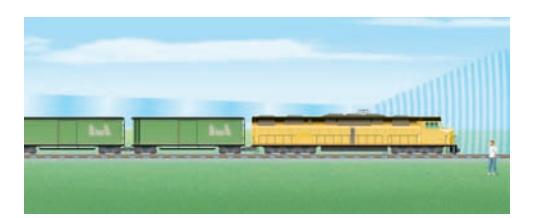
The Doppler Effect. As a train moves toward an observer (see the figure), the pitch of its whistle sounds higher to the observer than it would if the train were at rest, because the crests of the sound waves are compressed closer together. This phenomenon is called the Doppler effect. The observed pitch \(P\) is a function of the speed \(v\) of the train and is given by \(P(v) = P_0 \left(\dfrac{s_0}{s_0 - v}\right)\) where \(P_0\) is the actual pitch of the whistle at the source and \(s_0 = 332\) m/s is the speed of sound in air. Suppose that a train has a whistle pitched at \(P_0 = 440\) Hz. Graph the function \(y = P(v)\) using a graphing device. How can the vertical asymptote of this function be interpreted physically?
question image
87 Application - Focusing Distance · Level 3
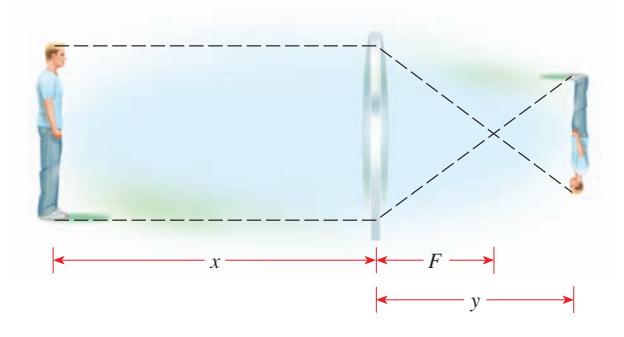
Focusing Distance. For a camera with a lens of fixed focal length \(F\) to focus on an object located a distance \(x\) from the lens, the film must be placed a distance \(y\) behind the lens, where \(F\), \(x\), and \(y\) are related by \(\dfrac{1}{x} + \dfrac{1}{y} = \dfrac{1}{F}\) (See the figure.) Suppose the camera has a 55-mm lens \((F = 55)\). (a) Express \(y\) as a function of \(x\) and graph the function. (b) What happens to the focusing distance \(y\) as the object moves far away from the lens? (c) What happens to the focusing distance \(y\) as the object moves close to the lens?
question image
88 Discovery - Constructing a Rational Function · Level 4
Constructing a Rational Function from Its Asymptotes. Give an example of a rational function that has vertical asymptote \(x = 3\). Now give an example of one that has vertical asymptote \(x = 3\) and horizontal asymptote \(y = 2\). Now give an example of a rational function with vertical asymptotes \(x = 1\) and \(x = -1\), horizontal asymptote \(y = 0\), and \(x\)-intercept \(4\).
89 Discovery - Rational Function With No Asymptote · Level 4
A Rational Function with No Asymptote. Explain how you can tell (without graphing it) that the function \(r(x) = \dfrac{x^6 + 10}{x^4 + 8 x^2 + 15}\) has no \(x\)-intercept and no horizontal, vertical, or slant asymptote. What is its end behavior?
90 Discovery - Graphs With Holes · Level 4
Graphs with Holes. In this chapter we adopted the convention that in rational functions, the numerator and denominator don't share a common factor. In this exercise we consider the graph of a rational function that does not satisfy this rule. (a) Show that the graph of \(r(x) = \dfrac{3 x^2 - 3 x - 6}{x - 2}\) is the line \(y = 3 x + 3\) with the point \((2, 9)\) removed. Hint: Factor. What is the domain of \(r\)? (b) Graph the rational functions: \(s(x) = \dfrac{x^2 + x - 20}{x + 5}\), \(t(x) = \dfrac{2 x^2 - x - 1}{x - 1}\), \(u(x) = \dfrac{x - 2}{x^2 - 2 x}\).
91 Discovery - Transformations of 1/x^2 · Level 4
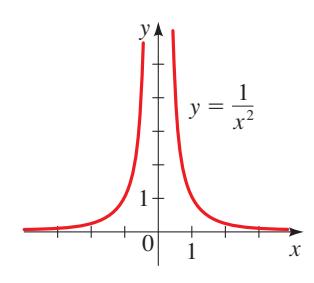
Transformations of \(y = 1/x^2\). In Example 2 we saw that some simple rational functions can be graphed by shifting, stretching, or reflecting the graph of \(y = \dfrac{1}{x}\). In this exercise we consider rational functions that can be graphed by transforming the graph of \(y = 1/x^2\), shown on the following page. (a) Graph the function \(r(x) = \dfrac{1}{(x - 2)^2}\) by transforming the graph of \(y = 1/x^2\). (b) Use long division and factoring to show that the function \(s(x) = \dfrac{2 x^2 + 4 x + 5}{x^2 + 2 x + 1}\) can be written as \(s(x) = 2 + \dfrac{3}{(x + 1)^2}\). Then graph \(s\) by transforming the graph of \(y = 1/x^2\). (c) Graph \(p(x) = \dfrac{2 - 3 x^2}{x^2 - 4 x + 4}\) and \(q(x) = \dfrac{12 x - 3 x^2}{x^2 - 4 x + 4}\).
question image
92 Example - A Simple Rational Function · Level 2
Graph the rational function \(f(x) = \dfrac{1}{x}\), and state the domain and range.
93 Example - Electrical Resistance · Level 3
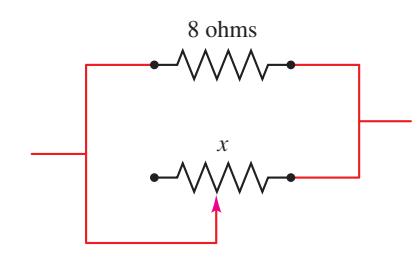
When two resistors with resistances \(R_1\) and \(R_2\) are connected in parallel, their combined resistance \(R\) is given by the formula \(R = \dfrac{R_1 R_2}{R_1 + R_2}\). Suppose that a fixed 8-ohm resistor is connected in parallel with a variable resistor. If the resistance of the variable resistor is denoted by \(x\), then the combined resistance \(R\) is a function of \(x\). Graph \(R\), and give a physical interpretation of the graph.
question image

Answered: 0 / 93