Stewart 9e Section 10.4: Calculus in Polar Coordinates

56 questions

--:--
0 / 56
Stewart 9e Section 10.4: Calculus in Polar Coordinates 0/56
1 Area in a polar sector · Level 2
Find the area of the region that is bounded by the given curve and lies in the specified sector: \(r = e^{-\dfrac{\theta}{4}}\), \(\dfrac{\pi}{2} \leq \theta \leq \pi\).
2 Area in a polar sector · Level 2
Find the area of the region that is bounded by the given curve and lies in the specified sector: \(r = \cos \theta\), \(0 \leq \theta \leq \dfrac{\pi}{6}\).
3 Area in a polar sector · Level 2
Find the area of the region that is bounded by the given curve and lies in the specified sector: \(r = \sin \theta + \cos \theta\), \(0 \leq \theta \leq \pi\).
4 Area in a polar sector · Level 2
Find the area of the region that is bounded by the given curve and lies in the specified sector: \(r = \dfrac{1}{\theta}\), \(\dfrac{\pi}{2} \leq \theta \leq 2 \pi\).
5 Area of a shaded region · Level 2
Find the area of the shaded region for \(r^2 = \sin(2 \theta)\) (see figure).
question image
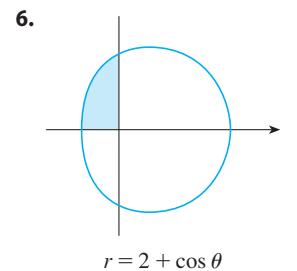
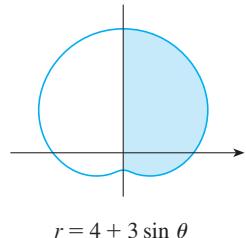
6 Area of a shaded region · Level 2
Find the area of the shaded region shown in the figure.
question image
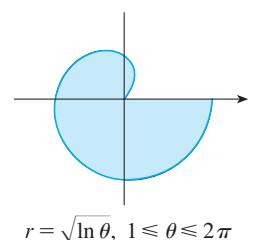
7 Area of a shaded region · Level 3
Find the area of the shaded region for \(r = \sqrt{\ln \theta}\), \(1 \leq \theta \leq 27\) (see figure).
question image
8 Sketch curve and find enclosed area · Level 2
Sketch the curve \(r = 2 \sin \theta\) and find the area that it encloses.
9 Sketch curve and find enclosed area · Level 2
Sketch the curve \(r = 1 - \sin \theta\) and find the area that it encloses.
10 Sketch curve and find enclosed area · Level 2
Sketch the curve \(r = 3 + 2 \cos \theta\) and find the area that it encloses.
11 Sketch curve and find enclosed area · Level 2
Sketch the curve \(r = 2 - \cos \theta\) and find the area that it encloses.
12 Graph and find enclosed area · Level 3
Graph the curve \(r = 2 + \sin(4 \theta)\) and find the area that it encloses (use a graphing device).
13 Graph and find enclosed area · Level 3
Graph the curve \(r = 3 - 2 \cos(4 \theta)\) and find the area that it encloses (use a graphing device).
14 Graph and find enclosed area · Level 3
Graph the curve \(r = \sqrt{1 + \cos^2(5 \theta)}\) and find the area that it encloses (use a graphing device).
15 Graph and find enclosed area · Level 4
Graph the curve \(r = 1 + 5 \sin(6 \theta)\) and find the area that it encloses (use a graphing device).
16 Area of one loop · Level 3
Find the area of the region enclosed by one loop of the curve \(r = 4 \cos(3 \theta)\).
17 Area of one loop · Level 3
Find the area of the region enclosed by one loop of the curve \(r^2 = 4 \cos(2 \theta)\).
18 Area of one loop · Level 3
Find the area of the region enclosed by one loop of the curve \(r = \sin(4 \theta)\).
19 Area of one loop · Level 3
Find the area of the region enclosed by one loop of the curve \(r = 2 \sin(5 \theta)\).
20 Area of inner loop of limaçon · Level 4
Find the area enclosed by the inner loop of \(r = 1 + 2 \sin \theta\).
21 Area enclosed by loop of strophoid · Level 4
Find the area enclosed by the loop of the strophoid \(r = 2 \cos \theta - \sec \theta\).
22 Area inside first, outside second curve · Level 3
Find the area of the region that lies inside the first curve and outside the second curve: \(r = 4 \sin \theta\), \(r = 2\).
23 Area inside first, outside second curve · Level 3
Find the area of the region that lies inside the first curve and outside the second curve: \(r = 1 - \sin \theta\), \(r = 1\).
24 Area inside first, outside second curve · Level 4
Find the area of the region that lies inside the first curve and outside the second curve: \(r^2 = 8 \cos(2 \theta)\), \(r = 2\).
25 Area inside first, outside second curve · Level 4
Find the area of the region that lies inside the first curve and outside the second curve: \(r = 1 + \cos \theta\), \(r = 2 - \cos \theta\).
26 Area inside first, outside second curve · Level 4
Find the area of the region that lies inside the first curve and outside the second curve: \(r = 3 \cos \theta\), \(r = 1 + \cos \theta\).
27 Area inside first, outside second curve · Level 4
Find the area of the region that lies inside the first curve and outside the second curve: \(r = 3 \sin \theta\), \(r = 2 - \sin \theta\).
28 Area inside both curves · Level 4
Find the area of the region that lies inside both curves: \(r = 3 \sin \theta\), \(r = 3 \cos \theta\).
29 Area inside both curves · Level 4
Find the area of the region that lies inside both curves: \(r = 1 + \cos \theta\), \(r = 1 - \cos \theta\).
30 Area inside both curves · Level 4
Find the area of the region that lies inside both curves: \(r = \sin(2 \theta)\), \(r = \cos(2 \theta)\).
31 Area inside both curves · Level 5
Find the area of the region that lies inside both curves: \(r = 3 + 2 \cos \theta\), \(r = 3 + 2 \sin \theta\).
32 Area inside both curves · Level 5
Find the area of the region that lies inside both curves: \(r^2 = 2 \sin(2 \theta)\), \(r = 1\).
33 Area inside both curves · Level 5
Find the area of the region that lies inside both curves: \(r = a \sin \theta\), \(r = b \cos \theta\), \(a > 0\), \(b > 0\).
34 Area between loops of a limaçon · Level 5
Find the area inside the larger loop and outside the smaller loop of the limaçon \(r = \dfrac{1}{2} + \cos \theta\).
35 Area between loops · Level 5
Find the area between a large loop and the enclosed small loop of the curve \(r = 1 + 2 \cos(3 \theta)\).
36 Points of intersection · Level 3
Find all points of intersection of the curves \(r = \sin \theta\) and \(r = 1 - \sin \theta\).
37 Points of intersection · Level 3
Find all points of intersection of the curves \(r = 1 + \cos \theta\) and \(r = 1 - \sin \theta\).
38 Points of intersection · Level 3
Find all points of intersection of the curves \(r = 2 \sin(2 \theta)\) and \(r = 1\).
39 Points of intersection · Level 3
Find all points of intersection of the curves \(r = \cos(3 \theta)\) and \(r = \sin(3 \theta)\).
40 Points of intersection · Level 3
Find all points of intersection of the curves \(r = \sin \theta\) and \(r = \sin(2 \theta)\).
41 Points of intersection · Level 3
Find all points of intersection of the curves \(r^2 = \sin(2 \theta)\) and \(r^2 = \cos(2 \theta)\).
42 Numerical intersection and area · Level 4
The points of intersection of the cardioid \(r = 1 + \sin \theta\) and the spiral loop \(r = 2 \theta\), \(-\dfrac{\pi}{2} \leq \theta \leq \dfrac{\pi}{2}\), can't be found exactly. Use a graphing device to find the approximate values of \(\theta\) at which they intersect. Then use these values to estimate the area that lies inside both curves.
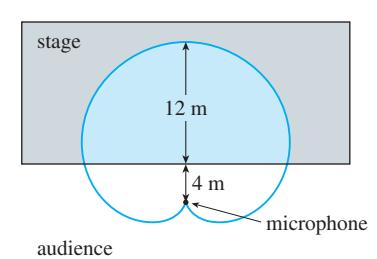
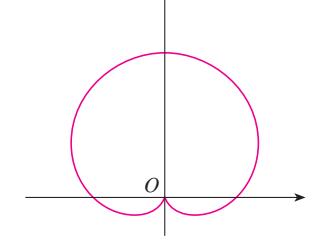
43 Application - microphone pickup area · Level 4
When recording live performances, sound engineers often use a microphone with a cardioid pickup pattern because it suppresses noise from the audience. The microphone is placed 4 m from the front of the stage and the boundary of the optimal pickup region is given by the cardioid \(r = 8 + 8 \sin \theta\), where \(r\) is measured in meters and the microphone is at the pole. Find the area on stage within the optimal pickup range of the microphone.
question image
44 Exact arc length of polar curve · Level 2
Find the exact length of the polar curve \(r = 2 \cos \theta\), \(0 \leq \theta \leq \pi\).
45 Exact arc length of polar curve · Level 3
Find the exact length of the polar curve \(r = 5^\theta\), \(0 \leq \theta \leq 2 \pi\).
46 Exact arc length of polar curve · Level 3
Find the exact length of the polar curve \(r = \theta^2\), \(0 \leq \theta \leq 2 \pi\).
47 Exact arc length of polar curve · Level 3
Find the exact length of the polar curve \(r = 2(1 + \cos \theta)\).
48 Exact arc length using graph for interval · Level 4
Find the exact length of the curve \(r = \cos^4\left(\dfrac{\theta}{4}\right)\). Use a graph to determine the parameter interval.
49 Exact arc length using graph for interval · Level 4
Find the exact length of the curve \(r = \cos^2\left(\dfrac{\theta}{2}\right)\). Use a graph to determine the parameter interval.
50 Numerical arc length · Level 3
Use a calculator to find the length of one loop of the curve \(r = \cos(2 \theta)\) correct to four decimal places.
51 Numerical arc length · Level 3
Use a calculator to find the length of the curve \(r = \tan \theta\), \(\dfrac{\pi}{6} \leq \theta \leq \dfrac{\pi}{3}\), correct to four decimal places.
52 Numerical arc length · Level 4
Use a calculator to find the length of the curve \(r = \sin(6 \sin \theta)\) correct to four decimal places. If necessary, graph the curve to determine the parameter interval.
53 Numerical arc length · Level 4
Use a calculator to find the length of the curve \(r = \sin\left(\dfrac{\theta}{4}\right)\) correct to four decimal places. If necessary, graph the curve to determine the parameter interval.
54 Surface area of revolution (polar) · Level 5
(a) Use Formula 10.2.6 to show that the area of the surface generated by rotating the polar curve \(r = f(\theta)\), \(a \leq \theta \leq b\) (where \(f'\) is continuous and \(0 \leq a < b \leq \pi\)) about the polar axis is \(S = \displaystyle\int_{a}^{b} 2 \pi r \sin \theta \sqrt{r^2 + \left(\dfrac{d r}{d \theta}\right)^2} d \theta\). (b) Use the formula in part (a) to find the surface area generated by rotating the lemniscate \(r^2 = \cos(2 \theta)\) about the polar axis.
55 Surface area of revolution (polar) · Level 5
(a) Find a formula for the area of the surface generated by rotating the polar curve \(r = f(\theta)\), \(a \leq \theta \leq b\) (where \(f'\) is continuous and \(0 \leq a < b \leq \pi\)), about the line \(\theta = \dfrac{\pi}{2}\). (b) Find the surface area generated by rotating the lemniscate \(r^2 = \cos(2 \theta)\) about the line \(\theta = \dfrac{\pi}{2}\).
56 Example - Arc length of a cardioid · Level 3
Find the length of the cardioid \(r = 1 + \sin \theta\).
question image

Answered: 0 / 56