Stewart Section 12.3: The Dot Product

65 questions

--:--
0 / 65
Stewart Section 12.3: The Dot Product 0/65
1 Vectors - Dot Product · Level 2
Which of the following expressions are meaningful? Which are meaningless? Explain.
(a) \((\mathbf{a} \cdot \mathbf{b}) \cdot \mathbf{c}\)
(b) \((\mathbf{a} \cdot \mathbf{b}) \mathbf{c}\)
(c) \(|\mathbf{a}|(\mathbf{b} \cdot \mathbf{c})\)
(d) \(\mathbf{a} \cdot (\mathbf{b} + \mathbf{c})\)
(e) \(\mathbf{a} \cdot \mathbf{b} + \mathbf{c}\)
(f) \(|\mathbf{a}| \cdot (\mathbf{b} + \mathbf{c})\)

Enter your answer directly below each part above.

2 Vectors - Dot Product · Level 2
Find \(\mathbf{a} \cdot \mathbf{b}\). \(\mathbf{a} = \langle 5, -2 \rangle\), \(\mathbf{b} = \langle 3, 4 \rangle\)
3 Vectors - Dot Product · Level 2
Find \(\mathbf{a} \cdot \mathbf{b}\). \(\mathbf{a} = \langle 1.5, 0.4 \rangle\), \(\mathbf{b} = \langle -4, 6 \rangle\)
4 Vectors - Dot Product · Level 2
Find \(\mathbf{a} \cdot \mathbf{b}\). \(\mathbf{a} = \langle 6, -2, 3 \rangle\), \(\mathbf{b} = \langle 2, 5, -1 \rangle\)
5 Vectors - Dot Product · Level 2
Find \(\mathbf{a} \cdot \mathbf{b}\). \(\mathbf{a} = \langle 4, 1, \dfrac{1}{4} \rangle\), \(\mathbf{b} = \langle 6, -3, -8 \rangle\)
6 Vectors - Dot Product · Level 3
Find \(\mathbf{a} \cdot \mathbf{b}\). \(\mathbf{a} = \langle p, -p, 2p \rangle\), \(\mathbf{b} = \langle 2q, q, -q \rangle\)
7 Vectors - Dot Product · Level 2
Find \(\mathbf{a} \cdot \mathbf{b}\). \(\mathbf{a} = 2 \mathbf{i} + \mathbf{j}\), \(\mathbf{b} = \mathbf{i} - \mathbf{j} + \mathbf{k}\)
8 Vectors - Dot Product · Level 2
Find \(\mathbf{a} \cdot \mathbf{b}\). \(\mathbf{a} = 3 \mathbf{i} + 2 \mathbf{j} - \mathbf{k}\), \(\mathbf{b} = 4 \mathbf{i} + 5 \mathbf{k}\)
9 Vectors - Dot Product · Level 2
Find \(\mathbf{a} \cdot \mathbf{b}\). \(|\mathbf{a}| = 7\), \(|\mathbf{b}| = 4\), the angle between \(\mathbf{a}\) and \(\mathbf{b}\) is \(30^{\circ}\)
10 Vectors - Dot Product · Level 2
Find \(\mathbf{a} \cdot \mathbf{b}\). \(|\mathbf{a}| = 80\), \(|\mathbf{b}| = 50\), the angle between \(\mathbf{a}\) and \(\mathbf{b}\) is \(3 \dfrac{\pi}{4}\)
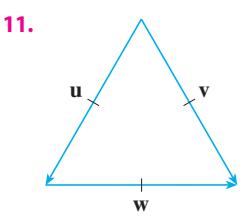
11 Vectors - Dot Product · Level 3
If \(\mathbf{u}\) is a unit vector, find \(\mathbf{u} \cdot \mathbf{v}\) and \(\mathbf{u} \cdot \mathbf{w}\).
question image
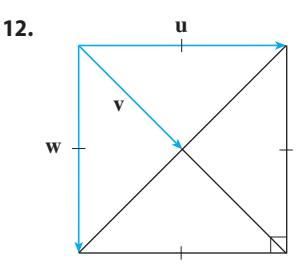
12 Vectors - Dot Product · Level 3
If \(\mathbf{u}\) is a unit vector, find \(\mathbf{u} \cdot \mathbf{v}\) and \(\mathbf{u} \cdot \mathbf{w}\).
question image
13 Vectors - Dot Product Properties · Level 3
(a) Show that \(\mathbf{i} \cdot \mathbf{j} = \mathbf{j} \cdot \mathbf{k} = \mathbf{k} \cdot \mathbf{i} = 0\).
(b) Show that \(\mathbf{i} \cdot \mathbf{i} = \mathbf{j} \cdot \mathbf{j} = \mathbf{k} \cdot \mathbf{k} = 1\).

Enter your answer directly below each part above.

14 Vectors - Dot Product Applications · Level 2
A street vendor sells \(a\) hamburgers, \(b\) hot dogs, and \(c\) soft drinks on a given day. He charges \$4 for a hamburger, \$2.50 for a hot dog, and \$1 for a soft drink. If \(\mathbf{A} = \langle a, b, c \rangle\) and \(\mathbf{P} = \langle 4, 2.5, 1 \rangle\), what is the meaning of the dot product \(\mathbf{A} \cdot \mathbf{P}\)?
15 Vectors - Angle Between Vectors · Level 3
Find the angle between the vectors. (First find an exact expression and then approximate to the nearest degree.) \(\mathbf{a} = \langle 4, 3 \rangle\), \(\mathbf{b} = \langle 2, -1 \rangle\)
16 Vectors - Angle Between Vectors · Level 3
Find the angle between the vectors. (First find an exact expression and then approximate to the nearest degree.) \(\mathbf{a} = \langle -2, 5 \rangle\), \(\mathbf{b} = \langle 5, 12 \rangle\)
17 Vectors - Angle Between Vectors · Level 3
Find the angle between the vectors. (First find an exact expression and then approximate to the nearest degree.) \(\mathbf{a} = \langle 1, -4, 1 \rangle\), \(\mathbf{b} = \langle 0, 2, -2 \rangle\)
18 Vectors - Angle Between Vectors · Level 3
Find the angle between the vectors. (First find an exact expression and then approximate to the nearest degree.) \(\mathbf{a} = \langle -1, 3, 4 \rangle\), \(\mathbf{b} = \langle 5, 2, 1 \rangle\)
19 Vectors - Angle Between Vectors · Level 3
Find the angle between the vectors. (First find an exact expression and then approximate to the nearest degree.) \(\mathbf{a} = 4 \mathbf{i} - 3 \mathbf{j} + \mathbf{k}\), \(\mathbf{b} = 2 \mathbf{i} - \mathbf{k}\)
20 Vectors - Angle Between Vectors · Level 3
Find the angle between the vectors. (First find an exact expression and then approximate to the nearest degree.) \(\mathbf{a} = 8 \mathbf{i} - \mathbf{j} + 4 \mathbf{k}\), \(\mathbf{b} = 4 \mathbf{j} + 2 \mathbf{k}\)
21 Vectors - Angle Between Vectors · Level 3
Find, correct to the nearest degree, the three angles of the triangle with the given vertices. \(P(2, 0)\), \(Q(0, 3)\), \(R(3, 4)\)
22 Vectors - Angle Between Vectors · Level 3
Find, correct to the nearest degree, the three angles of the triangle with the given vertices. \(A(1, 0, -1)\), \(B(3, -2, 0)\), \(C(1, 3, 3)\)
23 Vectors - Orthogonality · Level 3
Determine whether the given vectors are orthogonal, parallel, or neither.
(a) \(\mathbf{a} = \langle 9, 3 \rangle\), \(\mathbf{b} = \langle -2, 6 \rangle\)
(b) \(\mathbf{a} = \langle 4, 5, -2 \rangle\), \(\mathbf{b} = \langle 3, -1, 5 \rangle\)
(c) \(\mathbf{a} = -8 \mathbf{i} + 12 \mathbf{j} + 4 \mathbf{k}\), \(\mathbf{b} = 6 \mathbf{i} - 9 \mathbf{j} - 3 \mathbf{k}\)
(d) \(\mathbf{a} = 3 \mathbf{i} - \mathbf{j} + 3 \mathbf{k}\), \(\mathbf{b} = 5 \mathbf{i} + 9 \mathbf{j} - 2 \mathbf{k}\)

Enter your answer directly below each part above.

24 Vectors - Orthogonality · Level 3
Determine whether the given vectors are orthogonal, parallel, or neither.
(a) \(\mathbf{u} = \langle -5, 4, -2 \rangle\), \(\mathbf{v} = \langle 3, 4, -1 \rangle\)
(b) \(\mathbf{u} = 9 \mathbf{i} - 6 \mathbf{j} + 3 \mathbf{k}\), \(\mathbf{v} = -6 \mathbf{i} + 4 \mathbf{j} - 2 \mathbf{k}\)
(c) \(\mathbf{u} = \langle c, c, c \rangle\), \(\mathbf{v} = \langle c, 0, -c \rangle\)

Enter your answer directly below each part above.

25 Vectors - Orthogonality · Level 3
Use vectors to decide whether the triangle with vertices \(P(1, 3, -2)\), \(Q(2, 0, -4)\), and \(R(6, -2, -5)\) is right-angled.
26 Vectors - Angle Between Vectors · Level 3
Find the values of \(x\) such that the angle between the vectors \(\langle 2, 1, -1 \rangle\) and \(\langle 1, x, 0 \rangle\) is \(45^{\circ}\).
27 Vectors - Orthogonality · Level 3
Find a unit vector that is orthogonal to both \(\mathbf{i} + \mathbf{j}\) and \(\mathbf{i} + \mathbf{k}\).
28 Vectors - Angle Between Vectors · Level 4
Find two unit vectors that make an angle of \(60^{\circ}\) with \(\mathbf{v} = \langle 3, 4 \rangle\).
29 Vectors - Angle Between Lines · Level 3
Find the acute angle between the lines. \(2x - y = 3\), \(3x + y = 7\)
30 Vectors - Angle Between Lines · Level 3
Find the acute angle between the lines. \(x + 2y = 7\), \(5x - y = 2\)
31 Vectors - Angle Between Curves · Level 4
Find the acute angles between the curves at their points of intersection. (The angle between two curves is the angle between their tangent lines at the point of intersection.) \(y = x^2\), \(y = x^3\)
32 Vectors - Angle Between Curves · Level 4
Find the acute angles between the curves at their points of intersection. (The angle between two curves is the angle between their tangent lines at the point of intersection.) \(y = \sin x\), \(y = \cos x\), \(0 \leq x \leq \dfrac{\pi}{2}\)
33 Vectors - Direction Cosines · Level 3
Find the direction cosines and direction angles of the vector. (Give the direction angles correct to the nearest degree.) \(\langle 2, 1, 2 \rangle\)
34 Vectors - Direction Cosines · Level 3
Find the direction cosines and direction angles of the vector. (Give the direction angles correct to the nearest degree.) \(\langle 6, 3, -2 \rangle\)
35 Vectors - Direction Cosines · Level 3
Find the direction cosines and direction angles of the vector. (Give the direction angles correct to the nearest degree.) \(\mathbf{i} - 2 \mathbf{j} - 3 \mathbf{k}\)
36 Vectors - Direction Cosines · Level 3
Find the direction cosines and direction angles of the vector. (Give the direction angles correct to the nearest degree.) \(\dfrac{1}{2} \mathbf{i} + \mathbf{j} + \mathbf{k}\)
37 Vectors - Direction Cosines · Level 3
Find the direction cosines and direction angles of the vector. (Give the direction angles correct to the nearest degree.) \(\langle c, c, c \rangle\), where \(c > 0\)
38 Vectors - Direction Cosines · Level 4
If a vector has direction angles \(\alpha = \dfrac{\pi}{4}\) and \(\beta = \dfrac{\pi}{3}\), find the third direction angle \(\gamma\).
39 Vectors - Projections · Level 3
Find the scalar and vector projections of \(\mathbf{b}\) onto \(\mathbf{a}\). \(\mathbf{a} = \langle -5, 12 \rangle\), \(\mathbf{b} = \langle 4, 6 \rangle\)
40 Vectors - Projections · Level 3
Find the scalar and vector projections of \(\mathbf{b}\) onto \(\mathbf{a}\). \(\mathbf{a} = \langle 1, 4 \rangle\), \(\mathbf{b} = \langle 2, 3 \rangle\)
41 Vectors - Projections · Level 3
Find the scalar and vector projections of \(\mathbf{b}\) onto \(\mathbf{a}\). \(\mathbf{a} = \langle 4, 7, -4 \rangle\), \(\mathbf{b} = \langle 3, -1, 1 \rangle\)
42 Vectors - Projections · Level 3
Find the scalar and vector projections of \(\mathbf{b}\) onto \(\mathbf{a}\). \(\mathbf{a} = \langle -1, 4, 8 \rangle\), \(\mathbf{b} = \langle 12, 1, 2 \rangle\)
43 Vectors - Projections · Level 3
Find the scalar and vector projections of \(\mathbf{b}\) onto \(\mathbf{a}\). \(\mathbf{a} = 3 \mathbf{i} - 3 \mathbf{j} + \mathbf{k}\), \(\mathbf{b} = 2 \mathbf{i} + 4 \mathbf{j} - \mathbf{k}\)
44 Vectors - Projections · Level 3
Find the scalar and vector projections of \(\mathbf{b}\) onto \(\mathbf{a}\). \(\mathbf{a} = \mathbf{i} + 2 \mathbf{j} + 3 \mathbf{k}\), \(\mathbf{b} = 5 \mathbf{i} - \mathbf{k}\)
45 Vectors - Projections · Level 4
Show that the vector \(\text{orth}_\mathbf{a} \mathbf{b} = \mathbf{b} - \text{proj}_\mathbf{a} \mathbf{b}\) is orthogonal to \(\mathbf{a}\). (It is called an orthogonal projection of \(\mathbf{b}\).)
46 Vectors - Projections · Level 3
For the vectors in Exercise 40, find \(\text{orth}_\mathbf{a} \mathbf{b}\) and illustrate by drawing the vectors \(\mathbf{a}\), \(\mathbf{b}\), \(\text{proj}_\mathbf{a} \mathbf{b}\), and \(\text{orth}_\mathbf{a} \mathbf{b}\).
47 Vectors - Projections · Level 3
If \(\mathbf{a} = \langle 3, 0, -1 \rangle\), find a vector \(\mathbf{b}\) such that \(\text{comp}_\mathbf{a} \mathbf{b} = 2\).
48 Vectors - Projections · Level 4
Suppose that \(\mathbf{a}\) and \(\mathbf{b}\) are nonzero vectors.
(a) Under what circumstances is \(\text{comp}_\mathbf{a} \mathbf{b} = \text{comp}_\mathbf{b} \mathbf{a}\)?
(b) Under what circumstances is \(\text{proj}_\mathbf{a} \mathbf{b} = \text{proj}_\mathbf{b} \mathbf{a}\)?

Enter your answer directly below each part above.

49 Vectors - Work · Level 3
Find the work done by a force \(\mathbf{F} = 8 \mathbf{i} - 6 \mathbf{j} + 9 \mathbf{k}\) that moves an object from the point \((0, 10, 8)\) to the point \((6, 12, 20)\) along a straight line. The distance is measured in meters and the force in newtons.
50 Vectors - Work · Level 3
A tow truck drags a stalled car along a road. The chain makes an angle of \(30^{\circ}\) with the road and the tension in the chain is 1500 N. How much work is done by the truck in pulling the car 1 km?
51 Vectors - Work · Level 3
A sled is pulled along a level path through snow by a rope. A 30-lb force acting at an angle of \(40^{\circ}\) above the horizontal moves the sled 80 ft. Find the work done by the force.
52 Vectors - Work · Level 3
A boat sails south with the help of a wind blowing in the direction S36\({^{\circ}}\)E with magnitude 400 lb. Find the work done by the wind as the boat moves 120 ft.
53 Vectors - Projections · Level 4
Use a scalar projection to show that the distance from a point \(P_1 (x_1, y_1)\) to the line \(a x + b y + c = 0\) is \( \dfrac{|a x_1 + b y_1 + c|}{\sqrt{a^2 + b^2}} \) Use this formula to find the distance from the point \((-2, 3)\) to the line \(3x - 4y + 5 = 0\).
54 Vectors - Dot Product Applications · Level 4
If \(\mathbf{r} = \langle x, y, z \rangle\), \(\mathbf{a} = \langle a_1, a_2, a_3 \rangle\), and \(\mathbf{b} = \langle b_1, b_2, b_3 \rangle\), show that the vector equation \((\mathbf{r} - \mathbf{a}) \cdot (\mathbf{r} - \mathbf{b}) = 0\) represents a sphere, and find its center and radius.
55 Vectors - Angle Between Vectors · Level 3
Find the angle between a diagonal of a cube and one of its edges.
56 Vectors - Angle Between Vectors · Level 3
Find the angle between a diagonal of a cube and a diagonal of one of its faces.
57 Vectors - Dot Product Applications · Level 4
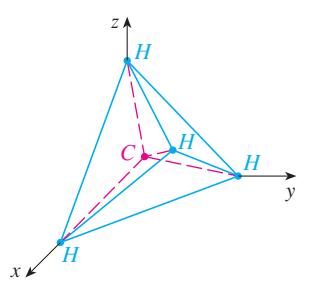
A molecule of methane, \(\text{CH}_4\), is structured with the four hydrogen atoms at the vertices of a regular tetrahedron and the carbon atom at the centroid. The bond angle is the angle formed by the H--C--H combination; it is the angle between the lines that join the carbon atom to two of the hydrogen atoms. Show that the bond angle is about \(109.5^{\circ}\). [Hint: Take the vertices of the tetrahedron to be the points \((1, 0, 0)\), \((0, 1, 0)\), \((0, 0, 1)\), and \((1, 1, 1)\), as shown in the figure. Then the centroid is \(\left(\dfrac{1}{2}, \dfrac{1}{2}, \dfrac{1}{2}\right)\).]
question image
58 Vectors - Dot Product Properties · Level 4
If \(\mathbf{c} = |\mathbf{a}| \mathbf{b} + |\mathbf{b}| \mathbf{a}\), where \(\mathbf{a}\), \(\mathbf{b}\), and \(\mathbf{c}\) are all nonzero vectors, show that \(\mathbf{c}\) bisects the angle between \(\mathbf{a}\) and \(\mathbf{b}\).
59 Vectors - Dot Product Properties · Level 4
Prove Properties 2, 4, and 5 of the dot product (Theorem 2).
60 Vectors - Dot Product Properties · Level 4
Suppose that all sides of a quadrilateral are equal in length and opposite sides are parallel. Use vector methods to show that the diagonals are perpendicular.
61 Vectors - Dot Product Properties · Level 4
Use Theorem 3 to prove the Cauchy-Schwarz Inequality: \( |\mathbf{a} \cdot \mathbf{b}| \leq |\mathbf{a}| |\mathbf{b}| \)
62 Vectors - Dot Product Properties · Level 4
The Triangle Inequality for vectors is \( |\mathbf{a} + \mathbf{b}| \leq |\mathbf{a}| + |\mathbf{b}| \)
(a) Give a geometric interpretation of the Triangle Inequality.
(b) Use the Cauchy-Schwarz Inequality from Exercise 61 to prove the Triangle Inequality. [Hint: Use the fact that \(|\mathbf{a} + \mathbf{b}|^2 = (\mathbf{a} + \mathbf{b}) \cdot (\mathbf{a} + \mathbf{b})\) and use Property 3 of the dot product.]

Enter your answer directly below each part above.

63 Vectors - Dot Product Properties · Level 4
The Parallelogram Law states that \( |\mathbf{a} + \mathbf{b}|^2 + |\mathbf{a} - \mathbf{b}|^2 = 2 |\mathbf{a}|^2 + 2 |\mathbf{b}|^2 \)
(a) Give a geometric interpretation of the Parallelogram Law.
(b) Prove the Parallelogram Law. (See the hint in Exercise 62.)

Enter your answer directly below each part above.

64 Vectors - Dot Product Properties · Level 4
Show that if \(\mathbf{u} + \mathbf{v}\) and \(\mathbf{u} - \mathbf{v}\) are orthogonal, then the vectors \(\mathbf{u}\) and \(\mathbf{v}\) must have the same length.
65 Vectors - Projections · Level 5
If \(\theta\) is the angle between vectors \(\mathbf{a}\) and \(\mathbf{b}\), show that \( \text{proj}_\mathbf{a} \mathbf{b} \cdot \text{proj}_\mathbf{b} \mathbf{a} = (\mathbf{a} \cdot \mathbf{b}) \cos^2 \theta \)

Answered: 0 / 65