Stewart Precalc 6e Section 1.1: Real Numbers

89 questions

--:--
0 / 89
Stewart Precalc 6e Section 1.1: Real Numbers 0/89
1 Concepts - Number Types · Level 1
Give an example of each of the following:
(a) A natural number
(b) An integer that is not a natural number
(c) A rational number that is not an integer
(d) An irrational number

Enter your answer directly below each part above.

2 Concepts - Properties of Real Numbers · Level 1
Complete each statement and name the property of real numbers you have used.
(a) \(a b\) = ____; ____ Property
(b) \(a + (b + c)\) = ____; ____ Property
(c) \(a(b + c)\) = ____; ____ Property

Enter your answer directly below each part above.

3 Concepts - Interval Notation · Level 1
The set of numbers between but not including \(2\) and \(7\) can be written as ____ in set-builder notation and ____ in interval notation.
4 Concepts - Absolute Value · Level 1
The symbol \(|x|\) stands for the ____ of the number \(x\). If \(x\) is not \(0\), then the sign of \(|x|\) is always ____.
5 Skills - Classifying Numbers · Level 2
Consider the numbers \(0, -10, 50, \dfrac{22}{7}, 0.538, \sqrt{7}, 1.2 \overline{\text{3}}, -\dfrac{1}{3}, \sqrt[3]{2}\). List the elements that are
(a) natural numbers
(b) integers
(c) rational numbers
(d) irrational numbers

Enter your answer directly below each part above.

6 Skills - Classifying Numbers · Level 2
Consider the numbers \(1.001, 0.333..., -\pi, -11, 11, \dfrac{13}{15}, \sqrt{16}, 3.14, \dfrac{15}{3}\). List the elements that are
(a) natural numbers
(b) integers
(c) rational numbers
(d) irrational numbers

Enter your answer directly below each part above.

7 Skills - Properties of Real Numbers · Level 1
State the property of real numbers being used. \(7 + 10 = 10 + 7\)
8 Skills - Properties of Real Numbers · Level 1
State the property of real numbers being used. \(2(3 + 5) = (3 + 5) 2\)
9 Skills - Properties of Real Numbers · Level 1
State the property of real numbers being used. \((x + 2y) + 3z = x + (2y + 3z)\)
10 Skills - Properties of Real Numbers · Level 1
State the property of real numbers being used. \(2(A + B) = 2A + 2B\)
11 Skills - Properties of Real Numbers · Level 1
State the property of real numbers being used. \((5x + 1) 3 = 15x + 3\)
12 Skills - Properties of Real Numbers · Level 1
State the property of real numbers being used. \((x + a)(x + b) = (x + a) x + (x + a) b\)
13 Skills - Properties of Real Numbers · Level 1
State the property of real numbers being used. \(2x(3 + y) = (3 + y) 2x\)
14 Skills - Properties of Real Numbers · Level 1
State the property of real numbers being used. \(7(a + b + c) = 7(a + b) + 7c\)
15 Skills - Applying Properties · Level 1
Rewrite the expression using the given property of real numbers. Commutative Property of addition: \(x + 3 = \) ____
16 Skills - Applying Properties · Level 1
Rewrite the expression using the given property of real numbers. Associative Property of multiplication: \(7(3x) = \) ____
17 Skills - Applying Properties · Level 1
Rewrite the expression using the given property of real numbers. Distributive Property: \(4(A + B) = \) ____
18 Skills - Applying Properties · Level 1
Rewrite the expression using the given property of real numbers. Distributive Property: \(5x + 5y = \) ____
19 Skills - Distributive Property · Level 2
Use properties of real numbers to write the expression without parentheses. \(3(x + y)\)
20 Skills - Distributive Property · Level 2
Use properties of real numbers to write the expression without parentheses. \((a - b) 8\)
21 Skills - Distributive Property · Level 2
Use properties of real numbers to write the expression without parentheses. \(4(2m)\)
22 Skills - Distributive Property · Level 2
Use properties of real numbers to write the expression without parentheses. \(\dfrac{4}{3}(-6y)\)
23 Skills - Distributive Property · Level 2
Use properties of real numbers to write the expression without parentheses. \(-\dfrac{5}{2}(2x - 4y)\)
24 Skills - Distributive Property · Level 2
Use properties of real numbers to write the expression without parentheses. \((3a)(b + c - 2d)\)
25 Skills - Fraction Operations · Level 2
Perform the indicated operations.
(a) \(\dfrac{3}{10} + \dfrac{4}{15}\)
(b) \(\dfrac{1}{4} + \dfrac{1}{5}\)

Enter your answer directly below each part above.

26 Skills - Fraction Operations · Level 2
Perform the indicated operations.
(a) \(\dfrac{2}{3} - \dfrac{3}{5}\)
(b) \(1 + \dfrac{5}{8} - \dfrac{1}{6}\)

Enter your answer directly below each part above.

27 Skills - Fraction Operations · Level 2
Perform the indicated operations.
(a) \(\dfrac{2}{3}\left(6 - \dfrac{3}{2}\right)\)
(b) \(0.25\left(\dfrac{8}{9} + \dfrac{1}{2}\right)\)

Enter your answer directly below each part above.

28 Skills - Fraction Operations · Level 2
Perform the indicated operations.
(a) \(\left(3 + \dfrac{1}{4}\right)\left(1 - \dfrac{4}{5}\right)\)
(b) \(\left(\dfrac{1}{2} - \dfrac{1}{3}\right)\left(\dfrac{1}{2} + \dfrac{1}{3}\right)\)

Enter your answer directly below each part above.

29 Skills - Fraction Operations · Level 3
Perform the indicated operations.
(a) \(\dfrac{2 - \dfrac{2}{3}}{2}\)
(b) \(\dfrac{\dfrac{1}{12}}{\dfrac{1}{2} - \dfrac{1}{3}}\)

Enter your answer directly below each part above.

30 Skills - Fraction Operations · Level 3
Perform the indicated operations.
(a) \(\dfrac{2 - \dfrac{3}{4}}{\dfrac{1}{2} - \dfrac{1}{3}}\)
(b) \(\dfrac{\dfrac{2}{5} + \dfrac{1}{2}}{\dfrac{1}{2} + \dfrac{3}{5}}\)

Enter your answer directly below each part above.

31 Skills - Comparing Numbers · Level 2
Place the correct symbol (\(<\), \(>\), or \(=\)) in the space.
(a) \(3\) ____ \(\dfrac{7}{2}\)
(b) \(-3\) ____ \(-\dfrac{7}{2}\)
(c) \(3.5\) ____ \(\dfrac{7}{2}\)

Enter your answer directly below each part above.

32 Skills - Comparing Numbers · Level 2
Place the correct symbol (\(<\), \(>\), or \(=\)) in the space.
(a) \(\dfrac{2}{3}\) ____ \(0.67\)
(b) \(\dfrac{2}{3}\) ____ \(-0.67\)
(c) \(|0.67|\) ____ \(|-0.67|\)

Enter your answer directly below each part above.

33 Skills - Inequalities · Level 1
State whether each inequality is true or false.
(a) \(-6 < -10\)
(b) \(\sqrt{2} > 1.41\)

Enter your answer directly below each part above.

34 Skills - Inequalities · Level 2
State whether each inequality is true or false.
(a) \(\dfrac{10}{11} < \dfrac{12}{13}\)
(b) \(-\dfrac{1}{2} < -1\)

Enter your answer directly below each part above.

35 Skills - Inequalities · Level 1
State whether each inequality is true or false.
(a) \(-\pi > -3\)
(b) \(8 \leq 9\)

Enter your answer directly below each part above.

36 Skills - Inequalities · Level 2
State whether each inequality is true or false.
(a) \(1.1 > 1.\overline{\text{1}}\)
(b) \(8 \leq 8\)

Enter your answer directly below each part above.

37 Skills - Writing Inequalities · Level 2
Write each statement in terms of inequalities.
(a) \(x\) is positive
(b) \(t\) is less than \(4\)
(c) \(a\) is greater than or equal to \(\pi\)
(d) \(x\) is less than \(\dfrac{1}{3}\) and is greater than \(-5\)
(e) The distance from \(p\) to \(3\) is at most \(5\)

Enter your answer directly below each part above.

38 Skills - Writing Inequalities · Level 2
Write each statement in terms of inequalities.
(a) \(y\) is negative
(b) \(z\) is greater than \(1\)
(c) \(b\) is at most \(8\)
(d) \(w\) is positive and is less than or equal to \(17\)
(e) \(y\) is at least \(2\) units from \(\pi\)

Enter your answer directly below each part above.

39 Skills - Set Operations · Level 2
Find the indicated set if \(A\) = {1, 2, 3, 4, 5, 6, 7}, \(B\) = {2, 4, 6, 8}, \(C\) = {7, 8, 9, 10}.
(a) \(A \cup B\)
(b) \(A \cap B\)

Enter your answer directly below each part above.

40 Skills - Set Operations · Level 2
Find the indicated set if \(A\) = {1, 2, 3, 4, 5, 6, 7}, \(B\) = {2, 4, 6, 8}, \(C\) = {7, 8, 9, 10}.
(a) \(B \cup C\)
(b) \(B \cap C\)

Enter your answer directly below each part above.

41 Skills - Set Operations · Level 2
Find the indicated set if \(A\) = {1, 2, 3, 4, 5, 6, 7}, \(B\) = {2, 4, 6, 8}, \(C\) = {7, 8, 9, 10}.
(a) \(A \cup C\)
(b) \(A \cap C\)

Enter your answer directly below each part above.

42 Skills - Set Operations · Level 2
Find the indicated set if \(A\) = {1, 2, 3, 4, 5, 6, 7}, \(B\) = {2, 4, 6, 8}, \(C\) = {7, 8, 9, 10}.
(a) \(A \cup B \cup C\)
(b) \(A \cap B \cap C\)

Enter your answer directly below each part above.

43 Set Operations · Level 2
Find the indicated set if \(A = \{x | x \geq -2\}\), \(B = \{x | x < 4\}\), \(C = \{x | -1 < x \leq 5\}\).
(a) \(B \cup C\)
(b) \(B \cap C\)

Enter your answer directly below each part above.

44 Set Operations · Level 2
Find the indicated set if \(A = \{x | x \geq -2\}\), \(B = \{x | x < 4\}\), \(C = \{x | -1 < x \leq 5\}\).
(a) \(A \cap C\)
(b) \(A \cap B\)

Enter your answer directly below each part above.

45 Intervals · Level 2
Express the interval in terms of inequalities, and then graph the interval. \((-3, 0)\)
46 Intervals · Level 2
Express the interval in terms of inequalities, and then graph the interval. \((2, 8]\)
47 Intervals · Level 2
Express the interval in terms of inequalities, and then graph the interval. \([2, 8)\)
48 Intervals · Level 2
Express the interval in terms of inequalities, and then graph the interval. \([-6, -\dfrac{1}{2}]\)
49 Intervals · Level 2
Express the interval in terms of inequalities, and then graph the interval. \([2, \infty)\)
50 Intervals · Level 2
Express the interval in terms of inequalities, and then graph the interval. \((-\infty, 1)\)
51 Inequalities and Intervals · Level 2
Express the inequality in interval notation, and then graph the corresponding interval. \(x \leq 1\)
52 Inequalities and Intervals · Level 2
Express the inequality in interval notation, and then graph the corresponding interval. \(1 \leq x \leq 2\)
53 Inequalities and Intervals · Level 2
Express the inequality in interval notation, and then graph the corresponding interval. \(-2 < x \leq 1\)
54 Inequalities and Intervals · Level 2
Express the inequality in interval notation, and then graph the corresponding interval. \(x \geq -5\)
55 Inequalities and Intervals · Level 2
Express the inequality in interval notation, and then graph the corresponding interval. \(x > -1\)
56 Inequalities and Intervals · Level 2
Express the inequality in interval notation, and then graph the corresponding interval. \(-5 < x < 2\)
57 Graphing Sets · Level 2
Graph the set. \((-2, 0) \cup (-1, 1)\)
58 Graphing Sets · Level 2
Graph the set. \((-2, 0) \cap (-1, 1)\)
59 Graphing Sets · Level 2
Graph the set. \([-4, 6] \cap [0, 8)\)
60 Graphing Sets · Level 2
Graph the set. \([-4, 6) \cup [0, 8)\)
61 Graphing Sets · Level 2
Graph the set. \((-\infty, -4) \cup (4, \infty)\)
62 Graphing Sets · Level 2
Graph the set. \((-\infty, 6] \cap (2, 10)\)
63 Absolute Value · Level 2
Evaluate each expression.
(a) \(|100|\)
(b) \(|-73|\)

Enter your answer directly below each part above.

64 Absolute Value · Level 2
Evaluate each expression.
(a) \(|\sqrt{5} - 5|\)
(b) \(|10 - \pi|\)

Enter your answer directly below each part above.

65 Absolute Value · Level 2
Evaluate each expression.
(a) \(|abs(-6) - abs(-4)|\)
(b) \(\dfrac{-1}{|-1|}\)

Enter your answer directly below each part above.

66 Absolute Value · Level 2
Evaluate each expression.
(a) \(|2 - abs(-12)|\)
(b) \(-1 - |1 - abs(-1)|\)

Enter your answer directly below each part above.

67 Absolute Value · Level 2
Evaluate each expression.
(a) \(|(-2) \cdot 6|\)
(b) \(|\left(-\dfrac{1}{3}\right)(-15)|\)

Enter your answer directly below each part above.

68 Absolute Value · Level 2
Evaluate each expression.
(a) \(|\dfrac{-6}{24}|\)
(b) \(|\dfrac{7 - 12}{12 - 7}|\)

Enter your answer directly below each part above.

69 Distance Between Numbers · Level 2
Find the distance between the given numbers.
(a) \(2\) and \(17\)
(b) \(-3\) and \(21\)
(c) \(\dfrac{11}{8}\) and \(-\dfrac{3}{10}\)

Enter your answer directly below each part above.

70 Distance Between Numbers · Level 2
Find the distance between the given numbers.
(a) \(\dfrac{7}{15}\) and \(-\dfrac{1}{21}\)
(b) \(-38\) and \(-57\)
(c) \(-2.6\) and \(-1.8\)

Enter your answer directly below each part above.

71 Repeating Decimals · Level 2
Express each repeating decimal as a fraction.
(a) \(0.\overline{\text{7}}\)
(b) \(0.2 \overline{\text{8}}\)
(c) \(0.\overline{\text{57}}\)

Enter your answer directly below each part above.

72 Repeating Decimals · Level 2
Express each repeating decimal as a fraction.
(a) \(5.\overline{\text{23}}\)
(b) \(1.\overline{\text{37}}\)
(c) \(2.1 \overline{\text{35}}\)

Enter your answer directly below each part above.

73 Applications · Level 3
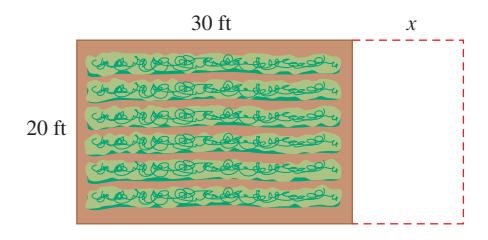
Area of a Garden. Mary's backyard vegetable garden measures 20 ft by 30 ft, so its area is \(20 \times 30 = 600\) ft\(^2\). She decides to make it longer, as shown in the figure, so that the area increases to \(A = 20(30 + x)\). Which property of real numbers tells us that the new area can also be written \(A = 600 + 20 x\)?
question image
74 Applications · Level 3
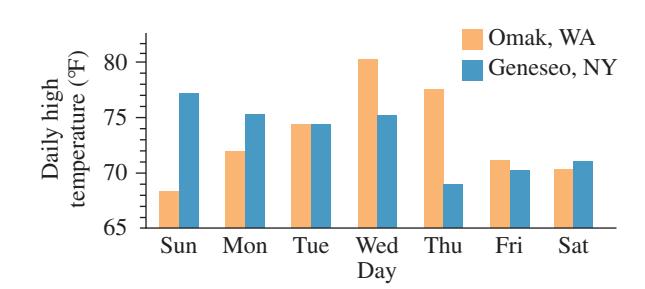
Temperature Variation. The bar graph shows the daily high temperatures for Omak, Washington, and Geneseo, New York, during a certain week in June. Let \(T_O\) represent the temperature in Omak and \(T_G\) the temperature in Geneseo. Calculate \(T_O - T_G\) and \(|T_O - T_G|\) for each day shown. Which of these two values gives more information?
question image
75 Applications · Level 3
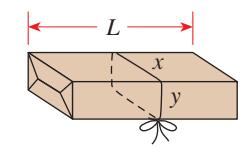
Mailing a Package. The post office will only accept packages for which the length plus the "girth" (distance around) is no more than 108 inches. Thus, for the package in the figure, we must have \(L + 2(x + y) \leq 108\).
question image
(a) Will the post office accept a package that is 6 in. wide, 8 in. deep, and 5 ft long? What about a package that measures 2 ft by 2 ft by 4 ft?
(b) What is the greatest acceptable length for a package that has a square base measuring 9 in. by 9 in.?

Enter your answer directly below each part above.

76 Discovery and Discussion · Level 3
Signs of Numbers. Let \(a\), \(b\), and \(c\) be real numbers such that \(a > 0\), \(b < 0\), and \(c < 0\). Find the sign of each expression.
(a) \(-a\)
(b) \(-b\)
(c) \(b c\)
(d) \(a - b\)
(e) \(c - a\)
(f) \(a + b c\) (g) \(a b + a c\) (h) \(-a b c\) (i) \(a b^2\)

Enter your answer directly below each part above.

77 Discovery and Discussion · Level 3
Sums and Products of Rational and Irrational Numbers. Explain why the sum, the difference, and the product of two rational numbers are rational numbers. Is the product of two irrational numbers necessarily irrational? What about the sum?
78 Discovery and Discussion · Level 3
Combining Rational Numbers with Irrational Numbers. Is \(\dfrac{1}{2} + \sqrt{2}\) rational or irrational? Is \(\dfrac{1}{2} \cdot \sqrt{2}\) rational or irrational? In general, what can you say about the sum of a rational and an irrational number? What about the product?
79 Discovery and Discussion · Level 3
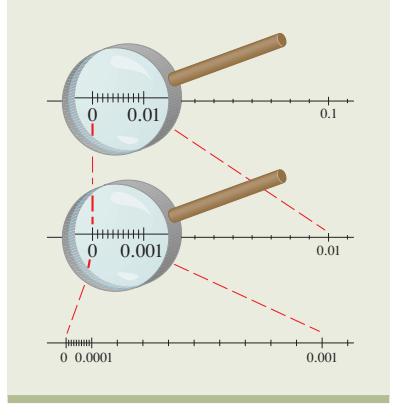
Limiting Behavior of Reciprocals. Complete the tables. What happens to the size of the fraction \(\dfrac{1}{x}\) as \(x\) gets large? As \(x\) gets small? Table 1: \(x\) values \(1, 2, 10, 100, 1000\) — find \(\dfrac{1}{x}\) for each. Table 2: \(x\) values \(1.0, 0.5, 0.1, 0.01, 0.001\) — find \(\dfrac{1}{x}\) for each.
80 Discovery and Discussion · Level 3
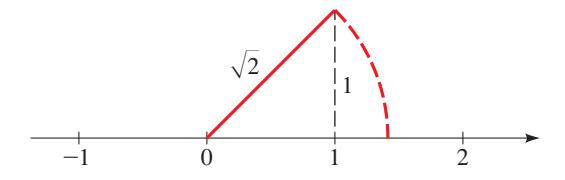
Irrational Numbers and Geometry. Using the following figure, explain how to locate the point \(\sqrt{2}\) on a number line. Can you locate \(\sqrt{5}\) by a similar method? What about \(\sqrt{6}\)? List some other irrational numbers that can be located this way.
question image
81 Discovery and Discussion · Level 3
Commutative and Noncommutative Operations. We have seen that addition and multiplication are both commutative operations.
(a) Is subtraction commutative?
(b) Is division of nonzero real numbers commutative?

Enter your answer directly below each part above.

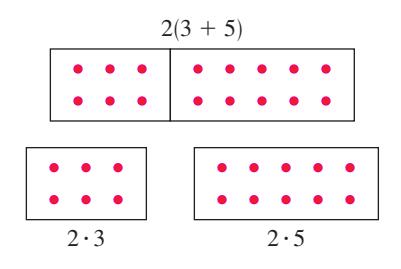
82 Example - Distributive Property · Level 2
Use the Distributive Property to simplify each expression.
question image
(a) \(2(x + 3)\)
(b) \((a + b)(x + y)\)

Enter your answer directly below each part above.

83 Example - Properties of Negatives · Level 2
Let \(x\), \(y\), and \(z\) be real numbers. Use the Properties of Negatives to simplify each expression.
(a) \(-(x + 2)\)
(b) \(-(x + y - z)\)

Enter your answer directly below each part above.

84 Example - LCD to Add Fractions · Level 2
Evaluate \(\dfrac{5}{36} + \dfrac{7}{120}\).
85 Example - Union and Intersection of Sets · Level 2
If \(S\) = {1, 2, 3, 4, 5}, \(T\) = {4, 5, 6, 7}, and \(V\) = {6, 7, 8}, find the sets \(S \cup T\), \(S \cap T\), and \(S \cap V\).
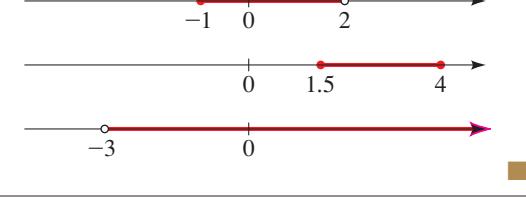
86 Example - Graphing Intervals · Level 2
Express each interval in terms of inequalities, and then graph the interval.
question image
(a) \([-1, 2)\)
(b) \([1.5, 4]\)
(c) \((-3, \infty)\)

Enter your answer directly below each part above.

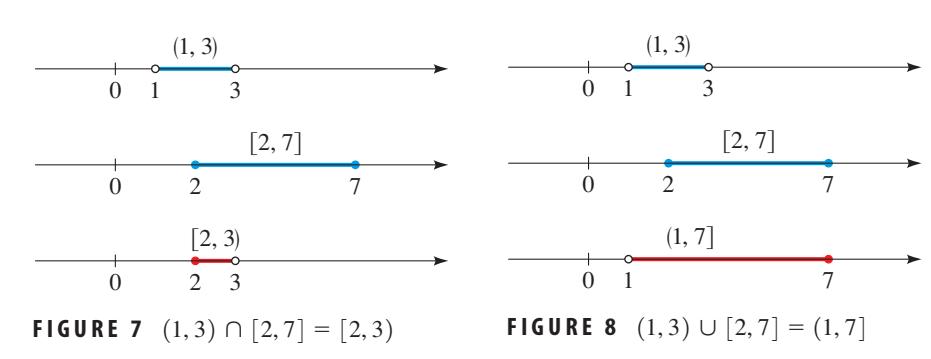
87 Example - Unions and Intersections of Intervals · Level 2
Graph each set.
question image
(a) \((1, 3) \cap [2, 7]\)
(b) \((1, 3) \cup [2, 7]\)

Enter your answer directly below each part above.

88 Example - Evaluating Absolute Values · Level 1
Evaluate each absolute value.
question image
(a) \(|3|\)
(b) \(|-3|\)
(c) \(|0|\)
(d) \(|3 - \pi|\)

Enter your answer directly below each part above.

89 Example - Distance Between Points on the Real Line · Level 2
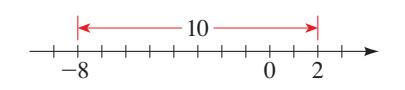
Find the distance between the numbers \(-8\) and \(2\) on the real line.
question image

Answered: 0 / 89