Stewart Precalc 6e Section 8.FocusModeling: Focus on Modeling - The Path of a Projectile

9 questions

--:--
0 / 9
Stewart Precalc 6e Section 8.FocusModeling: Focus on Modeling - The Path of a Projectile 0/9
1 Trajectories Are Parabolas · Level 3
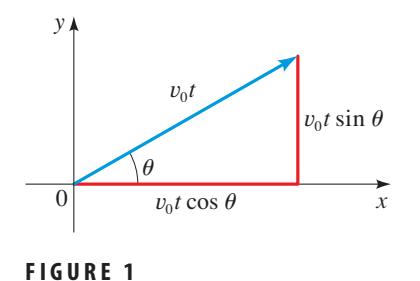
From the graphs in Figure 3 the paths of projectiles appear to be parabolas that open downward. Eliminate the parameter \(t\) from the general parametric equations to verify that these are indeed parabolas.
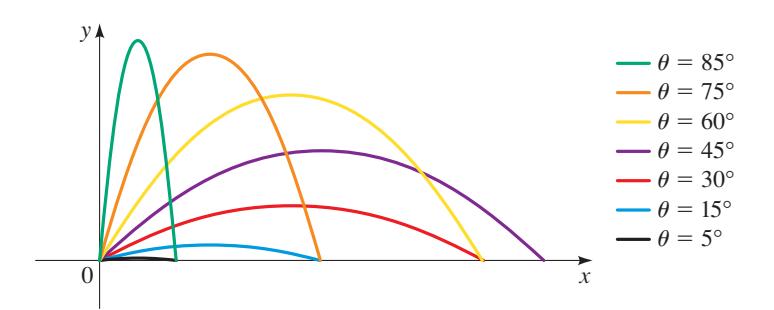
question image
2 Path of a Baseball · Level 2
Suppose a baseball is thrown at \(30\) ft/s at a \(60^{\circ}\) angle to the horizontal from a height of \(4\) ft above the ground.
(a) Find parametric equations for the path of the baseball, and sketch its graph.
(b) How far does the baseball travel, and when does it hit the ground?

Enter your answer directly below each part above.

3 Path of a Rocket · Level 3
Suppose that a rocket is fired at an angle of \(5^{\circ}\) from the vertical with an initial speed of \(1000\) ft/s.
(a) Find the length of time the rocket is in the air.
(b) Find the greatest height it reaches.
(c) Find the horizontal distance it has traveled when it hits the ground.
(d) Graph the rocket's path.

Enter your answer directly below each part above.

4 Firing a Missile · Level 3
The initial speed of a missile is \(330\) m/s.
(a) At what angle should the missile be fired so that it hits a target \(10\) km away? (You should find that there are two possible angles.) Graph the missile paths for both angles.
(b) For which angle is the target hit sooner?

Enter your answer directly below each part above.

5 Maximum Height of a Projectile · Level 4
Show that the maximum height reached by a projectile as a function of its initial speed \(v_0\) and its firing angle \(\theta\) is \(y = \dfrac{v_0^2 \sin^2 \theta}{2 g}\)
6 Shooting Into the Wind · Level 3
Suppose that a projectile is fired into a headwind that pushes it back so as to reduce its horizontal speed by a constant amount \(w\). Find parametric equations for the path of the projectile.
7 Shooting Into the Wind - Optimal Angle · Level 3
Using the parametric equations you derived in Problem 6, draw graphs of the path of a projectile with initial speed \(v_0 = 32\) ft/s, fired into a headwind of \(w = 24\) ft/s, for the angles \(\theta = 5^{\circ}, 15^{\circ}, 30^{\circ}, 40^{\circ}, 45^{\circ}, 55^{\circ}, 60^{\circ}\), and \(75^{\circ}\). Is it still true that the greatest range is attained when firing at \(45^{\circ}\)? Draw some more graphs for different angles, and use these graphs to estimate the optimal firing angle.
8 Simulating the Path of a Projectile · Level 2
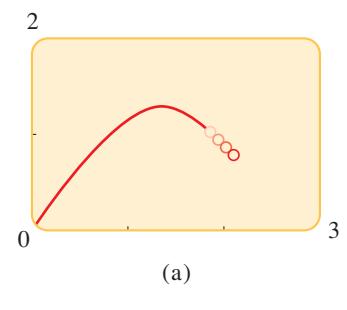
The path of a projectile can be simulated on a graphing calculator. On the TI-83, use the "Path" graph style to graph the general parametric equations for the path of a projectile, and watch as the circular cursor moves, simulating the motion of the projectile. Selecting the size of the Tstep determines the speed of the "projectile."
question image
(a) Simulate the path of a projectile. Experiment with various values of \(\theta\). Use \(v_0 = 10\) ft/s and Tstep \(= 0.02\).
(b) Simulate the path of two projectiles, fired simultaneously, one at \(\theta = 30^{\circ}\) and the other at \(\theta = 60^{\circ}\). This can be done on the TI-83 using Simul mode ("simultaneous" mode). Use \(v_0 = 10\) ft/s and Tstep \(= 0.02\). Where do the projectiles land? Which lands first?
(c) Simulate the path of a ball thrown straight up \((\theta = 90^{\circ})\). Experiment with values of \(v_0\) between \(5\) and \(20\) ft/s. Use the "Animate" graph style and Tstep \(= 0.02\). Simulate the path of two balls thrown simultaneously at different speeds. How does doubling \(v_0\) change the maximum height the ball reaches?

Enter your answer directly below each part above.

9 Example - The Path of a Cannonball · Level 2
Find parametric equations that model the path of a cannonball fired into the air with an initial speed of \(150.0\) m/s at a \(30^{\circ}\) angle of elevation. Sketch the path of the cannonball.
question image

Answered: 0 / 9