Stewart Precalc 6e Section 2.1: What Is a Function?

92 questions

--:--
0 / 92
Stewart Precalc 6e Section 2.1: What Is a Function? 0/92
1 Concept - Function Notation · Level 1
If a function \(f\) is given by the formula \(y = f(x)\), then \(f(a)\) is the _____ of \(f\) at \(x = a\).
2 Concept - Domain and Range · Level 1
For a function \(f\), the set of all possible inputs is called the _____ of \(f\), and the set of all possible outputs is called the _____ of \(f\).
3 Concept - Domain · Level 2
(a) Which of the following functions have 5 in their domain? \(f(x) = x^2 - 3x\), \(g(x) = \dfrac{x - 5}{x}\), \(h(x) = \sqrt{x - 10}\).
(b) For the functions from part (a) that do have 5 in their domain, find the value of the function at 5.

Enter your answer directly below each part above.

4 Concept - Four Representations · Level 2
A function is given algebraically by the formula \(f(x) = (x - 4)^2 + 3\). Complete these other ways to represent \(f\):
(a) Verbal: 'Subtract 4, then _____, then _____.'
(b) Numerical: Complete the table for \(x = 0, 2, 4, 6\), given \(f(0) = 19\).

Enter your answer directly below each part above.

5 Skills - Function Notation · Level 1
Express the rule in function notation. (For example, the rule 'square, then subtract 5' is expressed as \(f(x) = x^2 - 5\).) Add 3, then multiply by 2.
6 Skills - Function Notation · Level 1
Express the rule in function notation: Divide by 7, then subtract 4.
7 Skills - Function Notation · Level 1
Express the rule in function notation: Subtract 5, then square.
8 Skills - Function Notation · Level 1
Express the rule in function notation: Take the square root, add 8, then multiply by \(\dfrac{1}{3}\).
9 Skills - Expressing Functions in Words · Level 1
Express the function (or rule) in words: \(h(x) = x^2 + 2\).
10 Skills - Expressing Functions in Words · Level 1
Express the function in words: \(k(x) = \sqrt{x + 2}\).
11 Skills - Expressing Functions in Words · Level 1
Express the function in words: \(f(x) = \dfrac{x - 4}{3}\).
12 Skills - Expressing Functions in Words · Level 1
Express the function in words: \(g(x) = \dfrac{x}{2} - 4\).
13 Skills - Machine Diagrams · Level 1
Draw a machine diagram for the function \(f(x) = \sqrt{x - 1}\).
14 Skills - Machine Diagrams · Level 1
Draw a machine diagram for the function \(f(x) = \dfrac{3}{x - 2}\).
15 Skills - Tables of Values · Level 1
Complete the table for \(f(x) = 2(x - 1)^2\) at \(x = -1, 0, 1, 2, 3\).
16 Skills - Tables of Values · Level 1
Complete the table for \(g(x) = |2x + 3|\) at \(x = -3, -2, 0, 1, 3\).
17 Skills - Evaluating Functions · Level 2
Evaluate the function \(f(x) = x^2 - 6\) at the indicated values: \(f(-3)\), \(f(3)\), \(f(0)\), \(f\left(\dfrac{1}{2}\right)\), \(f(10)\).
18 Skills - Evaluating Functions · Level 2
Evaluate \(f(x) = x^3 + 2x\) at \(f(-2)\), \(f(1)\), \(f(0)\), \(f\left(\dfrac{1}{3}\right)\), \(f(0.2)\).
19 Skills - Evaluating Functions · Level 2
Evaluate \(f(x) = 2x + 1\) at \(f(1)\), \(f(-2)\), \(f\left(\dfrac{1}{2}\right)\), \(f(a)\), \(f(-a)\), \(f(a + b)\).
20 Skills - Evaluating Functions · Level 2
Evaluate \(f(x) = x^2 + 2x\) at \(f(0)\), \(f(3)\), \(f(-3)\), \(f(a)\), \(f(-x)\), \(f\left(\dfrac{1}{a}\right)\).
21 Skills - Evaluating Functions · Level 2
Evaluate \(g(x) = \dfrac{1 - x}{1 + x}\) at \(g(2)\), \(g(-2)\), \(g\left(\dfrac{1}{2}\right)\), \(g(a)\), \(g(a - 1)\), \(g(-1)\).
22 Skills - Evaluating Functions · Level 2
Evaluate \(h(t) = t + \dfrac{1}{t}\) at \(h(1)\), \(h(-1)\), \(h(2)\), \(h\left(\dfrac{1}{2}\right)\), \(h(x)\), \(h\left(\dfrac{1}{x}\right)\).
23 Skills - Evaluating Functions · Level 2
Evaluate \(f(x) = 2 x^2 + 3 x - 4\) at \(f(0)\), \(f(2)\), \(f(-2)\), \(f(\sqrt{2})\), \(f(x + 1)\), \(f(-x)\).
24 Skills - Evaluating Functions · Level 2
Evaluate \(f(x) = x^3 - 4 x^2\) at \(f(0)\), \(f(1)\), \(f(-1)\), \(f\left(\dfrac{3}{2}\right)\), \(f\left(\dfrac{x}{2}\right)\), \(f(x^2)\).
25 Skills - Evaluating Functions · Level 2
Evaluate \(f(x) = 2 |x - 1|\) at \(f(-2)\), \(f(0)\), \(f\left(\dfrac{1}{2}\right)\), \(f(2)\), \(f(x + 1)\), \(f(x^2 + 2)\).
26 Skills - Evaluating Functions · Level 2
Evaluate \(f(x) = \dfrac{|x|}{x}\) at \(f(-2)\), \(f(-1)\), \(f(0)\), \(f(5)\), \(f(x^2)\), \(f\left(\dfrac{1}{x}\right)\).
27 Skills - Piecewise Functions · Level 2
Evaluate the piecewise function \(f(x) = \begin{cases} x^2 & \quad \text{if } x < 0 \\ x + 1 & \quad \text{if } x \geq 0 \end{cases}\) at \(f(-2)\), \(f(-1)\), \(f(0)\), \(f(1)\), \(f(2)\).
28 Skills - Piecewise Functions · Level 2
Evaluate the piecewise function \(f(x) = \begin{cases} 5 & \quad \text{if } x \leq 2 \\ 2 x - 3 & \quad \text{if } x > 2 \end{cases}\) at \(f(-3)\), \(f(0)\), \(f(2)\), \(f(3)\), \(f(5)\).
29 Skills - Piecewise Functions · Level 3
Evaluate the piecewise function \(f(x) = \begin{cases} x^2 + 2 x & \quad \text{if } x \leq -1 \\ x & \quad \text{if } -1 < x \leq 1 \\ -1 & \quad \text{if } x > 1 \end{cases}\) at \(f(-4)\), \(f\left(-\dfrac{3}{2}\right)\), \(f(-1)\), \(f(0)\), \(f(25)\).
30 Skills - Piecewise Functions · Level 3
Evaluate the piecewise function \(f(x) = \begin{cases} 3 x & \quad \text{if } x < 0 \\ x + 1 & \quad \text{if } 0 \leq x \leq 2 \\ (x - 2)^2 & \quad \text{if } x > 2 \end{cases}\) at \(f(-5)\), \(f(0)\), \(f(1)\), \(f(2)\), \(f(5)\).
31 Skills - Function Expressions · Level 2
Use \(f(x) = x^2 + 1\) to evaluate and simplify \(f(x + 2)\) and \(f(x) + f(2)\).
32 Skills - Function Expressions · Level 2
Use \(f(x) = 3 x - 1\) to evaluate and simplify \(f(2 x)\) and \(2 f(x)\).
33 Skills - Function Expressions · Level 2
Use \(f(x) = x + 4\) to evaluate and simplify \(f(x^2)\) and \((f(x))^2\).
34 Skills - Function Expressions · Level 2
Use \(f(x) = 6 x - 18\) to evaluate and simplify \(f\left(\dfrac{x}{3}\right)\) and \(\dfrac{f(x)}{3}\).
35 Skills - Difference Quotient · Level 3
For \(f(x) = 3 x + 2\), find \(f(a)\), \(f(a + h)\), and the difference quotient \(\dfrac{f(a + h) - f(a)}{h}\), where \(h \neq 0\).
36 Skills - Difference Quotient · Level 3
For \(f(x) = x^2 + 1\), find \(f(a)\), \(f(a + h)\), and the difference quotient \(\dfrac{f(a + h) - f(a)}{h}\), where \(h \neq 0\).
37 Skills - Difference Quotient · Level 3
For \(f(x) = 5\), find \(f(a)\), \(f(a + h)\), and the difference quotient \(\dfrac{f(a + h) - f(a)}{h}\), where \(h \neq 0\).
38 Skills - Difference Quotient · Level 3
For \(f(x) = \dfrac{1}{x + 1}\), find \(f(a)\), \(f(a + h)\), and the difference quotient \(\dfrac{f(a + h) - f(a)}{h}\), where \(h \neq 0\).
39 Skills - Difference Quotient · Level 3
For \(f(x) = \dfrac{x}{x + 1}\), find \(f(a)\), \(f(a + h)\), and the difference quotient \(\dfrac{f(a + h) - f(a)}{h}\), where \(h \neq 0\).
40 Skills - Difference Quotient · Level 3
For \(f(x) = \dfrac{2 x}{x - 1}\), find \(f(a)\), \(f(a + h)\), and the difference quotient \(\dfrac{f(a + h) - f(a)}{h}\), where \(h \neq 0\).
41 Skills - Difference Quotient · Level 3
For \(f(x) = 3 - 5 x + 4 x^2\), find \(f(a)\), \(f(a + h)\), and the difference quotient \(\dfrac{f(a + h) - f(a)}{h}\), where \(h \neq 0\).
42 Skills - Difference Quotient · Level 3
For \(f(x) = x^3\), find \(f(a)\), \(f(a + h)\), and the difference quotient \(\dfrac{f(a + h) - f(a)}{h}\), where \(h \neq 0\).
43 Skills - Domain of a Function · Level 1
Find the domain of the function \(f(x) = 2 x\).
44 Skills - Domain of a Function · Level 1
Find the domain of the function \(f(x) = x^2 + 1\).
45 Skills - Domain of a Function · Level 1
Find the domain of the function \(f(x) = 2 x\), \(-1 \leq x \leq 5\).
46 Skills - Domain of a Function · Level 1
Find the domain of the function \(f(x) = x^2 + 1\), \(0 \leq x \leq 5\).
47 Skills - Domain of a Function · Level 2
Find the domain of the function \(f(x) = \dfrac{1}{x - 3}\).
48 Skills - Domain of a Function · Level 2
Find the domain of the function \(f(x) = \dfrac{1}{3 x - 6}\).
49 Skills - Domain of a Function · Level 2
Find the domain of the function \(f(x) = \dfrac{x + 2}{x^2 - 1}\).
50 Skills - Domain of a Function · Level 2
Find the domain of the function \(f(x) = \dfrac{x^4}{x^2 + x - 6}\).
51 Skills - Domain of a Function · Level 2
Find the domain of the function \(f(x) = \sqrt{x - 5}\).
52 Skills - Domain of a Function · Level 2
Find the domain of the function \(f(x) = \sqrt[4]{x + 9}\).
53 Skills - Domain of a Function · Level 2
Find the domain of the function \(f(t) = \sqrt[3]{t - 1}\).
54 Skills - Domain of a Function · Level 2
Find the domain of the function \(g(x) = \sqrt{7 - 3 x}\).
55 Skills - Domain of a Function · Level 2
Find the domain of the function \(h(x) = \sqrt{2 x - 5}\).
56 Skills - Domain of a Function · Level 2
Find the domain of the function \(G(x) = \sqrt{x^2 - 9}\).
57 Skills - Domain of a Function · Level 3
Find the domain of the function \(g(x) = \dfrac{\sqrt{2 + x}}{3 - x}\).
58 Skills - Domain of a Function · Level 3
Find the domain of the function \(g(x) = \dfrac{\sqrt{x}}{2 x^2 + x - 1}\).
59 Skills - Domain of a Function · Level 3
Find the domain of the function \(g(x) = \sqrt[4]{x^2 - 6 x}\).
60 Skills - Domain of a Function · Level 3
Find the domain of the function \(g(x) = \sqrt{x^2 - 2 x - 8}\).
61 Skills - Domain of a Function · Level 3
Find the domain of the function \(f(x) = \dfrac{3}{\sqrt{x - 4}}\).
62 Skills - Domain of a Function · Level 3
Find the domain of the function \(f(x) = \dfrac{x^2}{\sqrt{6 - x}}\).
63 Skills - Domain of a Function · Level 3
Find the domain of the function \(f(x) = \dfrac{(x + 1)^2}{\sqrt{2 x - 1}}\).
64 Skills - Domain of a Function · Level 3
Find the domain of the function \(f(x) = \dfrac{x}{\sqrt[4]{9 - x^2}}\).
65 Skills - Representing Functions · Level 2
A verbal description of a function is given. Find (a) algebraic, (b) numerical, and (c) graphical representations for the function: To evaluate \(f(x)\), divide the input by 3 and add \(\dfrac{2}{3}\) to the result.
66 Skills - Representing Functions · Level 2
A verbal description of a function is given. Find (a) algebraic, (b) numerical, and (c) graphical representations for the function: To evaluate \(g(x)\), subtract 4 from the input and multiply the result by \(\dfrac{3}{4}\).
67 Skills - Representing Functions · Level 2
A verbal description of a function is given. Find (a) algebraic, (b) numerical, and (c) graphical representations for the function: Let \(T(x)\) be the amount of sales tax charged in Lemon County on a purchase of \(x\) dollars. To find the tax, take 8% of the purchase price.
68 Skills - Representing Functions · Level 3
A verbal description of a function is given. Find (a) algebraic, (b) numerical, and (c) graphical representations for the function: Let \(V(d)\) be the volume of a sphere of diameter \(d\). To find the volume, take the cube of the diameter, then multiply by \(\pi\) and divide by 6.
69 Application - Production Cost · Level 3
Production Cost. The cost \(C\) in dollars of producing \(x\) yards of a certain fabric is given by the function \(C(x) = 1500 + 3 x + 0.02 x^2 + 0.0001 x^3\).
(a) Find \(C(10)\) and \(C(100)\).
(b) What do your answers in part (a) represent?
(c) Find \(C(0)\). (This number represents the fixed costs.)

Enter your answer directly below each part above.

70 Application - Area of a Sphere · Level 2
*Area of a Sphere* The surface area \(S\) of a sphere is a function of its radius \(r\) given by \( S(r) = 4 \pi r^2 \)
(a) Find \(S(2)\) and \(S(3)\).
(b) What do your answers in part (a) represent?

Enter your answer directly below each part above.

71 Application - Torricelli's Law · Level 3
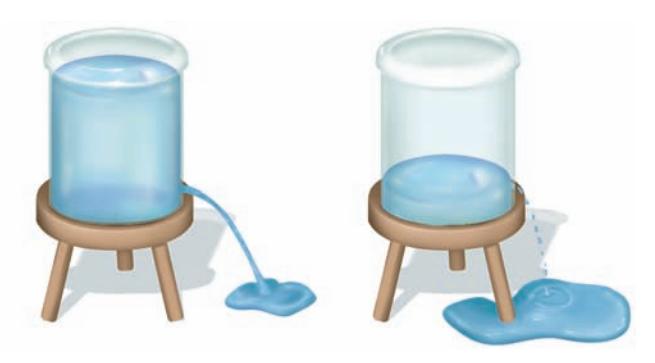
*Torricelli's Law* A tank holds 50 gallons of water, which drains from a leak at the bottom, causing the tank to empty in 20 minutes. The tank drains faster when it is nearly full because the pressure on the leak is greater. Torricelli's Law gives the volume of water remaining in the tank after \(t\) minutes as \( V(t) = 50 \left(1 - \dfrac{t}{20}\right)^2, \quad 0 \leq t \leq 20 \)
question image
(a) Find \(V(0)\) and \(V(20)\).
(b) What do your answers to part (a) represent?
(c) Make a table of values of \(V(t)\) for \(t = 0, 5, 10, 15, 20\).

Enter your answer directly below each part above.

72 Application - Distance to the Horizon · Level 3
*How Far Can You See?* Because of the curvature of the earth, the maximum distance \(D\) that you can see from the top of a tall building or from an airplane at height \(h\) is given by the function \( D(h) = \sqrt{2 r h + h^2} \) where \(r = 3960\) mi is the radius of the earth and \(D\) and \(h\) are measured in miles.
(a) Find \(D(0.1)\) and \(D(0.2)\).
(b) How far can you see from the observation deck of Toronto's CN Tower, 1135 ft above the ground?
(c) Commercial aircraft fly at an altitude of about 7 mi. How far can the pilot see?

Enter your answer directly below each part above.

73 Application - Law of Laminar Flow · Level 3
*Blood Flow* As blood moves through a vein or an artery, its velocity \(v\) is greatest along the central axis and decreases as the distance \(r\) from the central axis increases (see the figure). The formula that gives \(v\) as a function of \(r\) is called the *law of laminar flow.* For an artery with radius 0.5 cm, the relationship between \(v\) (in cm/s) and \(r\) (in cm) is given by the function \( v(r) = 18500 (0.25 - r^2), \quad 0 \leq r \leq 0.5 \)
question image
(a) Find \(v(0.1)\) and \(v(0.4)\).
(b) What do your answers to part (a) tell you about the flow of blood in this artery?
(c) Make a table of values of \(v(r)\) for \(r = 0, 0.1, 0.2, 0.3, 0.4, 0.5\).

Enter your answer directly below each part above.

74 Application - Pupil Size · Level 3
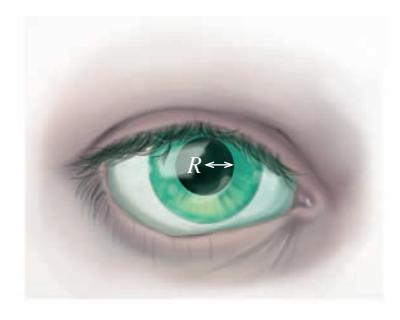
*Pupil Size* When the brightness \(x\) of a light source is increased, the eye reacts by decreasing the radius \(R\) of the pupil. The dependence of \(R\) on \(x\) is given by the function \( R(x) = \sqrt{\dfrac{13 + 7 x^{0.4}}{1 + 4 x^{0.4}}} \) where \(R\) is measured in millimeters and \(x\) is measured in appropriate units of brightness.
question image
(a) Find \(R(1)\), \(R(10)\), and \(R(100)\).
(b) Make a table of values of \(R(x)\).

Enter your answer directly below each part above.

75 Application - Special Relativity · Level 3
*Relativity* According to the Theory of Relativity, the length \(L\) of an object is a function of its velocity \(v\) with respect to an observer. For an object whose length at rest is 10 m, the function is given by \( L(v) = 10 \sqrt{1 - v^2 / c^2} \) where \(c\) is the speed of light (300,000 km/s).
(a) Find \(L(0.5 c)\), \(L(0.75 c)\), and \(L(0.9 c)\).
(b) How does the length of an object change as its velocity increases?

Enter your answer directly below each part above.

76 Application - Piecewise (Income Tax) · Level 3
*Income Tax* In a certain country, income tax \(T\) is assessed according to the following function of income \(x\): \( T(x) = \begin{cases} 0 & \quad \text{if } 0 \leq x \leq 10000 \\ 0.08 x & \quad \text{if } 10000 < x \leq 20000 \\ 1600 + 0.15 x & \quad \text{if } 20000 < x \end{cases} \)
(a) Find \(T(5000)\), \(T(12000)\), and \(T(25000)\).
(b) What do your answers in part (a) represent?

Enter your answer directly below each part above.

77 Application - Piecewise (Shipping Cost) · Level 2
*Internet Purchases* An Internet bookstore charges \$15 shipping for orders under \$100 but provides free shipping for orders of \$100 or more. The cost \(C\) of an order is a function of the total price \(x\) of the books purchased, given by \( C(x) = \begin{cases} x + 15 & \quad \text{if } x < 100 \\ x & \quad \text{if } x \geq 100 \end{cases} \)
(a) Find \(C(75)\), \(C(90)\), \(C(100)\), and \(C(105)\).
(b) What do your answers in part (a) represent?

Enter your answer directly below each part above.

78 Application - Piecewise (Hotel Cost) · Level 3
*Cost of a Hotel Stay* A hotel chain charges \$75 each night for the first two nights and \$50 for each additional night's stay. The total cost \(T\) is a function of the number of nights \(x\) that a guest stays.
(a) Complete the piecewise defined function by writing an expression for each case: one for \(0 \leq x \leq 2\) and one for \(x > 2\).
(b) Find \(T(2)\), \(T(3)\), and \(T(5)\).
(c) What do your answers in part (b) represent?

Enter your answer directly below each part above.

79 Application - Piecewise (Speeding Fines) · Level 4
*Speeding Tickets* In a certain state the maximum speed permitted on freeways is 65 mi/h, and the minimum is 40. The fine \(F\) for violating these limits is \$15 for every mile above the maximum or below the minimum.
(a) Complete the piecewise defined function, where \(x\) is the speed at which you are driving (one expression for each case: \(0 < x < 40\), \(40 \leq x \leq 65\), and \(x > 65\)).
(b) Find \(F(30)\), \(F(50)\), and \(F(75)\).
(c) What do your answers in part (b) represent?

Enter your answer directly below each part above.

80 Sketch from Description - Grass Height · Level 2
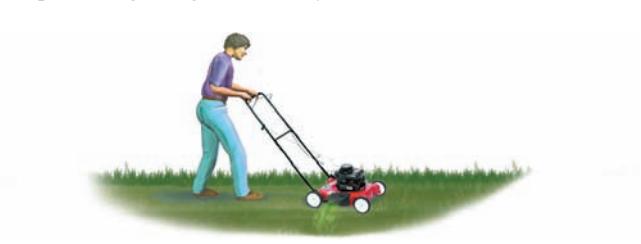
*Height of Grass* A home owner mows the lawn every Wednesday afternoon. Sketch a rough graph of the height of the grass as a function of time over the course of a four-week period beginning on a Sunday.
question image
81 Sketch from Description - Pie Temperature · Level 2
*Temperature Change* You place a frozen pie in an oven and bake it for an hour. Then you take the pie out and let it cool before eating it. Sketch a rough graph of the temperature of the pie as a function of time.
82 Sketch from Data - Daily Temperature · Level 2
*Daily Temperature Change* Temperature readings \(T\) (in \(^{\circ}\)F) were recorded every 2 hours from midnight to noon in Atlanta, Georgia, on March 18, 1996. The time \(t\) was measured in hours from midnight. Sketch a rough graph of \(T\) as a function of \(t\). Data \((t, T)\): \((0, 58)\), \((2, 57)\), \((4, 53)\), \((6, 50)\), \((8, 51)\), \((10, 57)\), \((12, 61)\).
83 Sketch from Data - Population Growth · Level 2
*Population Growth* The population \(P\) (in thousands) of San Jose, California, from 1988 to 2000 is shown in the table. (Midyear estimates are given.) Draw a rough graph of \(P\) as a function of time \(t\). Data \((t, P)\): \((1988, 733)\), \((1990, 782)\), \((1992, 800)\), \((1994, 817)\), \((1996, 838)\), \((1998, 861)\), \((2000, 895)\).
84 Discovery - Examples of Functions · Level 2
*Examples of Functions* At the beginning of this section we discussed three examples of everyday, ordinary functions: Height is a function of age, temperature is a function of date, and postage cost is a function of weight. Give three other examples of functions from everyday life.
85 Discovery - Four Representations of a Function · Level 3
*Four Ways to Represent a Function* In the box on page 148 we represented four different functions verbally, algebraically, visually, and numerically. Think of a function that can be represented in all four ways, and write the four representations.
86 Example - Analyzing a Function · Level 2
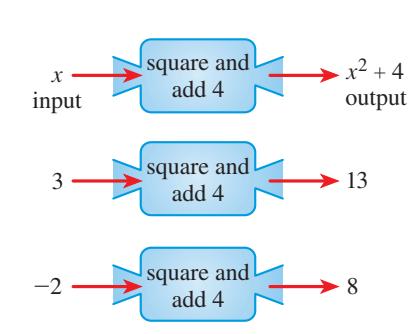
A function \(f\) is defined by the formula \(f(x) = x^2 + 4\). (a) Express in words how \(f\) acts on the input \(x\) to produce the output \(f(x)\). (b) Evaluate \(f(3)\), \(f(-2)\), and \(f(\sqrt{5})\). (c) Find the domain and range of \(f\). (d) Draw a machine diagram for \(f\).
question image
87 Example - Evaluating a Function · Level 1
Let \(f(x) = 3x^2 + x - 5\). Evaluate each function value. (a) \(f(-2)\) (b) \(f(0)\) (c) \(f(4)\) (d) \(f\left(\dfrac{1}{2}\right)\)
88 Example - A Piecewise Defined Function · Level 2
A cell phone plan costs \$39 a month. The plan includes 400 free minutes and charges 20 cents for each additional minute of usage. The monthly charges are a function of the number of minutes used, given by \(C(x) = \begin{cases} 39 & \quad \text{if } 0 \leq x \leq 400 \\ 39 + 0.20(x - 400) & \quad \text{if } x > 400 \end{cases}\). Find \(C(100)\), \(C(400)\), and \(C(480)\).
89 Example - Difference Quotient · Level 3
If \(f(x) = 2x^2 + 3x - 1\), evaluate the following. (a) \(f(a)\) (b) \(f(-a)\) (c) \(f(a + h)\) (d) \(\dfrac{f(a + h) - f(a)}{h}\), where \(h \neq 0\).
90 Example - The Weight of an Astronaut · Level 2
If an astronaut weighs 130 pounds on the surface of the earth, then her weight when she is \(h\) miles above the earth is given by the function \(w(h) = 130 \left(\dfrac{3960}{3960 + h}\right)^2\). (a) What is her weight when she is 100 mi above the earth?
question image
91 Example - Finding Domains of Functions · Level 2
Find the domain of each function.
(a) \(f(x) = \dfrac{1}{x^2 - x}\)
(b) \(g(x) = \sqrt{9 - x^2}\)
(c) \(h(t) = \dfrac{t}{\sqrt{t + 1}}\)

Enter your answer directly below each part above.

92 Example - Representing a Function Four Ways · Level 2
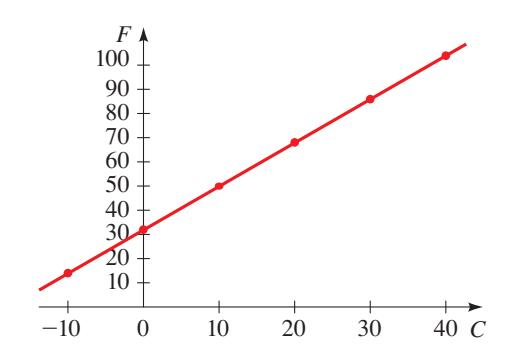
Let \(F(C)\) be the Fahrenheit temperature corresponding to the Celsius temperature \(C\). The verbal description is: 'To convert from Celsius to Fahrenheit, multiply the Celsius temperature by \(\dfrac{9}{5}\), then add 32.' Find ways to represent this function (a) algebraically (using a formula), (b) numerically (using a table of values), and (c) visually (using a graph).
question image

Answered: 0 / 92